“I don’t like my boss and my career is going nowhere in this organization, but we get free lunch and the office has a game room, so I think I’ll stay,” said no employee ever.
Employees enjoy free lunch and ping pong, but these perks don’t improve retention or performance. The only perks known to improve employee loyalty and commitment is time off, a flexible schedule, and the ability to work from home. Everything else is nice to have, but does not impact career decisions.
We’ve all heard about the great workplace exodus. Employees are leaving jobs in droves for a different life. To retain employees, a job has to work for employees’ desired lifestyle – the number of hours employees want to work, the amount of commuting and travel they want to do, and the social aspects that get met at work. Once those basic needs are met, leaders and managers can focus on other things.
Organizational leaders and managers have been led down a path of expensive distractions disguised as employee retention strategies. Eliminate the noise and focus on the four things that really matter to employees. And provided you meet your employees’ lifestyle needs, your best people will stay.
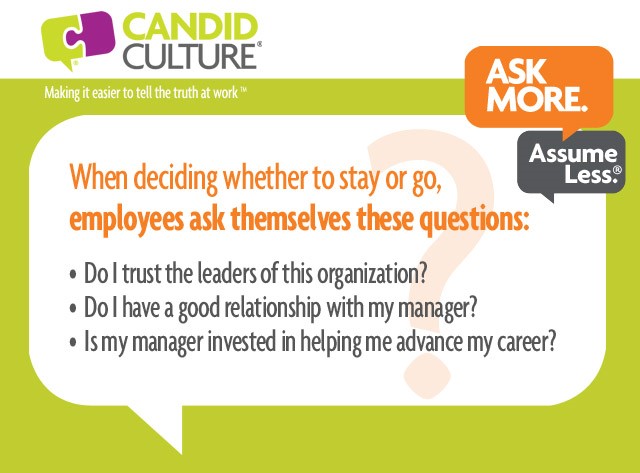
After lifestyle needs, this is what’s important to your employees:
I trust the leaders who run this organization.
My opinion means something. I am listened to.
I feel respected (by my manager) and have good relationships in the organization.
My work is challenging and interesting.
So what should you do if you want to be a best place to work?
Here are Four Employee Retention Strategies Managers Can Take:
1. Meet one-on-one with employees and have meaningful discussions about performance and career goals.
2. Ask employees for their opinion and demonstrate that you’ve heard them.
3. Provide opportunities for employees to do work they enjoy.
4. Ensure employees who want to advance in your organization are learning and growing.
Read about our Be a Great Place to Work leadership training program that eliminates the noise and teaches the things leaders and managers really need to do to retain the best employees.
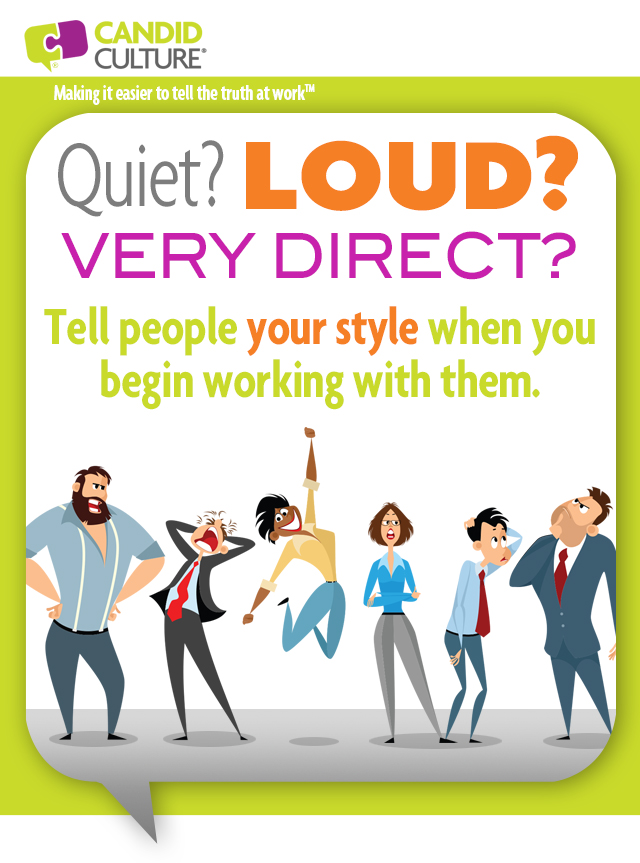
At the end of presentations, attendees often approach me and say something like, “People tell me my communication style is really direct and that it can be off putting. I don’t know what to do about this.” Or they say, “People say I’m really quiet and hard to read. They have a difficult time getting to know me.”
If you’ve been given the same feedback repeatedly, or know you create a first impression that may be challenging to others, set expectations and tell people about your communication style when you begin working with them. Don’t wait until they feel offended, confused, or frustrated. Simply tell people when you meet them, “I’ve been told that I’m too direct and how I provide feedback can be off putting. Anything I say is to be helpful. If I ever offend you or provide too much information, I hope you’ll tell me.” Or you could say something like, “I’m told that I’m quiet and it’s hard to get to know me. I’m more open than I may appear. If you want to know anything about me, feel free to ask.”
People will make decisions about and judge you. There is nothing you can do about this. But you can practice what I call, ‘get there first.’ Set people’s expectations about your communication style and what you’re like to work with, and then ask people to speak freely when they aren’t getting something they need.
The root of frustration and upset is violated expectations. People may not be aware of their expectations of you or be able to articulate those expectations, but if they didn’t have certain expectations, they wouldn’t be upset when you acted differently than how they (possibly unconsciously) expected.
I’m a proponent of anticipating challenges and talking about them before problems arise. If you know something about your behavior is off putting to others, why not be upfront about it.
When people interview to work for me, I set clear expectations about my communication style and what I’m like to work with. I tell them all the things I think they’ll like about working for me and all the things I suspect they won’t. I tell them the feedback I’ve received from past employees and things I’m working to alter. People often nod their heads and say, “no problem,” which, of course, may not be true. They won’t know how my style will impact them until they begin working with me. But when I do the things I warned them would likely be annoying, we can more easily talk about those behaviors, than if I had said nothing.
Talk about your communication style when projects and relationships begin. Replace judgment and damaged relationships with dialogue.
Some people say that you show employees appreciation by giving them a paycheck and that any more thanks is over the top. We call that old school management. And it doesn’t work.
The human brain thrives on recognition. People are more likely to replicate positive behaviors when those behaviors are recognized. If your employees are doing a good job and you appreciate them, don’t make them guess. “Well, my badge still works. So I guess things are going ok,” is not sufficient recognition.
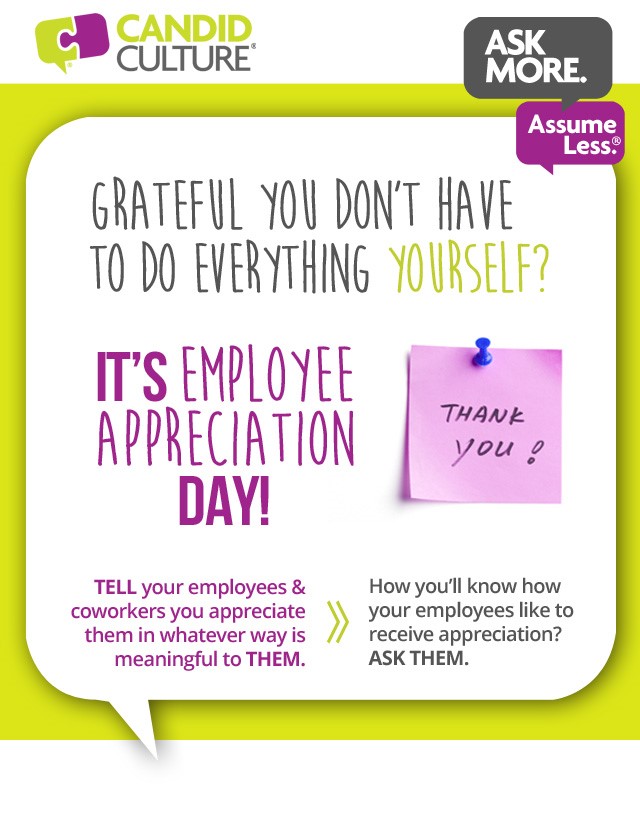
Today is Employee Appreciation Day – a made-up holiday to remind us to say “thank you” to the people we work with, who contribute every day.
Don’t take your employees for granted, or you’ll be finding new ones.
Here are six ways to mark Employee Appreciation Day today and every day:
Employee appreciation ideas 1) Ask employees what’s important to them – why they accepted the job, why they stay, and how they would like to receive recognition.
Most employees will work their entire career without a manager ever asking these questions. Getting to know your employees better and differently costs nothing but a little time.
Employee appreciation ideas 2) Ask employees about the kind of work they want to do in the future and what they want to learn and gain exposure to. Write down what they say (so you don’t have to remember) and give employees exposure to this type of work when it’s appropriate (when there’s a business need and when they’ve earned it by doing good work.)
Employee appreciation ideas 3) Give very specific, positive feedback regularly. Giving specific feedback demonstrates you’re paying attention to employees’ work and noticing the impact they’re making. Employees want to know how they’re doing. As odd as it may sound, feedback is a form of recognition. Taking the time to observe performance and give specific, timely feedback tells employees they matter.
Employee appreciation ideas 4) Tell the senior people in your organization what a great job your employees are doing. Employees have limited exposure to senior leaders. Don’t make the people who can influence your employees’ careers guess who’s doing great work.
Employee appreciation ideas 5) Take the time to write a handwritten note. In my 15 years of working in a corporate environment, I received one handwritten note from one of my managers. I kept it for 10 years.
Employee appreciation ideas 6) Spend time with your employees. Every employee needs face time with his/her boss. Don’t underestimate the value employees place on the time you give them. If you’re not meeting with your employees on a one-on-one basis regularly, start. Meet for 30-minutes once a quarter. Then meet once a month. Employees create the meeting agenda and come prepared to give you an update on their work. You should be prepared to give both positive and upgrade feedback.
Notice not one of the employee appreciation ideas or ways to recognize Employee Appreciation Day above is monetary in nature. Employees want your time and attention. They want to learn and grow. Provided employees feel fairly compensated, money is secondary.
Today, and every day, find a way to say “thank you” that’s meaningful to your employees. And the only way to know what employees will find meaningful is to ask.
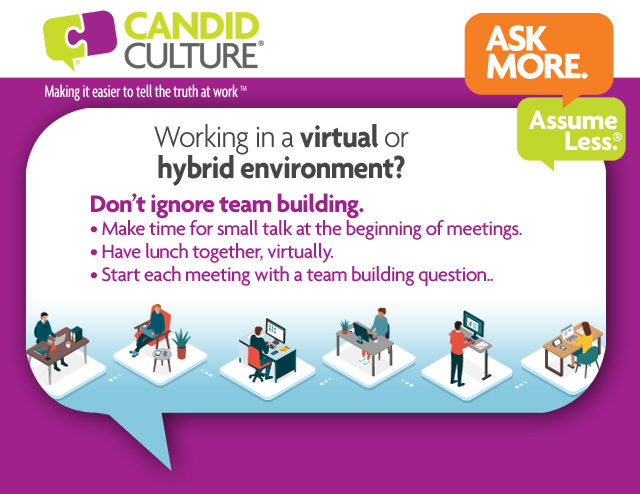
It’s easy to forget about team building when you’re working virtually, or to think that team building can’t be don’t virtually, or to decide to wait to do team building until your whole team can get together in person. My advice; don’t wait.
Often the most meaningful aspects of work are the people we work with and the relationships we build. When you leave a job, you leave your laptop and take your friendships. You can build team work virtually, you just need to make the time.
Even if you’re type A and tightly wound (like I am), spend the first few minutes of meetings on small talk, just like you would if you were gathering in a physical conference room. Ask what people are doing for the holidays. Commiserate over vacations you’re missing and food you know you shouldn’t be eating.
Eat lunch together, virtually. Remember when people used to sit together in the office breakroom or cafeteria? Why not eat together via video? Team building doesn’t have to be elaborate. It can just be spending time together, talking about things other than work.
Humans need people contact and relationships. People are missing other people. Connections with our coworkers make us feel connected to our organizations.
Small talk and group lunches create camaraderie, but they don’t teach people how to work together. In addition to social activities, give people a chance to talk about working style preferences too. You don’t have to do personality assessments and long training programs to build teamwork. Just give people a chance to talk about how they like to work, on a regular basis.
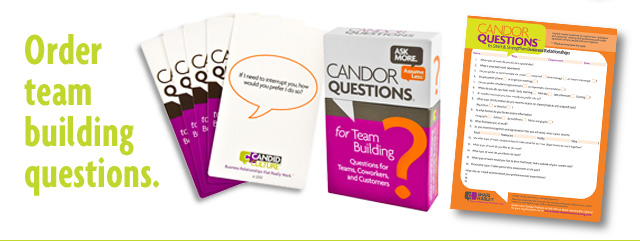
Tell you team you want to help people get to know each other better so work gets done more easily. Start each team meeting with one of the questions below, then move on to your meeting agenda. Do this all year.
Here are a few team building questions you can use:
What are your pet peeves at work?
What time of day do you do your best work?
Do you leave your email, phone, or text alerts on at night? If I text you after hours, will you get a ping?
If I email you on weekends and evenings, do you think I expect a response? Would you prefer I send messages only during regular business hours?
What work do you like to do most?
What work do you like to do least?
What’s an area of our business you’d like to learn more about?
What’s something you’d like to learn to do that you don’t have a chance to do now?
Read a question to the group. Give everyone at the meeting the opportunity to answer the question about themselves. And remember, the meeting leader/facilitator speaks last. People will often follow the most senior person’s lead. You want people to answer authentically rather than providing what they think is the ‘right’ answer.
Team building doesn’t have to take a lot of time or money. Don’t wait until everyone is back in the office or for a future retreat. Help coworkers spend time together formally and informally, getting to know each other better now.
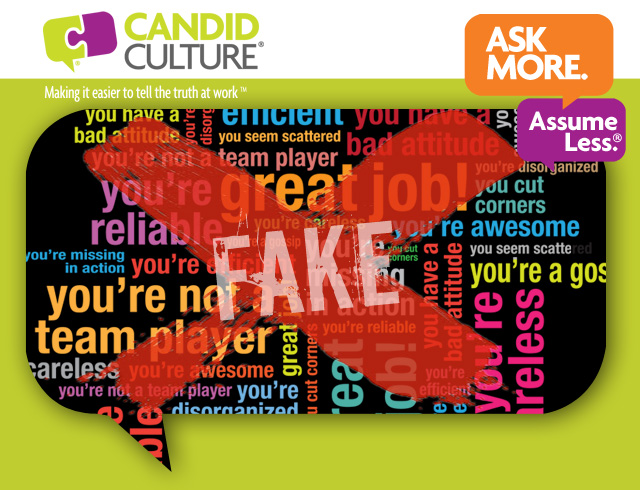
I’m not sure why, I wish I could give you a good reason, but the vague phrases above are what come out of people’s mouth’s first when giving feedback. To prevent giving fake feedback, you have to prepare.
There is a reason you think the person is awesome or has a bad attitude. What did they do that created that impression? Until you can describe what the person did to create an impression, you’re not ready to give feedback. You’re better off saying nothing.
All of the phrases above are opinions with no facts. Opinions are judgments. Feeling judged makes people defensive. When people are defensive, it’s hard to listen.
The purpose of feedback is to help another person. Give the person enough information that they know what to replicate and what to change. Before you give feedback, write down three things the person did that created your impression. If you can’t give an example, wait to have the conversation until you can. It’s better to say nothing than to say something vague and unhelpful.
Vague positive feedback sounds inauthentic. Vague negative feedback is judgmental. Neither strengthens your relationship or are helpful.
If you really want to be heard and you want to be helpful, provide an example. No example, no feedback.
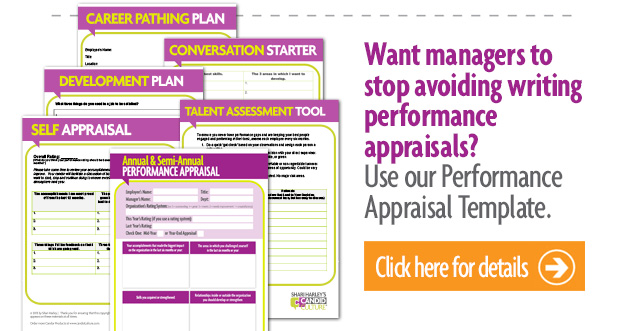
No one (I know) enjoys writing, delivering or receiving performance feedback. It’s time consuming to write, challenging to deliver, and can be difficult to hear. Unfortunately, most performance management systems – goal setting forms, performance appraisal templates and online templates – don’t make the process easier. Instead, they make it harder. Short and simple is best.
When I started managing leadership development for a mutual fund company, I inherited a 12-page performance appraisal form and what seemed like 89 competencies. One of the business leaders I supported told me, “I’m not asking my people to use this form. If you can give me something that’s one page, I’ll have my managers use it.” That conversation sent me on a mission to make all performance management forms one or two pages. And really, why shouldn’t they be? People can only focus on leveraging and changing a few things at a time. Why give more feedback than that at any given time?
If you’re chasing people to use your performance management tools and templates, you have the wrong forms. In my experience, when people find something easy to use and valuable, they’ll use it. If something is difficult to use or doesn’t seem to add value, people drag their heels.
Here are a few ideas for making your performance management process easier:
Make your forms and templates simple. No performance management tool should be more than two pages. In a performance appraisal – quarterly, annual, or otherwise – identify up to three things the person did well and a max of three things they can either do more, better, or differently next year. Anything more is overwhelming and a set up for disappointment, frustration, and overwhelm.
If you have additional areas for the person to work on, meet again in 90-days and assess how the person has done with the three pieces of feedback already provided. If they have made significant progress on the things they were already working on, add a few new things to work on. If significant progress hasn’t been made on the existing feedback, wait to add more.
I know your existing performance management templates may not allow for what I’m suggesting. If you’re working with a template that requires more input, write up to three clear, succinct, and actionable bullets in each required area and not more. Bullets are better than paragraphs. Be specific. “Great job” is not feedback. Neither is, “needs improvement.” Give a specific example or two. No example, no feedback.
Resist the urge to write paragraphs of vague feedback or to accept that type of feedback in a self-appraisal. Paragraphs of feedback take too long to write and often say little. I’d suggest spending less time writing performance feedback and instead spend the time observing performance, asking others for input on the person’s performance, and writing three succinct, specific bullets that describe an action taken or outcome produced. Specific feedback is meaningful, useful, and received with less defensiveness.
Click below to see our suite of one and two-page performance management templates.
When my son started pre-school and kindergarten, I went to new parent orientation. At those orientations I sat next to parents who told me their questions about the programs. But they never asked the people running the meeting their questions. They wondered in silence, whispering to seat mates who didn’t know any more than they knew. I’m always flabbergasted by these situations until I remind myself that people don’t like to admit they don’t know something. No one wants to look stupid.
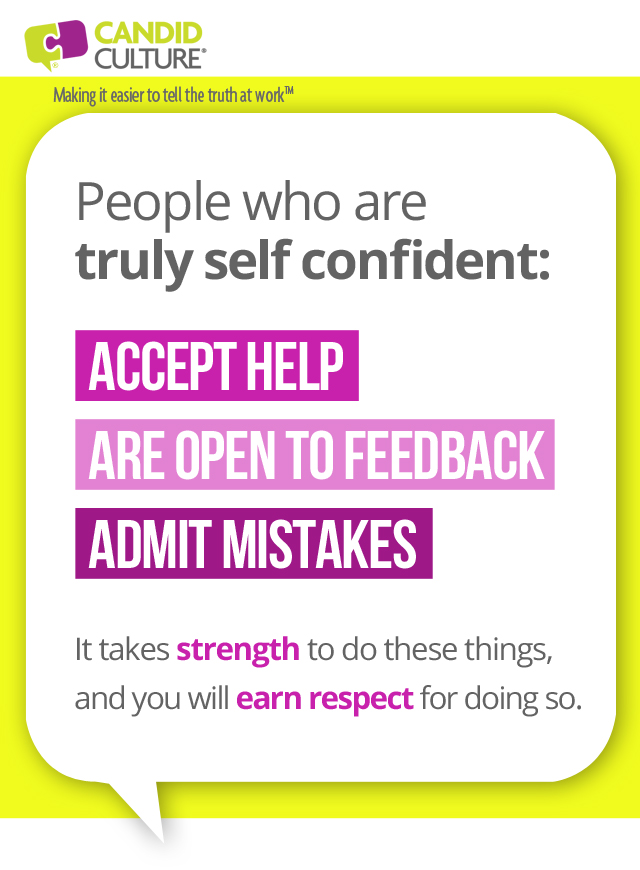
Most of us aren’t eager to admit when we don’t know something, need help, or make a mistake. We fear these things will damage our reputation and make us appear less than to others. But neither are true. It takes strength and self confidence to admit mistakes, accept feedback, and ask for help. Strong, self-confident people do all of these things.
When someone who works for me is willing to admit mistakes, I think more of them. When employees ask for help rather than spin their wheels unnecessarily, I’m appreciative. When they’re open to feedback, I’m grateful they’re easy to work with. And the same is likely true for you.
Before launching Candid Culture, I worked with a CEO who frequently lead with, “I may not be the smartest guy in the room, but…” The CEO was trying to appear humble and relatable, but he was the smartest guy in the room and we all knew it, thus his attempts were false and came off as such. Arrogance masquerades as self confidence. People who are arrogant come off as strong and self confident, but it’s a façade.
It may seem like your personal power and reputation will be diminished by admitting mistakes and accepting help. But this couldn’t be further from the truth. It takes strength to say you don’t know how to do something, to embrace feedback that stings, and to admit bad choices. And strong, self-confident people do all of these things, regularly.
You won’t lose credibility or damage your reputation by being humble, instead you’ll be seen as real, relatable, and willing to admit a lack of perfection. And all of those things take strength that ingratiate you to others. So be yourself. Don’t pretend you’re better or more knowledgeable than you are. Authenticity goes a long way.
Get the words to say the hardest things in two minutes or less. If you work long enough, you’ll eventually be confronted with these situations. Giving feedback doesn’t have to be hard.
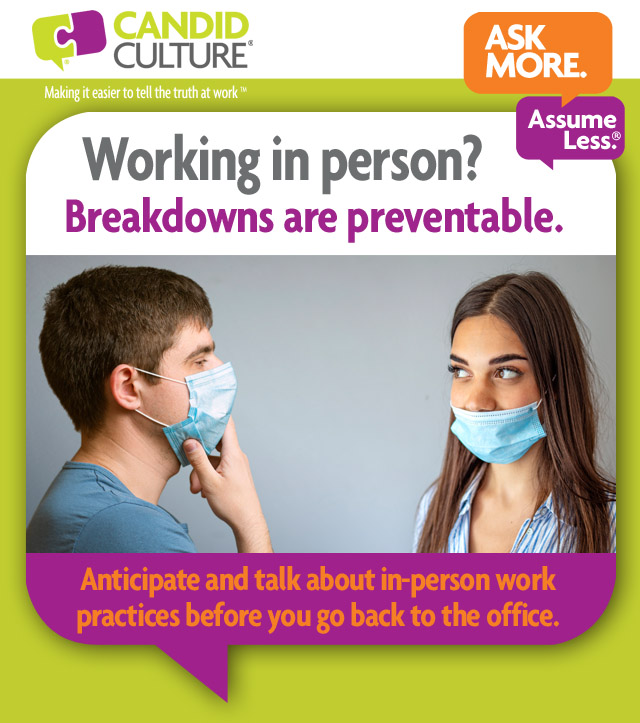
Perhaps you’re going back to work in person part or full time and you’re nervous. Will people sit closer than you’re comfortable sitting? Will people wear masks? Will someone ask you to wear a mask when you don’t think it’s necessary? Yes, yes, and yes. All of these things are likely to happen. And addressing each situation will be uncomfortable. The good news is, if all of these events are predictable, they’re also preventable.
The time to talk about how people will behave in the office, is before people return to the office. Preventing a breakdown is always easier than addressing one.
Managers, get your team members together via phone or video and outline the organization’s expectations around masks, physical distancing, etc. Be explicitly clear. “Everyone is expected to be courteous and use common sense.” is not clear. My definition of being courteous and using common sense is different from yours. Follow the meeting up with written expectations that reiterate what you outlined during the meeting.
Direct reports, speak candidly with your managers about what you need. If you’re not comfortable working in an open floor plan, talk about it before you go back to the office. If you’re not comfortable attending a meeting with others in a conference room, have the conversation before the first in-person meeting. It’s ok to have concerns, and it’s ok to talk about them.
Teams, get together via phone or video before you go back to the office and agree on the practices you will follow. For example, if your organization’s policy is to wear a mask and a team member’s mask is below their nose, everyone on the team has the right to ask the person to pull it up. If a team member feels people are sitting too close, it’s ok to ask for space.
My point isn’t which Covid safety practices to employ. My point is to have the conversations before you return to the office. Anticipate every possible outcome. Talk with friends and colleagues who are already working in person and ask for the pitfalls and breakdowns they’ve experienced. Set clear expectations with your manager, peers, and internal and external customers. Then agree to talk about breakdowns as they happen. If you can predict it, you can prevent it.
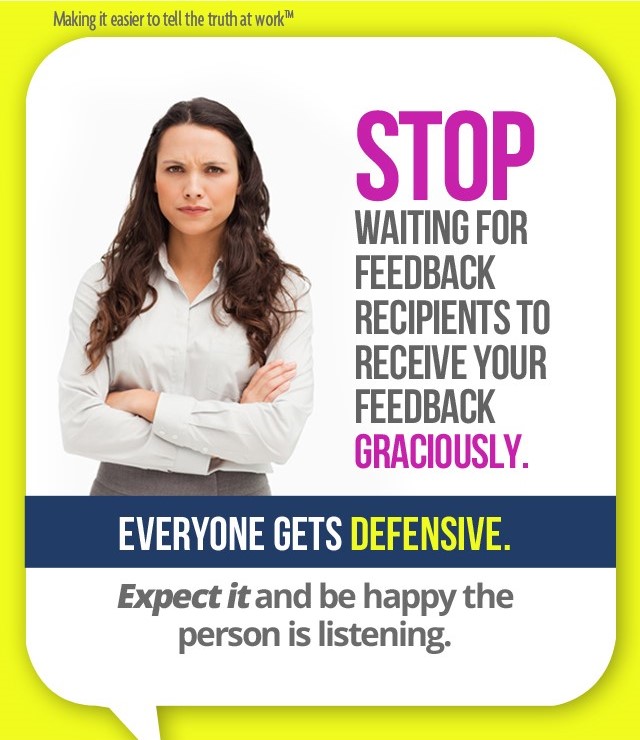
Most of us avoid giving negative feedback because we don’t want to deal with the recipient’s defensive behavior. We’re waiting for what I call, The Freak Out. The Freak Out is the predictable response to negative feedback.
Everyone wants to be seen as competent and adding value. When we give people negative feedback, we call those two things into question and the brain instinctively reacts. It’s as if you were driving down the road and the person in front of you slammed on their brakes. As an act of survival, you’d hit your brakes too. Becoming defensive when receiving negative feedback is the same instinctual response. We (almost) can’t help ourselves. So rather than dread and avoid others’ defensive behavior, expect it and have a plan.
Here are five ways to deal with defensive behavior:
Plan your conversation by writing notes and bringing them to your conversation. I’m a fan of typed, double-spaced bullets that are easy to follow.
Practice what you want to say out loud. What you say in your head is often different than what comes out of your mouth.
Ask others for help. Change names and details to protect the feedback recipient and ask how someone else might deliver the feedback. Someone who is not emotionally involved will likely handle the conversation better.
When the feedback recipient exhibits defensive behavior, take a breath and pause. Remember that you expected this. Don’t retract what you’ve said. Just let the person speak.
Stay on track. Defensive behavior is designed to derail conversations. Keep the conversation focused on the feedback. Don’t become distracted.
What to say when people respond to feedback defensively:
Defensive behavior: “Why are you talking to me? I’m not the only one doing this.”
Appropriate response: “If others are doing this, I promise you that I’m managing it. Right now we’re talking about you. I know this is difficult. Let’s stay here.”
Defensive behavior: “You’re wrong. Everyone else has given me positive feedback.”
Appropriate response: “I know this is difficult. I’m asking you to __________. Please do that.”
Defensive behavior: “You don’t like me and you’re picking on me.”
Appropriate response: “I’m sorry you feel that way. The reason I’m asking you to ________ is _______.”
Defensive behavior: “I disagree.”
Appropriate response: “I know that we disagree. And I’m asking you to __________.”
The key is not to get baited by defensive behavior. This is why I suggest preparing and bringing notes. When I’m having a particularly difficult conversation and the other person becomes defensive, I often become flustered and either forget what I want to say or back pedal. Do neither. Expect defensive behavior. Don’t get distracted. Stay on track. You can handle anything someone says.