Someone asks if you can (fill in the blank). You look at your calendar. That hour is open. You say, “yes.” You forgot that hour was designed for something you’ve been meaning to do, for yourself. You’re angry for forgetting. You promise to do better tomorrow.
The next day… repeat.
A way out of tired-inducing-people-pleasing is to set boundaries and stick to them. And this is hard, for me.
Examples of boundaries: Putting an hour in your calendar during the day to exercise; blocking 30-minutes between meetings to work on projects; only scheduling 80% of your workday to allow for last-minute requests and emergencies. Putting a boundary in place doesn’t mean saying no. Boundaries create the conditions that tell us, without struggle, when to say yes.
Before I had my son, I traveled for work constantly. Some weeks I was on the road for six consecutive days, in three different states. And I loved every second of it. Audience + microphone = happiness. When I had a child, I knew that schedule wasn’t going to work. So, I set boundaries. I decided how many nights per week I would travel and the time I needed to arrive home from each trip. And I didn’t violate those boundaries for 8 years. If a piece of work would require me to violate my travel boundaries, I said no without struggle, no matter how much I wanted to do that piece of work. The boundaries made the decisions easy. There was no deliberating or debating.
I’ll admit, I’m not as effective as setting boundaries in other areas of my life. Last week, I had a yoga class on my calendar. When I learned a repair person was able to be at my house during that hour, the yoga class was quickly deleted from my calendar. Yesterday, I asked my son what he wanted for breakfast, before flag football. He wanted scrambled eggs and a smoothie. I made both, knowing there wasn’t time. We were late for flag football. What was missing in both situations? Boundaries.
How does this apply to work? The key to preventing tired, burnt-out employees is to make it safe to speak up. Burnout is a systemic issue, not a personal one. Burnout at work comes from too much to do, over time. One way out is to make it safe to tell the truth at work.
For the most part, no one wants to admit to their boss that they are overextended or overwhelmed. Doing so feels like failure, and who wants to admit failure? If you want employees who are energized versus exhausted, focus on making it safe to tell the truth at work.
Five ways to make it safe to tell the truth at work:
Leaders and managers share their own strategies for managing time and priorities.
Ask your employees and coworkers meaningful questions. “How’s it going?” is not a meaningful question. Try: “What are your preferred working hours? What times a day would you prefer not to be contacted?”
Show appreciation when employees risk and say hard things.
Reward the truth. Make employees who are willing to say hard things a positive example.
Help employees problem solve to manage their time and priorities. Be ‘in it’ with them.
The good news about violating your own boundaries is you will get another chance to do it differently tomorrow. You can always reset a boundary. This time, tell the other people in your life about your boundaries. Tell your coworkers if you don’t do happy hours, 7:00 am Zoom calls, and back-to-back meetings, and tell them why. Then offer an alternative. Everything in life is a negotiation.
When my son started school, I went to new parent orientation. At the orientation I sat next to parents who told me their questions about the program, but they never asked the people running the meeting their questions. They wondered in silence, whispering to seat mates who didn’t know any more than they knew. I’m always flabbergasted by these situations until I remind myself that people don’t like to admit they don’t know something. No one wants to look stupid.
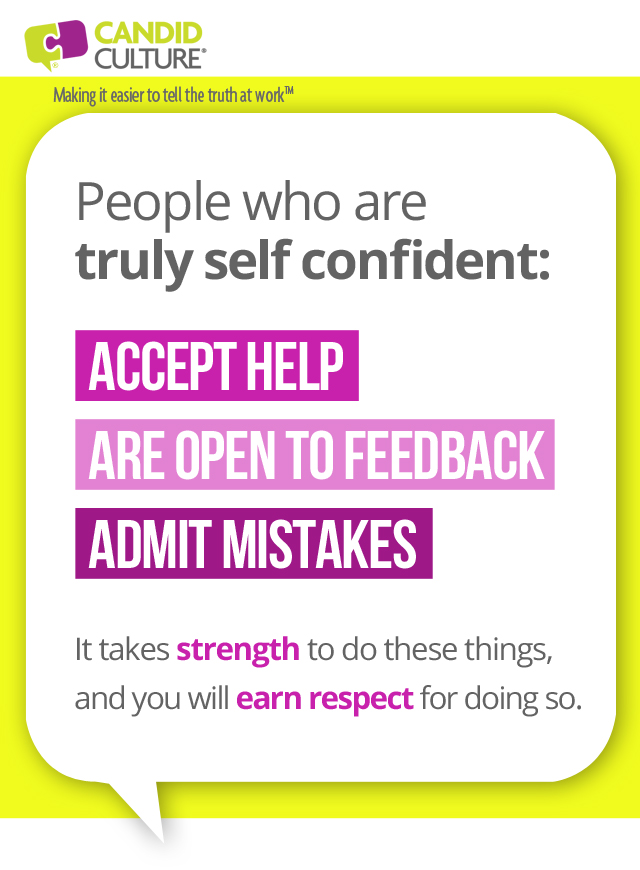
Most of us aren’t eager to admit when we don’t know something, need help, or make a mistake. We fear these things will damage our reputation and make us appear less than to others. But neither are true. It takes strength and self-confidence to admit mistakes, accept feedback, and ask for help. Strong, self-confident people do all of these things.
When someone who works for me is willing to admit mistakes, I think more of them. When employees ask for help rather than spin their wheels unnecessarily, I’m appreciative. When they’re open to feedback, I’m grateful they’re easy to work with. And the same is likely true for you.
Before launching Candid Culture, I worked for a CEO who frequently led with, “I may not be the smartest guy in the room, but…” The CEO was trying to appear humble and relatable, but he was the smartest guy in the room, and we all knew it, thus his attempts were false and came off as such. Arrogance masquerades as self-confidence. People who are arrogant come off as strong and self-confident, but it’s a façade.
It may seem like your personal power and reputation will be diminished by admitting mistakes and accepting help. But this couldn’t be further from the truth. It takes strength to say you don’t know how to do something, to embrace feedback that stings, and to admit bad choices. And strong, self-confident people do all of these things, regularly.
You won’t lose credibility or damage your reputation by being humble, instead you’ll be seen as real, relatable, and willing to admit a lack of perfection. And all of those things take strength that ingratiate you to others. So be yourself. Don’t pretend you’re better or more knowledgeable than you are. Authenticity goes a long way.
I’m embarrassed how often I do things I don’t want to do because I’m afraid of looking bad. I agree to things I don’t want to do. I even suggest doing things I don’t want to do, because I think it will look bad if I don’t. Then I have deep regrets.
If I’m aware of this practice, why do I keep doing it, over and over and over? I suspect the need to look good and be liked is so pervasive, it over-powers reason and self-talk. Telling myself, “Don’t do it. You will regret this,” doesn’t help. The need for approval is all-powerful (to me).
My old boss told me many years ago, “Your need to be liked will kill you as a manager,” and he was right. It’s why I can’t interview my own candidates. I want them to like me too.
I suspect I’m not alone here. I lot of us say yes when we want to say no. We extend ourselves and regret it later.
What can be done, at an organizational level, to prevent ourselves and fellow employees from over-extending?
Sanction, at a team and organizational level, that sometimes it’s ok to say no.
Try saying, “Here’s what I can do…” or “Here is what we will do” when you don’t want to say “no”.
Suggest that at times people take 24-hours before agreeing to take on a new task or project. Pause before committing.
Make room for negotiation, so people can say yes on terms that work for them.
Speak your truth and know that it’s ok to set boundaries. Boundaries prevent burnout.
It’s not unusual to wait too long to give feedback. Giving feedback often feels awkward and uncomfortable. What happens if the person cries, or gives us the cold shoulder, or worse, quits?
Working virtually over the past few years has exacerbated the waiting. Many managers who were accustomed to giving feedback in person hesitated to have hard conversations over the phone or via video.
Perhaps you waited so long to give feedback, you feel like you can’t.
It’s never too late. You just need to set the expectation that you’re going to give feedback and why. And know that anything you can say in person, you can say via video or phone.
One of the keys to being (more) comfortable giving feedback is to know that most people genuinely want to know how they’re doing. Working in the dark is frustrating. Not knowing the behaviors that impact us and our opportunities is also frustrating. Working on a project for months only to find out the work we did wasn’t what the other person wanted is ultimately frustrating.
Most people genuinely want feedback. They may struggle to hear feedback, they may get defensive, they may not take responsibility, but it doesn’t mean they don’t want to know.
If you want to give feedback but feel like you waited too long, say so. The conversation could sound like this:
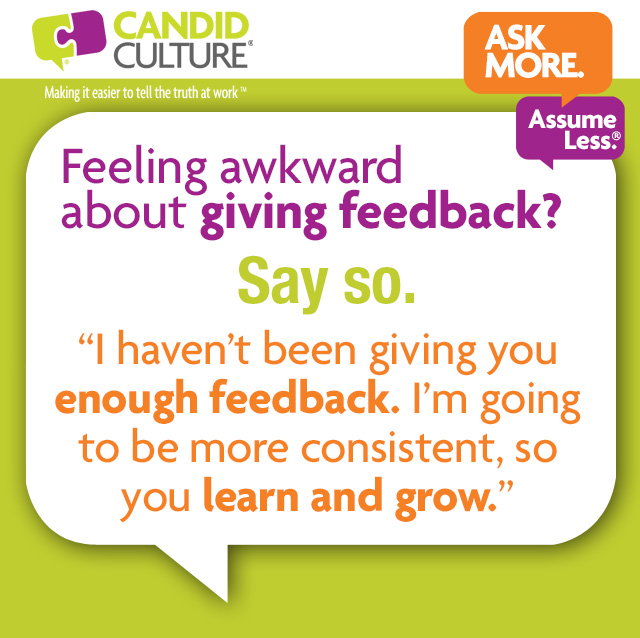
Manager to direct report: “I realized that I haven’t been giving you enough feedback. I’d like to start doing a semi-monthly debrief, not because anything is wrong or has changed. I want you to learn and grow as a result of working with me, and you won’t if I’m not providing regular feedback”
Peer to peer: “I need to talk with you about something and I’ve realized that I’ve waited too long. As a result, I’m feeling awkward and hesitant. Is it ok if I speak freely?”
Talking with someone more senior than yourself: “I want to talk with you about something I’ve been seeing for a while. I should have said something sooner. I’m sorry I didn’t. Can I talk with you about it now?”
It’s ok if you waited too long. It’s ok not to say things perfectly. Authenticity goes a long way. Be real. If you’re nervous, say so. If you’re wondering if it’s ok to speak up, say so. If you waited too long, say so. Relationships are built on trust, and authenticity builds trust. The time to start is now.
The purpose of feedback isn’t to teach people a lesson, it’s to elicit certain behavior. Below are six strategies for giving helpful and succinct upgrade feedback:
Write down your message. Save it as a draft. Re-read it later, when you’re not emotional, then cut the words in half. Shorter is better.
Remove emotion. Examples are helpful, emotion is not. Emotion: You embarrassed me. Example: You raised your voice at me in front of others.
Remove judgments. Vague words are judgmental. Judgment: Your behavior was unacceptable. Specific: You rolled your eyes at a coworker.
When you can deliver your message in about a minute, without emotion or judgment, you’re ready to speak.
Deliver all upgrade feedback in a private setting, behind a closed door.
Then, let it go. When the conversation is over, it’s over. Don’t stay angry or remind the person of the situation. If the behavior is repeated, discuss it then.
Say only what you need to. Deliver messages privately. Protect the person’s ego, which is fragile. Let people save face.
No one likes giving people negative feedback. Giving negative feedback often makes both the feedback deliverer and the recipient feel badly. To make everyone feel better, we dress negative feedback up with pickles and relish, otherwise known as The Empathy Sandwich.
The Empathy Sandwich in action: “You’re doing really great. Now you did almost cost the company $50,000, but in general, things are going great.”
The Empathy Sandwich leaves people unclear, wondering if there is a problem. Instead of softening negative feedback with positive platitudes on both ends, tell people you’ll be providing positive and negative feedback as things happen, and then separate both types of feedback.
Giving feedback to people you manage: “As your manager, my job is to help you be successful. As a result, I’ll tell you what I see, as I see it. I’ll give you both positive and upgrade (negative) feedback in a timely way. Because if I don’t, you won’t grow as a result of working with me.”
Paving the way to give feedback to peers and those at a higher level: “We see each other work and are in a unique position to provide each other with feedback. If you see me do something positive or not so positive, I’d like to know. I promise I’ll be receptive.”
Delivering feedback and avoiding The Empathy Sandwich: When you give feedback, separate the positive from the negative. You could say something like, “I want to talk about a few things today. Here are some things that are going well… Now, I also have something to talk with you about that is not going as well… After you deliver the negative feedback, say something like, “I know there is a tendency to dwell on negative feedback. I want to remind you of the positive things we talked about today.”
People can handle negative feedback. They won’t quit if you’re honest about their performance. They will likely become defensive and get upset for a time. That’s ok! Your job when giving feedback is to be clear, timely, and specific. Prepare and practice your delivery out loud. Ensure you have the relationship to deliver the feedback. Don’t worry so much about the response.
The daily monologue in my house sounds like, “I am not your housekeeper. My job in life is not to clean up after you.” I am, of course, talking to my nine-year-old son who leaves his stuff all over the house and doesn’t see it as his job to clean it up. My expectation is that he will pick up after himself, and when he doesn’t, I get very frustrated.
Violated expectations are at the root of disappointment, frustration, and broken relationships. We think, “I expect you to do or be a certain way and you’re not, so I’m unhappy.” If you want to be more satisfied and less frustrated, change your expectations. I don’t mean lower your expectations. I really do mean change them.
My son’s behavior was tortuous until I got the sage advice, “You’re not going to get everything you want. Pay attention to the big things and be ok with good enough.” That’s hard for me. I want things done a certain way (my way). But I also don’t want to do everything myself. So, I find myself altering my expectations and being ok with good enough. And it is very, very difficult.
You likely want each of your employees, coworkers, boss, clients, and vendors to do things a certain way. Sometimes they’ll meet those expectations and sometimes they won’t. Decide what you must have, communicate those expectations (repeatedly if necessary), and let the rest go.
Here are four steps for setting expectations at work:
Setting expectations step one: Consider everything you need or want from a person. Make a list, even if you’ll be the only person who sees it.
Setting expectations step two: Determine what that person is capable of providing. What’s realistic given who they are and the constraints they’re under (time, skills, experience, etc.)?
Setting expectations step three: Reset your expectations, if necessary.
Setting expectations step four: Ask for what you want and be specific about your requests. Telling someone, “This needs to get better,” will accomplish nothing. Telling someone, “I’d like to be included in each meeting that relates to this project and cc’d on all pertinent emails,” may just get you what you need.
As William Ury said in his book Getting to Yes, be hard on the problem and easy on the person. When you address violated expectations, simply share what you expected to have happen and what actually did happen. That could sound like, “I thought we agreed I would be invited to each meeting pertaining to this client. There was a meeting last week I wasn’t invited to. What happened?” Watch your tone of voice when asking this question. Be neutral and curious.
Changing your expectations will likely be a daily occurrence. People won’t necessarily do things your way or even the way you hoped. Decide what you must have, and let the rest go. Just think of all the time and aggravation you’ll save.
You’ve likely either seen the video or heard about the group think that happened before NASA’s rocket the Challenger exploded in 1986. One engineer felt strongly that there was a defect in the Challenger’s design. He spoke up, others disagreed. He continued to speak up, until it became too uncomfortable to do so.
Most employees don’t get that far. Many employees are afraid to speak up at all, feeling that it’s not ok to have a counter-point-of-view, and that those who disagree with ‘management’ are eventually fired. I honestly am not sure where this comes from. It hasn’t been my experience, and yet the fear of speaking up is pervasive. I hear it in almost every organization with which I work.
If it’s not ok to express different opinions, your organization will deliver the same-old products and services you always have. If staying the same works in your industry, great. But stagnation is detrimental to most organizations.
If you want more innovation in the workplace, you have to make it safe to speak up and offer a different point of view. Saying new, different, and even controversial things must be encourage and rewarded.
Five Ways to Encourage Innovation in the Workplace:
Ask for new ideas and different points of view often and wait until you get both.
Don’t allow a meeting or discussion to move on until you get new, opposing, and different points of view.
Positively acknowledge people who risk by saying something new or different from the norm.
Ensure people with new ideas and different points of view are allowed to finish speaking before they’re interrupted or before someone else tries to negate their ideas.
Create a few awards for speaking up in your organization and announce winners publicly and with great fanfare. You get what you reward.
Create Awards to Encourage Innovation in the Workplace:
Acknowledge the person who fails massively trying something new.
Award the person who brings new ideas to the table, regardless of what happens to those ideas.
Celebrate the person who willingly gives you the worst news.
The fear of speaking up and saying something new or different will destroy your innovation efforts. It will also squelch your employees’ ambition and ability to be creative. Make it safe to tell the truth, even when the truth is hard to understand or unpopular, and see what happens to innovation, creativity, and employee productivity and morale.
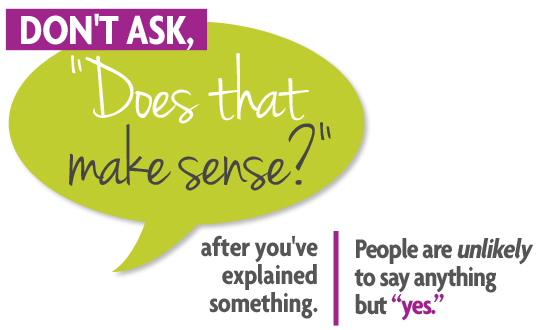
I’m taking golf lessons, which should frighten anyone within 100 feet. Every time the instructor explains something new, he asks me, “Does that make sense?” “Does that make sense” is a common clarifying question that many people ask, but it’s not a good question for two reasons.
Reason number one: If an explanation doesn’t make sense to me, I’m the idiot for not “getting it.” The question implies that the instructor was clear, I just “didn’t get it.”
Reason number two: The question doesn’t force me to speak, thus the person asking the question doesn’t get any information. “Does that make sense” is like asking a shopper in a store, “Can I help you?” We all know the right answer to that question is, “No, I’m just looking.” This is a similar to when someone asks, “Are there any questions?” The right answer is “no.” And when people say “no,” the person who asked the question often says, “good,” affirming people for not asking questions and making it less likely that questions will be asked in the future.
The purpose of asking questions is to get information. The problem with asking, “Does that make sense?” or “Do you have any questions?” is that the typical answers teach us nothing.
The golf instructor should be asking me:
What did you learn today?
What are you planning to do as a result of what we’ve covered?
What techniques did I demonstrate? Let me see how that form looks.
What questions do you have for me?
If he asks me the clarifying questions above, he will know what I am likely to do on the golf course.
Here are some clarifying questions that will force people to talk and won’t make them feel stupid for asking questions. Instead of asking, “Does that make sense,” consider asking:
“I want to make sure I gave clear instructions. Will you tell me what I’m asking you to do?” You could also phrase the questions like this, “Just so I know how I landed, what do you think I’m asking/expecting you to do?” or “What does a good job look like?” or “What should this look like when it’s complete?”
** These questions may sound condescending and like micromanaging in writing, but the questions can be asked in a supportive and non-judgmental manner. If you’re worried that the questions will make you appear as controlling or micromanaging, just say that. “I want to be sure you’re set up for success. If any of my questions feel condescending, please tell me. That isn’t my intention.”
I was talking with one of my clients a few months ago. She was very upset because she told one of her employees what to do and he didn’t do it. Frustrated, she said, “He knew what to do, and he didn’t do it.” I asked her, “How do you know that he knew what to do?” She replied, “I told him what to do and when I asked if he had any questions, he said no.”
Her situation is a common one. The right answer to “Do you have any questions” is “no.” And we’re surprised when we swing by the person’s desk two weeks later to get a status update on the project, and they haven’t started working on it yet.
Here are some additional examples of clarifying and delegation questions. These questions will force people to speak, providing a clearer sense of what people know and are likely to do.
What questions do you have?
What are you planning to do first? If the person answers this question appropriately, ask what they are planning to do next. If they don’t answer the question appropriately, step in and give more direction.
Provided you trust that the person knows what to do, give a tight deadline and ask to review the person’s work in a few days. Give people some freedom, but not enough to waste a lot of time and go down a fruitless path. Delegation is something at which most managers can improve. More effective delegation will lead to fewer missed deadlines and frustrations in the workplace.
Surveys are a great way to gather data. They’re not a great way to build relationships. In addition to sending out employee engagement surveys, ask questions live. Employees want to talk about their experience working with your organization, and employees will give you real, honest, and salient data, if you ask them and make it safe to tell the truth.
Here are a few methods of gathering data, in addition to sending employee engagement surveys:
Managers, ask questions during every one-on-one and team meeting with employees.
Managers, consider asking:
What’s being talked about in the rumor mill?
What do I need to know about that you suspect I don’t?
What makes your job harder than it has to be? What would make your job easier?
What meetings are not a good use of time?
Listen and be careful not to defend. Employees want to be heard. Respond if you’re able, but don’t deflect the feedback you receive.
Leaders, conduct roundtable discussions with small groups of employees throughout the year. I’d suggest discussions with groups of six employees. Have virtual or in-person lunch or coffee. Keep the meetings informal.
Leaders, consider asking:
What’s a good decision we made in the last six months? What’s a decision we made that you question?
Do you refer your friends to work here? If not, why not?
What’s something happening in the organization that you’re concerned about?
How to Get the Truth:
Ensure there are no negative consequences for people who tell you the truth.
Give positive attention to the people who risk and give you negative information.
Tell employees throughout the organization what you learn during these discussions and what you will and won’t be doing with the information. Share as much information as you can.
You don’t need to act on every piece of data you receive. Just acknowledge what you heard and explain why you will or won’t be taking action.
Employees are loyal to managers and organizations they feel connected to, and connections are formed through conversations. So, in addition to sending employee engagement surveys, ask questions during every conversation and make it clear that you’re listening to the answers.