Business Communication Archive
No matter how much you like and get along with your boss, your boss is not your friend. Nor is your boss your confidant or venting buddy.
Unless your boss follows you around all day, every day, she is not aware of all the things you do at work. And if she does follow you around, she probably needs more to do, which I doubt.
Given that your boss often doesn’t see you work, the only exposure you may have to each other is during one-on-one and group meetings. So be careful how you behave during these meetings.
I’ve made lots of career mistakes . . . once. Here’s a mistake I made before launching Candid Culture. I’m hoping you won’t replicate it.
In my last job, I was lucky enough to have a great boss. He was a good coach and mentor. He supported me, gave me exposure throughout the company, and always had my back. We didn’t cross paths much at work, except during our regularly scheduled one-on-one meetings.
I’m what some might call passionate. I have a strong sense of what is right and what is wrong. And I can be critical of those who I think don’t do the right things.
I would often share my frustrations with my boss. The head of that department didn’t do this. This person made a bad call. So and so was making my employees’ lives hard. I wasn’t complaining, well I kind of was, but not without a purpose.
One day my boss called me out on my passionate (and at times critical) style. He said that if I was so impassioned during meetings with him, he assumed I was equally vocal in meetings with other people and departments.
This wasn’t the case. I was very careful in how I managed myself with other people in our company. I understood the importance of good business relationships and knew that people work with the people they want to work with and around the people they don’t.
But my boss didn’t get to see any of those interactions. For the most part all he saw was how I interacted with him during our meetings. With no other point of reference he was left to assume that if I vented with him, I did this with other people. If I got a little too soapboxish about an issue with him, I must do the same in other meetings. I didn’t do those things with other people, but he had no way to know that.
My boss and I had a good relationship and I felt comfortable with him, probably too comfortable. I was politically savvy with everyone but him.
Your boss is an appropriate person with whom to express frustration, but manage how you do it. Don’t vent to vent. Every topic you raise should be with the aim of problem solving. Keep things honest but positive. Vent and complain at home, or with someone who doesn’t know the people you work with. Or better yet, spare your friends and family, and take your frustration to the gym, or the shoe department, whatever your preferred form of therapy.
Assuming you have limited exposure to your boss, make the time you have with her count. Put in front of your boss only what you want her to see. I’m not saying to be disingenuous or brush problems under the rug. Speak candidly, but manage yourself with your boss as you would with any internal or external customer.
If you stayed out until two in the morning and you’re dragging the next day, your boss doesn’t need to know that. She will assume you’re not on your game that day and that will be a check mark in the negative category for lacking good judgment and commitment to your job and the company. If you had a bad date, your boss doesn’t need or even want to know. If you think someone you work with is a dolt, ask for help in how to work well with him, and keep your opinion of his acumen to yourself.
Your boss has limited time and exposure to you. Manage yourself by showing him your polished and professional self.
Indecision plagues many of us at work.
- Hire the person or source additional candidates?
- Let the employee go or keep him?
- Launch the software implementation or wait?
- Gather more technical requirements or move forward with the information you have?
- Ask for different responsibilities or look for a job?
- Announce upcoming organizational changes to all employees or just to the leadership team?
We meet and discuss, meet some more, discuss some more, and still don’t decide. Endless meetings, discussions, and indecision exhausts and discourages employees and costs money.

Do your due diligence:
- involve the people closest to the work in making the decision;
- gather enough information to make an informed decision;
- get key stakeholders’ buy in;
- then decide and act.
And if it’s the wrong decision you’ll know soon enough and can course correct.
The indecision is often worse than making the wrong decision. My friend and colleague Steve Shapiro author of Goal Free Living would say that the only wrong decision is not making one.
But we know there are decisions that have negative consequences, which is why we’re often hesitant to make decisions. If we make the wrong decision families, careers, and companies are impacted.
So we wait and discuss, dialogue, and debate, over and over and over. Follow the steps above regarding due diligence and decide. Don’t wait too long or stay too long. It’s not good for anyone, especially you.
Even after working in the corporate arena for 18 years, I am amazed at how much people talk about other people. I’m a little embarrassed that gossip in the workplace still catches me off guard. I used to live in New York City. How can I be this naïve?
Last week I talked with a friend I used to work with. She still works for the company where we worked together. She told me that Michael, one of our old coworkers, was job hunting. “How do you know that?” I asked. She said Bob the IT manager had told her, and Lisa the marketing director had told Bob. Lisa is friends with Michael. Michael must have confided in Lisa, who told Bob, who told my friend, who told me. I have, by the way, changed everyone’s names, so as not to tell the rest of the world that Michael is job hunting. But in the event that you have an open job that would be a good fit for Michael, perhaps I should put his real name and email address here.
Michael trusts Lisa. But Lisa clearly isn’t trustworthy. I’m sure she thinks she is, but clearly, she can’t keep information to herself. Lisa trusts Bob to keep a secret, but clearly Bob can’t and neither can my friend.
So what does this say? Everyone is a liar and no one keeps confidences? No, I’m actually saying neither of these things.
I really believe that people think they keep a confidence when they share information like this. We rationalize telling ourselves, “I only told one person, and Bob won’t say anything. I trust him. And Michael wouldn’t mind if I told Bob. They’re friends. And even if he did mind, Bob needs to know because if Michael leaves it will impact IT.” And so it goes.
I’m not telling you this to make you paranoid. I’m saying it to make you careful.
I have started to assume that whatever I tell someone will be told to someone else. And it makes me more careful about what I say and write, especially what I write. Don’t put anything in an email you wouldn’t be comfortable being forwarded to someone else.
You may be wondering how this is possible. There is no one who keeps a confidence? How can you run a business like that? Anything I tell someone will be told to someone else? Not if you’re talking to an outside consultant, a business coach, your attorney or accountant, but inside your organization, yes. People have a tendency to share gossip in the workplace with their inner circle –the people in the organization they’re close to. So be careful. Watch what you say and to whom. And assume that whatever you tell someone may go elsewhere. Consider the upside –you can use your coworkers to share news that you don’t have time to broadcast yourself.
Unfortunately people taking phone calls via speaker phone, listening to music without headphones, and entertaining a posse’ of visitors in his/her cube is not limited to the movie Office Space, which should be required viewing for anyone who works with other people.
Cubeland can be loud. And most people are hesitant to ask our coworkers to quiet down. We’re afraid of the conflict. We don’t want our coworkers to dislike us, talk poorly about us when we’re not there, or kill us off. So we suffer in silence, hoping the person will get a clue that he’s making us crazy. He won’t. If he knew the phone calls bugged you, he would have already stopped making them.
You may find it incredulous that your coworkers don’t know how annoying noise in cubeland is. It’s an obvious, no brainer. How could they not know?
Much of Candid Culture’s work is dedicated to people feeling more comfortable telling the truth at work. But even with books, and training on how to establish candid relationships and tell the truth, speaking up is often challenging. So know that if you are doing annoying people at work, they are not likely to tell you.
Here’s what you can do: Avoid annoying people at work. For your convenience, I’ve made a short list.
- Conversations, music, and phone calls taken on speaker phone in cubicles. Take the meeting or conversation to an empty office or conference room.
- People who are late for meetings and text or email throughout meetings.
- People who start most sentences with, “No we can’t do that, and here’s why.”
- People who say they’ll do something and miss the deadline every time.
- People who borrow your stuff and don’t return it.
Look at how much stress I’ve saved you. Now you don’t need to give the people you work with feedback, you can just forward them this blog, which is a passive aggressive form of feedback. But it beats throwing their phone out the window or hiding out in an empty office so you can actually get some work done.
If you choose candor instead (which I, of course, prefer) simply say, “It’s hard to work when music is playing, or when you’re on your speaker phone, or you’ve got visitors in your cube. I know space is at a premium. But if you’d be willing to take the conversations elsewhere, I’d really appreciate it.” Done in twenty seconds or fewer. And no one died. You can do it. And if you can’t, call me, and I’ll do it. It’s always easier to have these conversations when they’re not your own. But it will cost you a bag of chocolate chip cookies or perhaps a Candor Bar.
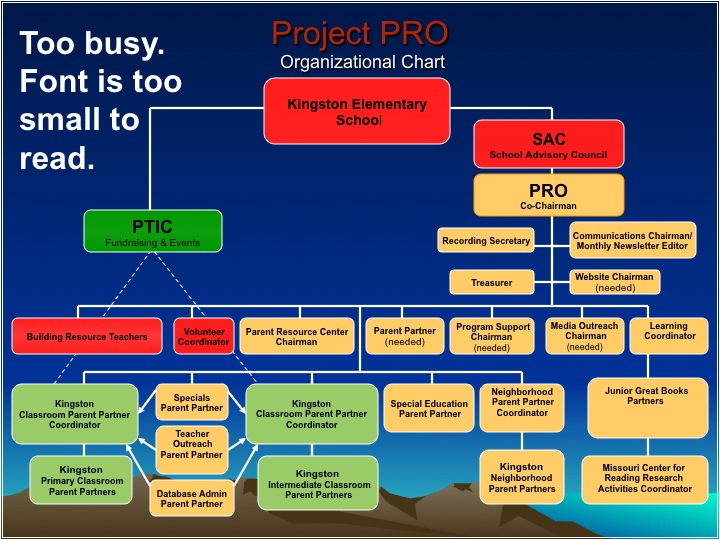
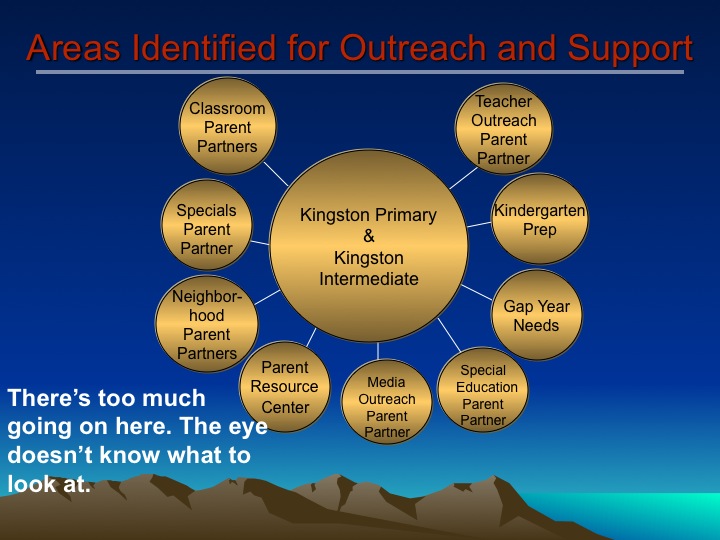
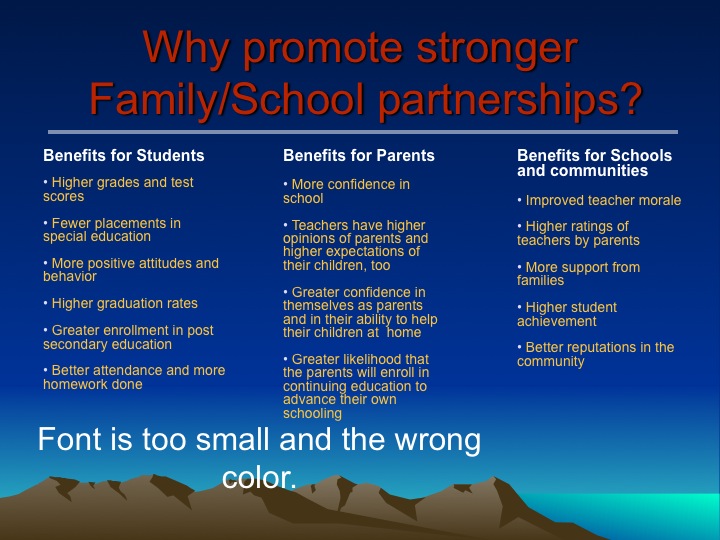
PowerPoint is the worst thing that ever happened to speakers and presenters. When used well PowerPoint adds depth to presentations and a visual component that many people need to digest information. But most presenters misuse PowerPoint, overloading slides with too much data and text that is too small to read, that they cover too quickly.
Presenters are thinking through and designing their presentations in PowerPoint. Meaning, most people open a blank presentation and type as they’re thinking about what they want to say. This is not a bad practice in and of itself. It’s only bad if presenters don’t remove the words they should say during a presentation, but not put on the slides.
Examples of common but ineffective slides are below.
Creating a presentation should mimic packing for a trip. We throw everything we want to take with us on the bed. Then we stuff everything in a bag. When we see it’s not all going to fit, we take stuff out. Then we realize we’re going to pay an overweight fee, so we take more stuff out, admitting that we don’t need eleven t-shirts. We then get where we’re going with much less stuff than we started with, but still more than we need. Creating a presentation should follow the same process.
Create your presentations in PowerPoint and then remove everything but the necessary points your audience needs to follow your presentation. Leave bullets that you will discuss in greater detail, important numbers, and statistics. Delete the rest. If your slides mimic every word you’re going to say, the audience doesn’t need you. If you’re going to read your slides, save your audience some time, email the presentation, and cancel your meeting.
If you want to hand out or use a more detailed version of the presentation to prompt you while you’re speaking, save two versions –version one with all the detail and a parsed down version two to project while you’re speaking. The notes feature is a good place to put extra detail you want to be sure to cover, but don’t want on your slides.
The objection I often get to the suggestion above is, “I have to provide a lot of information. I know it’s too much data for one slide and the text is too small to read. But I have to provide that level of detail.” When you have a lot of information you can put it on a slide, but you should also provide the slide as a handout. Tell people you know they can’t read all the information on the slide, and tell them to follow along on their handout. Use a pointer or a different color to highlight the sections of the slide you’re talking about. If you aren’t going to give a handout, then remove the slide from the deck and email it as follow up. Showing slides that are too small or too detailed to read is frustrating for your audience and doesn’t put you in the most positive light.
Avoid Death By PowerPoint and Make PowerPoint Work For You:
- Use 24-point font or larger. People can’t read 14 or 16 point font on a slide.
- Put 6 to 7 lines of text on a slide, not more.
- Avoid distractions on slides –like images that float in or explode. Make your slides more interesting by adding relevant pictures and videos, versus unrelated images.
- Always speak with the lights full up. NEVER speak in a dim or dark room. YOU are the presentation, not your PowerPoint slides.
- Use a white background and a dark font, so you NEVER have to dim the lights.
- Use fewer slides than you think you need to, and give your audience time to read each slide. If the audience doesn’t have time to read a slide, they will feel ripped off and frustrated, and wonder what they’re missing.
PowerPoint can be a great tool, when used well. If your slides add to, but don’t replace your message, and if everyone in the room can and has time to reach every word on your slides, you’re using PowerPoint as it was intended. If your slides can be followed by the words, “I know you can’t read this but…,” it’s time to start deleting.
Think about all the people in your life who frustrate you. The employees who turn in work without checking for errors. The person who offices next to you and takes phone calls via speaker phone. The person who is always late for meetings and then proceeds to text under the table, like no one can see him. And in personal relationships, our friends who come late, cancel, or just aren’t in touch as often as we’d like.
These situations annoy us, but we often don ’t say anything because giving feedback is simply too hard. Why risk the person’s defensiveness? Or we don’t think addressing the situation will make a difference.
Giving feedback can be hard. Asking for what you want is easier, but most of us don’t do it.
The question is why? If making a request is easier than correcting someone’s behavior, why not ask for what you want upfront? Why wait until expectations are violated to make a request? The answer is simple.
We don’t think we should have to make requests. We assume our employees, coworkers, and friends will do things as we do.
We would never turn in work without checking it for accuracy or come to a meeting late. So we assume others won’t either. And when they do, it feels too hard to speak up, so we don’t.
I’m going to suggest you approach relationships differently –more proactively.
Ask for what you want at the beginning of a relationship, project, meeting – anything new. Set clear expectations. If you want to start and end meetings on time, tell people that during your first meeting. And if you have an existing behavior you want to shift, simply say, “I realized I didn’t tell you that starting and ending meetings on time is really important to me. Going forward, we’re going to start and end all meetings on time. So please be ready for that.” If you need a quiet work environment, when you get assigned a new desk or seat mate, tell your coworkers that you are easily distracted by noise and ask them to take all calls via a hand or head set and to limit posses of visitors. If it bugs you when people wear shoes in your house, tell them when they arrive. Don’t expect people to guess you’re frustrated and alter their behavior without you making a request. It’s not going to happen.
Consider all the things that annoy you. Then consider what you did or didn’t ask for. If you haven’t made your expectations clear, it’s not too late. Asking for what you want is easier than you think.
Looking for a 5 10’, 45 year-old with some of his hair. Must enjoy long walks on the beach, dogs, and great conversations. No baggage please!!
At work this might sounds like, looking for employees who will do good work with little to no oversight, be open to feedback, and never get defensive, no matter what bad news we give them. Otherwise known as, no baggage.
Unless you work alone, you know that people come with baggage. I’m calling our negative experiences with other people –parents who lost their tempers when we expressed a counter point-of-view, bosses who punished us for saying what we really thought, and peers who killed us off when we told them the truth – baggage. Every time we got yelled at, in trouble, or punished in any way for giving feedback, we learned it was not safe to speak up.
Your direct reports and coworkers have been trained by every person who came before you, both personally and professionally. We have all been trained.
We all know that when we tell most people what we really think, and they don’t like it, there are negative consequences. So we learn, pretty quickly, to keep our opinions to ourselves.
If you want people to tell you the truth about what’s not working in your organization or about your own performance, you need to retrain them. You need to get your employees and coworkers to believe that it’s safe to tell you the truth, even when the news is bad.
So how do you make people feel safe giving feedback and speaking up? Be open to feedback:
- Ask for their opinion.
- Promise that no matter what they tell you, you will say “thank you”.
- Manage yourself and ensure the other person felt heard. Say “thank you” out loud, regardless of what you say inside your head.
- Then walk away.
- Once you’ve had some time to process the feedback, you can go back to the person to discuss it.
- If you got defensive, apologize and recommit
Every time you get defensive you train people it’s not safe to tell you the truth. The more often you ask for input and are open to feedback, the more information you’ll get.