When selling a product, service, or idea, people often think that providing more information is better. The more data points, the more likely the other person is to be persuaded. This is not necessarily the case. Excluding data hounds, most people don’t like to be overloaded with information. But people do appreciate the opportunity to talk about what they want and need. So if you want to sell something, give people a chance to talk.
I’ll never forget one of my first sales calls, early in my career. I was selling Dale Carnegie Training. After calling a prospect for six months, he agreed to spend ten minutes with me. Feeling rushed, I laid out all of our training brochures and quickly told him about every program we offered. Then I asked if he wanted to buy anything. He didn’t.
If I had asked a few questions and listened to his answers, I could have provided information on just the training programs he needed, instead of giving him a list of likely irrelevant options.
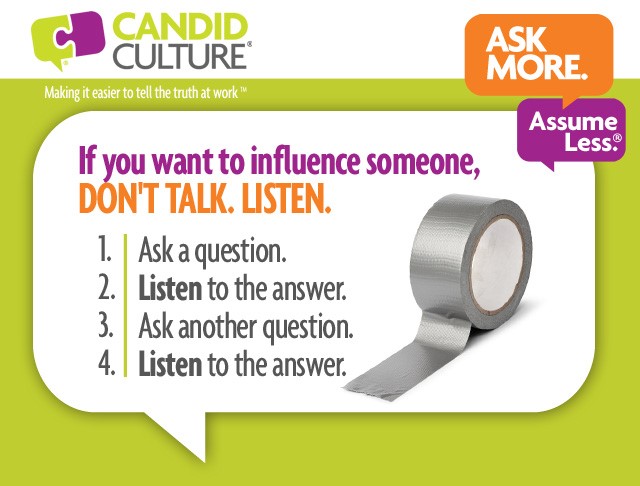
Selling a product or service is no different from selling an idea. You are trying to persuade someone to your way of thinking. Resist the temptation to persuade solely by educating. Instead, ask questions, listen to the answers, and then tell the person what you heard her say. If you’ve taken a listening class, you learned the practice of paraphrasing what someone said. Paraphrasing is a very old, very effective practice.
People need to feel heard and understood. From my experience, asking relevant questions, demonstrating that you listened to the answers by paraphrasing what the person said, and providing pertinent and succinct information is what people need to make a decision.
When you feel you’ve been wronged, it’s natural to lay into the offending person, give negative feedback, and tell him exactly what you think. The problem with doing this is that as soon as a person feels accused, he becomes defensive. And when people are put on the defensive and feel threatened, they stop listening. And you’ve potentially damaged your workplace relationship.
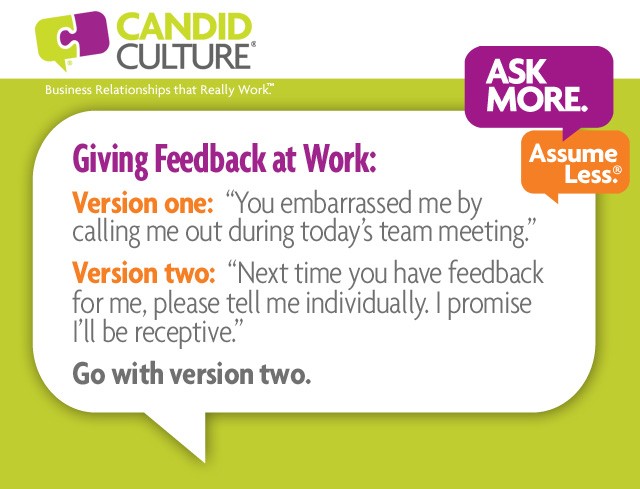
When someone does somethingfor the first time that violates your expectations, use the lowest level of intervention necessary. Allow the person to save face, and ask for what you want, without giving an abundance of negative feedback and pointing out all the things he’s done wrong.
Likewise, when you cut your finger while cooking, you put a Band-Aid on your finger. You don’t cut off the finger. This is true with business communication too.
When you’re facilitating a meeting, you can ask the two people who are side talking to stop, or you can go third grade on them and ask, “Is there something you want to share with the rest of us?” Both methods will stop the behavior. But one embarrasses the side talkers a lot, the other only a little.
Likewise, when one of your coworkers takes credit for your work, you can give feedback and say, “I noticed you told Mike that you worked on that project, when we both know that you didn’t. Why did you do that?” Or you can skip the accusation and ask a question instead, saying, “I noticed you told Mike you worked on that project. Can I ask why you did that?” From there you can have a discussion, give feedback if you need to, and negotiate.
When your boss doesn’t make time to meet with you, rather than saying, “You don’t make time for me. That makes it hard for me to do my job and makes me feel unimportant.” Instead consider saying, “I know how busy you are. Your input is really important in helping me move forward with projects. How can we find 30 minutes a week to connect so I can get your input and stay on track?”
In each of the situations above, you’d be justified in calling the person out and giving negative feedback. And it might feel good in the moment. But being right doesn’t get you closer to what you want, and it can damage your workplace relationships.
Practice good business communication –say as little as you have to, to get what you want. If this method doesn’t work, then escalate, communicate more directly, and give feedback. The point is to get what you want, not to make the other person look bad. The better the ‘offender’ feels after the conversation, the more likely you are to get what you want in the future.
Many organizations spend more money than they have to on employee recognition gifts and appreciation programs that often involve bonuses, paid time off, contests, gifts, and other expensive forms of compensation. What employees want most is to know they’re doing a good job.
Giving feedback in the workplace is the cheapest, most effective, and often overlooked form of employee recognition. Employees want to know how they’re performing, and most employees get little to no positive or negative feedback at work. They may not want to hear negative feedback, but employees want to know if they aren’t meeting expectations.
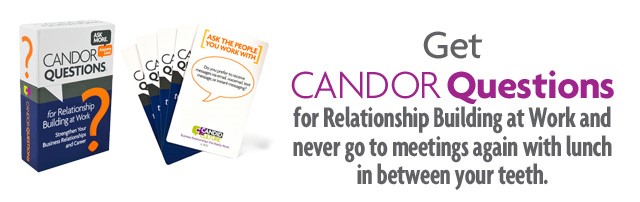
In several of Candid Culture’s training programs, I give participants a box of questions to help coworkers set expectations and improve workplace communication. Some of the questions include:
Do you prefer to receive information via email, voicemail, or text message?
Are you a big picture or a detail-oriented person?
What are your pet peeves at work?
What type of work do you like to do the most? What type of work do you like to do the least?
What do you wish I would start, stop, and continue doing?
Participants use the questions during the training, and I am consistently amazed at how often training participants ask what their coworkers wish they would start, stop and continue doing. I assume employees will be hesitant to ask for feedback in front of a group of peers. But training participants consistently tell me that they get almost no feedback at work, and they’re desperate for the information.
Here’s How to Celebrate Valentine’s Day at Work Without Spending Money:
Give clear, specific, and timely positive and negative feedback. Employees want to know how they’re performing.
Ask what type of work employees really want to do, and let them do that work most of the time.
Ask what skills employees want to learn, and give them a chance to attain those skills.
Write handwritten notes of appreciation.
Employees at Candid Culture get their birthdays off paid. We often buy employees lunch, give bonuses, and have a generous time-off policy. Those perks are important and do help retain employees. But monetary rewards never replace or supersede the value of being aware of employees’ performance and caring enough to tell employees the truth.
Today I’m having lunch with people I worked with twenty years ago. Twenty years. I have long forgotten the projects we worked on, the deadlines, and deliverables that were important at the time. What I do remember, are Jim and Siobhan. Some of my closest friends and the people most important to me in the world, are the people I’ve worked with.
It makes sense that we make friends at work, it’s where we spend a lot of time. And the people we work with make work fun or miserable.
There is a considerable amount of research citing the connection between having good business relationships and employee engagement, retention, and performance. When we feel we belong and have good relationships at work, we are happier and do better work. It makes perfect sense.
As I’m writing this, I’m thinking about my coworkers who I traveled with for weeks on end, who endured a CEO who made us practice and re-write presentations until 1:00 am for a meeting the next morning, and the coworkers I worked with at the World Trade Center. As much as I appreciated and cared about the people I worked with, I’m not sure how often I told them that they made my work world better.
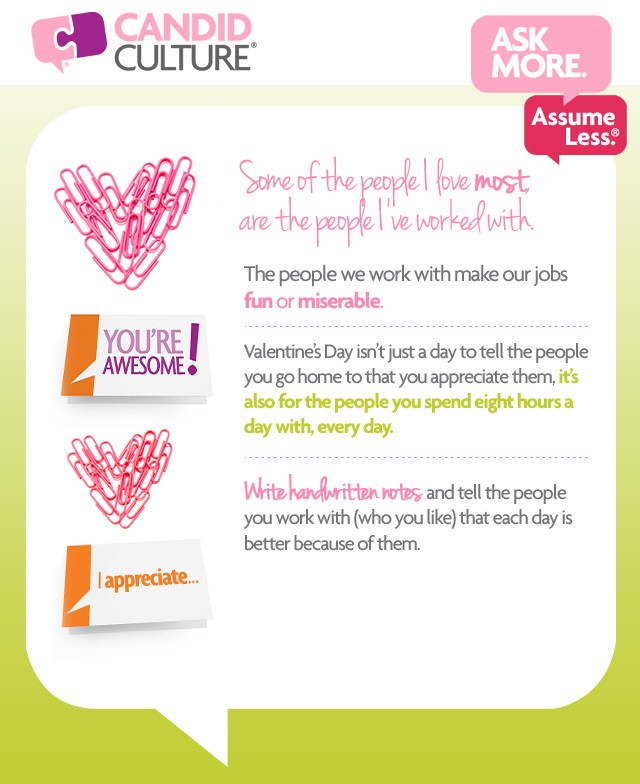
Valentine’s Day is a day we express appreciation for the people closest to us. Don’t limit your appreciation to your loved ones at home; include your coworkers who make your work fun and who help you get things done. Of course, I hope you’ll express appreciation more than once a year, but Valentine’s Day is an occasion not to miss.
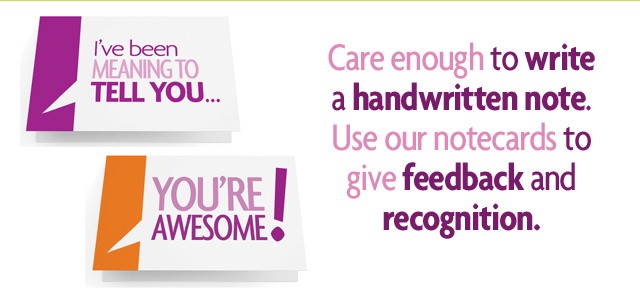
Write the people you work with, who matter most to you, a handwritten note that they’ll keep for a long, long time. You can see our assortment of greeting cards for the workplace here. I’ll admit that I collect stationery and love giving and receiving handwritten notes. I suspect the people you work with will appreciate receiving a handwritten note too.
Last week I had lunch with a client. When I returned from lunch I saw a friend who told me I had something stuck in my teeth. I was embarrassed and wondered why my client hadn’t told me.
It’s quite possible he hadn’t noticed. In fact, knowing this guy and how much work I’ve done with his firm on being candid, it’s probable he hadn’t noticed. But we all know people who notice and say nothing. We could walk around all day with toilet paper on our shoe, lipstick on our teeth, or our fly down, and the people around us won’t tell us.
If you read my blog weekly, you already know that people have been trained not to tell you the truth.
But I think there is more preventing people from telling us the truth. Complete this sentence: “If you have nothing nice to say, _________________________________. Who told you that? Your mother!!!
I do think there’s something to this. We’re raised to believe that it’s not nice to say something to another person that isn’t positive. And in the past, when we did speak up, it’s likely the other person got defensive. So it’s no wonder that we don’t readily give people bad news.
Here are five tips for getting feedback from the people around you:
Establish a core team of people who will always tell you the truth. These can be friends, coworkers, clients, vendors, your boss, etc.
Give people permission, to be honest with you. “Let’s make a deal. I always want you to tell me the truth. If I have something stuck in my teeth, or I’m inappropriately dressed for a meeting, or I’m doing something that damages my reputation, I want you to tell me.”
Make it easy to tell you the truth. “I promise no matter what you tell me and how hard it is to hear, I will say thank you. I won’t get defensive. And if I do, I’ll apologize and try to do better next time.”
Offer to do the same for them. “And if you want me to do the same thing for you, I’m happy to do it.”
Periodically check in with people and ask for feedback. “A few months ago I asked you to tell me anything I said, did, or wore that got in the way of my success. Is there anything you’ve seen that you want to tell me?”
Every time you ask for feedback and take it graciously, you train the person to give you more feedback. On the contrary, every time you get defensive, you make it hard for people to give you feedback, making it likely they won’t do it again.
If you don’t want to walk around looking silly all day, create a safe environment where co-workers can tell the truth.
Several years ago, a guy I was dating asked, “We don’t really need to do anything for your birthday do we?” I was taken aback by his question (which was really a statement) and replied, “No, we don’t.” But I didn’t mean it. And when he blew off the ‘big day’ I was furious and let him know it. Instead of having dinner on my birthday, we had an ugly conversation and a lousy rest of the week. Asking for what I wanted upfront would have been much less painful.
Why is it so hard to ask for what we want, especially from the people who love us? Learn how to get what you want on your birthday and every day.
We aren’t likely to get what we don’t ask for. The people in our lives can’t read our minds. They don’t know what we want. This is true at home and at work. If you want a report to look a certain way, sketch it out for your employees. If you want a meeting handled in a certain fashion, give detailed instructions. For the most part, we expect things to go well and thus we delegate insufficiently at work and hope to be pleasantly surprised at home.
I hope the people who love you, know you well enough and are intuitive enough to give your heart what it wants on your birthday, and every day. But if they don’t, make it easy for them to please you by telling them what you want. For example, tell the person you love, “I’d love to spend the day together. I don’t care what we do, as long as we’re together.” Or, “I don’t care what you do for my birthday, but please do something to mark the day.” And if you want something specific, ask for it. “I’d love flowers, despite that they’ll die and are impractical. Anything but roses and carnations would be lovely.”
A few weeks ago, a college student introduced me before I spoke at a conference. I heard him practicing out loud shortly before he was to read my introduction on stage. As he practiced, I heard him struggle with the word candor. Initially, he pronounced it as can-door vs. can-dor. He’d never seen the word and didn’t know what it meant.
The word candor is not being used on a regular basis. Younger people may not know what it means. And, in my experience, people who are familiar with the word often misinterpret candor to mean bad news. Most people expect bad news to come after the question, “Can I be candid with you?”
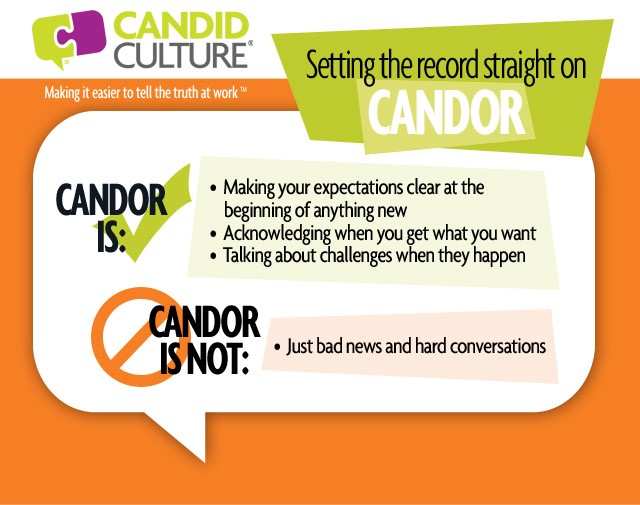
The definition of candor is, to be honest, truthful and forthright. We at Candid Culture define candor differently. The Candid Culture definition of candor: Telling people what you need before challenges occur. Anticipating everything that can take a project or relationship off track and talking about potential pitfalls before they happen.
Think about the projects and processes in your office – hiring someone new, sourcing a vendor, training people on new software. The potential breakdowns are predictable. You know the pitfalls that can happen when starting anything new because you’ve experienced them.
What if candor sounded like, “We want this project to be smooth. There are a couple of things that will make our work together go well and a few things that may delay the project and have it cost more than we budgeted. Let’s talk about what needs to happen for things to go smoothly, ways to prevent missed deadlines, and how we’re going to handle breakdowns when they happen.”
Some call a conversation like this setting expectations, others call it planning. In my world, these conversations are called candor –talking about what you need when projects begin, rather than letting the anticipatable train wreck happen.
Candor isn’t bad news. It’s telling people how to win with you vs. making them guess.
Examples of candor at work and at home:
“Here a few of my pet peeves… It would be great if you could avoid them.”
“What will frustrate you?”
“I turn off my cell phone alerts at night, so feel free to text or call me anytime. I’ll respond to all messages in the morning.”
“I respond to text messages mostly quickly, then voicemail, then emails. If you don’t get a reply to an email within two or three days, don’t take it personally. Chances are I haven’t read the message. Feel free to follow up with a text or voicemail.”
“I work best by appointment. Drop by’s are hard because they interrupt my flow. Email or text me if you need something, and I’ll tell you when I can swing by. Does that work for you?”
For the most part, we treat people as we want to be treated. Other people aren’t us. They don’t do things as we do and don’t know what we want. Don’t make people guess how to work with you, what you need, and what you expect. Be candid and tell them! Then ask what the people you work and live with expect from you.
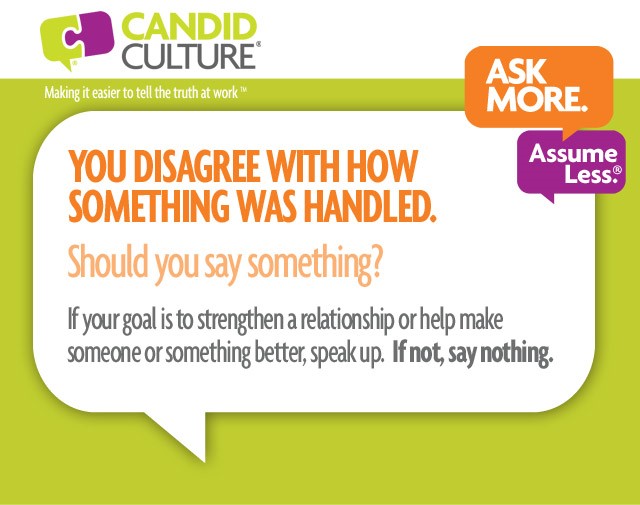
Most of us grapple with whether or not we should give feedback when someone else does or says something frustrating.
Here are a few criteria to help you decide whether or not you should give feedback or say nothing:
Do you have a relationship with the person? Do you know each other well enough to share your opinion? Aka, have you earned the right?
Has the other person requested your opinion? Unsolicited feedback is not typically received well.
If the other person has not requested your opinion, does he appear open to hearing feedback?
Are you trying to make a difference for the other person or just make him look or feel bad?
Do you want to strengthen the relationship?
Before you give feedback, do something I call, ‘check your motives at the door.’ If your motives are pure – you want to strengthen the person or the relationship, and you have a good enough relationship that you’ve earned the right to speak up — then do it.
People are more open to feedback when they trust our motives. If we have a good relationship with the person and he knows we’re speaking up to make a difference for him or for the relationship, you’ll be able to say way more than if your motives are questionable – aka you want to be right.
Employees are often afraid of the most senior people in organizations, simply because of their titles. The better the title, the scarier people are. And if employees are scared of organizational leaders, they’re not going to give those leaders negative feedback. The most senior people in an organization get the least information of anyone.
No one likes to be told that he is wrong. Negative feedback tells the person he did something wrong. But there is more than one way to give feedback. Asking questions can be equally as effective as giving direct feedback.
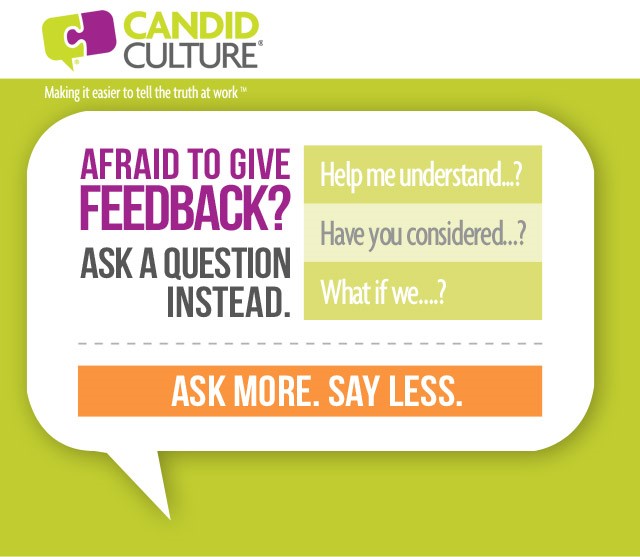
If you want to give a senior person negative feedback, but you’re afraid of the consequences, manage up by asking more and saying less.
Here are some ways to manage up by asking questions:
Rather than saying, “I disagree, I think you’re wrong, or this is a mistake,” consider managing up by asking questions like:
We’ve chosen to invest a lot in this software. I wasn’t here when the software was chosen. What’s the history of this initiative?
What were the criteria for selection?
What are you concerned about?
What are you satisfied with?
What else have we tried?
What are your thoughts about…?
What if we tried…?
Asking questions gets the person involved in a discussion, during which you can eventually express your point of view. When you ask questions, you say very little, and definitely don’t call the person’s decision-making into question.
Human beings are wired for survival. Receiving negative feedback kicks the need to defend oneself into gear, hence why people become defensive when they receive negative feedback. Negative feedback calls survival into question. If you don’t want people to become defensive, don’t require them to defend themselves. A discussion, during which you ask questions, is much less threatening than overtly disagreeing with someone’s point of view.
Asking questions takes more time and more patience than giving direct feedback. But it also takes less courage, and the quality of your relationship doesn’t have to be as good. You need a pretty good relationship to give direct feedback. If you don’t have that relationship, manage up by asking questions instead of being so direct.
If you do choose to ask questions, watch your tone. If you can safely add the words “you dummy” to a question, you aren’t really asking a question, you’re giving feedback, which is likely to evoke the defensive response you’re seeking to avoid.
It’s important to be able to express your point-of-view at work. Staying in a job or organization in which you can’t speak up, doesn’t feel great and doesn’t leverage the best of what you have to offer. But if you’re concerned about giving direct feedback, manage up by asking questions. Say less. Ask more.
Changing a damaged reputation is challenging. My number one piece of advice: Be very overt about the changes you’re making.
Here are eight steps to discover and repair your professional reputation:
Step one to repair your professional reputation: Make a list of people who observe your performance and who can impact your career. If you’re not sure who these people are, ask your boss and peers. They know.
Step two to repair your professional reputation: Ask for specific, candid feedback at least twice a year, and tell people why you’re asking for the information.
Asking, “How am I doing?” is not specific. Instead, say something like, “I want to learn more about my reputation in the office and want to eliminate my blind spots. I’d be grateful for any input you can provide on my reputation and what people say about me when I’m not there.” Then schedule a specific time in the near future to discuss the feedback, so you don’t catch people off guard. You’ll get better feedback when people have had a chance to observe your behavior and think about what they’d like to say.
Step three to repair your professional reputation: Listen to the feedback and no matter how hard the feedback is to hear, say, “Thank you for telling me that.” Don’t defend yourself. Instead, leave the conversation, think about what the person has said, and then go back to him a few days later with questions, if you need to.
Step four to repair your professional reputation: If the feedback you receive doesn’t feel accurate, tell others who you trust about the feedback and ask them to provide input.
Step five to repair your professional reputation: Sit with the feedback before taking action. Let yourself be emotional. You might feel angry, sad, or betrayed. All of those are normal responses to feedback.
Step six to repair your professional reputation: Take action. Make changes that feedback providers suggested.
Step seven to repair your professional reputation: Tell people who provided input and who are impacted by your behavior about the changes you’ve made. You could say, “I recently received feedback that I’m not careful enough and that my work often has errors. I’m really working on this. Will you pay attention to the accuracy of what you receive from me and let me know if you see changes? I’d really appreciate your input.”
Step seven is very important and something people rarely do. Don’t assume people will notice the changes you’ve made. Instead, assume they won’t. Without being told what to look for, the decisions people have already made about you will supersede changes you’ve made. It takes a lot of effort to see people differently. Validating what we already know and think about someone is much easier and more likely than noticing changes.
Step eight to repair your professional reputation: Continue to ask for feedback. Receiving feedback is not a one-time event. It’s an ongoing process. Don’t ask for feedback weekly, rather check in once a quarter, tell people the changes you’ve made, and ask for specific input.
You can change your reputation if you want to. Doing so will require courage, openness, and effort on your part. Work on one or two things at a time, not ten. And then reward yourself for the changes you’ve made with a pint of Ben & Jerry’s because too often we’re hard on ourselves and forget to celebrate wins.