No one likes to make mistakes. We want to do good work and have people think well of us.
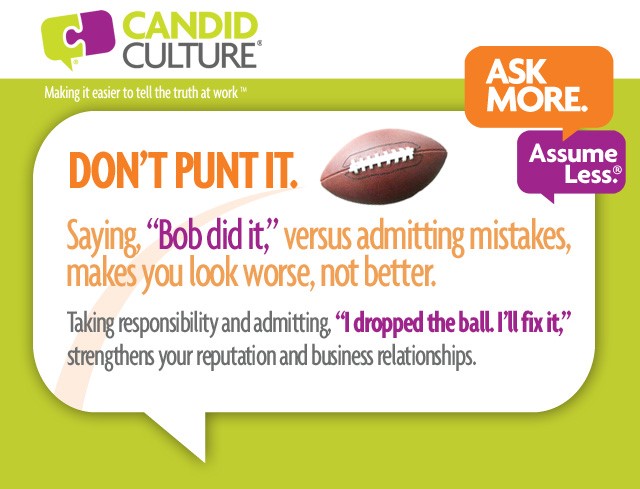
The key to maintaining your relationships and reputation, when you make a mistake, is to take responsibility and make things right as soon as possible. Saying something wasn’t your fault or becoming defensive will only damage your reputation and relationships. As counterintuitive as it sounds, you will gain respect and credibility by taking responsibility and correcting problems.
I often get asked if people lose credibility by being humble – asking for feedback and admitting to making mistakes. It takes strength to ask for and be open to feedback and to admit when you drop the ball. So, while it may seem counterintuitive, the more you ask for and respond to feedback, and admit when you make mistakes, the stronger you will appear.
I made a mistake at work. Now what?
When you make a mistake say something like:
“I dropped the ball on that. I apologize. I’ll fix it and let you know when it’s been handled.”
Or, “Thank you for the feedback. This clearly didn’t go as planned. I’ll make those changes and let you know when they’re done.”
Also, let people know the steps you’ll take to avoid similar challenges in the future.
You could say something like:
“Thanks for letting me know that our process is causing your department challenges. We certainly want the process to be smooth. My team will fix this month’s report, so your team doesn’t have to invest more time. We’ll update the process for next month and walk you through the changes before the report is due next month.”
Don’t provide a bunch of reasons for breakdowns. No one cares. Telling people why something occurred can sound like excuse management. People just want to know things will be made right.
Asking for feedback, taking responsibility, and telling people how you will correct errors may not be your natural or first reaction. The more you can train yourself to do these things, the easier you will be to work with and the better your reputation and business relationships will be.
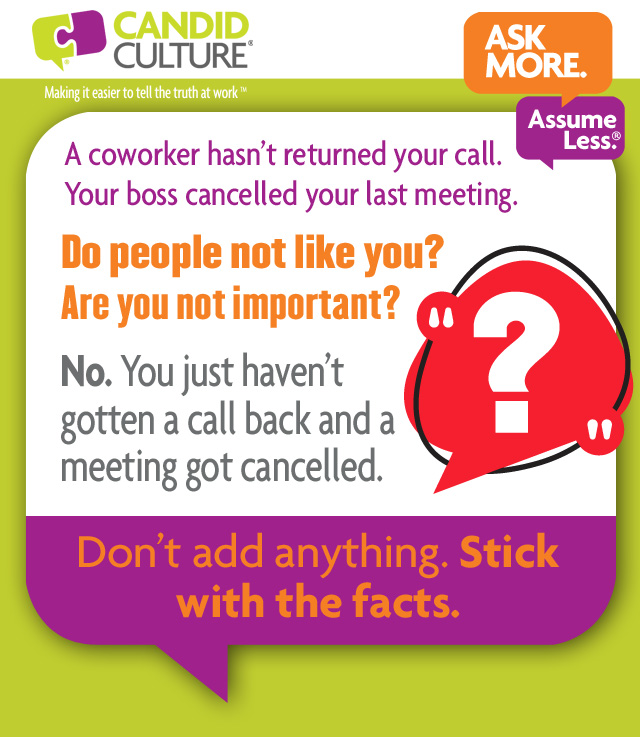
You interviewed for a job four weeks ago but haven’t heard back from the recruiter. You asked a coworker to have lunch, no reply. You asked a team member for a document, but after three emails, two texts messages, and a voicemail, still no reply.
It’s normal and natural to go to a dark place when we don’t get the response we’re expecting. We wonder, “Maybe they don’t like me? Perhaps they don’t want me involved in the project? Did I step on their toes? Maybe I asked in the wrong way?”
Wondering why we haven’t heard from people and inventing reasons for the lack of communication is normal and natural. It’s also exhausting and draining.
I’ll admit, I am on pins and needles after I deliver a training program, until I connect with my client to hear how they felt about the program. Even when I know I did a great job, I need to get the feedback and I’m on edge until I get it.
I’ve had enough training on communication and interpersonal relationships to know that others’ responses are usually not personal. People are busy taking care of themselves, as they should. They’re thinking about their own deadlines, deliverables, and the demands on their own time. Ninety-nine percent of the time they’re not thinking about us.
People are wired for self-preservation, and this very good and important. If you don’t take care of yourself, who will? The question, is how do we get our own needs met when we don’t get the response we’re expecting or the communication we need?
The most powerful approach is to remember that people’s response or lack thereof has nothing to do with us, and to let it go. Don’t be consumed with the lack of communication. Move on. You’ll hear back from the person when you hear back. This would be a powerful position to take, and it’s very difficult, at least for me.
The next approach could be to make up an interpretation that empowers you. If you’re inventing a reason you haven’t heard from the person; you might as well invent a reason that makes you feel good. For example, “The person participated in an escape room this past week and hasn’t made it out yet. They don’t have an Apple watch and have no way to communicate.”
Another approach is to set expectations when you begin working with people. Ask the recruiter, “If I haven’t heard back from you and a few weeks have passed, is it ok if I call to check in?” Ask your boss, “Is it ok if I reschedule meetings that get cancelled?” Ask your coworkers, “If I need information but haven’t heard back after three attempts, what should I do? Who else can I ask rather than wait?” Having a plan in place when you don’t get the communication you need will give you a clear course of action, rather than guessing.
But ultimately the most powerful – even if it’s the most difficult – response is to know deep down that the lack of communication is not about us.
Yoga, wellness programs, and mindfulness will not prevent or eliminate burnout. Burnout is an organizational issue. If you want to prevent and eliminate burnout, focus on your organization, not individuals.
Burnout comes from a lack of role clarity and employees feeling like they can’t be successful at work, either because they consistently have more work than can be done in a regular work week or because they work for a manager who is a perfectionist, and nothing is ever good enough. Employees who constantly feel pressured at work or feel like they’re failing, regardless of the amount or level of work they produce, are susceptible to burnout.
Have you ever gone on vacation, had a relaxing time, and two days after you returned to your regular life, forgot all about that vacation? That’s like burnout. When the yoga class or vacation is over, you go back to your job with unrealistic expectations. Nothing has been solved.
Companies try to make employees’ experience more manageable with programs and perks, but what employees really need is a manager who clarifies roles so everyone knows who does what, helps employees manage their workload, and creates open relationships so employees feel comfortable saying when they’re overwhelmed.
Train your managers to do these three things to prevent and reduce burnout:
Clarify roles so people know what they’re accountable for and to eliminate redundancy. It’s very frustrating to feel overwhelmed, only to find that someone else on your team or in another department is working on the same project as you.
Manage workload and set realistic deadlines. If an employee regularly has more to do than can be done in a 40-hour work week, eliminate something – change deadlines, reallocate work, and evaluate if everything being done is necessary. If you can’t eliminate a project, evaluate if it can be scaled back. Is every bell or whistle necessary?
Create an atmosphere of psychological safety so employees are comfortable asking for help prioritizing work. Most employees suffer in silence until they’re so overwhelmed and exhausted, they quit. Finding employees’ resumes circulating on LinkedIn is predictable and thus preventable.
You can get employees talking by scheduling a short, weekly debrief – 10 minutes – of what’s working and not working.
Help employees prioritize responsibilities by assigning each priority a letter – A, B, or C – in order of urgency.
Ensure there are no consequences for asking for support. Word gets around. If an employee is penalized for asking for help, other employees will learn not to speak up when they need support.
Allocate work to allow employees to be successful, focus on the projects that really matter and eliminate the rest, and create an organization in which it’s safe to tell the truth. That will solve burnout.
Most training programs about giving feedback focus on negative feedback, because giving negative feedback is hard and makes us uncomfortable. But most people aren’t any better at giving positive feedback.
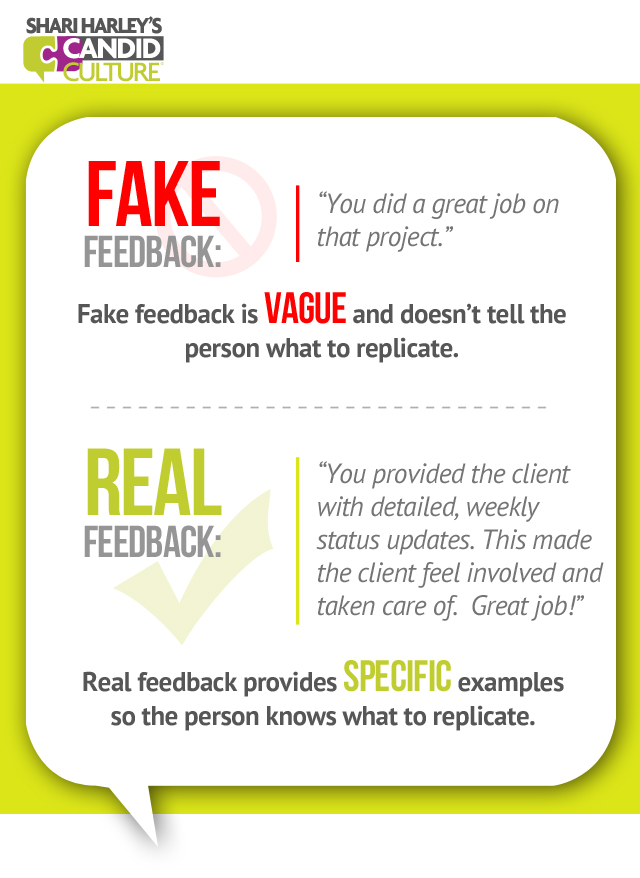
Most of the positive feedback people get at work really isn’t feedback at all. It’s vague, fluffy, and unhelpful. Aka, Cap’n Crunch – sweet but useless.
“Great job.” “You’re awesome.” “You’re great to work with.” None of this qualifies as real feedback.
The purpose of positive feedback is to make people feel valued and appreciated and to get them to replicate a behavior. Telling someone, “great job” or “you’re doing great work” will make the person feel good (momentarily), but won’t tell them what to replicate. These phrases are vague, and vague positive comments come across as inauthentic at best and unhelpful at worst.
Here are a few examples of what I refer to as real vs. fake feedback:
Example of positive feedback:
Fake feedback: “Great job.”
Real feedback: “You researched three vendors when making a proposal of who we should choose to manage our payroll operations. You included all the necessary information for us to make a decision and presented the information in a one-page table that was easy to read. Your work made it really easy to make a decision.”
Example of positive feedback:
Fake feedback: “You’re really reliable.”
Real feedback: “I know that whatever I give you to do will get done the first time I ask and will be accurate. I don’t have to ask again or check your work. You check your work for typos and mistakes before submitting it.”
Example of positive feedback:
Fake feedback: “You make my job easy.”
Real feedback: “Last week you noticed an invoice that didn’t seem accurate. You researched the invoice and got the mistake corrected before I even knew there was a problem.”
Example of positive feedback:
Fake feedback: “You’re awesome.”
Real feedback: “You always do what’s right for the company. Last week you called a vendor whose service has been spotty. You provided them with feedback and asked for their plan to improve their service levels. This added a lot of value to our organization.”
The guidelines for giving positive feedback are the same as giving negative feedback:
Be specific.
Give an example.
Give feedback close to the time an event happens.
To give specific and meaningful positive comments, you will have to observe performance, and that takes time. But if you want someone to replicate a behavior, tell the person specifically what they did well.
Many years ago, before starting Candid Culture, during my annual performance review, my manager said, “You had a great year. You rolled out 18 new training programs and got more participation in those programs than we’ve ever seen in the past. But you’re all substance and no sizzle. You’re not good at sharing the work you’re doing, and as a result my boss doesn’t know enough about what you’re doing to support a significant salary increase for you, so I can’t even suggest one.”
That happened to me ONCE, and I swore it would never happen again.
Too many people believe that if they do good work, the right people will notice, and they will be rewarded appropriately. Part of this thinking is accurate. To be rewarded appropriately, you need to be doing good work. But the people in a position to reward you also need to know what you’re doing and the value you’re adding.
You need to find a way to share the value you’re providing without going over your boss’s head, sucking up, or alienating your coworkers.
All of these practices work whether you’re working virtually, hybrid, or in the office full-time.
Manage up tip number one: Ask your manager’s permission to send them a monthly update of what you accomplished during the month. The update should be a one-page, easy-to-read, bulleted list of accomplishments or areas of focus.
Your boss is busy doing their own work. As a result, you need to let managers know about the work you’re doing. Don’t make them guess.
Manage up tip number two: Periodically share what you’re doing with the people your manager works for and with. That can sound like, “I just wanted to share what my department is accomplishing. We’re really excited about it.” Ask your manager’s permission to do this and tell them why you want to do it (to ensure that the senior people in your organization are in-the-know about what your department’s accomplishments).
If you’re not sure who can impact your career and thus who you should inform about your work, ask your manager. Managers know and will tell you, if you ask.
Manage up tip number three: Use the word “we” versus “I.” “We accomplished…..” “We’re really excited about….” Using the word “we” is more inclusive and makes you sound like a team player versus a lone ranger.
Don’t assume people know what you’re doing or the value you’re adding to your organization. Instead, assume people have no idea and find appropriate ways to tell them. You are 100% accountable for your career.
There are three reasons people say “that’s above or below my paygrade” or “that’s not my job” – they don’t feel empowered to make decisions, they think they’re being unfairly compensated for the challenges at hand, or they aren’t particularly motivated.
“That’s not my job” (aka, I don’t do things that are outside of my job description) is a mindset, and if someone has it, I’d suggest not hiring that person. People who think they should only have to do what’s on their job description aren’t utility players, and your organization is likely too lean to afford employees who only want to perform in a narrow box.
“That’s not my job” can also be an outcome of leaders and managers who can’t let go and let employees take risks and make decisions. If that’s your management style, hire people who will follow directions and don’t want to create new things and solve problems. Problem solvers will be frustrated if they only get to follow instructions.
Here are six steps to steer clear of “that’s not my job” syndrome and advance your career, regardless of your current role in your organization:
Never say the words “that’s above or below my paygrade” or “that’s not my job.” Even if it’s true.
If you don’t have the latitude to solve certain problems, ask the people you work for how they want you to handle those types of issues when you see or hear about them. That’s a subtle way to provide feedback that you don’t have the latitude you need to solve certain problems.
When you see an impending train wreck, say something. I see lots of very capable employees see the train wreck coming, comment to themselves or others who can’t do anything about the problem (aka gossip), and then nod knowingly when the *&#@ hits the fan. Don’t be that person. Look out for your organization and the people you work with.
If you see a broken or lacking process, raise the issue with someone who can do something about it, and offer to take a stab at fixing the problem. One of managers’ biggest complaints is employees who dump and run – “I’ve identified a problem. I’m leaving it for you to fix.”
Go out of your way to do the right thing, even if you are uncomfortable or don’t want to. If it’s easier to email someone, but you know the right thing to do is to pick up the phone, pick up the phone. If an internal or external customer express concerns and you can’t solve the problem, find someone who can. There are lots of ways to make an impact.
Ask more questions. Find a non-judgmental way to ask, “Why do we do this this way?” “Have we considered…?” “Would you be open to trying…?” Status quo can be the right thing and what’s necessary. It can also be the death of organizations.
Make stuff happen. Don’t pass the buck. And if you are going to pass the buck, don’t announce it. It only makes you look disempowered and uncommitted.
How many times have you been sitting at your desk wondering, “Why won’t they ___________ ?” Perplexed, you talk with your buddy at work. The conversation goes something like, “I’ve got this person, and I can’t figure out why they won’t ______________.” Or perhaps you talked directly to the person, but after several conversations, they still haven’t done what you asked them to do.
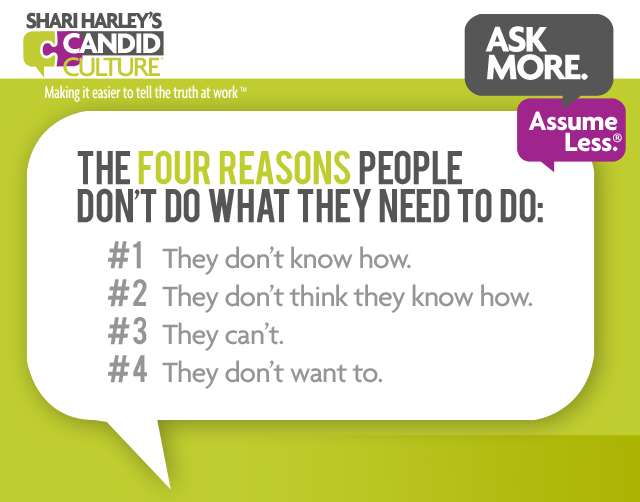
There are four reasons why people don’t do what you ask them to do:
They don’t know how.
They don’t think they know how.
They can’t.
They don’t want to.
Reason number one for a lack of employee performance, they don’t know-how, is the easiest to solve. People who don’t know how to do something need training, coaching, a mentor, a job aid, or some other form of instruction. The hope is that with the right training and exposure, they will be able to do what you’re asking.
Reason number two for a lack of employee performance, they don’t think they know how, can be improved over time with patience and consistent coaching. You aren’t working with clean slates. Most people are recovering from or reacting to a past relationship or situation. If a person worked for a controlling manager who never let them make a decision or worked for someone who invoked punitive consequences for making mistakes, the person will likely be hesitant to make decisions. Hence why they continue to ask questions and repeatedly check in, but never make a decision independently.
If you work with someone who doesn’t think they know what to do, but you know they have the answer, encourage them to trust themself. When they come to you for validation or approval, ask questions, don’t give answers. Tell the person you trust their judgment and encourage risk-taking. Tell them you’ll support their decision, even if it proves to be the wrong one. And encourage them to make a decision next time without consulting you. Then keep your word. If they make a wrong call, you have to have their back and can’t invoke negative consequences.
Reason number three for a lack of employee performance, they can’t, is challenging but clear cut. People who can’t do a task their brains aren’t wired for, will never do that responsibility well, regardless of how much coaching, training, and assistance you provide. If you have repeatedly and effectively, coached, trained, and provided support and the person still can’t do what is being asked, remove that responsibility and give the person something they can do well. If that responsibility is a large part of the job, you have someone in the wrong job. It’s time to make a change.
Reason number four for a lack of employee performance, they don’t want to, is annoying but manageable. There are lots of reasons people don’t do things they don’t want to do. Those reasons include, but aren’t limited to, boredom, lack of buy-in as to why something is important, insufficient time, feeling like a task is beneath them, etc. If you’ve got someone who can but doesn’t want to do something, you can either take the responsibility away, incent them to do it, or give feedback EVERY TIME the task doesn’t get done.
Giving negative feedback isn’t fun for the giver or the receiver. No one wants to hear that they aren’t meeting expectations, and most people don’t want to tell you. But the discomfort of receiving negative feedback EVERY TIME the person doesn’t do what they need to do will create behavior change. They will either begin doing what you ask, quit, or ask for a transfer. Either way, your problem is solved.
The first step in getting people to do what you want them to do is to discover why they’re not doing what you ask. It’s impossible to appropriately manage employee performance if you don’t know why someone isn’t doing what needs to do be done. And the person to ask why a responsibility isn’t getting done isn’t you or your buddy, it’s the person not doing the work. So, get out of your head, leave your office or laptop, and go talk to the person not doing the work.
Here’s how to start an employee performance conversation:
“I’ve noticed you’re not doing ___________. Help me understand what’s happening.” Watch your tone, inquire from a place of genuine curiosity, and identify the reason they aren’t doing what they need to do. Then you can intervene appropriately and hopefully get the behavior you want.
Get the words to say the hardest things in two minutes or less. If you work long enough, you’ll eventually be confronted with these situations. Giving feedback doesn’t have to be hard.
Avoiding having difficult conversations because you’re uncomfortable? Afraid you’ll hurt someone’s feelings? Worried you’ll damage your relationship? Why not just say so?
The people you work with want to work with other human beings. And part of being human is expressing how you feel.
It may seem that admitting that you’re nervous or uncomfortable weakens your position and diminishes your power. This couldn’t be further from the truth. Saying how you feel and being willing to be vulnerable are signs of strength. People with strong egos can admit when they are uncomfortable, people with weak egos feel too threatened to do so. Vulnerability and authenticity help other people see you as human, and make people feel closer to you. And people want to work with other human beings, not emotionless androids who never show their cards.
If you’re nervous, say you’re nervous. If you’re afraid you’ll negatively impact your relationship by speaking up, say so. If you’re not sure it’s your place to raise an issue, say that. You won’t lose anything by stating your concerns. You only stand to gain.
Starting difficult conversations could sound like this:
Having difficult conversationsoption one: “I’m not sure it’s my place to talk about our department’s Customer Service Survey results, but I care about our reputation and have a few thoughts. Is it ok if I talk about them with you?”
Having difficult conversations option two: “I’ve got some input that I’ve been hesitant to share, but I think the information could be helpful to you. I care about you and your career, and I want you to be successful. Is it ok if I share my thoughts?”
Having difficult conversations option three: “I’ve got a few things to talk with you about, but haven’t brought them up because I’m a bit concerned about how you’ll react. Is it ok if I share them with you? I’m saying these things because I care about our department, and I’m noticing a few things I think we can do differently, for better results.”
You probably noticed that in the examples above, I stated that I was concerned about speaking up, asked for permission to do so, and stated the reason I wanted to provide input. Your motive for having difficult conversations is very important. When people trust your motives, you can say anything. When they don’t trust your motives, you can say little.
Don’t be afraid to say how you feel. If you’re afraid to speak up, saying so won’t reduce your credibility, it will likely increase it. State your concerns, explain why you’re speaking, and ask for permission to give feedback. Doing those three things will help any message be well received and is likely to make it easier for you to say what you want to say.
As crazy as it sounds, it can be difficult to get work done at work. There are the drive bys – people who want your opinion on EVERYTHING before they make decisions, the interrupters who have just one question, several times a day, the visitors who want to update you on EVERYTHING happening in their personal lives, and coworkers who host meetings at their workstation, take phone calls on speaker phone, and who listen to music without headphones, while loudly eating potato chips. All of these distractions are enough to make many employees want to find a quieter place to work.
The concept that it can be hard to get work done at work is crazy. We’re at work to work. And yet many employees, with and without a door, get in at 7:00 am, before others arrive, so they can “get some work done” and stay late because they “got nothing done all day.”
Open work environments can be productive and interruptions can be minimized, but managing interruptions at work will require some clear guidelines and direct communication, which many workplaces are missing.
Managing interruptions at work – practices for creating a work environment that works for everyone:
Write workspace practices down, share them with all employees, post the practices in every work area, and discuss them frequently.
Examples of practices for managing interruptions at work:
Use a headset for all phone calls.
Pay attention to your volume. Speak as quietly as possible.
If you have visitors at your desk for business or non-business related conversations that last longer than five minutes, take the conversation to a conference room, empty office, or local coffee shop.
Use headphones to watch videos and listen to music.
Avoid prairie dogging—calling down a row, hallway, or over a cubicle wall. Instead, walk to the person’s desk, call, or send an email or text message.
Turn off all auditory alerts on computers and cell phones, so your coworkers don’t have to hear pinging and ringing all day. The people you sit with don’t need to know every time you receive an email, text, or Facebook message.
Finally, but MOST IMPORTANTLY, give all employees permission to make requests and give feedback when workspace guidelines are broken. It must not only be acceptable but expected that employees will say something when a guideline is broken and the workspace gets too loud.
Most employees will not speak up when others are being loud. It’s easier to find another location to work than risk a coworker’s defensive response. And no one wants to be ‘that person’ who complains about how loud someone is. If employees aren’t comfortable speaking up and making requests, offer training on how to have these conversations, and provide written examples of what employees can say that is respectful and clear.
Guidelines for dealing with interruptions at work:
You’d think that having a door would make people immune to workplace distractions, but that’s not the case. Employees with offices also deal with drivebys and interruptions. The key to dealing with both is communication.
Don’t wait for problems to occur. Anticipate challenges and talk about them before guidelines are broken. It’s much easier to make a request than to give feedback.
Each time a new person joins a team, department, or workspace, ask everyone on the team to share their work-related pet peeves, how they like to communicate, and how they prefer to be interrupted. Everyone deals with interruptions, so you might as well express a preference. If you’d prefer people email you to ask when you have time for a quick question, make that request. If you’re ok with people interrupting you without notice, let people know. If you’re not distracted by noise, tell people. If you are, make that preference known.
People are too hesitant to speak up at work for fear of damaging relationships and hurting people’s feelings. The best thing leaders can do to improve the working environment (or any workplace challenge) is to set clear expectations, create opportunities to talk about how things are going, and make it ok to speak up. Suffering at work is optional. Everyone is accountable for the work environment, and you won’t get what you don’t ask for.