When my son started pre-school, I attended new parent orientation. I had never sent my son to school and I had lots of questions. I asked my questions at the orientation; I was the only parent who asked questions. The mom sitting next to me wasn’t even sure she qualified for the program. Her child was enrolled in a parent-tot program; parents had to attend with their child and couldn’t send a caregiver. The mom worked full-time and couldn’t attend herself. Even though she wasn’t sure her child could participate in the program, she didn’t ask any questions. It was just me asking all the questions. By the end if the evening, I could feel the other parents’ eyes on me, wishing I’d shut up so they could go home and relieve their babysitter.
One of managers’ and employers’ biggest complaints is the inability to hire critical thinkers – employees who question. I hear this complaint all the time. Yet we often find the people who ask questions irritating and bothersome. “Why do they have to look for what’s wrong? Why do they have to question?”
Questioners are often seen as boat rockers, challenging the status quo. They are ‘difficult’.
We can’t have it both ways. We can’t hire people who think critically, who don’t question.
I’m not talking about people who can’t make a decision and are constantly asking managers to validate their solutions or employees who use managers as google rather than doing their own research. I’m talking about squelching the counter-point-of-view.
If you want employees who identify and solve problems and create new products and ways of working, then you need to reward those who question.
One of the reasons employees may not ask questions is the fear of appearing as if they don’t know. Who likes to admit they don’t know something at work? Not knowing makes us appear less valuable, less reliable. It takes strength to admit, “I don’t know.” Managers and leaders need to model the behaviors they want to see. We need to ask our own questions visibly and regularly. We need to admit when we don’t know. We need to be willing to be wrong and to let others see it.
There is an old workplace adage, you get what you reward. Does your organization have an award for the employee who asks the most questions? If not, create one. Do you recognize employees publicly who are willing to point out inefficient processes and costly systems? Do you have a reward system in place for employees who fail trying to fix a problem or create something new? If we get what we reward, what are we rewarding?
Our company got a shipment of products this week that were partially defective. When I called our vendor to tell him about the defective products, he sighed knowingly. He knew part of our order was imperfect and waited for me to find the problems versus telling me himself.
What?!?!
I love surprise gifts, trips, and discounts. But I don’t like surprise errors and your internal and external customers don’t either.
Everyone makes mistakes at work. Making a mistake is not necessarily a problem. It’s how you deal with the error that matters more. Letting those who are impacted by a mistake be surprised damages your reputation and working relationships much more than coming clean as soon as you realize the error. Rather than waiting to get caught, tell your customers about mistakes and work together to make things right.
Here are a few ways to tell people you made a mistake, while saving face:
Fessing up to making mistakes at work tip #1: When you realize you’ve made a mistake, pick up the phone and tell the person live, as soon as you know. Don’t wait.
Fessing up to making mistakes at work tip #2: Apologize and work with your customer to develop a solution. Be part of the process. Don’t leave your internal or external customer holding the bag.
Fessing up to making mistakes at work tip #3: Don’t give a bunch of reasons or justifications for what happened. It sounds like excuse management and no one cares. Your customers just want to know how you’re going to solve the problem.
Fessing up to making mistakes at work tip #4: Say something like, “I realized we sent you a report with incorrect information. I’m so sorry. I’d like to work with you to make this right. Here are a couple of ideas of what we can do… Would any of these suggestions work for you?”
Or you could say, “I realized parts of your order are imperfect. I’m so sorry. Here’s how we’d like to make things right. Are these solutions satisfactory to you?”
Or consider saying something like, “I’ve realized we can’t fulfill your order by the date we promised. I’m so sorry. Here’s what I suggest we do to get you what you need in a timely way. Does this work for you?”
We all make mistakes. How you handle mistakes determines how your internal and external customers view you and how much they trust you. Come clean quickly. Take responsibility. Don’t provide a bunch of reasons for a mistake. Help make things right. And you’ll likely preserve your reputation and business relationships.
Many people struggle to say no. As a result, when someone has a request that we can’t or don’t want to meet, we often say nothing. We simply don’t respond. Or we put the person off telling them we’ll get back to them. Then people wonder. “Did they get my request? Should I send the request again? Will I look bad if I ask again? How many times should I ask before I just let the request go?”
Saying no is better than saying nothing. No gives people closure. Silence leaves people in limbo wondering what they should do next.
Saying no is hard. We don’t want to disappoint or let people down. And yet, you can’t say yes to everything. You can say no and still sound like a responsible, easy-to-work-with, accommodating professional.
Here are ways to say no:
Thank the person for asking. “Thank you for asking me.”
Saying “thank you” acknowledges the other person and buys you time to think about their request.
Tell the person you need some time to think about their request. Ask, “Can I have a few days to think about it? I’ll get back to you by Friday.”
You don’t need to reply in the moment. I often regret things I agree to without thinking through the request thoroughly.
Consider what you really want and are willing to do. It’s much worse to over commit and under deliver than to simply say no or renegotiate requests.
Get back to the person in a timely way (when you said you would) and tell them what you’re willing to do.
How to Say No Option One: Simply say no.
Example: “I really appreciate you asking me to write the proposal for the __________ RFP. I’m not able to do that. Can I recommend someone else who has the expertise and time to do a great job?”
Don’t give a bunch of reasons for saying no. People aren’t interested in why we can or can’t do something; they just want to know if we will do it.
How to Say No Option Two: Agree and negotiate the time frame.
Example: “I’d be happy to do that. I can’t do it before the last week of the month. Would that work for you?” If the answer is no, negotiate further. Ask, “When do you really need it? I can certainly do pieces by then, but not the whole thing. Given that I can’t meet your timeline, who else can work on this in tandem or instead of me?”
How to Say No Option Three: Say no to the request but say what you can do.
Example: “I can’t do _______. But I can do ________. How would that work?”
A review of how to say no:
Acknowledge the request by getting back to the requestor within 24 hours.
Give yourself time to think about and respond to requests.
Negotiate requests to your and the requestor’s satisfaction.
Agree on what you can and are willing to do.
Keep your commitments.
Saying no is always hard. But it’s always better to say no than to ignore requests, or to say yes and do nothing.
Your boss’s job is to help you eliminate obstacles, ensure you have the resources you need to be successful, and to be a coach. A manager’s job is also to evaluate you.
Managers only have so many points of reference to evaluate their employees’ performance. If you tend to vent with your boss how your internal customers are difficult to work with, your boss doesn’t know that you don’t do this with everyone. It’s a point of reference that makes an impression. How do I know this? I learned it the hard way.
My last boss, before I started Candid Culture, was the best boss I ever had. He always had my back. He was knowledgeable about the business and happy to share his knowledge. He trusted me and gave me a lot of latitude. And I confused that positive relationship with that of a confidante.
I felt comfortable with my boss, so I complained about my internal customers to him. I thought he was a safe person to do that with. I was wrong. He eventually told me he had no way to determine that I didn’t vent with everyone. My naïve decision to vent to my boss was a point of reference about my professionalism and not a good one.
It would have been fine to tell my boss I was struggling to work with an internal customer and to ask for suggestions for how to work better with the person. It would have been fine to say that I was frustrated or discouraged and was in need of support. It’s ok to share problems and breakdowns and leverage your boss to find solutions and to get help. Asking your boss to help you solve a problem you haven’t been able to solve yourself is expected. Using your boss as a therapist is not.
I don’t want you to be paranoid, to feel that you have to watch every word that comes out of your mouth, and that you always have to be on your guard. Just know the role people in organizations play. Leaders and managers have to determine who is successful in their current role and who is a good fit for future roles. So be mindful of how you show up and to whom.
We all know impressions are formed quickly and are hard to change. If someone sees you once a week, one a month, once a quarter, what are they seeing? People only know what we show them and what others tell them.
I know this post is political. I’m almost hesitant to write it. But I don’t want you labeled as someone with poor judgment or someone who can’t manage their emotions. Remember, let your boss see the poised professional you are. Let your friends and family see the rest.
Organizations are working hard to retain employees. Employees are watching how their organization’s leaders and managers work, and often make career decisions based on the hours the most senior people keep. Not a recipe for retaining employees.
Many employees pay particular attention to how often managers and senior leaders take time off and whether or not leaders attend meetings and respond to emails while they’re ‘off.’ Employees observe the late nights that leaders and managers put in and the emails sent at 11:00 pm and on the weekends. I’ve heard lots of employees say, “If I need to work like my boss works to get ahead in this organization, I’m not interested.”
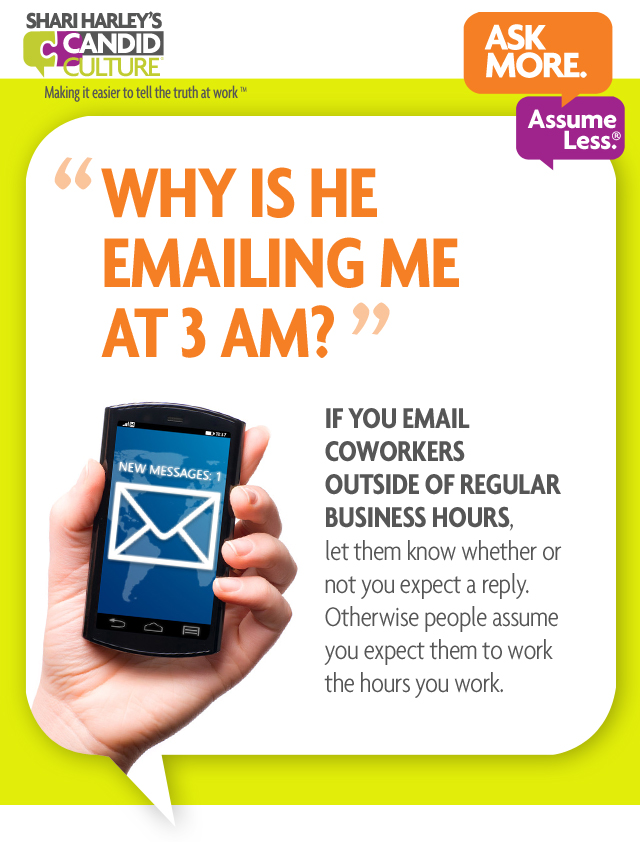
Managers, one of the keys to retaining employees is to communicate expectations. If you’re available while you’re on vacation, but don’t expect employees to do the same, set that expectation. If you send an email outside of regular business hours but don’t expect employees to respond until the next business day, tell them so. They don’t know. Many employees assume that if you email them at night, you expect a reply.
Instead of allowing employees to make assumptions about what managers do and don’t expect, set clear expectations. Be overt and clear. Tell employees, “I work most evenings and weekends, but don’t expect you to do so. And I work these hours because I enjoy it, not because I have to. If I email you outside of regular business hours, I am not expecting you to reply.” Retaining good employees begins during the interview process when initial expectations are set.
Managers, if you expect employees to check and respond to emails outside of regular business hours and to be available while on vacation, tell candidates during the interview process. If working long hours is a criteria for promotion, set that expectation. It’s completely fine to expect long hours and for employees to be accessible outside of regular business hours. There is nothing wrong with either expectation. There is only a problem if employees don’t know that’s the expectation.
Employees, if your manager emails you outside of regular business hours and she doesn’t tell you whether or not she expects you to reply, ask. Simply say, “I often receive emails outside of regular business hours. How will I know when you need me to reply?” Likewise, if you notice your manager emails you on vacation, you can say, “I typically hear from you when you’re on vacation. Are you expecting me to check in while I’m off?”
The need to ask questions and set expectations goes both ways. Don’t wait to be told. Ask.
Managers and employees, ask these Candor Questions about working style preferences to aid in retaining employees:
How do you feel about being contacted outside of regular business hours?
If I need to reach you over a weekend or in the evening, what method is best?
Would you prefer I text you so you don’t have to check your email outside of business hours?
What time is too early and too late to call, text, and/or email?
Ask more. Assume less and make retaining employees easier.
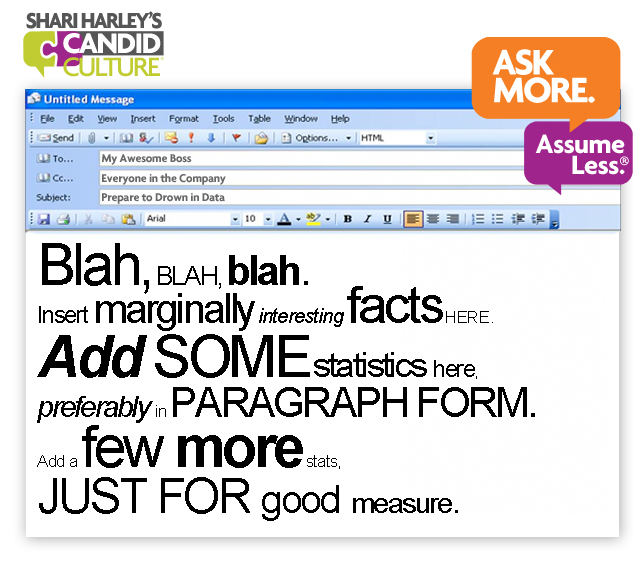
When I get an email that has multiple paragraphs I look at it, decide I don’t have time to read it, and close it out, promising to go back to it later when I have more time, which never happens.
Here are a few tips for writing effective emails that are more likely to be read:
Put a specific subject in the subject line that says what the email is about.
This does not include your name. We already know your name.
Ex.: “Meeting” (that’s not specific). Instead try: “Meeting to agree upon February goals.”
Highlight and bold important parts of the email
Limit this practice so what’s bolded and highlighted stands out.
If everything is bold, nothing stands out.
Use bullets
Use the fewest number of words possible
Use links that send readers to relevant information
Offer additional information, if desired
The shorter your emails are, the more likely they are to get read. You can always offer additional information, but readers won’t get to the detail if they never read the email. When it comes to writing effective emails, shorter is better.
One of the hardest things I ever did was to hire someone to care for my infant son. “Here is the person most important to me in the world. Keep him alive.” I had no idea how difficult it would be to trust a relative stranger so implicitly. And as a result, let’s just say I was not the easiest parent to work for.
I’m embarrassed to admit that I wrote sixteen-pages of instructions on how to take care of my kid. And I gave that ‘booklet’ to a nanny with much more childcare experience than I had. When I heard my son crying, I would tell myself not to walk into the room and check on him, knowing it undermined the nanny, but I did it anyway. When the nanny sent me an update of when my son last ate, I replied telling her when he should eat again, even though I knew she already knew that. Yes, I really did these things.
Each time I over instructed, monitored, and advised, I regretted it. I knew micromanaging our nanny made me difficult to work with, which is not how I wanted to be. It reminds me of a comment an old boss said to me after we interviewed a candidate for a job together. He said, “Shari, your job as the interviewer is to make the candidate feel comfortable and ensure she leaves feeling good, regardless of how well or poorly she interviewed.” During the interview, my face must have said anything but, “I want you to feel comfortable and you’re doing a great job.” His words stuck with me and I was reminded of them each time I over managed our nanny.
Many people attend training on how to manage others. I’d suggest we also look at how we manage ourselves. How does working with you make people feel? Do your questions, requests, and interactions make people feel more self-confident and valued, or do people feel questioned and undermined? Do you pick your battles? Do you give just enough direction but not so much as to squelch the other person’s ideas, initiative, and spirit, especially when the stakes are high?
As you know, I’m evaluating how I do these things too. We are always a work in progress.
Here are four ways to build confidence in the people you work with:
Build Confidence 1: Ask people for their ideas and implement those ideas whenever possible. And if you aren’t open to others’ ideas, don’t ask for them. It’s better not to ask for ideas than to ask when you’re really not interested.
It’s not easy to admit when we’re overwhelmed and need help. In fact, it’s such a hard thing to say that instead of asking for help, most of us either work harder or longer or job hunt. Admitting work overload isn’t a weakness and it isn’t bad. It’s all in how you handle it.
If you find yourself with work overload and you aren’t sure what to do, consider taking these four steps.
Eliminate work overload step one: Every time you find yourself doing something that someone else could and should do, write it down, including how much time the task took. Doing this will create awareness of how much time you spend doing things that may not be the best use of your skills and experience. Then work with whomever you need to in your organization to align that work where it belongs. This practice isn’t to make you sound like an entitled prima donna. It’s an entrepreneurial way to approach your work.
The business owner’s mantra is, “If I can pay someone less than I get paid to do something, I should do that.” Consider how you can apply that practice to your workplace, without appearing to be someone who won’t ‘wash windows.’ Meaning, you don’t want to be or appear to be someone who isn’t willing to do grunt work. Every job has it. But those tasks shouldn’t be where you spend most of your time unless your job description and annual goals say so.
Eliminate work overload step two: Watch out for and eliminate time suckers. This includes people, problems, and processes. If you find yourself in meetings all day long, consider which meetings you don’t really need to attend or send someone else on your team. If someone in your organization calls you daily to have personal conversations, tell the person, “I’d love to talk with you and I’m working under a deadline. Can we catch up later?”
Eliminate work overload step three: Sometimes doing 110% percent isn’t important. Notice when you’re doing more than you need to and when that additional work doesn’t add significant value. I.e., you put together an elaborate PowerPoint presentation and then spent five more hours printing and stuffing folders to mail to coworkers’ homes. Next time, focus on the content and worry less about the aesthetics.
Eliminate work overload step four: Lastly, know when and how to ask for help. The last organization where I worked, before starting Candid Culture, was very fast-paced and lean. I worked all the time and consistently felt overwhelmed. I eventually went to my boss to ask for help. I made a list of everything I was working on and asked him to rate each item based on how important he saw the project/task. He put an “A” next to the things that needed to get done first, a “B” next to the things that came next, and a “C” next to the things that were the least important. He told me to do the A’s first, then the B’s, and if I got to the C’s, great, if not, no problem.
The meeting was eye-opening for me. I assumed he thought everything on my list was an “A” and that left me stressed with an inability to prioritize. Hearing how he perceived my workload reduced my anxiety and gave me permission to ease up on projects I’d previously considered timely.
Don’t suffer in silence. But do approach reducing work overload in a positive way. Rather than whining to your boss and coworkers, end conversations that you know are a time drain, limit work that doesn’t add significant value, and ask for help prioritizing when you can’t do it for yourself.
The coaches of my son’s pre-Covid soccer class would frequently tell the kids, “You get what you get and you don’t throw a fit.” As adults entering performance appraisal season, I think we can do better.
Performance appraisals are, for many, the most dreaded day of the year. Most employees anticipate the meeting, wondering what their manager will say. In addition to hearing about the situations your manager, and others in your organization, observed throughout the year, why not tell your manager what you’d like to know?
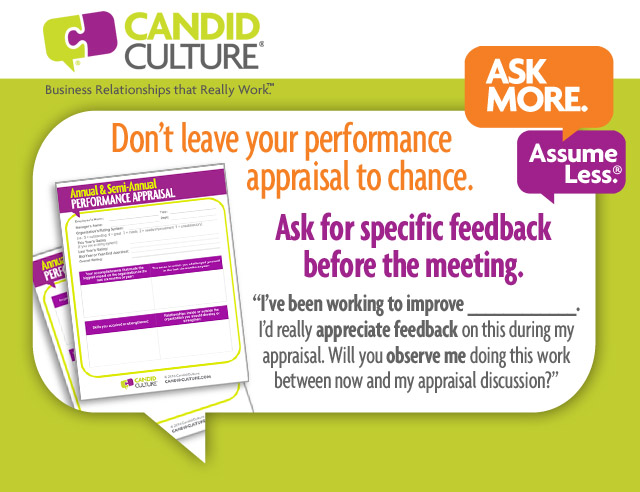
It’s perfectly appropriate to tell your manager if you’d like feedback about a specific aspect of your performance or about a certain project or piece of work. And the time to ask for this feedback is at least one month BEFORE your appraisal meeting.
If you ask for feedback during the meeting, you’re likely to catch your boss off guard. Managers don’t typically follow employees around or call into every meeting in which employees participate. As a result, your boss may not have an answer to your question. She is likely not thinking about the specific input you want.
Most people don’t like to be caught off guard or feel that they can’t answer a question. Asking for feedback in the moment, that your boss can’t address, may embarrass your manager. Don’t put managers on the spot. Set your boss and yourself up for success by asking for specific feedback BEFORE meetings, and give your manager a chance to observe you doing that kind of work.
Ask a vague question, get a vague answer. Ask a specific question, get a specific answer. If you want specific feedback, let your manager know and give her time to observe you doing the actions you’re asking about BEFORE the feedback conversation.
If you want to know how you manage telling internal or external clients “no”, give your boss a chance to see or hear you do this. If you want feedback on how you built relationships with peers virtually this year, give your boss a chance to observe that behavior or time to ask your peers for input.
Here’s how asking for specific feedback might sound: “My annual performance appraisal is in January. I am, of course, interested in everything you have to say. I’d also like feedback on how I lead large meetings. I’m leading two meetings between now and my appraisal. If you have the availability to call into either one and listen to how I elicit participation while maintaining control of the meeting, I’d really appreciate it. I’ll send you the call-in information.”
When you tell your manager the specific feedback you want to hear and give her an opportunity to observe you doing that work, you demonstrate seriousness about getting feedback and that you respect your manager’s time. You’re also likely to get more useful, specific feedback.
The practice of asking for specific feedback before one-on-one meetings and giving your manager time to observe you doing that work, is something I recommend doing all year, not just during performance appraisals. Feedback should be delivered as work is produced. The annual review should be just that, a review of conversations that happened during the year.
Remember, you get what you ask for. Ask a vague question, get a vague answer.
People get defensive when they receive negative feedback. It’s hard not to. Everyone wants to be seen as competent, and when we receive negative feedback, our competence is called into question. So we react.
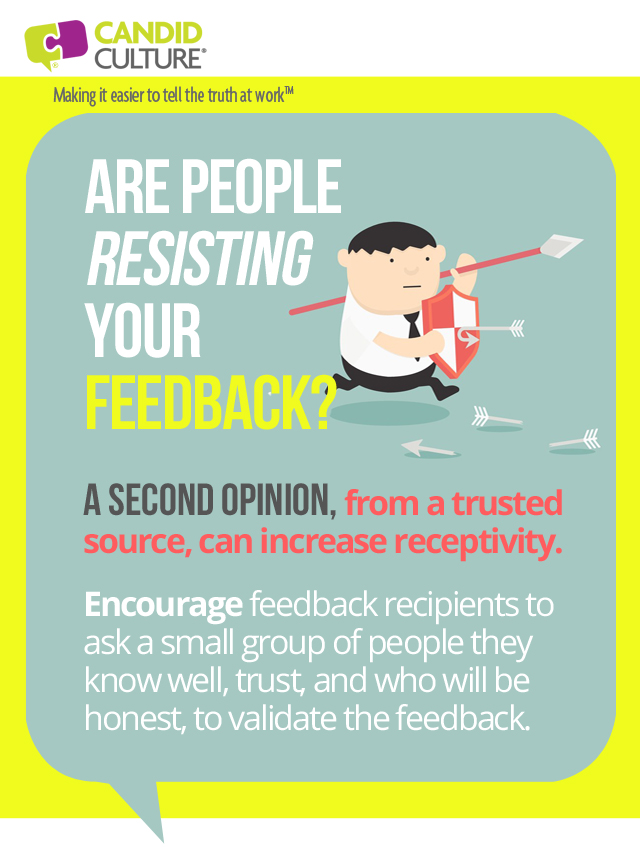
There are several things you can do to reduce others’ defensiveness – ensure you have a trusting relationship and thus have earned the right to give feedback, watch your words, deliver feedback in a private setting, etc. But for today, I’m going to focus on getting a second opinion.
If you want people to be more receptive to your feedback, consider encouraging them to get a second, third, or fourth opinion. I’m a fan of casual 360-degree feedback – when we ask for feedback from people we work with both inside and possibly outside the organization. Think of 360-degree feedback like an orange, it’s all the way around, like a sphere. When you get 360-degree feedback, you gather input from all the different types of people you interact with, thus getting a more comprehensive and accurate picture of performance. There are different types of 360-degree feedback. 360-degree feedback ranges from the formal – an online, anonymous survey (I’m not a fan) – to casual conversations (which I recommend). In this instance, I’m suggesting something I call The Core Team.
I suggest everyone has a Core Team of about five people who love you, know you well, and have your back. Most important is that you trust these people. Your Core Team may be personal or professional relationships or a mixture of both. You may have worked with Core Team members or not. What all Core Team members have in common is that they know you well, want what’s best for you, and will tell you the truth when asked.
My core team consists of a friend from high school, two people I used to work with, and my parents. When I get feedback that I’m having a hard time reconciling, I ask people on my Core Team to validate the feedback. It doesn’t matter if they’ve worked with me or not. I am who I am. I do the same annoying stuff in my personal and professional relationships. So a personal Core Team member can provide valid, professional feedback and vice versa. Sometimes they agree with the feedback I’ve been given and sometimes they don’t. But I always get compelling information to think about. And because I trust the people on my Core Team, I listen to what they have to say.
Don’t be disheartened if people don’t trust your feedback and aren’t receptive. Instead, see their resistance as human and encourage them to get a second opinion. And then talk again. Listening to and incorporating feedback is a process. It takes time, courage, and patience.