Think about all the people in your life who frustrate you. The employees who turn in work without checking for errors. The person who cancels meetings two minutes before meetings are scheduled to start. And in personal relationships, our friends who come late, cancel, or just aren’t in touch as often as we’d like.
These situations annoy us, but we often don’t say anything because giving feedback feels too hard. Why risk the person’s defensiveness? Or we don’t think addressing the situation will make a difference. Or perhaps we don’t feel we have the right to speak up.
Giving feedback can be hard. Asking for what you want is easier, but most of us aren’t clear about our requests and expectations.
The question is why? If making a request is easier than asking someone to change their behavior, why not ask for what you want upfront? Why wait until expectations are violated to make a request? The answer is simple.
We don’t think we should have to make requests. We assume our employees, coworkers, and friends will do things as we do. And most of these assumptions are unconscious. We don’t even think about it.
We would never turn in work without checking it for accuracy or come to a meeting late. We would never not send a thank you card after receiving a gift or miss a close friend’s birthday, so we (unconsciously) assume others won’t either. And when people violate our unstated expectations, it feels too hard to speak up, so we don’t.
I’m going to suggest you approach relationships differently –more proactively.
Ask for what you want at the beginning of a relationship, project, or meeting. Make requests at the onset of anything new. Set clear expectations. If you want to start and end meetings on time, tell people that during your first meeting. If it bothers you when people wear shoes in your house, tell visitors when they arrive, or even better, tell them before they arrive.
If you have an existing behavior you want to shift, simply say, “I realized I didn’t tell you that starting and ending meetings on time is really important to me. Going forward, we’re going to start and end all meetings on time. So please be ready for that.” Tell visitors to your home, “I realized that I forgot to tell you that we don’t wear shoes in our house.” It’s never too late. Don’t expect people to guess you’re frustrated and alter their behavior without you making a request. It’s not going to happen.
Consider all the things that annoy you. Then consider what you did or didn’t ask for. If you haven’t made your expectations clear, it’s not too late. Asking for what you want is easier than you think.
People have a tendency to talk about us, not to us. If you haven’t been gossiped about, you just need to meet more people.
If you have something to say, say it directly to the person involved. If you’re not going to speak to the person directly, say nothing at all. As we all know, this is easier said than done. Gossip will destroy relationships, organizational cultures, and careers faster than anything else. And we are all tempted to gossip.
Most of us consider gossip to be saying something bad about someone else when that person isn’t there. But what if we say something good?
The strictest definition of gossip is talking about another person while she is not present. But for our purposes, let’s say gossip is talking about another person so as to alter how others think about that person.
Several years ago, I took a year-long class with about eighty other people. The class met one weekend a quarter over twelve months and had a few ground rules, one of which was no gossip. Participants couldn’t gossip anywhere, at any time, during the class’s entire duration. No gossip with friends, family, or coworkers for a year.
When the class started, I assumed the no-gossip guideline would be no problem for me. Then I started to notice my behavior. At the time, I was a director in my organization and had one friend at work who was my typical confidant. Most of us have “our person” at work—someone we confide in and complain to. The two of us would sit in my office with the door closed, talking about all the bad decisions the leaders of our company had made. The moment I began paying attention to the no-gossiping rule, I realized that not only did I gossip, but I was good at it and even enjoyed it. (Oh, come on, admit it—it’s fun.)
The problem is that gossiping breaks trust. If a coworker gossips with you about someone else, he will talk about you to someone else. You are not special or different. (Well, you are, but you know what I mean.) You are not exempt.
As you rise in an organization, you have exposure to more and more sensitive information. You know about employees’ performance ratings, the organization’s financial results, and impending layoffs. One criterion of promotion is being able to be trusted with sensitive information. If the senior people in your organization think you’re a gossip and can’t be trusted to keep confidences, your career is going nowhere.
People will never stop gossiping. It’s one of those human things. We all do it, and we aren’t going to quit. The best we can hope for is to reduce the amount of time we spend talking about other people behind their backs.
I won’t suggest you stop gossiping. I merely suggest you bring attention to the gossip circulating throughout your organization. Bringing attention to the gossip circulating in your organization will raise awareness, and reduce the gossip, just a little bit.
** This blog is an excerpt from the book How to Say Anything to Anyone.
We’ve all heard about the great workplace exodus. Over the last two years, millions of people have quit their jobs in favor of doing something different. You too may have realized that you want something different from life and work.
Despite wanting something different, you may find it difficult to make those requests at work. You may be worried that if you ask for what you want, you’ll be fired before you’re ready to leave, or you’ll be seen as disloyal and unreliable, and thus not promotable. Many people suffer in silence fearing that speaking up will get them ‘in trouble.’
Regardless of your concerns, you aren’t likely to get what you don’t ask for. So how do you ask?
Here are five steps to ask for what you want at work:
Become very clear about what you need and want. Don’t have a conversation with your manager that sounds like a conversation with a friend. “I don’t know what I want. I just know it isn’t this.”
Lead with your intentions. Difficult conversations are easier when we start the conversation with our intention. “I really love this company and I want to stay here.”
Then make a clear ask. “I’ve realized over the past two years that I really want to be doing ____________. I’m wondering if there is an opportunity to do that kind of work here?” Or, “I’ve realized that I really want to live in __________” Or, I’ve realized that I really want to work a flexible schedule.”
Create a plan. “Can we make a plan to move me to ___________ department or role in next 12 months?” Or, “Can we make a plan to make that happen in the next 12 months?”
Don’t give ultimatums. No one likes to be forced. Negotiate a realistic time period to make your desired changes. Saying “I need this, or I have to leave now” isn’t likely to produce the result you’re looking for. “What’s a realistic time period to make this transition?” is better.
You can make requests as I’ve suggested and still not get what you want. Then you have decisions to make. But you are unlikely to get what you don’t ask for. Asking for what you want, in a professional way, is better than leaving, never knowing if your needs could have been negotiated.
You might be lucky enough to have a manager who helps you advance your career, but you might not. Either way, you deserve to have the career you want, and ultimately, it’s your job to advance your career.
Advance Your Career Step One: Learn about different areas of your organization and become clear on what you want to learn and what areas of the business you want exposure to. You won’t know what to ask for from your manager if you don’t know what your organization does and the opportunities that are available.
Advance Your Career Step Two: Get to know the leaders and employees in other departments. Find out what they do on a daily basis, the initiatives they’re working on, and their short and long-term goals.
If you’re working virtually or in a hybrid environment, you may be wondering how to learn more about your organization and build relationships from a distance? How do you meet with people you never see? Anything you can do in-person, you can do over the phone or via video. It’s nice to be able to walk into someone’s office and ask a question or connect with someone in the hallway or a breakroom, but it isn’t essential.
Reach out to people in the organization you already know. You can make these connections via email or phone. I recommend phone. Tell people you want to learn more about the organization’s objectives and different departments. Ask who they can connect you with. Networking and building new business relationships virtually takes more upfront work than walking into someone’s office, but it can be done. Ask people to make virtual connections for you and then follow up on those connections within one business day.
Remember the job search advice you were given early in your career, to have informational interviews with people doing the work you wanted to do? Getting to know your current organization better is similar. Ask for informational meetings within your organization. And then communicate with the people you’re connected with in the way THEY like to communicate. Tell a person you’ve been connected with that you’d appreciate 15 minutes of their time and ask how they’d like to meet – via phone or video? Then schedule a short meeting via their preferred medium. When the 15-minutes is up, tell the person, you’re watching the time and you respect their time. Ask if they’d like to hang up or continue the conversation? And then honor their request. If you’d like to meet again, ask for another meeting. If there are next steps, make those steps clear and follow up via email, if it’s appropriate.
Advance Your Career Step Three: Ask your manager, your peers, and other organizational leaders who you need a good working relationship with and who can influence your next career opportunity.
You never know who talks to whom and who can influence your future opportunities. Department heads you don’t know well talk to other department heads. Don’t assume that because you don’t know someone well that they can’t influence your next opportunity or lack thereof.
Advance Your Career Step Four: Tell people who can influence your career what you want to do.
Don’t assume people know what you want to do in the future. In fact, assume others have no idea about the work you want to do and the things you want to learn. Tell people, “I’m really interested in learning more about ___________. I’d like exposure to __________ part of our organization.”
Your career is your responsibility. Don’t wait for your manager make your career happen. Take matters into your own hands. Follow the steps above and get more of what you want at work.
As someone who writes and teaches about effective communication in the workplace, I suspect the people I work and live with are expecting me to model good communication skills all the time. The good news: I try really hard to always do the right thing and impact people positively. The bad news, I’m human and sometimes I don’t get it right.
One of the things I’m proud of about Candid Culture, is that we are real people, working with real people. We work very hard to practice effective communication in the workplace and to always model what we’re teaching. And yet, like all people, we get busy, rushed, and tired. We read emails we intend to reply to, but then forget to do so. We occasionally send emails, when we should pick up the phone.
In my world, a good communicator is not someone who always communicates perfectly.
A good communicator who practices effective communication in the workplace is someone who:
Cares about people and consistently works to communicate in the way others need.
Asks for and is open to feedback about how they impact people.
Listens and watches other people’s verbal and non-verbal communication.
Alters their communication style to meet other people’s needs.
Takes responsibility when things don’t go well.
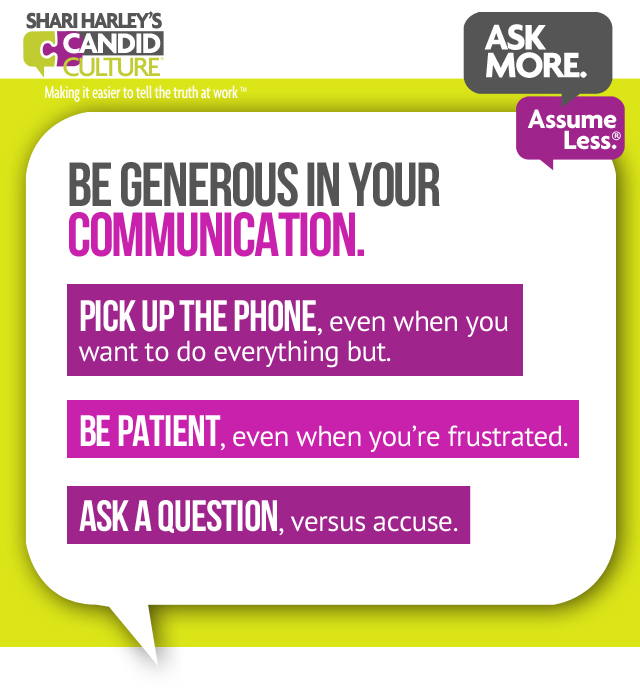
I advocate for picking up the phone, even when you want to do everything but, being patient, even when you’re frustrated, and asking questions, versus accusing. And I’m going to admit, I’m working to do these things too. Sometimes I get it right, and sometimes I don’t. I’m in the trenches with you, working to say and do the right things every day.
I promised you five tips to practice effective communication in the workplace and to be generous with people:
Only call people when you have adequate time, attention, and patience to have whatever conversation needs to be had.
If you need a few days to return a call, say so. Let the person know when you’ll call.
Prepare for conversations. Plan what you’re going to say and how you’re going to say it.
Don’t have hard conversations when you’re frustrated, tired, or busy. They won’t go well.
If the conversation goes poorly, call back later and clean it up.
Being a good communicator doesn’t mean being perfect. It means caring enough to notice when you miss the mark, cleaning up your messes, and working to do it better next time. I’m working on the above recommendations too. And when I screw it up, you can be assured that my mistakes will become examples in our training programs of what not to do, followed by a new technique that will hopefully work for all of us.
It’s the time of year when people start to think about their goals for 2022 and make New Year’s resolutions. I won’t suggest you do either. You likely have enough to do. My only suggestion (in this arena) is to ensure you’re doing what you really want to do.
There are lots of things we need to do and think we should be doing. And it’s really easy to get caught up in that long list of could and should do’s. If that list brings you joy, do those things. If not, consider another path.
I’m pretty sure at least one person reading this blog has a magnet or card hung at their desk with the words, “What are you going to do with your one precious life?” As far as we know, we only get one go around. So, while the question may be overused, what are you going to do to create your life with the time you’re given?
I have an existential friend who is trying to convince me that there is no such thing as time. I am not persuaded. All we have is time, and it’s the only thing we can’t get back. You can gain weight and lose weight, make money and lose it, make friends and lose them, but you can never get back your time. So, what are you doing with your time?
You create your life.
A few questions to consider:
What do you love doing most? How often are you doing that?
What’s most important to you in life? Does what’s most important to you make up a majority of where your time and energy goes?
How much time do you spend doing things you think you should be doing, but don’t really want to be doing?
How much time do you spend doing things someone else wants you to do?
I’m not suggesting you live an indulgent life without compromise. If you’re in relationship with other people, you will, at times, do things you don’t want to do. But I’m hoping that doing things out of obligation is not what your life’s about.
Not everyone in your life will approve of your choices. That’s ok. This is your life. Don’t knowingly harm anyone or anything. Besides that, I don’t know of any rules, except for this, don’t get to the end of the road and wonder “what if.” Create your life.
Read How to Say Anything to Anyone and take charge of your career and life. Holiday offer! Buy 3 books at candidculturepress.com and we’ll send you a 4th book free. Offer ends 1/10/22.
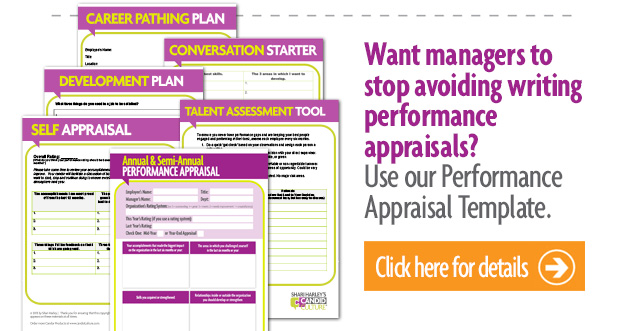
No one (I know) enjoys writing, delivering or receiving performance feedback. It’s time consuming to write, challenging to deliver, and can be difficult to hear. Unfortunately, most performance management systems – goal setting forms, performance appraisal templates and online templates – don’t make the process easier. Instead, they make it harder. Short and simple is best.
When I started managing leadership development for a mutual fund company, I inherited a 12-page performance appraisal form and what seemed like 89 competencies. One of the business leaders I supported told me, “I’m not asking my people to use this form. If you can give me something that’s one page, I’ll have my managers use it.” That conversation sent me on a mission to make all performance management forms one or two pages. And really, why shouldn’t they be? People can only focus on leveraging and changing a few things at a time. Why give more feedback than that at any given time?
If you’re chasing people to use your performance management tools and templates, you have the wrong forms. In my experience, when people find something easy to use and valuable, they’ll use it. If something is difficult to use or doesn’t seem to add value, people drag their heels.
Here are a few ideas for making your performance management process easier:
Make your forms and templates simple. No performance management tool should be more than two pages. In a performance appraisal – quarterly, annual, or otherwise – identify up to three things the person did well and a max of three things they can either do more, better, or differently next year. Anything more is overwhelming and a set up for disappointment, frustration, and overwhelm.
If you have additional areas for the person to work on, meet again in 90-days and assess how the person has done with the three pieces of feedback already provided. If they have made significant progress on the things they were already working on, add a few new things to work on. If significant progress hasn’t been made on the existing feedback, wait to add more.
I know your existing performance management templates may not allow for what I’m suggesting. If you’re working with a template that requires more input, write up to three clear, succinct, and actionable bullets in each required area and not more. Bullets are better than paragraphs. Be specific. “Great job” is not feedback. Neither is, “needs improvement.” Give a specific example or two. No example, no feedback.
Resist the urge to write paragraphs of vague feedback or to accept that type of feedback in a self-appraisal. Paragraphs of feedback take too long to write and often say little. I’d suggest spending less time writing performance feedback and instead spend the time observing performance, asking others for input on the person’s performance, and writing three succinct, specific bullets that describe an action taken or outcome produced. Specific feedback is meaningful, useful, and received with less defensiveness.
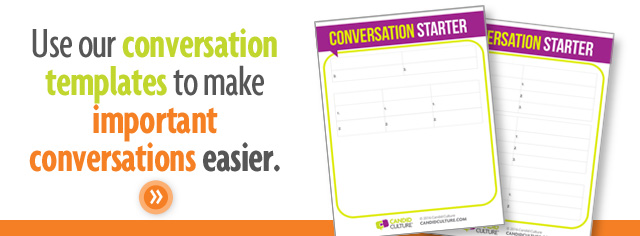
Click below to see our suite of one and two-page performance management templates.
Thanksgiving is coming up. Many people will spend time with family and friends they haven’t seen in a long time. Some people will be indoors with a larger group than they’ve seen in almost two years. And many people are anxious about that.
The time to talk about what everyone needs to feel comfortable at Thanksgiving dinner is now. Don’t wait until Thursday. Consider what you need to feel comfortable and make requests today. Breakdowns are predictable. And what you can predict, you can often prevent.
How many people do you feel comfortable being in the same room and house with? Do all attendees need to be vaccinated? Do you want assigned seating so people sit with people they see regularly? Do you want people to take Covid tests before attending an event? You can likely have whatever you’re willing to ask for. But you likely won’t get what you don’t ask for.
You may be concerned that your requests are too much and thus you’re hesitant to make those requests. If you’re afraid to ask for something, feeling like it’s just too big of an ask, say that. Saying how you feel has a lot of power and is disarming. It could sound something like, “I’m feeling nervous about Thanksgiving dinner. I’ve been hesitant to say anything because I don’t want to offend you. Is it ok if I ask a few questions?”
“I haven’t been in the same room as a group of people I don’t know well in a long time. How many people are coming? What requests are you making of guests from a health and safety perspective? Are you comfortable asking that everyone be vaccinated and take a rapid Covid test before arriving?”
Sprinkle your questions into the conversation. Ask for what you really need. Asking these questions of the host before the dinner is a lot less confrontational than telling a guest they’re sitting too close to you and asking if they’re vaccinated. Thinking through your needs and making requests before an event is always easier than trying to change a situation. The best way to prevent an uncomfortable situation is to talk about it before it happens.
When my son started pre-school and kindergarten, I went to new parent orientation. At those orientations I sat next to parents who told me their questions about the programs. But they never asked the people running the meeting their questions. They wondered in silence, whispering to seat mates who didn’t know any more than they knew. I’m always flabbergasted by these situations until I remind myself that people don’t like to admit they don’t know something. No one wants to look stupid.
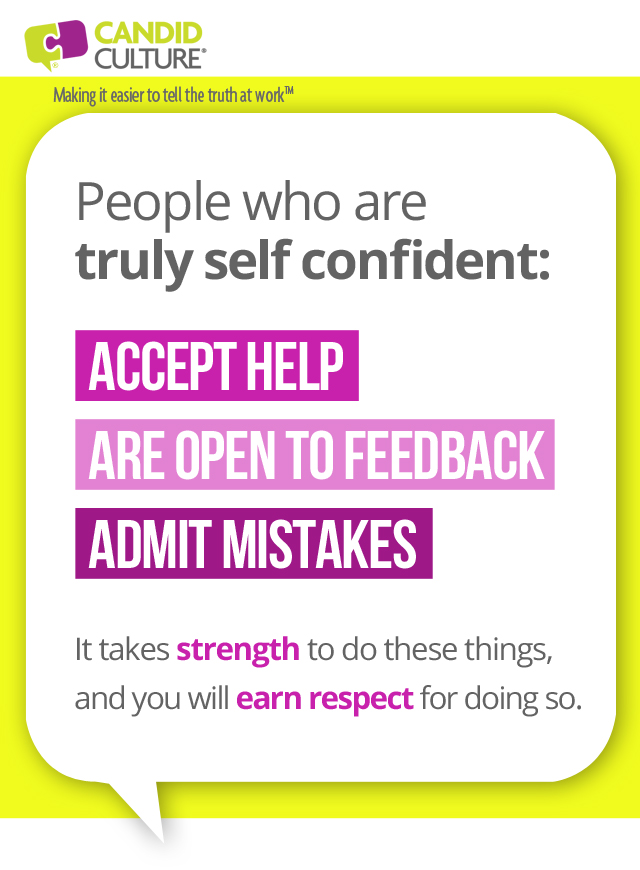
Most of us aren’t eager to admit when we don’t know something, need help, or make a mistake. We fear these things will damage our reputation and make us appear less than to others. But neither are true. It takes strength and self confidence to admit mistakes, accept feedback, and ask for help. Strong, self-confident people do all of these things.
When someone who works for me is willing to admit mistakes, I think more of them. When employees ask for help rather than spin their wheels unnecessarily, I’m appreciative. When they’re open to feedback, I’m grateful they’re easy to work with. And the same is likely true for you.
Before launching Candid Culture, I worked with a CEO who frequently lead with, “I may not be the smartest guy in the room, but…” The CEO was trying to appear humble and relatable, but he was the smartest guy in the room and we all knew it, thus his attempts were false and came off as such. Arrogance masquerades as self confidence. People who are arrogant come off as strong and self confident, but it’s a façade.
It may seem like your personal power and reputation will be diminished by admitting mistakes and accepting help. But this couldn’t be further from the truth. It takes strength to say you don’t know how to do something, to embrace feedback that stings, and to admit bad choices. And strong, self-confident people do all of these things, regularly.
You won’t lose credibility or damage your reputation by being humble, instead you’ll be seen as real, relatable, and willing to admit a lack of perfection. And all of those things take strength that ingratiate you to others. So be yourself. Don’t pretend you’re better or more knowledgeable than you are. Authenticity goes a long way.
Get the words to say the hardest things in two minutes or less. If you work long enough, you’ll eventually be confronted with these situations. Giving feedback doesn’t have to be hard.