Business Relationships Archive
When I was in college I wrote a paper making the case that most of the decisions we make are based on fear. My professor told me that I wouldn’t want the grade she’d put on the paper and told me to rewrite it. Clearly, she disagreed. Many years later, I still believe the premise of what I wrote. Much of our decision making is fear based.
We make decisions based on fear of what will and won’t happen.
Is that a good decision? What will happen if I say or do that? Will I get in trouble? Will I get what I want, or will there be negative consequences? Will we make or lose money? Will I lose my job? What impression will that decision make on other people?
Fear is pervasive. It hides in our brain and guides our decision making, without us even being aware of its presence.
I’ll never forget driving up to an ATM machine with one of my closest friends from high school. We were 30 at the time, long past high school, and were in a very quiet and safe neighborhood. And yet my friend told me not to go to the ATM machine after dark because it wasn’t safe.
Says who? A long time ago, someone told her that it wasn’t safe to go to an ATM machine at night. And she believed that she’d be robbed at night, at any ATM machine, anywhere, throughout her adult life. Not sound decision making nor a rationale fear.
Regarding decision making, who is running the show, you or your past?
When decision making, you know what’s best for you. When you quiet the noise in your head and listen, you know what to do. Trust yourself.
 Tap into your real desires. When desire overtakes fear, the world will be at your feet. But it can take a lot to even identify that fear is running the show and to know what those desires are.
Trust yourself. Not your fear. When fear rears its head, go to a quiet place, literally and figuratively, and ask yourself:
What do I really want? What should I do? You’ll know. Don’t ask 100 people what you should do. Or do ask other people for advice, but be careful with the answers you get. Underneath all that worry and concern, you know what you want. The key is to listen and be willing to trust yourself.
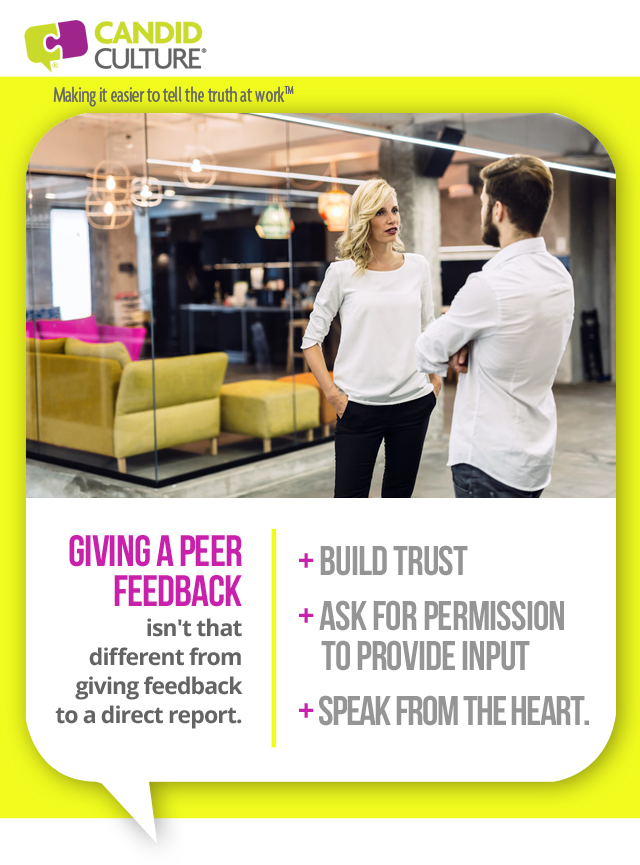 Many of us are hesitant to give peer feedback. We worry that giving peer feedback will damage our relationships. We wonder if we have the right and if it’s our place to give peer feedback. And we are concerned about what the consequences of giving peer feedback will be.
Giving peer feedback isn’t so different from giving feedback to a friend or even a direct report. While you have an implicit ‘right’ to give a direct report feedback, doing so without building trust will ensure your feedback falls flat.
People respond to feedback in predictable ways. Most people get upset and defend themselves. This is normal and natural. Negative feedback conflicts with our desire to be thought well of, which all people (despite what they might say) want. People are more open and less defensive when they trust the source of the feedback and trust the sources’ motives. Follow these practices when giving peer feedback and your feedback will hopefully be well received.
Four practices for giving peer feedback:
- Think about why you want to give feedback. Really think about this. Is your desire to help the person change a behavior, or are you just being judgmental? If your intention isn’t to help someone replicate or change a behavior, say nothing. It’s not feedback you’re planning to give, it’s only your opinion you want to disseminate. One of my friends recently told me she felt my son’s name was waspy. Her comment wasn’t feedback as there was nothing I could do with the information. She simply gave me her judgmental opinion, which annoyed me.
Also consider why you want to give feedback. Do you simply want something done your way, or do you feel strongly that what the person is doing is having a negative impact on him/her or the organization? I worked with a business leader who red lined every document his staff created. He didn’t only change language that was wrong, he edited documents so they were written more akin to his writing style. This made his staff feel that they couldn’t do anything right and it wouldn’t matter what they produced, he’d revise even the most ‘perfect’ work. So they stopped trying. Evaluate your true motive. Just because something wasn’t done your way, doesn’t mean it wasn’t done well.
- Provided your motives are pure – you’re trying to make a difference for someone and his/her behavior is causing real challenges, it’s ok to speak up. Be sure you have the relationship to give peer feedback. Does the person know you have his/her back? If you speak up, will s/he trust it’s because you care about her or the organization, versus you just want to express your opinion and be right.
- Provided you are giving feedback to alter a behavior and you have the relationship to give feedback, it’s important that you ask for permission. A peer relationship is a lateral one. You each have the same ‘power’ (at least by title) in the organization, thus you don’t intrinsically have the ‘right’ to give feedback. You earn the right to give feedback by asking for permission and being willing to hear, “No, thank you.”
Asking for permission to give feedback might sound something like, “I’ve noticed a few things that I think are making ________ project harder than it has to be. Would you be willing to talk with me about it?”
Or, “Our weekly team meetings are tough. It’s a challenging group. I have a couple of ideas that might make the meetings easier to run. Would you be interested in talking about them?”
Or, “I have something I want to share with you. I feel awkward bringing this up because we’re peers and I’m not sure it’s my place to do so. But I care about you and want you to be successful. Would it be ok if I shared? Feel free, of course, to say no.”
- Lastly, don’t worry about giving peer feedback perfectly. You might follow our feedback formula to a tee. You might not. There is no one right way to give feedback. Speak from the heart. If you’re nervous to have a conversation, say so. If you’re not sure it’s your place to give a piece of feedback, say so. If you’re worried you won’t deliver the feedback well, say that. Saying how you really feel, being human and vulnerable builds trust, relationships, and credibility. People want to work with other real people, and real people have concerns. It’s ok to share them.
Giving peer feedback doesn’t have to be hard. Evaluate your motives. Ensure that what you plan to share is really feedback versus merely your opinion. Build trust, ask for permission, and speak from the heart. If you make a mess, you can always clean it up. Simply repeat the steps by saying something like, “I’m sorry if I hurt your feelings. I hope it’s ok I said something. I really want this project to go well for both you and the team. How could I have done that better for next time?”
 I’ve wanted to be an introvert my whole life. It’s going poorly. Introverts think, then speak. What an amazing quality. Extroverts, like me, wake up talking and then spend much of the day apologizing for what we’ve said.
While I covet introverts’ thoughtful communication style, they are at a disadvantage. The people we work with are busy and have limited exposure to coworkers. As a result, others judge us very quickly. If we don’t speak up in meetings or find another way to express our thoughts, people are likely to think we have little to offer. Regardless of your communication style, if you want people to know the value you provide, find a way to share it.
You can’t, won’t, and shouldn’t become a different person to get ahead at work. You have to be yourself. Trying to be someone you’re not, will be painful, frustrating, and short lived. Rather than trying to become someone or something else, find ways to express yourself within your natural style.
Here are four tips to communicate powerfully as an introvert:
Being introverted communication tip one: If you know you’re hesitant to speak up in a meeting, perhaps share your views with the meeting attendees individually – verbally or in writing – before the meeting happens.
Being introverted communication tip two: Make sure the people who can impact your career know your accomplishments. You don’t need to wear a billboard advertising what you’re doing, sending a monthly list of accomplishments and priorities to your boss and boss’s boss (clear this with your boss first) will do the trick.
Being introverted communication tip three: Find your own way of talking about what you think is important. Maybe your conversations will be over lunch with one or two people. Perhaps you’ll periodically email key people with ideas. The point is to find a way to express yourself that resonates with your personal style. Don’t keep all your ideas to yourself.
Being introverted communication tip four: Push yourself to speak up in meetings more than you might naturally be inclined to do so. Being prepared will help you speak up.
Know what’s on meeting agendas. When you feel strongly about a topic, prepare what you want to say. Take notes and consider practicing out loud. Do whatever you need to to feel comfortable expressing yourself in front of a group. And if speaking up in a meeting feels too uncomfortable, remember, people who don’t get a lot of exposure to you are evaluating you based on your contributions during meetings. Find a way to make your views known.
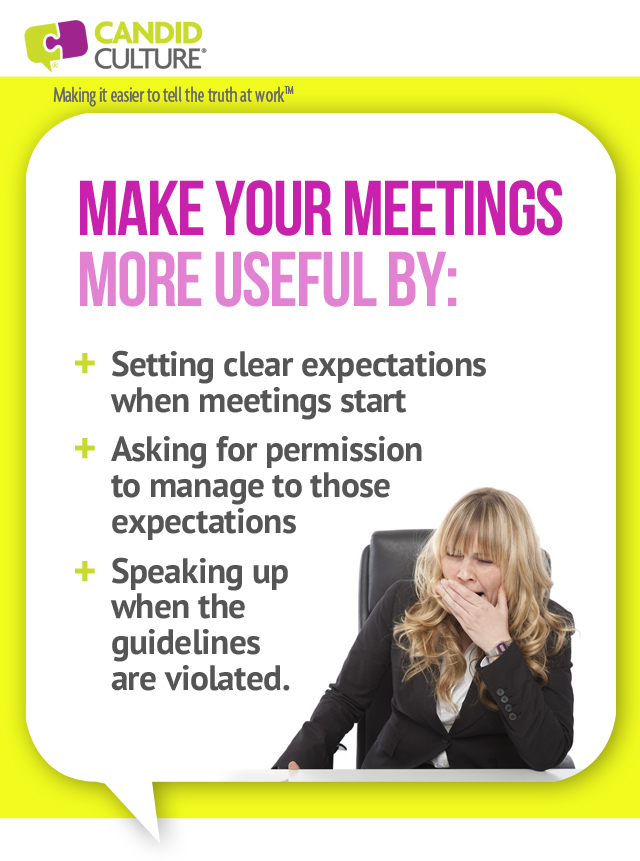
Running effective meetings is hard. It takes courage. Who wants to tell their boss, peers, and customers to put away their phones, stop side talking, and laser their communication? No one. But if you don’t manage ‘bad’ meeting behavior, you look bad and you won’t get the results you want.
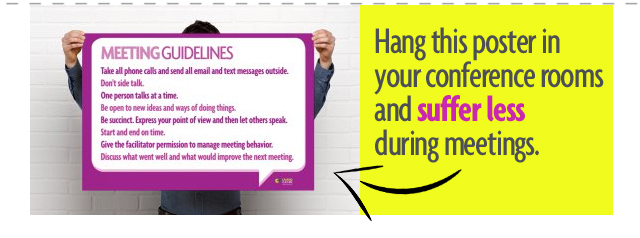
If you run meetings, work with the meeting participants to set expectations everyone agrees to follow. Standard meeting guidelines for running effective meetings include not side talking, putting away or silencing electronics, tabling tangents, not interrupting others, speaking succinctly, etc. You can set any behavior guidelines you like as long as the meeting participants agree to those expectations. Ask meeting participants what behavior guidelines they want to follow. The more control you give people, the more buy in you’ll get.
Possibly even more frustrating than running a meeting in which participants break all the ‘rules’, is participating in inefficient meetings when you aren’t the facilitator. It’s difficult to sit through a poorly run meeting feeling there isn’t anything you can do to make it better.
Luckily, there are things you can do to improve the meetings you don’t run. None of my suggestions will be comfortable. But think of all the time you’ll save.
Conversation one – running effective meetings: If you want to impact the meetings you attend, approach the facilitator(s), empathize about what a challenging meeting it is to run, tell the person you want to be supportive, and ask if s/he wants to discuss some different ways to manage the meeting. That conversation could sound something like, “Wednesday’s staff meeting is tough to run. I empathize with you. Would you be interested in talking through some different ways to manage participant behavior? I have some ideas and would be happy to discuss. I’d like to be supportive.”
Conversation two – running effective meetings: If you want to be more direct, you could say something like, “Can we talk about Wednesday’s staff meeting? It can’t be an easy meeting to run. I empathize with you. Key decision makers are missing meetings and a few people tend to take over the conversation and take us off track. Can I make a few suggestions that might help? What do you think of working with the group to set some expectations people agree to be managed to and then holding people to those agreements? We can share the facilitation responsibilities by assigning jobs during the meeting – back up facilitator, note taker, time keeper, etc. – so all of the responsibility doesn’t fall to you. What do you think?”
The person running the meetings knows they’re not going well. They just don’t know what to do about it. Offer support. Don’t judge. Be helpful and possibly they’ll be receptive.
The key to running an effective meeting is to set clear expectations people agree to follow and be managed to, hang up and review those expectations at the beginning of every meeting, and speak up when the expectations are violated. All of these things take courage. But meeting participants will be grateful to you for being strong.
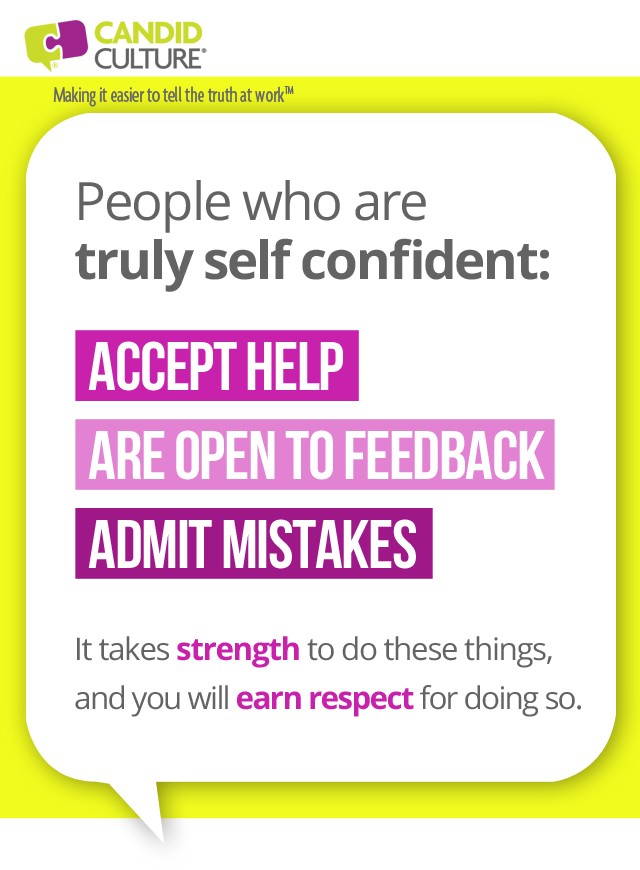
Most of us aren’t eager to admit when we don’t know something, need help, or make a mistake. We fear these things will damage our reputation and make us appear less than to others. But neither are true. It takes strength and self confidence to admit mistakes, accept feedback, and ask for help. Strong, self confident people do all of these things.
When someone who works for me is willing to admit mistakes, I think more of them. When employees ask for help rather than spin their wheels unnecessarily, I’m appreciative. When they’re open to feedback, I’m grateful they’re easy to work with. And the same is likely true for you.
Arrogance masquerades as self confidence. People who are arrogant come off as strong and self confident, but it’s a façade.
It may seem like your personal power and reputation will be diminished by admitting mistakes and accepting help. But this couldn’t be further from the truth. It takes strength to say we don’t know how to do something, to embrace feedback that stings, and to admit bad choices. And strong, self confident people do all of these things, regularly.
You won’t lose credibility or damage your reputation by being humble, instead you’ll be seen as real, relatable and willing to admit a lack of perfection. And all of those things take strength that ingratiate you to others. So be yourself. Don’t pretend you’re better or more knowledgeable than you are. Authenticity goes a long way.


The approach of summer and summer office attire can make even the most seasoned HR person weary. No one wants to tell an employee that her belly button isn’t for public viewing or to leave the flip flops at home.
Like any behavior you want to generate, it’s much easier to set clear expectations of what is and isn’t acceptable summer office attire before the season begins. So this spring, do some prevention before you have to give an employee feedback for wearing something that fits better at the beach than at work.
Most organizations have a written dress code. I recommend making it visual. Like the image here, post pictures of summer office attire do’s and don’ts in visual form. A picture makes a lasting impression employees are likely to remember; bullet points are easy to forget. If employees are wearing flip flops, tank tops, sheer blouses, spaghetti straps, wrinkled capris, etc., simply post photos of those articles in the no category. Don’t make employees guess if something is appropriate, make it visually clear.
I also recommend hosting a fashion show. Order food, have employees model summer office attire do’s and don’ts. Make it fun. Watching your peers walk ‘the runway’ in both appropriate and inappropriate summer office attire will make a much bigger impact than any ‘memo’ will.
But let’s say you already have a summer dress code violater and you know you need to say something to the person. Addressing inappropriate office attire is just like any other feedback conversation. Make it short. Tell the person why you’re speaking – because you care about him and want to help him manage his reputation – and be direct.
Here are a few examples of how to tell someone she is violating the summer dress code:
Preface each example below with something like, “I care about you and I care about your career. I’ve got some input about your summer office attire. Please take my feedback in the spirit it’s intended, which is to be helpful to you.” This language is appropriate for any type of relationship – peer, manager, and direct reports.
- Summer casual dress code scenario one: “Those are super cute shoes, but they violate our company dress code of no open toed shoes. Please don’t wear them again at work.”
- Summer casual dress code scenario two: “I can see your bra straps under that shirt. Please wear an additional layer under the shirt, the next time you wear it.” Women should have this conversation, men should not. If a man manages a female who needs to alter her summer attire, ask another female she has a good relationship with to have that conversation for you.
- Summer casual dress code scenario three: “Those pants are too tight for work. Please wear looser fitting clothing.”
Effective feedback is short and clear. You can do it. Unless you hire and manage life guards, simply tell the people you work with the truth about the impression their clothing makes and why that’s important. But it’s always easier to set clear expectations before challenges occur, so start there.
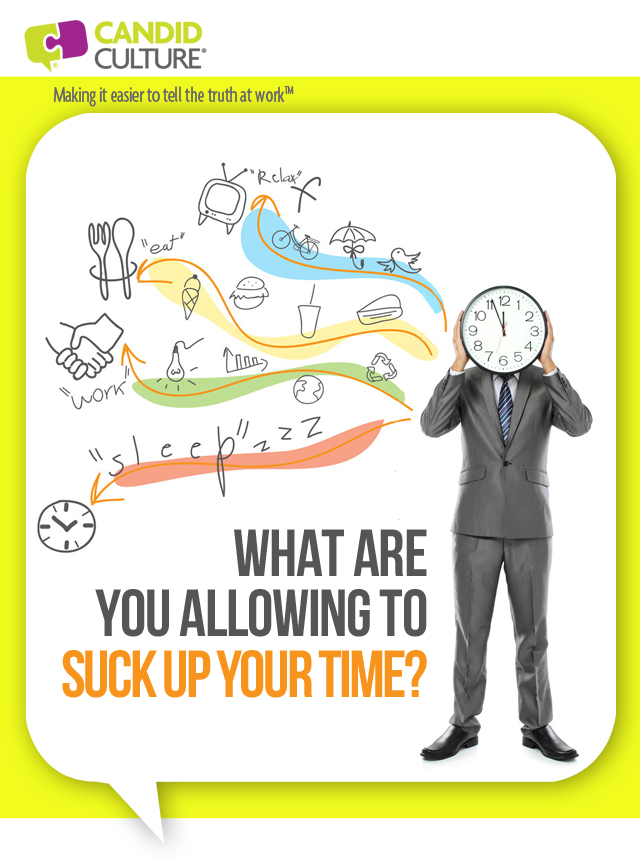 Nothing will help you with time management more than having a baby. Since having my son, deciding what to say yes and no to has become very easy. I do just what I have to and really, really want to, and say no to everything else. Work that wasn’t where I should be spending my time is now done by someone else. Social events that I didn’t really want to attend get declined.
Time is the only thing in life you can’t get back. You can make friends and lose friends. You can make money and lose money. You can gain weight and lose weight. But you never ever get back your time.
So where is your time going? What are you doing that you know someone else should be doing? What are you doing out of obligation that is devoid of enjoyment? Where do you invest more time than you need to, requiring you to give short shrift to another priority?
It may seem odd that a communications expert is writing about time management. I don’t speak or train on time management. But I am knowledgeable and passionate about people loving the work they do, where they do it. And it’s hard to love what you and do your best work when you don’t allocate your time well.
Here are five time management questions:
Time management question one: What are you doing that you know someone else could or should do?
Time management question two: If you invested a few hours training someone, what could you give up to create room for something new?
Time management question three: What personal relationships do you invest time in because you think you’re supposed to?
Time management question four: Which family events are you attending out of obligation?
Time management question five: What do you give 110% percent to that 70% would be more than sufficient, leaving more of your time and energy for something more important?
You only have so much time and energy. Where are you going to put it – on the things that matter most or on distractions that seem important?
I’m not suggesting you skip every family event you don’t want to go to. But perhaps go for less time or skip every third event. I’m not advocating cutting corners or doing mediocre work. But sometimes we spend much more time on things than we need to, when investing less time would deliver the same result.
Here are a few examples of what I mean by 70% being more than enough:
- You spend 25 hours on the formatting of a presentation when the content is what’s really important. You create gorgeous tables and graphs when five bullets were what the client really wanted.
- You host a party and make hand painted table tents describing each food, when your guests will have a great time with typed descriptions or no descriptions at all.
- You maintain friendships you know should have ended long ago because it seems like the right thing to do.
- You avoid calling friends if you don’t have an hour to talk instead of calling and saying, I only have ten minutes but really want to talk with you.
Invest your time in what produces the greatest results and maximizes your enjoyment. Work hard, do great work, invest in your family and friends, and know when “no thank you” is the right answer.
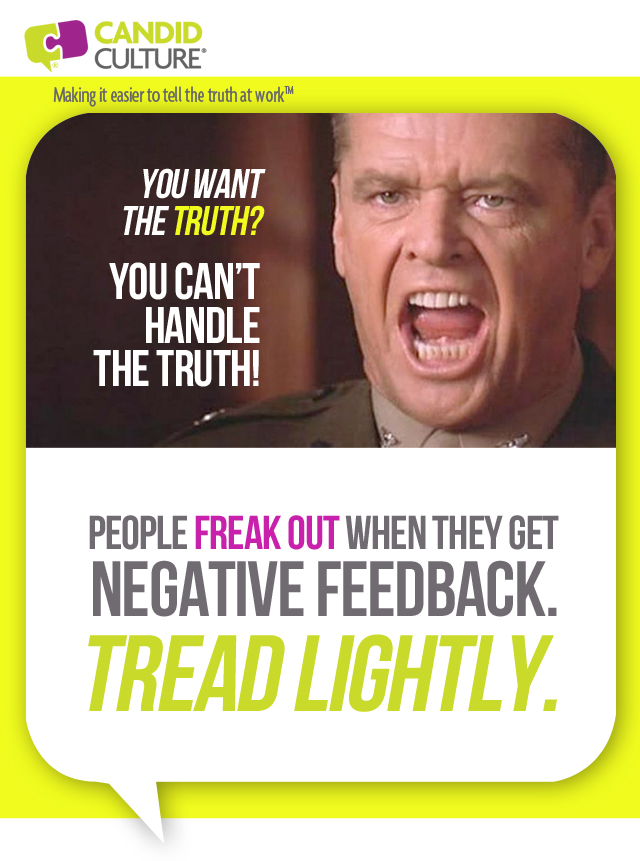
Last week I was talking with a friend who works for a large investment bank. He said, “I don’t believe in the premise of your book. There is no place for negative feedback in the workplace. It’s just not possible.” And I’m seeing firsthand how hard it is for people to receive negative feedback. All kinds of people – sensitive people and less sensitive people, Type A and laid back types. No one wants to hear she made a mistake, could have done something better, or any other type of negative feedback. It’s just too hard.
This is a massive conflict for me. At Candid Culture, we teach people how to give and receive feedback and yet, here I am wondering if it’s even possible.
We need to be able to tell people what they can do better. And the truth, is, while people may not want to hear negative feedback, most people do want to know what they can do to improve their performance and get ahead, hence the quandary. Give negative feedback and evoke others’ defensiveness or say nothing and put up with whatever isn’t working? I, of course, would prefer that you give the feedback, believing that it empowers people to make better personal and professional choices. The question is how?
Here are six steps to make giving negative feedback possible:
- Set the expectation at the onset of working relationships that you will give and receive balanced (positive and negative) feedback regularly. If you’ve worked with people for years and have not set this expectation, it’s not too late. Simply say, “I realized we don’t give each other a lot of feedback. In the spirit of continuous improvement, I’d like to implement a weekly debrief during which we talk about what’s working and not working. We’ll give each other feedback during the meetings.”
- Assess candidate’s openness to feedback when you interview, and don’t hire people who don’t accept negative feedback. We do practical interviews at Candid Culture. We give candidates a chance to do some of the work they’ll be doing on the job and tell candidates what they can do to improve, during the interview. Then we see how they accept our feedback. We also ask interview questions that help elucidate whether or not candidates are open to feedback and we ask candidates’ references how well the person accepts negative feedback.
- Observe performance regularly and provide balanced feedback from the start. Don’t wait until a problem occurs or until you have time to give feedback. Begin the practice of meeting weekly to review and discuss work, setting the precedent that this is the way you do business.
- Provide positive feedback regularly so people know the good stuff and aren’t solely focused on the negative feedback they receive.
- Ask for and be open to feedback. When you demonstrate being open to feedback, you earn the right to give feedback.
- Lastly, don’t underestimate how hard it is to hear negative feedback. When some people receive negative feedback, they begin to question themselves, their skills, and their value. So tread lightly. Pick your battles. Address only what you really need to and say things gingerly, remembering that you’re talking to a sensitive person, no matter how tough he may seem.
 When I was pregnant, I worried that I would gain sixty pounds and never take the weight off. Well, that’s not what happened. I gained 18 pounds (amazing) and most of it was gone when Grayson was a week old. Six months later, I’m fourteen pounds below my pre-pregnancy weight. I can’t explain it. It certainly isn’t a result of eating well or exercising, because I’m doing neither. But it has left me with a problem that’s impacting my professional image. None of my clothing fits. This is a good problem to have, but nonetheless, it’s a problem.
Last week I was at a networking event wearing a suit that was huge. When I put it on, I hoped no one would notice. And they might not have. For all I know, I was the only person who knew I was wearing ill-fitting clothing. But more important than what others saw, is how I felt in the suit. I felt unprofessional, unpolished and silly. Aka, I was uncomfortable. I didn’t trust my appearance and it had me doubt myself. So instead of networking, which was the purpose of the event, I went to an empty room and made phone calls.
We feel more confident and do better work when we feel good in what we’re wearing and know we look good.
Here are four things you can do to elevate your professional image:
Elevate your professional image tip #1: Take photos of yourself wearing your ‘go to’ outfits. Look at the photos and assess how you look in your favorite clothing. I’m often dismayed at how I ‘really look’ in my favorite pieces of clothing. Then start taking photos of how you look in pieces of clothing before you buy them.
Elevate your professional image tip #2: Ask a friend whose judgment you trust to weigh in on your clothing. Specifically ask, “What’s the first impression I make in this outfit? Where should I wear this? Where shouldn’t I wear it?”
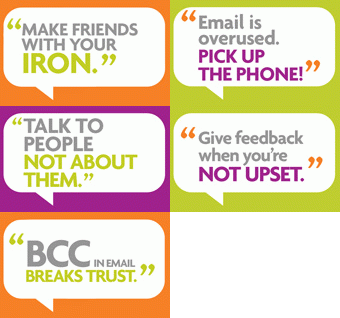
Elevate your professional image tip #3: Get a good haircut. You get what you pay for. Utilize the same practice as above. Ask a friend who always looks great to share the first impression your hair makes. Then make friends with your blow dryer. This might be the part of the blog when men check out. Stay with me. This applies to you too.
Elevate your professional image tip #4: Try on old items in your closet and get rid of everything that doesn’t pass the photo and friend evaluations. If you can’t bear to get rid of things you love, box them up so you won’t wear them.
You’ll present yourself more confidently when you have confidence in your appearance.
Note, these suggestions only apply when you’re in front of other people. If you work from home and don’t see anyone during the day but your dog and the occasional neighbor, bring on the spandex or the jammies. There is a school of thought that says you’ll do better work, even at home, if you’re professionally dressed. This isn’t true for me. I do better work when I’m comfortable. So now you know what I’m wearing when you call me. Aren’t you glad we don’t Skype!
You may not impress everyone you meet, hit every deadline, and consistently knock it out of the park. Bad days and breakdowns happen. But there are a few business etiquette practices you can consistently do to make you easy to work with and to present yourself in a professional and credible way.
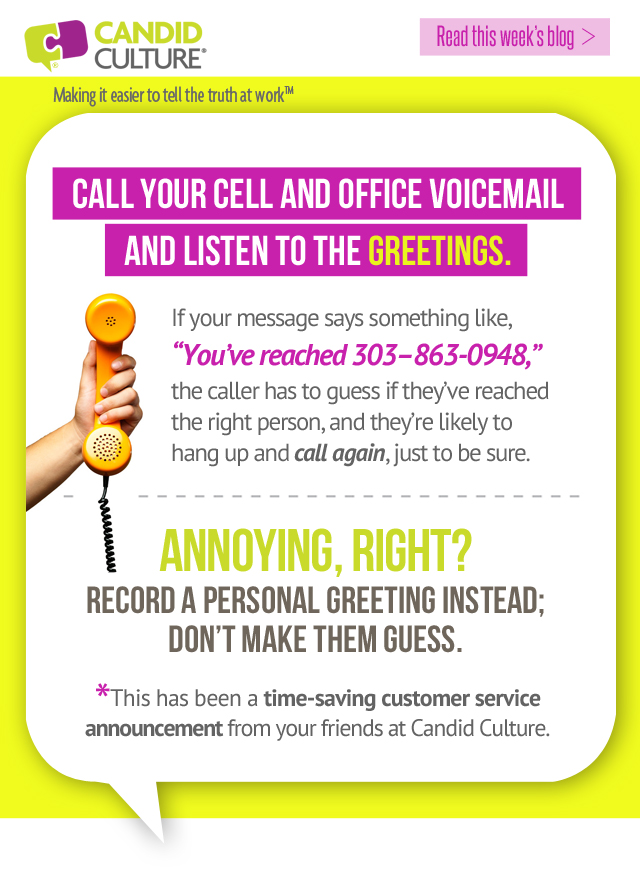
Business Etiquette tip #1: Listen to your cell and work voicemail greetings. Have you recorded a personal greeting that assures callers they’ve reached your phone? If the message says, “You’ve reached 303-863-0948, callers may wonder if they’ve called the right number and are likely to hang up and call back. And make sure the greeting doesn’t sound as if you recorded it while you were outside waiting for a bus, or standing in line at the grocery store, or under water. You get the point.
Business Etiquette tip #2: Make it easy to contact you. Include all of your contact information at the bottom of your outgoing and reply emails, in a clickable format (versus a non-clickable image). Don’t make people search for your contact information. Oh, and spell check your salutation. I’m amazed at how many spelling errors and typos I see in people’s contact information.
Business Etiquette tip #3: Turn off your out-of-office voicemail and email messages when you return from a trip. Telling people that you’ll be back on January 3rd, in March, makes you appear checked out.
Business Etiquette tip #4: Don’t wear perfume or cologne to work. It likely bothers someone but s/he won’t tell you about it.
Business Etiquette tip #5: Want to avoid people asking you, “Did you get my email?” or sending you yet another email? Reply to all emails, letting people know you received their message and letting them know when you’ll respond. That could read something like, “I received your message. I’ll reply with an answer by Friday.”
I could go on – eating smelly food in a cubicle, taking phone calls via a speaker phone from a cubicle, stealing other people’s lunches out of the refrigerator, taking up two parking spots, almost finishing the coffee, but not making more, borrowing someone’s chair and returning it at a different height, leaving conference rooms a mess, ending meetings late so a posse of people wait outside to use the conference room, flushing the toilet while participating in a remote conference call, but this is a good start. I’m looking forward to listening to your personal yet succinct voicemail greeting soon!
Leave a comment and tell us your easily fixed, work-related pet peeve!