Business Relationships Archive
As someone who writes and teaches about effective communication in the workplace, the people I work and socialize with are expecting me to model good communication skills all the time. The good news: I try really hard to always do the right thing and impact people positively. The bad news, I’m human and sometimes I don’t get it right.
One of the things I’m proud of about Candid Culture, is that we are real people, working with real people. We work very hard to prac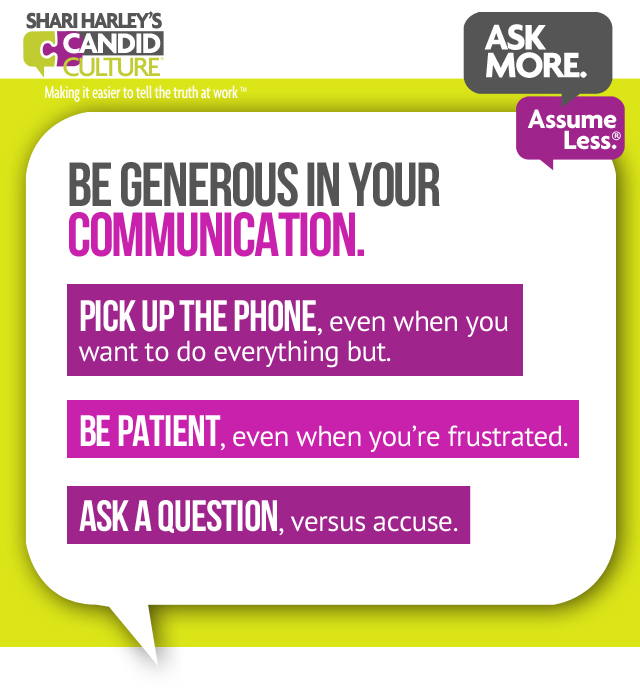 tice effective communication in the workplace and to always model what we’re teaching. And yet, like all people, we get busy, rushed, and tired. We read emails we intend to reply to, but then forget to do so. We occasionally send emails, when we should pick up the phone.
In my world, a good communicator is not someone who always communicates perfectly.
A good communicator who practices effective communication in the workplace is someone who:
- Cares about people and consistently works to communicate in the way others need.
- Asks for and is open to feedback about how s/he impacts people.
- Listens and watches other people’s verbal and non-verbal communication.
- Alters his/her communication style to meet other people’s needs.
- Takes responsibility when things don’t go well.
This week I’m advocating for picking up the phone, even when you want to do everything but, being patient, even when you’re frustrated, and asking questions, versus accusing. And I’m going to admit, I’m working to do these things too. Sometimes I get it right, and sometimes I don’t. I’m in the trenches with you, working to say and do the right things every day.
I promised you five tips to practice effective communication in the workplace and to be generous with people:
- Only call people when you have adequate time, attention, and patience to have whatever conversation needs to be had.
- If you need a few days to return a call, say so. Let the person know when you’ll call.
- Prepare for conversations. Plan what you’re going to say and how you’re going to say it.
- Don’t have hard conversations when you’re frustrated, tired, or busy. They won’t go well.
- If the conversation goes poorly, call back later and clean it up.
Being a good communicator doesn’t mean being perfect. It means caring enough to notice when you miss the mark, cleaning up your messes, and working to do it better next time. I’ll be working on the above recommendations too this week. And when I screw it up, you can be assured that my mistakes will become examples in our training programs of what not to do, followed by a new technique that will hopefully work for all of us.
Consider the things other people do that frustrate you. Now consider what you’re asking for.
You aren’t likely to get what you don’t ask for, but most people don’t ask for very much. We assume that the people in our lives will do the right thing without prompting. We’ll get the recognition and compensation we deserve at work because it’s the right thing to do. Our friends will remember our birthday because how couldn’t they know that’s important to us? And no one will come to our home empty handed for dinner because we would never do that.
If you read this blog regularly, you already know that I’m a proponent of setting clear expectations and asking more questions before problems occur. Consider what you want and need, anticipate what can go wrong, and plan accordingly before problems happen. Doing that sounds great in theory, but how does it work in practice?
 Here are five ways to increase your job satisfaction:
Increasing your job satisfaction tip one: Be honest with yourself about what you need to be happy at work. Rather than tell yourself you won’t get what you need or try to convince yourself that you shouldn’t need something, just admit your needs to yourself.
Increasing your job satisfaction tip two: Share your needs with people who can help you get those needs met. Don’t make people guess. Chances are they won’t guess at all or will guess wrong.
Increasing your job satisfaction tip three: Don’t assume things will go well and just wait and see what happens. Instead, set clear expectations at the beginning of new projects and working relationships.
Here’s how that could sound: “We’re going to be working together for the next six months. Let’s talk about how everyone likes to communicate, what people’s pet peeves are, and the kind of information each person wants to receive.”
Here’s another example of how that could sound: “I’m excited to work on this project with you. There are a few things to know about me that will help us work well together and deliver timely results. I ask a lot of questions. Let me know if this frustrates you. I’m not questioning you; I just have a need to understand why we do what we do. And I work best with a deadline. I am happy to be available off hours, but you probably won’t hear from me before 9 am. You will get messages and work from me at night and on the weekends. Just let me know if you’d prefer I schedule messages to go out during regular business hours.”
People might give you what you need if you ask, but they likely won’t if you don’t. Train others how to work with you.
Increasing your job satisfaction tip four: Agree to talk about things as they happen. Don’t wait until you’re about to explode to speak up.
That could sound like, “I want us to work well together, and things will go wrong. Can we agree that we’ll provide feedback as things happen so we can make timely adjustments?”
Increasing your job satisfaction tip five: Renegotiate when you need to. If you realize you need or want something that you didn’t ask for, go back and ask. It’s never too late.
Here’s how that could sound, “We touch base about once a month and I’m realizing that if we could talk for about 20 minutes once a week, I’d be able to get more done. Can we make that happen?”
Job satisfaction and happiness at work (and at home) don’t just happen. The people you live and work with are not you and they don’t know what you need. Make a regular practice of identifying what you need, making those needs known, and then speaking up when things go array. You won’t get what you don’t ask for. But you will get whatever you allow.

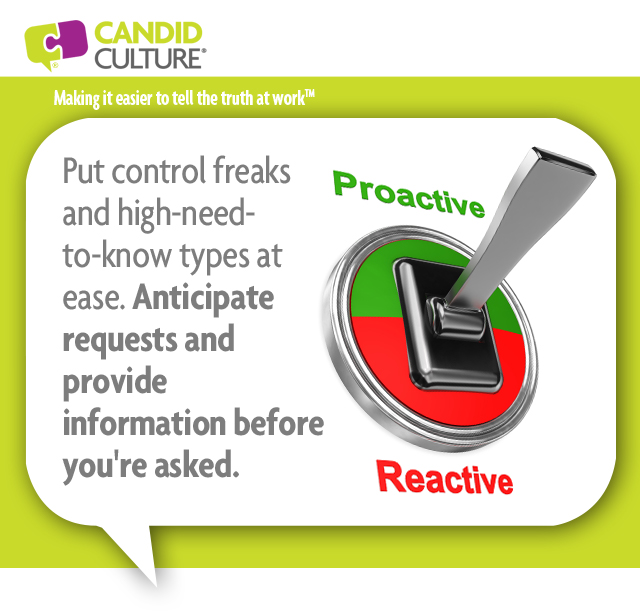
Frustrated by a control freak, micromanager, or a high-need-to-know type? Controlling behavior stems from a need that isn’t being met. Identify the need, meet it, and your life gets easier.
This is similar to what sales people learn during good sales training. The customer wants to buy the car but doesn’t. She visits the dealership three times, but just can’t pull the trigger. She has some sort of a concern. If the sales person can identify the concern, he can possibly resolve it, and sell the car. Working with control freaks is the same.
If someone wants more updates, information, or involvement than you’re comfortable with, he has a need that isn’t being met. When you meet the need, the person will likely back off.
I ask the people who work for me to never make me ask for something twice. Meaning, if I ask for an update the week before a speaking engagement, anticipate that I’ll want that information for all engagements. Confirm by asking me and then provide the data without being asked for all future engagements. Getting the information regularly without having to ask builds trust and credibility.
Here are six tips for working with control freaks:
- If you don’t know, ask:
- Their work-related goals.
- What the person is concerned about at work.
- How s/he likes to communicate – in-person, email, phone, voicemail, or text.
- How often s/he wants information, in what format, and with how much detail.
2. Provide more information than you think you need to, and then ensure the person wants that information in the future.
3. If you’re asked for information, ask why the person wants it, and if s/he wants it in the future. Then provide the information before you’re asked.
4. If someone is overly involved in your work and you feel you have no freedom, state your observation and ask for information. That could sound like, “You’ve been involved with each major decision with this project. I’m used to working with less oversight. Do you have a concern about my approach?” Then you negotiate. Everything is a negotiation.
5. This will put the other person on the defensive. A less confrontational approach is to discuss and agree upon levels of involvement and supervision when projects begin. That could sound something like, “What kind of involvement do you want to have in this project? What do you want to do? What do you want me to do? What kind of updates would you like, how often, and with how much detail?” It’s always easier to prevent a problem than to fix one.
6. Lastly, don’t take anything personally. Oversight and involvement may be a reflection of how someone feels about your performance, but it might not. When in doubt, ask.
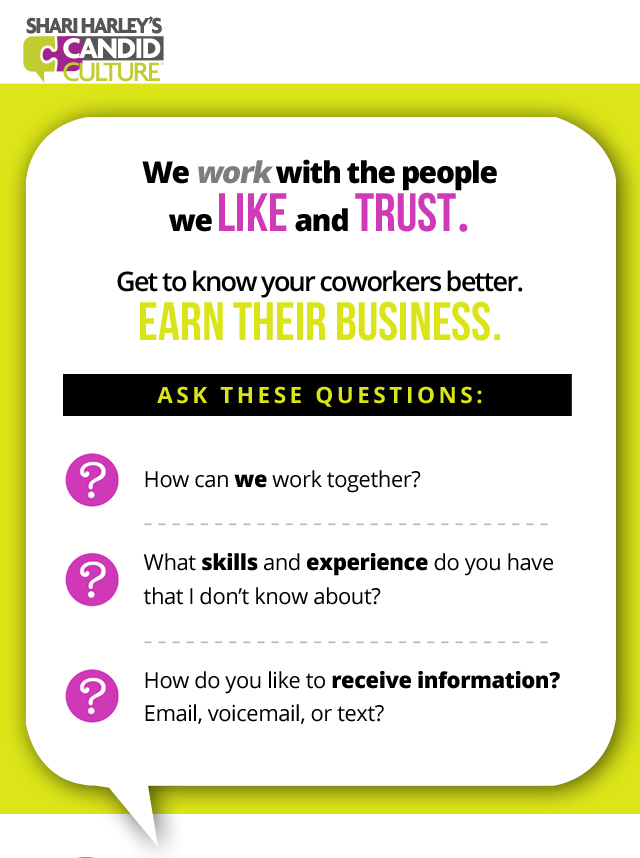
Regardless of who your company’s org chart says you should work with, people work with the people they want to work with and around those they don’t. One way to get people working with you (by choice) is to get to know your coworkers better, and I don’t mean personally.
Most people don’t know the people they work with very well. Coworkers often don’t know what fellow team members are tasked with doing for the company, their past work experience, education, or working style preferences. They often don’t know how fellow team members like to receive information, but get annoyed when they don’t return unopened emails.
If you’ve had any team building training with me, you know I advocate getting to know people better by asking more questions.
Organizations spend a lot of money on team building. Teams go bowling, out to happy hour, and have pot luck lunches, etc. All of those activities are fun and build comradery, and that’s important. But comradery and enjoying spending time together outside of work won’t help a team learn to communicate or overcome challenges.
If you’re really committed to team building and working well with people, ask more questions at the onset and throughout working relationships.
Here are five team building questions coworkers should be asking each other:
- What are your pet peeves? How would I frustrate you and not even know it?
- Are you a big picture or detail oriented person? Should I send you information in bullets or paragraphs?
- What are you best at doing? What type of work could you be doing that you’re not doing now?
- What are you working on now? What are your priorities for the next six months?
- What’s something I could do differently that would make your job easier? (You will survive the answer. I promise)
Your manager may coordinate an activity that gives your team the ability to ask questions like this, and s/he might not. Either way, ask the questions and be forthcoming if others ask you for this information. It’s not just your manager’s job to get your team working well together.
Your daily experience at work – how much you get done, how easily you get that work done, and how much fun you have along the way – is largely dependent on the people you work with. Don’t leave your working relationships to chance. Be assertive. Get to know people better. Ask more questions and offer information about yourself.
Most training programs about giving feedback focus on negative feedback, because giving negative feedback is hard and makes us uncomfortable. But most people aren’t any better at giving positive feedback.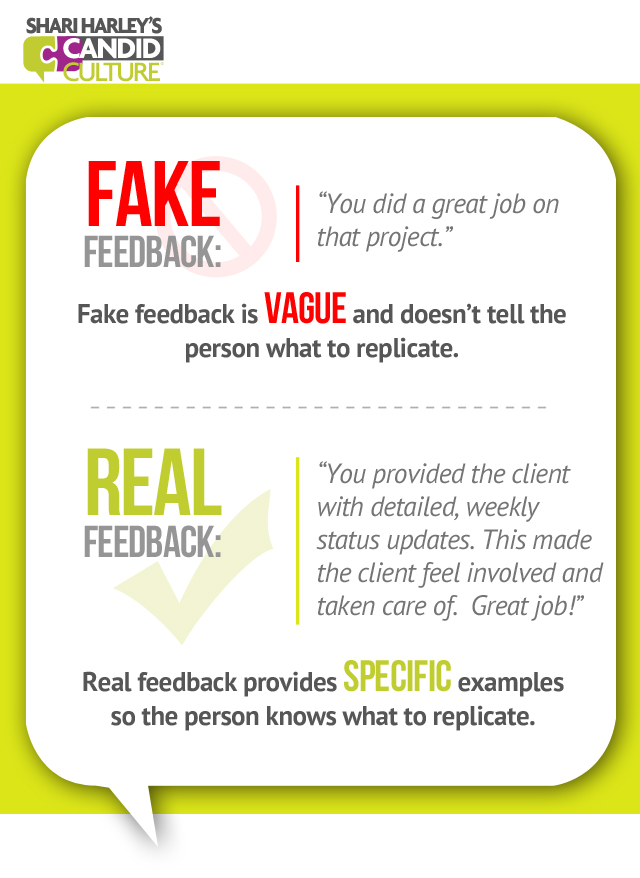
Most of the positive feedback people get at work really isn’t feedback at all. It’s vague, fluffy, and unhelpful. Aka, Cap’n Crunch – sweet but useless.
“Great job.” “You’re awesome.” “You’re great to work with.” None of this qualifies as real feedback.
The purpose of positive feedback is to make people feel valued and appreciated and to get them to replicate a behavior. Telling someone, “great job” or “you’re doing great work” will make the person feel good (momentarily), but won’t tell her what to replicate. These phrases are vague, and vague positive comments come across as inauthentic at best and unhelpful at worst.
Here are a few examples of what I refer to as real vs. fake feedback:
Examples of positive feedback:
Fake feedback: “Great job.”
Real feedback: “You researched three vendors when making a proposal of who we should choose to manage our payroll operations. You included all the necessary information for us to make a decision and presented the information in a one-page table that was easy to read. Your work made it really easy to make a decision. Great job!”
Examples of positive feedback:
Fake feedback: “You’re really reliable.”
Real feedback: “I know that whatever I give you to do will get done the first time I ask and will be accurate. I don’t have to ask again or check your work. You check your work for typos and mistakes before submitting it.”
Examples of positive feedback:
Fake feedback: “You make my job easy.”
Real feedback: “Last week you noticed an invoice that didn’t seem accurate. You researched the invoice and got the mistake corrected before I even knew there was a problem. You make my job easy.”
Examples of positive feedback:
Fake feedback: “You’re awesome.”
Real feedback: “You always do what’s right for the company. Last week you called a vendor whose service has been spotty. You provided them with feedback and asked for their plan to improve their service levels. This added a lot of value to our organization.”
The guidelines for giving positive feedback are the same as giving negative feedback:
- Be specific.
- Give an example.
- Give feedback close to the time an event happens.
To give specific and meaningful positive comments, you will have to observe performance, and that takes time. But if you want someone to replicate a behavior, tell the person specifically what she did well.
People are not us; they do things their way, not ours. This is so obvious. Yet violated expectations are consistently a source of lots of frustration and upset, both personally and professionally. “How could you not check your work before submitting information to a client?” “What do you mean you didn’t call that person back?” “You said what?!”
The most frequent request we get at Candid Culture is for feedback training. The call usually goes something like this, “The  communication isn’t great at our company. Managers don’t give a lot of feedback. People don’t talk directly to each other when there are problems, they talk about each other. Can you help?”
Sure, we can help. But once we’re having this conversation people are already frustrated. Trust has been violated and relationships and reputations have been damaged. Instead of waiting for problems to occur, expect the unexpected. Set clear expectations before people don’t proofread reports, miss deadlines, and do other things you wouldn’t dream of doing.
How to avoid violated (often unstated) expectations? Ask more questions.
Here are five questions you should ask every person you work with to set expectations. And if you do, your workplace will have fewer frustrations and violated expectations:
- What’s most important that you’re working on right now? What are your goals this quarter?
- What are we both working on that we can work on together? Or what should one of us stop working on?
- How do you like to communicate? Phone, in-person, by appointment or drop by’s.
- How do you like to receive information – email, voicemail, text message or instant messenger?
- If I need information from you and I haven’t heard back from you, what should I do, and is it ok to do that?
- What are your pet peeves at work? How will I annoy you and not even know it?
- How do you like to be interrupted? (You’re going to be interrupted. You might as well have a preference.)
I know. That was seven questions, not five. I could keep going. But this is a good start.
Here’s the philosophy and practice: People aren’t you. Anticipate challenges, breakdowns, and violated expectations, and talk about them before they happen. Make requests. Ask questions.
It’s always easier to ask for what you want than to give feedback.
Most of us aren’t eager to admit when we don’t know something, need help, or make a mistake. We fear these things will damage our reputation and make us appear less than to others. But neither are true. It takes strength and self confidence to admit mistakes, accept feedback, and ask for help. Strong, self confident people do all of these things.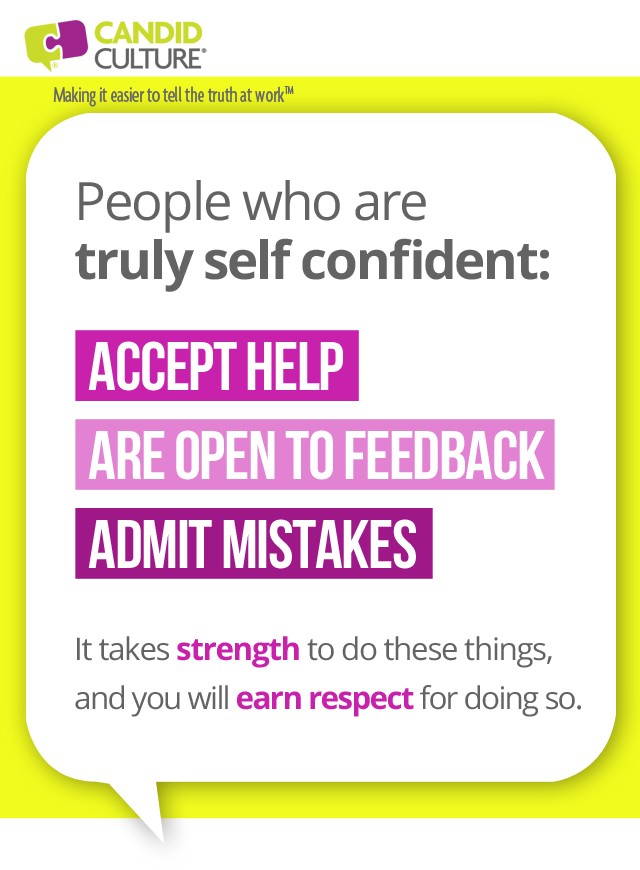
When someone who works for me is willing to admit mistakes, I think more of them. When employees ask for help rather than spin their wheels unnecessarily, I’m appreciative. When they’re open to feedback, I’m grateful they’re easy to work with. And the same is likely true for you.
Arrogance masquerades as self confidence. People who are arrogant come off as strong and self confident, but it’s a façade.
It may seem like your personal power and reputation will be diminished by admitting mistakes and accepting help. But this couldn’t be further from the truth. It takes strength to say we don’t know how to do something, to embrace feedback that stings, and to admit bad choices. And strong, self confident people do all of these things, regularly.
You won’t lose credibility or damage your reputation by being humble, instead you’ll be seen as real, relatable and willing to admit a lack of perfection. And all of those things take strength that ingratiate you to others. So be yourself. Don’t pretend you’re better or more knowledgeable than you are. Authenticity goes a long way.

I recently interviewed a candidate who asked for a lot of ‘stuff’ during the interview process. He wanted compensation, perks, accommodations, and benefits that were way outside the norm. I’m assuming he was employing the adage we’ve all heard, that “it can’t hurt to ask.” Unfortunately, it can hurt to ask.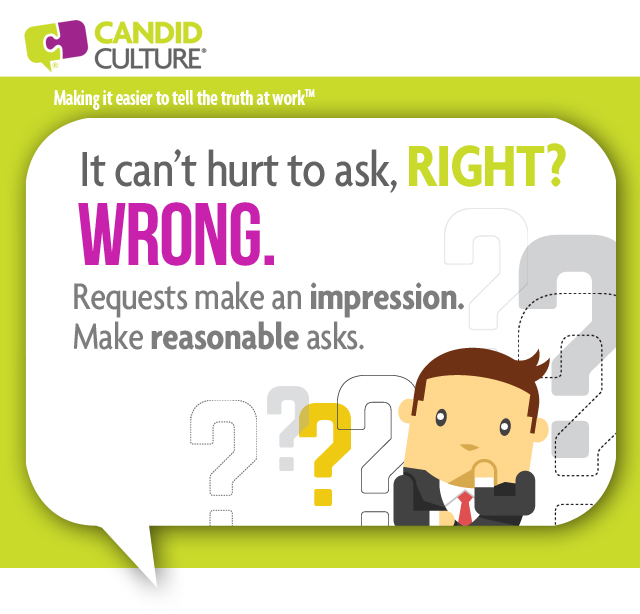
When forging new relationships, we watch (judge) people. We’re trying to figure out who they are and how they are. Are they the person they claimed to be during the interview process? Are they trustworthy? Did I make the right decision in bringing this person into my team, organization, and life?
Requests always make an impression. When we’re building new relationships, requests make an even bigger impression. Candidates who said the commute wouldn’t be an issue, but complain about it two weeks into the job, cause managers to doubt their hiring decision. Coworkers who consistently ask for extensions to deadlines, appear unreliable.
People watch us and silently judge, making assessments about our commitment, reliability and even character. Don’t make people question you. Make reasonable asks.
Five ways to make reasonable requests:
- Vet your requests with people who know your company, manager, and/or industry, before making them. What is a reasonable request in one organization, might not be in another.
- If something is important to you, ask for it during the interview process or at the onset of new projects and relationships. Don’t wait. Waiting to ask for things, until after you’ve started a job and are comfortable with your manager, can damage your relationships and reputation. Managers don’t like bait and switch, even when it’s unintended.
- Don’t ask again, once you’ve received an emphatic “no.” I worked with someone who asked for something during the interview process. I said “no” and explained why. He asked again after being hired. This annoyed me and made me feel like he didn’t listen and would push me on this and on other things.
- If you aren’t sure that what you’re asking for is reasonable, say so. Tell the person you’re asking what you want and to please tell you if it isn’t a reasonable request.
- Ask for feedback on your requests. If you’ve seen me speak, you know I’m a proponent of telling people, “If I do anything that damages our working relationship or makes you question me, I hope you’ll tell me. I promise I’ll take your feedback graciously, and say “thank you.””
Ask for what you want, within reason, be up front when relationships begin, and build your relationships rather than break them.
It can’t hurt to ask, right? Wrong. Requests make an impression. Make reasonable asks. Repair a relationship, when you’ve asked for too much.
When I was pregnant, I worried that I would gain sixty pounds and never take the weight off. Well, that’s not what happened. I gained 18 pounds (amazing) and most of it was gone when Grayson was a week old. Six months later, I was fourteen pounds below my pre-pregnancy weight. I couldn’t explain it. It certainly isn’t a result of eating well or exercising, because I did neither. But it lef t me with a problem that impacted my professional image. None of my clothing fit. This was a good problem to have, but nonetheless, it was a problem.
Until I made some changes to my wardrobe, I went to events in my ‘old clothes’ and hoped no one would notice. And they might not have. For all I know, I was the only person who knew I was wearing ill-fitting clothing. But more important than what others saw, is how I felt. I felt unprofessional, unpolished and silly. Aka, I was uncomfortable. I didn’t trust my appearance and it had me doubt myself.
We feel more confident and do better work when we feel good in what we’re wearing and know we look good.
Here are four things you can do to elevate your professional image:
Elevate your professional image tip #1: Take photos of yourself wearing your ‘go to’ outfits. Look at the photos and assess how you look in your favorite clothing. I’m often dismayed at how I ‘really look’ in my favorite pieces of clothing. Then start taking photos of how you look in pieces of clothing before you buy them.
Elevate your professional image tip #2: Ask a friend whose judgment you trust to weigh in on your clothing. Specifically ask, “What’s the first impression I make in this outfit? Where should I wear this? Where shouldn’t I wear it?”
Elevate your professional image tip #3: Get a good haircut. You get what you pay for. Utilize the same practice as above. Ask a friend who always looks great to share the first impression your hair makes. Then make friends with your blow dryer. This might be the part of the blog when men check out. Stay with me. This applies to you too.
Elevate your professional image tip #4: Try on old items in your closet and get rid of everything that doesn’t pass the photo and friend evaluations. If you can’t bear to get rid of things you love, box them up so you won’t wear them. I admit, this is a painful process.
You’ll present yourself more confidently when you have confidence in your appearance.
Note, these suggestions only apply when you’re in front of other people. If you work from home and don’t see anyone during the day but your dog and the occasional neighbor, bring on the spandex or the jammies. There is a school of thought that says you’ll do better work, even at home, if you’re professionally dressed. This isn’t true for me. I do better work when I’m comfortable. So now you know what I’m wearing when you call me. Aren’t you glad we don’t Skype!
One of the hardest things I’ve ever done is hire someone to care for my almost two year old son. “Here is the person most important to me in the world. Keep him alive.” I had no idea how difficult it would be to trust a relative stranger so implicitly. And as a result, let’s just say I’ve not been the easiest for a nanny to work with.
I’m embarrassed to admit that I wrote sixteen-pages of instructions of how to take care of my kid. And I gave that ‘booklet’ to a nanny with much more childcare experience than I have. When I work from home and hear my son crying, I tell myself not to walk into the room and check on him, knowing it undermines the nanny, but I do it anyway. When the nanny sends me an update of when my son last ate, I reply telling her when he should eat again, even though I know she knows. Yes, I’ve really been doing these things.
Each time I over instruct, monitor, and advise, I regret it. I know micromanaging the nanny makes me difficult to work with, which is not how I want to be. It reminds me of a comment an old boss said to me after we interviewed a candidate for a job together. He said, “Shari, your job as the interviewer is to make the candidate feel comfortable and ensure she leaves feeling good, regardless of how well or poorly she interviewed.” My face must have said anything but, “I want you to feel comfortable and you’re doing a great job.” His words stuck with me and I’m reminded of them each time I over manage our nanny.
Many people attend training on how to manage others; I’d suggest we also look at how we manage ourselves. How does working with you make people feel? Do your questions, requests, and interactions make people feel more self-confident and valued or do people feel questioned and undermined? Do you pick your battles? Do you give just enough direction but not so much as to squelch the other person’s ideas, initiative and spirit, especially when the stakes are high?
As you know, I’m evaluating how I do these things too. We are always a work in progress.
Here are four ways to build confidence in the people you work with:
Build Confidence 1: Ask people for their ideas and implement those ideas whenever possible. And if you aren’t open to others’ ideas, don’t ask for them. It’s better not to ask for ideas than to ask when you’re really not interested.
Build Confidence 2: Ask for and be open to others’ feedback. People will be more receptive to your feedback when you’re receptive to theirs.
Build Confidence 3: Say “thank you” regularly and mean it. Give specific examples about what you’re thankful for.
Build Confidence 4: Admit when you’re wrong. Strong people admit mistakes, weak people don’t.
People can work with you, around you, and against you. Earn loyalty and respect by respecting others’ talents and knowing when to take a step back.