Years ago, a guy I was dating asked, “We don’t really need to do anything for Valentine’s Day, do we?” I was taken aback by his question (which was really a statement) and replied, “No, we don’t.” But I didn’t mean it. And when he blew off the ‘holiday’, I was furious and let him know it. Instead of having dinner on Valentine’s Day, we had an ugly conversation and a lousy rest of the week. Asking for what I wanted upfront would have been much less painful.
Why is it so hard to ask for what we want, especially from the people who love us? Learn how to get what you want on Valentine’s Day and every day.
We aren’t likely to get what we don’t ask for. The people in our lives can’t read our minds. They don’t know what we want. This is true at home and at work. If you want a report to look a certain way, sketch it out for your employees. If you want a meeting handled in a certain fashion, give detailed instructions. For the most part, we expect things to go well and thus we delegate insufficiently at work and hope to be pleasantly surprised at home.
I hope the people who love you are intuitive enough to give your heart what it wants on Valentine’s Day, and every day. But if they don’t, make it easy for them to please you by telling them what you want. For example, tell the person you love, “I’d love to spend the day together. I don’t care what we do, as long as we’re together.” Or, “I don’t care what you do for Valentine’s Day, but please do something to mark the day.” And if you want something specific, ask for it. “I’d love flowers, despite that they’ll die and are impractical. Anything but roses and carnations would be lovely.”
There is one job interview question recruiters and hiring managers must ask. And the answer should be a deal-breaker.
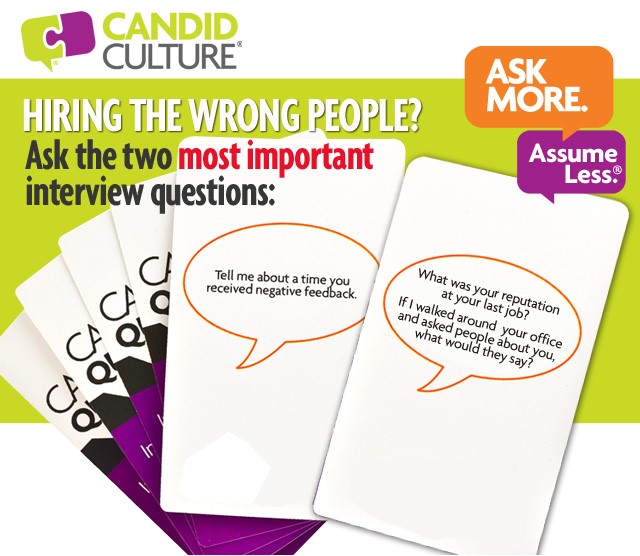
The most important job interview question for any role in every organization: Tell me about a time you received negative feedback.
This is NOT the same question as tell me about a weakness. Or tell me about a time you made a mistake at work. Those are also important job interview questions to ask. But they’re not the most important question.
Let’s assume everyone you interview is age sixteen and older. Unless your candidates live in a cave, never speaking to anyone, it’s not possible to arrive at age 16 without having received negative feedback. The feedback can come from a friend, teacher, or parent. It doesn’t need to be work-related.
The point of the question is to discover whether the candidate is open to feedback. People who are not open to feedback are extraordinarily difficult to work with. They aren’t coachable. Any type of feedback they receive will result in resistance and defensiveness.
Employees who aren’t open to feedback won’t change or improve their behavior, regardless of how effective a manager is. Instead of listening to feedback and taking corrective action, employees who are not open to feedback will tell managers why they are wrong.
Everyone you interview has received negative feedback at some point. The question is whether or not candidates were receptive to the feedback. People who aren’t open to feedback won’t be able to answer your question.
If candidates can’t tell you about a time they received negative feedback, ask a follow-up question. Your job as the interviewer is to give candidates every possible opportunity to be successful. If you don’t get the answer you’re looking for, ask the interview question in two different ways, until you’re certain the candidate can’t or won’t answer the question.
If candidates can’t tell you about a time they received negative feedback, ask what their reputation is at their current job or was at a previous job. Candidates probably won’t be able to answer this question either. Most people don’t know their reputation at work.
Even if a candidate doesn’t know with certainty their reputation at work, the answer they provide will give you a sense of how self-aware they are. People who are self-aware are more open to feedback and are easier to coach and manage than people who are not self-aware.
I eliminate candidates who demonstrate they aren’t open to feedback, whether I’m hiring for Candid Culture or for one of my clients. I don’t care how credentialed or experienced the candidate is. If candidates aren’t receptive to feedback, they don’t get a job offer.
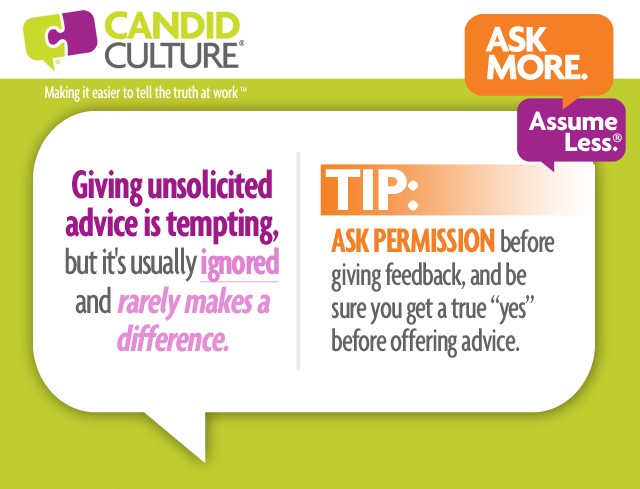
It’s hard to watch people do things that impact them negatively – personally or professionally. And yet, if they haven’t asked for feedback, people likely won’t listen to unsolicited advice, so don’t bother giving it.
If you really want to give unsolicited advice, ask for permission and make sure you get a true “yes” before speaking up.
The conversation could go something like this:
“I noticed we’re getting behind on the XYZ project. I have a couple of ideas about what we can do. Would you be interested in talking about them?” Or “That Monday meeting is rough. I feel for you. I used to run meetings like that. Would you be interested in talking about some meeting management strategies? I’d be happy to share what I’ve learned.”
After you offer to talk (aka, give your opinion), listen and watch the response you get. Do the person’s words and body language portray a true “yes, I’d like your opinion” or what seems like an “I know I’m supposed to say yes, but I’m really not interested” reply? If you get the latter, you’re likely just giving unwanted advice that won’t be heard. If that’s the case, let it go. But if the person appears generally interested and open, proceed.
You could also say something like:
“Last week we were talking about your frustrations about not being promoted. I have a couple of ideas about that. Do you want to talk about them? Either way is fine, but I thought I’d offer.”
Or “That was a tough conversation during today’s staff meeting. It’s hard to present ideas and not have them be embraced. I have a couple of thoughts about ways you can approach the conversation during the next meeting. Do you want to talk about them?”
If you extend the invitation to talk, the other person has to be able to say no. An invitation is only an invitation if “no” is an acceptable answer. You can’t ask if the person wants your input and then keep talking if they verbally or physically said no.
Be brave. If you care about someone personally or professionally and you see them doing something that gets in the way of their success, ask permission to say something. If you get the go ahead, proceed. If you get a “no thank you,” accept that and move on. You’ve done your part.
Many year-end performance reviews include whatever the manager and direct report can remember happening during the last six weeks of the year. For the most part, managers and direct reports sit in front of blank performance appraisals and self-appraisal forms and try to remember everything that happened during the year. The result: A vague, incomplete performance review that leaves employees feeling disappointed, if not discounted.
If you were disappointed by your performance review last year, don’t let it happen again this year. Take charge of your career by writing your own goals.
One of the first companies I worked for did the goal process so well, I learned early in my career how powerful well-written goals could be. Each employee set five to seven goals. Experienced employees wrote their own goals and then discussed those goals with their manager. Less experienced employees wrote their goals with their manager. Managers wrote goals for inexperienced employees. The goals were so specific and clear that there could be no debate at the end of the year whether or not the goal had been achieved. It was obvious. Either employees had done what they said they would, or they hadn’t. This made writing performance appraisals very easy. Very little on the appraisal was subjective. And this gave employees a feeling of control over their year and performance.
It’s great if you work for an organization or manager who works with you to write goals. If you don’t, write your own goals and present them to your manager for discussion and approval. Managers will be impressed you took the initiative to write goals and will be thankful for the work it takes off of them.
Goals should be simple and clear. It must be obvious whether you achieved the goal or not. There should be little if any room for debate. Sample goals are below.
Desired Outcome (goal):
• Improve client feedback – too vague • Get better-written reviews from clients – better • 80% of clients respond to surveys and respond with an average rating of 4.5 or above – best
Actions you will take to achieve the goal:
• Ask clients for feedback throughout project — too vague • Ask clients for feedback weekly – better • Visit client site weekly. Talk with site manager. Ask for feedback — best
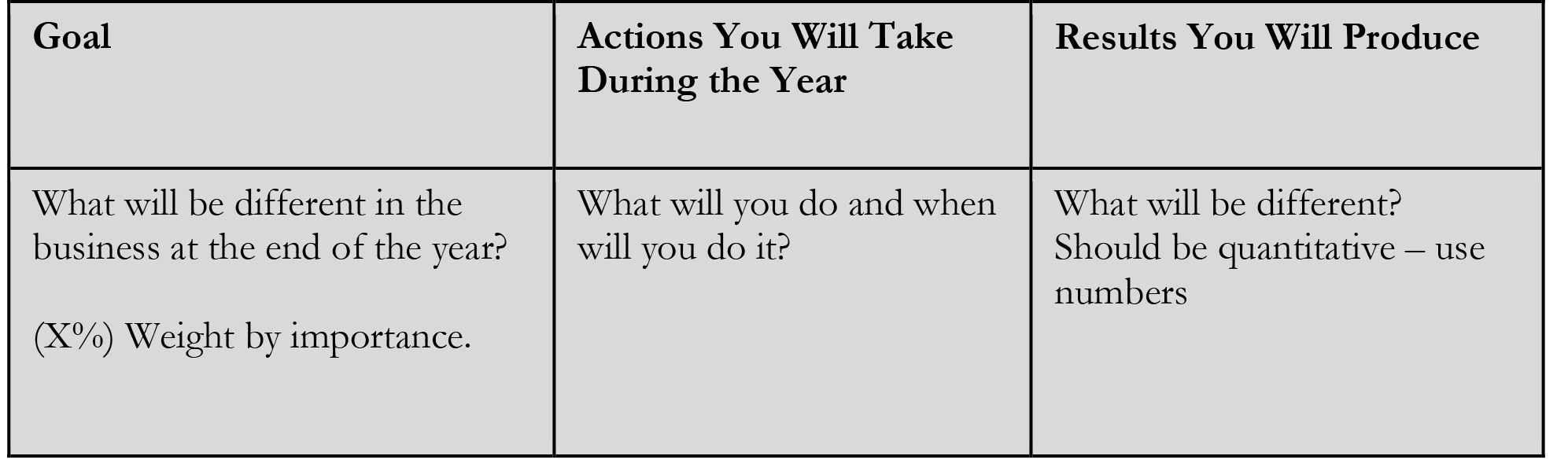
Goal template:
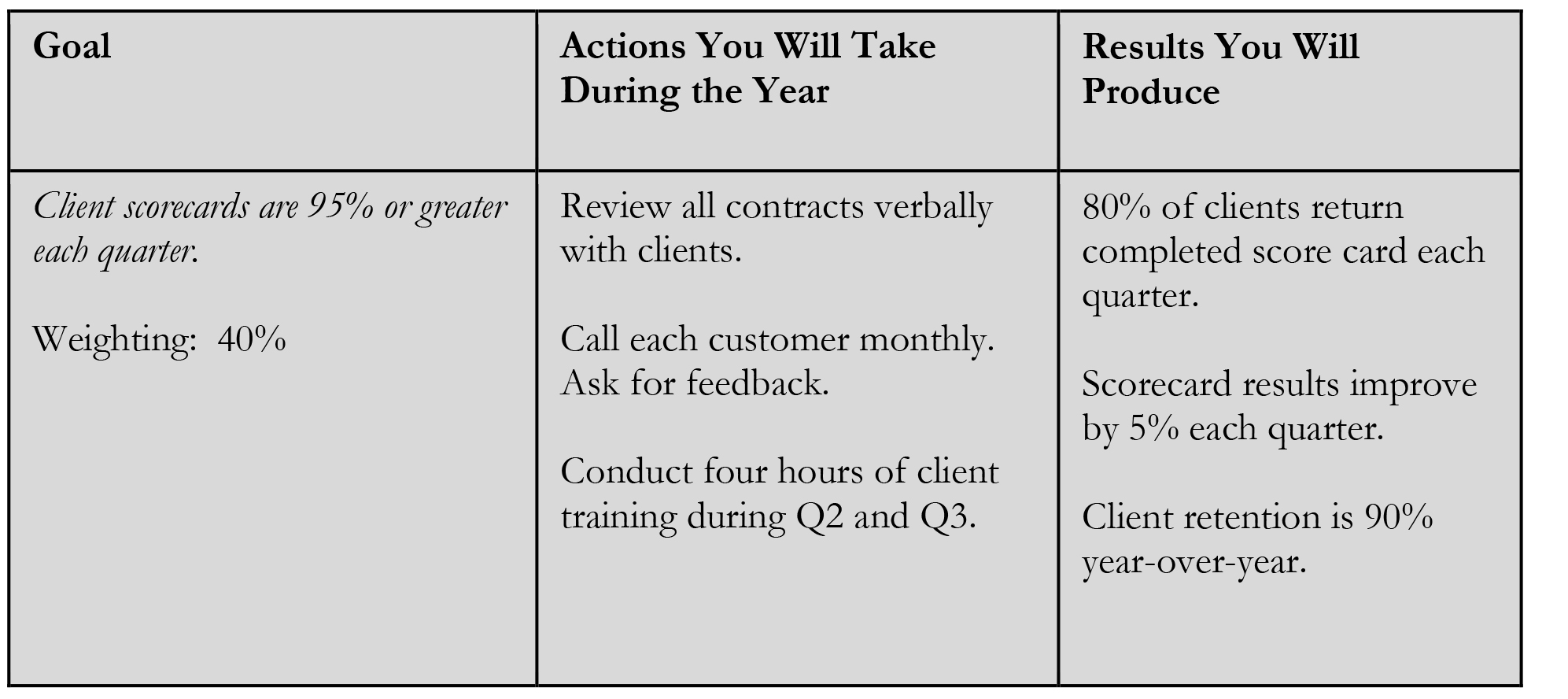
Completed sample goal:
How to approach your manager with written goals:
Try using this language with your manager: “I want to be sure I’m working on the things that are most important to you and the organization. I’ve written some goals for 2024 to ensure I’m focused on the right things. Can we review the goals and I’ll edit them based on your input? And what do you think of using the agreed-upon goals to measure my performance in 2024?”
You have nothing to lose by writing goals and presenting them to your manager. You will gain respect from your manager, clarity of your 2024 priorities, and more control of your year-end-performance review. Give it a try and let me know how it goes.
The inspiration for this week’s blog came from the most unlikely source, time with my son. I want each of his days to be exciting and fun. On the days we do nothing but hang out and play at home, I feel like I’ve failed just a little bit. It’s a lot of pressure. Not unlike work and creating an office culture.
I want each of my employees to be happy and to enjoy their jobs and enjoy working for me, every day. That can’t and won’t happen. Some days are hard. Some are dull. Sometimes I’m fun and easy to work for. Lots of days I’m not.
I had a manager years ago who told me that my need to be liked by my employees would take me down. He was right. Unfortunately, I’m not the only manager with this challenge.
Lots of managers tell me they’re hesitant to give feedback because they’re afraid employees will quit. Other managers do work they know they shouldn’t be doing, because they don’t want to burden their employees.
Not every day will be great. And that’s ok. Work is a roller coaster. Some days are awesome. Others are the pits. Your job isn’t to make people happy at every moment, it’s to create a supportive environment and ensure people have the tools to be successful.
My son has a clean and safe home full of fun toys. I’ve created a positive environment for him. My employees have all the tools they need to be successful. I work hard to set clear expectations and give timely positive and upgrade feedback. The rest is up to them. Some days I’m sure they’re happy. Most days, hopefully. And then I’m sure there are days that a job elsewhere sounds appealing.
Here are five actions to create a positive culture at work:
Office culture tip #1: Set clear expectations at the beginning of every new project and task. The root of frustration and unhappiness is thwarted expectations.
Office culture tip #2: Ask for and be open to feedback from your employees and coworkers. Ask for feedback regularly and work to respond with, “Thank you for telling me that.”
Office culture tip #3: Respond to feedback by changing what it makes sense to change. Giving feedback that is never acted upon creates cynicism and distrust.
Office culture tip #4: Provide rationale for your decisions. It’s fine to do things the way you want to do them, even if others disagree. Explain your rationale. You’ll get more buy in.
Office culture tip #5: Don’t be afraid to make decisions that are unpopular. There is a reason that you want to do what you want to do, the way you want to do it. Vet your plans, when appropriate. Be open to others’ input. And then do what you think is right (within the scope of your role).
Your job isn’t to please everyone and trying to do so will likely produce lesser results and be exhausting.
If you want to freak out the people you work with, tell them, “We need to talk.” If you really want to freak them out, say those four magical words on a Friday, or even better, the day before someone goes on vacation. “We need to talk” is rarely followed by, “and you’re awesome.” People know bad news is likely coming, and they’ll inevitably be on edge.
The antidote to asking for time to talk is to create opportunities to give feedback regularly.
There are many reasons giving feedback is hard. One of them is we wait too long. Something happens. We know we should address it, but we don’t want to. So, we wait to see if the behavior is really ‘a thing.’ Then it happens again. And now we know it’s ‘a thing.’ But we still don’t want to address it. Then the situation gets really bad, and now we have to say something. The conversation then takes 90 minutes, is painful, and everyone goes home unhappy.
Here are two keys to make giving feedback easier:
Giving feedback strategy one: Debrief everything. Do a quick plus/delta a regular basis to assess how things are going. Plus – what went well? Delta – what would we change if we could/what did we learn?
I recommend doing a quick debrief at the end of important meetings, hiring processes, projects, and when anything changes. Conduct a short debrief when you have staffing changes, gain or lose a client, launch or eliminate a product or service, etc. Change is an opportunity to evaluate how you work and to make adjustments.
When you debrief important events, you tell people that feedback is important and that it’s ok to be candid. Conducting regular debriefs also gives employees a chance to practice giving feedback, which is a hard skill. And like anything, the more we give feedback, the easier it becomes.
Conducting short, regular debriefs is one of the easiest ways to learn from the past and become a more candid culture.
Giving feedback strategy two: Schedule five to fifteen minutes each week to talk as a team and with direct reports. When you know you have time each week to talk with your manager, direct reports, and team members, you never have to ask for time to talk. Issues don’t build up or linger. Breakdowns and frustrations are discussed within of few days of their occurrence, and no one is worried that bad news is coming at their end of their vacation.
The key to being effective at giving feedback is to give feedback regularly. Short, frequent feedback conversations are much more effective than infrequent, long conversations that everyone dreads and leaves feeling exhausted and demoralized.
Debrief everything meaningful. Meet with people weekly. Ask for and give feedback as things happen, and watch your culture change.
Posted under Career Management on January 2, 2024 by Shari Harley. 0 Comments
People often hoard feedback until a situation becomes so frustrating that they can’t help but speak up. And because they waited too long to say what they think, many more words come tumbling out than is either necessary or helpful.
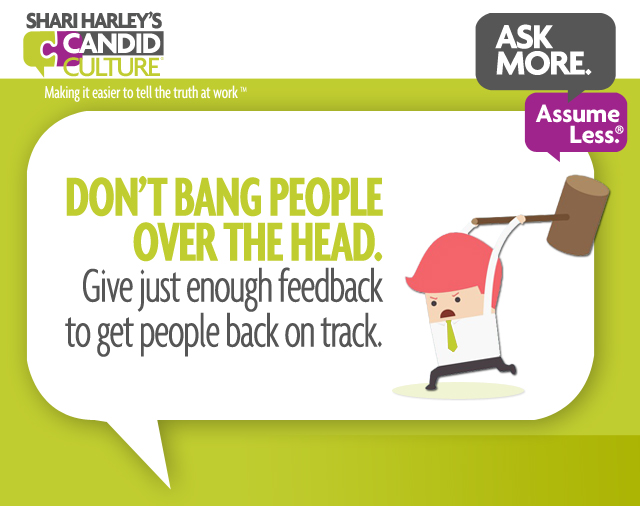
When it comes to giving feedback, less is more. Be specific, give an example or two, and stop talking.
If you want people to be receptive to your feedback, make it easier to hear by saying less. By saying less, I don’t mean don’t tell the truth or provide enough information that the person knows precisely what to do differently. I do mean, don’t provide more information than is necessary.
You are likely familiar with the phrase “let someone save face.” Allowing someone to save face requires saying just enough that the person knows what to do differently, but not so much that the person feels attacked.
Too much feedback: Last week you turned in a report that had five typos and had important pieces of information missing. I’m surprised you’d be so careless. It made our entire department look bad. I’m perplexed that you’d submit work without checking it first. What is leading you not to check your work and submit incomplete reports?
Don’t repeat feedback. Say it once and move on. And remove unnecessary judgments (careless) and share just the facts.
Just the right amount of feedback: The report you gave me last week had a few typos and was missing some important information. The report went to the client with those errors which didn’t reflect well on our department. What happened?
Too much feedback: I noticed you didn’t speak up during last week’s department meeting. People won’t know the value you provide if you don’t share what you’re working on. You need to be more vocal. People’s only exposure to you is often during our team meetings. If you don’t speak up, you won’t establish yourself as a leader in your department. People really need to know what you’re working on and the impact you’re making.
Redundant feedback feels critical and leaves the person feeling like they have been hit over the head with a mallet.
Just the right amount of feedback: I noticed you didn’t speak during last week’s department meeting. Often, team members’ only exposure to you is during our weekly meetings. How can I help you feel comfortable speaking up so you can establish yourself as a leader in the department?
It’s easy to get carried away when giving feedback. We’re likely frustrated. And when our emotions run the show, it’s easy to say too much.
Here are three practices for giving feedback:
Practice the 24-hour guideline and the one-week-rule. If you’re upset, wait 24-hours to give feedback, but not longer than a week after an event.
Plan what you’re going to say both in writing and out loud. Practicing a conversation in your head is not the same as speaking it.
Let someone you trust hear what you’re planning to say and ask that person how you can improve the feedback. Ask what you can remove without losing any of the message.
Planning a conversation is like packing for a trip. When packing for a trip, many people put their clothes on the bed, then put the clothing in a suitcase. Realizing they have way more than they need, they start taking things out of the suitcase. Eventually they arrive at their destination with much less than they initially packed, but still more than they need.
Use the same principles when planning a feedback conversation. Put every thought you have on paper, and then remove what you don’t need, leaving only the necessary points that tell the person just what they need to do differently.
When giving feedback, less is more. Tell the person what happened, why it’s a problem, and what they need to do differently. Then stop talking and let the person save face.
Posted under Career Management on December 25, 2023 by Shari Harley. 0 Comments
So much has changed in the last few years. And what you need to be happy at work may have changed too. The question is, do the people you work for and with know what you need?
You aren’t likely to get what you don’t ask for, but most people don’t ask for very much. We assume that the people we work with will do the right thing without prompting. We’ll get the recognition and compensation we deserve at work because it’s the right thing to do. We’ll be included in important meetings and decisions regardless of from where we are working.
If you read this blog regularly, you already know that I’m a proponent of setting clear expectations and asking more questions before problems occur. Consider what you want and need, anticipate what can go wrong, and plan accordingly before problems happen. Doing that sounds great in theory, but how does it work in practice?
Here are five ways to increase your job satisfaction:
Increasing your job satisfaction tip one: Be honest with yourself about what you need to be happy at work. Rather than tell yourself you won’t get what you need or try to convince yourself that you shouldn’t need something, just admit your needs to yourself.
Increasing your job satisfaction tip two: Share your needs with people who can help you get those needs met. Don’t make people guess. Chances are they won’t guess at all or will guess wrong.
Increasing your job satisfaction tip three: Don’t assume things will go well and just wait and see what happens. Instead, set clear expectations at the beginning of new projects and working relationships.
Here’s how that could sound: “We’re going to be working together for the next six months. Let’s talk about how everyone likes to communicate, what people’s pet peeves are, and the kind of information each person wants to receive.”
Here’s another example of how that could sound: “I’m excited to work on this project with you. There are a few things to know about me that will help us work well together and deliver timely results. I ask a lot of questions. Let me know if this frustrates you. I’m not questioning you; I just have a need to understand why we do what we do. And I work best with a deadline. I am happy to be available off hours, but you probably won’t hear from me before 9 am. You will get messages and work from me at night and on the weekends. Just let me know if you’d prefer I schedule messages to go out during regular business hours.”
People might give you what you need if you ask, but they likely won’t if you don’t. Train others how to work with you.
Increasing your job satisfaction tip four: Agree to talk about things as they happen. Don’t wait until you’re about to explode to speak up.
That could sound like, “I want us to work well together, and things will go wrong. Can we agree that we’ll provide feedback as things happen so we can make timely adjustments?”
Increasing your job satisfaction tip five: Renegotiate when you need to. If you realize you need or want something that you didn’t ask for, go back and ask. It’s never too late.
Here’s how that could sound, “We touch base about once a month and I’m realizing that if we could talk for about 20 minutes once a week, I’d be able to get more done. Can we make that happen?”
Job satisfaction and happiness don’t just happen. The people you work with are not you and they don’t know what you need. Make a regular practice of identifying what you need, making those needs known, and then speaking up when things go awry. You won’t get what you don’t ask for, but you will get what you allow.
No one likes to hear people complain, especially people who go on, and on, and on. But there is a reason people complain for longer than may seem necessary. For the most part, the people who sound like a broken record don’t feel heard. And when people don’t feel heard, they repeat themselves, again, and again, and again.
One of the first practices for how to handle customer complaints taught during customer service training is to acknowledge the other person’s concern. Demonstrate that you listened and heard. We often think that complainers want us to solve their problems. That’s not always the case. Sometimes feeling heard is enough, even if there is no resolution to the complaint.
Last week I had a horrible experience in a hotel. I called the front desk staff to voice my concerns with how an incident was handled. Her response: “Ok….ok….ok.” I wasn’t satisfied. So the next morning I spoke to the front desk manager. She responded by explaining why her staff had done what they did. Still, no apology or demonstration of understanding my frustration. So I went to the hotel general manager, who did all the right things. She listened and apologized. She didn’t defend or explain. And then I stopped escalating my complaint.
Here are a eight tips for how to handle customer complaints:
How to handle customer complaints tip #1: Resist the temptation to defend yourself, your team, or your organization.
How to handle customer complaints tip #2: Watch your tone of voice. If you sound annoyed, the other person will just become more upset and will, you guessed it, continue complaining.
How to handle customer complaints tip #3: Tell the person you’re sorry for their experience. Apologizing doesn’t mean the person is right or that you agree. You are simply sorry they had the experience they did. That could sound like, “I’m sorry that was your experience. That sounds frustrating. That’s certainly not the experience we want customers to have.”
How to handle customer complaints tip #4: Ask clarifying questions, if you need to. That could sound like, “Can I ask you a few questions, so I fully understand the situation?”
How to handle customer complaints tip #5: Paraphrase what the person said to ensure you understand the complaint and to demonstrate that you heard. Nothing sounds better to someone who is upset than another person who understands their concerns. That could sound like, “I just want to be sure I understand your concern. You’re concerned that _______ “ (repeat or paraphrase what the person said.)
How to handle customer complaints tip #6: Apologize again for the person’s experience. Often, all the person wants is an authentic apology. An apology doesn’t admit fault or wrong doing. You are simply apologizing for the person’s perception of their experience.
How to handle customer complaints tip #7: Tell the person what action(s) you’ll take, if any. People like to know that their complaints aren’t wasted.
How to handle customer complaints tip #8: Don’t be a black hole. Circle back to the person and let them know what action was or wasn’t taken.
The key to getting someone to stop complaining is to make the other person feel heard. Acknowledge the complaint. Watch your tone of voice. Apologize for the person’s experience. And watch people’s complaints dissipate more quickly than you thought possible.
Posted under Career Management on December 11, 2023 by Shari Harley. 0 Comments
I’m a big fan of taking responsibility and personal accountability. I think being accountable is easier than passing the buck. When I’m accountable, I have more power and control. When someone else is accountable, I have neither. But there’s a difference between being accountable and apologizing for yourself.
Last week I vowed to stop saying, “I’m sorry.” And yet, the next words out of my mouth were apologetic. Apologizing for oneself is so natural, it’s pervasive, aka, a hard habit to break.
Below are a few strategies for being accountable but not apologetic:
Establish clear priorities and boundaries. Having clearly established boundaries makes decision making easy.
Only commit to things you know you will do. For personal situations, only commit to things you genuinely want to do.
Tell the truth. If you don’t plan to do something, say so, without apology. “Thank you but no” has a lot of power.
Know your limits and what you need to be healthy and functioning at an optimum level. If you need eight hours of sleep, structure your life to get it. If you need weekends focused on your family, do that. Taking care of yourself enables you to take care of others.
Renegotiate when you need to. If you realize something you agreed to isn’t feasible or in your best interest, renegotiate versus suffer through it. Or, keep your commitment, but don’t agree again the next time a similar opportunity or request comes around.
Be careful where you invest your energy. I love my family and friends, and they will never get a printed party invitation or holiday card from me. I want to do both; I really do. But just thinking about collecting addresses puts me over the edge.
Give yourself a break. You’re doing the best you can. You’re a human like everyone else. We’re all doing the best we can.
Being accountable isn’t being perfect, it’s being human. Be yourself. Take care of yourself. And do your best, unapologetically.














 No one likes to hear people complain, especially people who go on, and on, and on. But there is a reason people complain for longer than may seem necessary. For the most part, the people who sound like a broken record don’t feel heard. And when people don’t feel heard, they repeat themselves, again, and again, and again.