Author Archive

There are two purposes of giving feedback and only two purposes – to encourage people to either replicate or change a behavior. Providing input for any other reason doesn’t actually qualify as feedback and only serves to damage relationships.
Sometimes we provide input because we’re frustrated or simply don’t like someone. Consider the purpose of your comments before you make them. If your intentions are pure – to help someone replicate or alter a behavior, then ask for permission and give feedback once given the green light. If you’re ‘just talking’ to talk or vent, say nothing.
Here are five criteria for when to give feedback and when to say nothing:
Giving feedback criteria one: You have the relationship to do so. You’ve built trust. The recipient will know your motives are pure – to add value and help.
Giving feedback criteria two: You’ve asked for permission to give feedback. Even if your title grants you the permission to give feedback, asking if the person is open to the feedback can increase receptivity.
Giving feedback criteria three: You’re not upset. Wait to give feedback until you’re calm, but don’t wait longer than a week (max two).
Giving feedback criteria four: Four months haven’t passed since the incident happened that you want to address. If the purpose of feedback is to encourage someone to replicate or change a behavior, the feedback needs to be given shortly after the event occurred. If you wait, the feedback is unhelpful and creates suspicion of other things you haven’t said.
Giving feedback criteria five: You have a specific example to provide. No example, no feedback. Feedback is supposed to be helpful. Telling someone they’re “doing a great job” is nice to hear but isn’t specific enough to be helpful or sincere. Likewise, telling someone their work isn’t “detailed oriented,” isn’t helpful without a specific example or two.
Evaluate your motives before you speak. Are you attempting to encourage someone to alter or replicate a behavior, or are you just sharing your unsolicited opinion? Give feedback for the right reasons, and retain your relationships.

Every time I ignore the red flags I see when interviewing a candidate, or when I feel an employee is struggling, or a project is off track, I pay the price. Every single time. 
You interview a candidate whose commute will be 75-minutes each each way, but she says she likes to drive. Sure, until it snows. Move on. You haven’t gotten an update from a project team in over a month, but this group is typically reliable, so things are probably fine. Check in. Even the most diligent employees need accountability and attention.
They call them red flags for a reason. If you suspect a problem, there likely is one. Don’t just wait and ‘see how things go.’ Make a hard decision, get more information, or get involved. Wait and see is often a recipe for disaster.
Sometimes we don’t get involved because we don’t have the time or want to focus on other things. Other times we just don’t trust or listen to our gut.
Trust yourself.
I usually know what I want and need to do, both personally and professionally. Yet I tend to ask LOTS of people for their opinions of what I should do. I solicit advice from friends and colleagues, and in the end, I usually do whatever I want. Why not just trust that I know the right thing to do and just do it? Dad, are you reading this? See, I listen. My dad tells me all the time to stop soliciting opinions, I often ignore anyway, and just act.
Here are a six steps you can take to help listen to yourself and ensure you don’t overlook or ignore red flags:
1. Become very clear about your desired outcome. Decide what you want.
2. Eliminate distractions. Get quiet, aka, still your mind.
3. Think about the situation at hand. Weigh the facts and your options.
4. Decide without belaboring.
5. Act on your decision.
6. Don’t look back. Your initial decision is usually the right one.
Trusting and listening to ourselves can be hard. Perhaps it’s the fear of making a mistake or being wrong. Chances are you’re right. So pay attention to the red flags, trust yourself, and listen to your gut.

I think Instacart is a brilliant idea. I make a grocery list online, someone else goes shopping for me, and drops my groceries on my porch. What a  great way to save time, unless I want a certain brand of canned tomatoes with no rosemary, and two green bananas and three that are almost ripe and one that is ripe right now. Meaning, if I want my groceries a certain way, I need to go shopping myself. No one else will pick precisely what I would. And delegating work and managing people is the same.
No one will do something just like you will. They might do it better or worse, but either way, work won’t be done just as you would do it. If you want something done precisely your way, you’re likely going to need to do it yourself.
There is little more demoralizing than working hard on a document and having your manager red line it with edits that aren’t wrong, they’re just not her way. This kind of feedback makes employees wonder why they bothered doing the work in the first place. Employees find themselves thinking and possibly saying, “If you’re going to change my work to be more your way, you should just do it yourself.”
This isn’t to say that if you have a vision for how work should be done that you shouldn’t delegate. Managers need to delegate work or they will be focused on the wrong things, exhausted, and resentful, and employees won’t grow, develop, and be properly utilized.
Managers need to set clear expectations, follow up to review work, provide regular feedback as the work is in process, and then expect and accept that completed projects won’t look just like what they would have done. Employees might produce great work, but it likely won’t be a mirror image of what the manager would have done herself.
If getting work that is slightly askew from what you would have done works for you, delegate the work. If work produced must be a certain way, you should likely do it yourself, or risk both you and your employees’ frustration.
Here are six steps on how to delegate, a skill I think most managers can strengthen:
How to delegate step one: Provide clear instructions to the person to whom you’re delegating. If you have an image of what something should look like, provide a sample document.
How to delegate step two: Ask the person to whom you delegated to tell you what you’re expecting. Don’t ask, “Do you have any questions?” The right answer to that question is, “No,” and gives you no insight about the person’s understanding of your expectations. Instead, ask, “So I know I’ve been clear, what am I asking you to do?” Or you could ask, “Based on what I’ve said, what do you think I’m looking for?” There are lots of ways to assess a person’s understanding. You simply need to get the person talking.
How to delegate step three: Don’t assume people know what to do. We have all left someone’s office with a new project thinking, “I have no idea where to start.” And then that project goes on the bottom of the pile.
Ask the person, “What are you going to do first?” If they give you an answer that tells you they know what to do, step back. They’ve earned some freedom. If they give you an answer that will not lead to the results you want, step in and offer help.
How to delegate step four: Ask to see work as the work is completed versus reviewing all of the work when the project is done. Giving a lot of upgrade feedback after work is completed is demoralizing to employees and wastes a lot of time. Tell employees, “I’d like to see your progress every Friday (or whatever interval is appropriate depending on the length and complexity of the project). This isn’t to micromanage you, it’s to ensure you don’t do a bunch of work that I will want changed. I don’t want you to waste your time.”
How to delegate step five: Give candid feedback when you review work. Don’t say something is fine if it’s not. Make changes while the work is in its early stages versus when it’s almost complete.
How to delegate step six: Resist the temptation to edit work or give feedback on work that is correct but wasn’t done your way. Remember, if you want something done your way, sometimes it makes sense to do it yourself.
When it makes sense to do something yourself: When you must have something a certain way and you’re the only person who can and will do it that way. If you’re ok with things not having the same words, formatting or flavor you’d put on them, delegate. If you need your bananas to look a certain way, go pick them up yourself. And both options are right answers. It’s ok to want what you want.

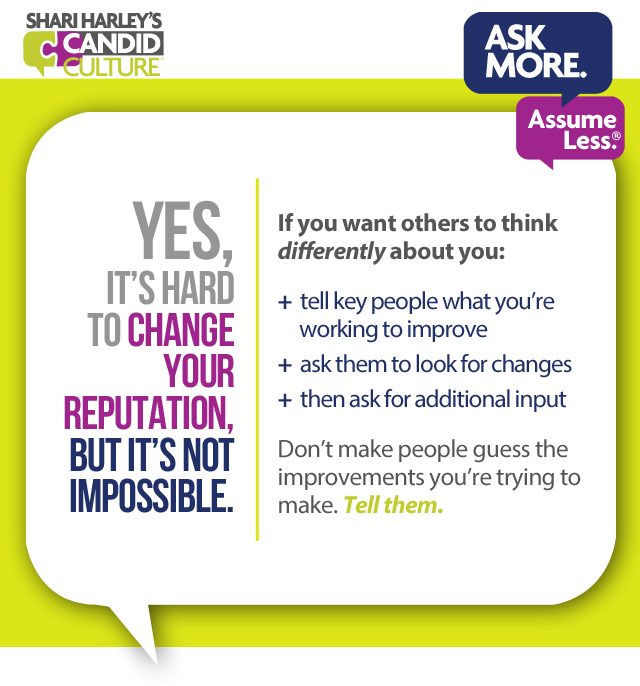 We know impressions are made quickly and are hard to change. But it’s not impossible to repair your reputation. If you want to change how people see you, I’d suggest being very overt about the changes you’ve made. Don’t simply alter your behavior and wait for people to notice. They likely won’t.
Once people have formed an opinion about you, that’s often their opinion for as long as they know you. For example, if you have a tendency to be late, even if you periodically show up on time, your friends and coworkers will think of you as the person who is always late. If you work with someone who tends to miss deadlines, even if she periodically turns work in on time, you’ll think of her as someone who misses deadlines.
Once people make a decision about us, that’s often how they’ll see us for the duration our relationship. So if you want to repair your reputation, you’re going to have to do it overtly. Making changes and hoping people notice, won’t produce the desired result.
Here Are Eight Steps to Repair Your Reputation:
- Ask people who can impact your reputation and whose judgment you trust for feedback.
- Work hard to manage yourself and not get defensive. Respond to all feedback, no matter how hard it is to hear or how invalid it may feel with, “Thank you for telling me that. I’m going to think about what you said. I may come back to talk more later.”
- Once you’ve absorbed the feedback, decide what, if any, changes you will make.
- Change your behavior for a period of weeks.
- Return to the people who gave you feedback, tell them about the behavior changes you’ve made, and ask them to observe your behavior.
- Tell the people who gave you feedback that you’ll ask them for feedback again in a few weeks, and you want to know what they see.
- Return to the people who gave you feedback and ask what changes they have or haven’t noticed.
- Repeat steps 3 through 7 at least quarterly. Everyone periodically does things that can damage their reputation.
Overtly pointing out the behavior changes you’ve made, asking people who are important to you to pay attention, and give you additional feedback, is key to altering your reputation. Most people working to change their reputation don’t do this. They make behavior changes and hope others notice. If you want to alter your reputation and how others see you, you need to do so overtly. Tell people the changes you’ve made; don’t make them guess. Ask people to observe your behavior, and then ask for more feedback. And no matter how hard the feedback is to hear, don’t get defensive. Becoming defensive will ensure you don’t get feedback the next time you ask.

Hire people using whatever (legal) criteria you like. Compensate employees however you like. Charge for your products and services however you like. Run your business however you like. But be transparent about your practices. People want to work with those they trust. Transparency builds leadership trust.
A few weeks ago one of our vendors gave me a bill that was higher than what I expected, so I asked for an itemized invoice. I never heard from the company again. Poof; they disappeared. Not a great way to build leadership trust nor a reputation.
Another vendor was very delayed in filling our product orders. When I asked questions about how such a thing could happen, I got a vague answer. “I guess we have communication issues and you got lost in the shuffle.” It was an insufficient and thus bad answer that didn’t instill confidence in the company. Instead, it created doubt that they could reliably meet our needs and we’re going to replace them.
One of my friends recently got turned down for an internal job. She was told, “She just wasn’t the right fit.” An unhelpful and yet typical way to decline an internal candidate.
You don’t owe your employees or customers answers, but if you want people to want to work with you, have confidence in you, and trust you, you’ll provide more information than you think you need to.
Employees and customers can handle the truth. And while you may not think you need to provide it, people want to work with those they trust. We trust people who give us the whole truth. Or at least more of it than, “I guess you got lost in the shuffle.”
Increase business trust: Outline how you derive your pricing. Be clear and transparent about your pricing.
Increase corporate trust: Tell employees how and why you make the hiring decisions you do. They’ll refer friends to work for you, even when you decline them.
Increase leadership trust: Tell employees how the organization makes money, the feedback you’re getting from prospects and customers, and why you’re making the business decisions you’re making. Employees will feel more connected and thus committed to the organization.
Knowledge makes people feel comfortable. The people who work for and with you want to understand how and why decisions are made. If you want your customers and employees to trust you, give them a little more truth than you might think necessary.

Most hiring best practices tell you not to hire people like yo u, and instead create diversity in your workforce by hiring people different from you. And that’s sort of true. You should hire people with different skill sets, experiences, and ways of thinking. And you should hire people with a similar work ethic and values, or you will consistently be frustrated.
Here’s what I mean: If you live to work and hire people who work to live, that’s a values difference. If your view of what is reasonable regarding expected hours worked is different from your employees, that difference will cause conflict. If, like in our company, you value open, candid communication, but your employees can’t or won’t speak honestly, that’s going cause frustration. And these values and practices won’t change. Trust me.
The question is how to identify candidates’ values and work ethic before you hire them.
Here are a five hiring tips to ensure you hire people who reflect your values and work ethic:
Hiring tips number one: Describe what it’s really like to work for you and your organization. Don’t sugar coat the bad stuff. Tell the truth. Candidates will find out eventually. If the negatives of the job are deal breakers, your new employees will leave anyway.
Hiring tips number two: Check references. I’m shocked at the number of hiring managers who don’t check references. You might think that references have been so well trained to say nothing incriminating, that making the call is a waste of time. This couldn’t be further from the truth. Be personable, make friends with the reference, ask innocent sounding questions, and references will tell you everything you need to know.
Hiring tips number three: Require candidates to jump through some hoops during the interview process. Ask candidates to invest time doing a little of the work they’ll do on the job (this is called a Practical Interview, something way too few hiring managers do) and observing people work in your office. If candidates aren’t willing to invest this time, cut them.
Hiring tips number four: Ask how many hours candidates want to work and candidate’s preferred work hours, and believe what they tell you. If someone wants to work 35 hours per week and your culture is 50 hours a week, no matter how much your new hire wants and enjoys her new job, she doesn’t want to work 50 hours a week, and won’t do so for very long.
Hiring tips number five: Don’t ignore red flags or your instincts. If you think, “I have some concerns, but let’s see. Maybe it will work out.” Run the other way. It won’t work out. You’ll end up cutting that employee after months of training and coaching, or s/he’ll end up cutting you. It’s faster, cheaper, and easier to wait to hire until you find the right person.
Hiring rule of thumb: Be slow to hire and quick to fire.

People sometimes leave feedback training confused. Armed with the skills to be candid, they think they have the right to say anything they want. Not the case. Feedback isn’t a weapon or a license to barf your opinion on people. Unsolicited and unwelcome feedback is like fish you left on your counter top for too long. It stinks.
You have the right to ask for and accept the feedback you want and reject the feedback you don’t, from peers and customers. Help people know the difference by providing clear parameters on what type of input you do and don’t want. You are not a dumping ground.
Follow these steps to manage the feedback you get from others:
Giving and receiving feedback tip one: Don’t ask for feedback because you think you’re supposed to. There are lots of leadership books and training programs that tell leaders to be open to and ask for others’ input. Only ask for input you want. If you’ve made a decision or don’t want others’ input, don’t ask for it. While you might get more buy in by asking people for their input on decisions that impact them, you’re allowed to decide without forming a committee.
Giving and receiving feedback tip two: When you ask for input, be very specific about the type of input you want. Guide people. Tell them, “I’m specifically looking for input on ____________. I’m not looking for input on ____________.” And if you still receive unwanted feedback, remind people about the input you are and aren’t looking for. In the spirit of being helpful, people can overstep their bounds.
Giving and receiving feedback tip three: Don’t be afraid to shut people down who provide unsolicited feedback. The words, “Thank you for your concern. I’m not looking for input on that at this time” will do the trick. Yes, you really can say that.
Giving and receiving feedback tip four: Don’t take feedback personally. While most people don’t think about it in this way, giving feedback subtly tells you that you’re doing something wrong, or at least not how the other person would do it. There are lots of ways to skin a cat. Their way may or may not be better than yours. To “skin a cat” is a terrible expression, by the way.
Giving and receiving feedback tip five: Trust yourself. You likely know what you want to do a lot of the time. If you find yourself asking for input when you know what you want to do, stop asking. Listen to your gut and decide.
Feedback has a time and a place. I ask for and listen to a lot of feedback, but not all the time and not about everything. If I listened to everything everyone in my life suggested, I wouldn’t own a business or have a baby. Sometimes you know best.

When I had knee surgery a bunch of years ago, the surgeon told me, “I didn’t fix your knee. I altered it.” He was trying to set the expectation that my knee wouldn’t be perfect, it would be different.

Violated expectations are at the root of disappointment, frustration, and broken relationships. We think, “I expect you to do or be a certain way and you’re not, so I’m unhappy.” If you want to be more satisfied and less frustrated, change your expectations. I don’t mean lower your expectations. I really do mean change them.
When I had a baby, I had no idea how difficult it would be to have someone I barely knew (our first nanny) take care of my son. It was tortuous until I got the sage advice, “You’re not going to get everything you want. Pay attention to the big things and be ok with good enough.” That’s hard for me. I have high standards and I want things done a certain way (my way). But I also don’t want to do everything myself. So I find myself altering my expectations and being ok with good enough. And it’s very, very difficult.
You likely want each of your employees, coworkers, boss, clients, and vendors to do things a certain way. Sometimes they’ll meet those expectations and sometimes they won’t. Decide what you must have, communicate those expectations (repeatedly if necessary), and let the rest go.
Here are four steps for setting expectations at work:
Setting expectations step one: Consider everything you need or want from a person. Make a list, even if it’s just for you.
Setting expectations step two: Determine what that person is capable of providing. What’s realistic given who they are and the constraints they’re under (financial, time, skills, experience, etc.)?
Setting expectations step three: Reset your expectations, if necessary.
Setting expectations step four: Ask for what you want and be specific about your request. Telling someone, “This needs to get better,” will get you nothing. Telling someone, “I’d like to be included in each meeting that relates to this project and cc’d on all pertinent emails,” may just get you what you need.
As William Ury said in his book Getting to Yes, be hard on the problem and easy on the person. When you address violated expectations, simply share what you expected to have happen and what actually did happen. That could sound like, “I thought we agreed I would be invited to each meeting pertaining to this client. There was a meeting last week I wasn’t invited to. What happened?” Watch your tone of voice when asking this question. Be neutral and curious.
Changing your expectations will likely be a daily occurrence. People won’t necessarily do things your way or even in the way you hoped. Decide what you must have, and let the rest go. Just think of all the time and aggravation you’ll save.

I’ve wanted to be an introvert my whole life. It’s going poorly. Introverts think, then speak. What an amazing quality. Extroverts, like me, wake u p talking and then spend much of the day apologizing for what we’ve said.
While I covet introverts’ thoughtful communication style, they are at a disadvantage. The people we work with are busy and have limited exposure to coworkers. As a result, others judge us very quickly. If we don’t speak up in meetings or find another way to express our thoughts, people are likely to think we have little to offer. Regardless of your communication style, if you want people to know the value you provide, find a way to share it.
You can’t, won’t, and shouldn’t become a different person to get ahead at work. You have to be yourself. Trying to be someone you’re not, will be painful, frustrating, and short lived. Rather than trying to become someone or something else, find ways to express yourself within your natural style.
Here are four tips to communicate powerfully as an introvert:
Being introverted communication tip one: If you know you’re hesitant to speak up in a meeting, perhaps share your views with the meeting attendees individually – verbally or in writing – before the meeting happens.
Being introverted communication tip two: Make sure the people who can impact your career know your accomplishments. You don’t need to wear a billboard advertising what you’re doing, sending a monthly list of accomplishments and priorities to your boss and boss’s boss (clear this with your boss first) will do the trick.
Being introverted communication tip three: Find your own way of talking about what you think is important. Maybe your conversations will be over lunch with one or two people. Perhaps you’ll periodically email key people with ideas. The point is to find a way to express yourself that resonates with your personal style. Don’t keep all your ideas to yourself.
Being introverted communication tip four: Push yourself to speak up in meetings more than you might naturally be inclined to do so. Being prepared will help you speak up.
Know what’s on meeting agendas. When you feel strongly about a topic, prepare what you want to say. Take notes and consider practicing out loud. Do whatever you need to to feel comfortable expressing yourself in front of a group. And if speaking up in a meeting feels too uncomfortable, remember, people who don’t get a lot of exposure to you are evaluating you based on your contributions during meetings. Find a way to make your views known.

The normal, natural reaction to negative feedb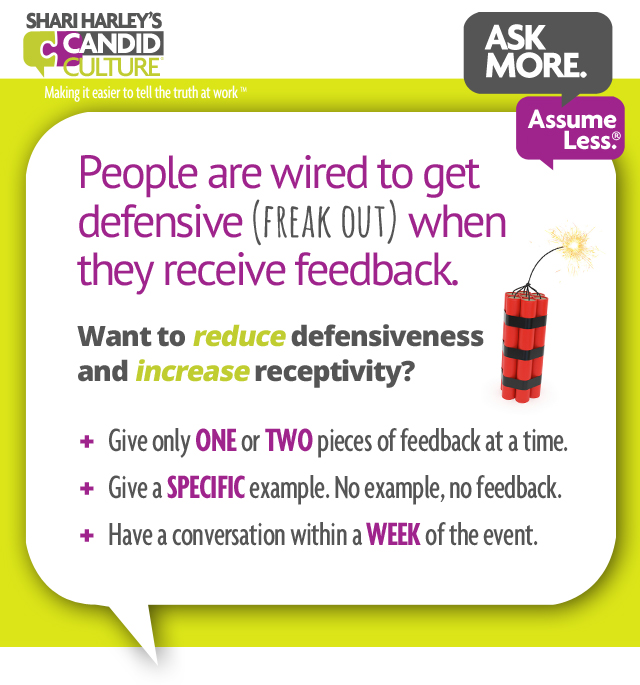 ack is to become defensive, a response I’ve labeled as The Freak Out.
Everyone, even the people you think do little work, wants to be seen as good – competent, hardworking, and adding value. When anyone calls our competence into question, we get defensive. Becoming defensive is an automatic response that we have to train out of ourselves.
Until the people you work with train themselves not to become visibly defensive when receiving feedback, just expect it. And be happy when you get a defensive response. It means the person is breathing and cares enough about what you’re saying to get upset.
While you can’t get rid of a defensive response to feedback, you can reduce it by following a few employee feedback practices. Practice these methods of giving feedback and your input will be heard and acted on, more often than not.
Employee feedback practice one: Don’t wait. Give feedback shortly after something happens. But do wait until you’re not upset. Practice the 24-hour guideline and the one week rule. If you’re upset, wait at least 24-hours to give feedback, but not longer than a week. If the feedback recipient can’t remember the situation you’re talking about, you waited too long to give feedback, and you will appear to be someone who holds a grudge.
Employee feedback practice two: Be specific. Provide examples. If you don’t have an example, you’re not ready to give feedback.
Employee feedback practice three: Praise in public. Criticize in private. Have all negative feedback discussions behind a closed door.
Employee feedback practice four: Effective feedback discussions are a dialogue; both people talk. When the feedback recipient responds defensively, don’t be thwarted by his/her reaction. Listen to what s/he has to say and keep talking. Don’t get distracted.
Employee feedback practice five: Give small amounts of feedback at a time – one or two strengths and areas for improvement during a conversation. People cannot focus on more than one or two things at a time.
Employee feedback practice six: Give feedback on the recipient’s schedule and in his/her workspace, if s/he has a door. It will give the other person a sense of control and s/he will be more receptive.
Employee feedback practice seven: Talk with people – either in person or via phone. Don’t send an email or voicemail. Email is for wimps and will only damage your relationships.
Employee feedback practice eight: Prepare. Make notes of what you plan to say and practice out loud. Articulating a message and thinking about it in your head are not the same thing.
Employee feedback practice nine: Avoid The Empathy Sandwich – positive feedback before and after negative feedback. Separate the delivery of positive and negative feedback, so your message is clear.
Employee feedback practice ten: Offer an alternative. Suggest other ways to approach challenges. If people knew another way to do something, they would do it that way.
You can deal with whatever reaction to negative feedback you get. The other person’s response will not kill you. It might make you uncomfortable, but that’s ok. You’ll survive. Try to practice the guidelines above, and if you don’t, and you ‘do it all wrong,’ at least you said something. Just opening your mouth is half the battle. When you come from a good place of truly wanting to make a difference for the other person, and you have both the trust and permission to give feedback, you really can’t go wrong.