Chances are, at some point in your career, you’ve worked with someone you wished would go away. Maybe the person repeatedly threw you under the bus, took credit for your work, or didn’t keep their commitments. And at some point, you wrote the person off, and have been merely tolerating them ever since.
Damaged relationships can be repaired, if you’re willing to do some work.
The first step in repairing a damaged relationship is to decide that you really want to do so. Managing conflict in the workplace isn’t easy. It will take effort and will likely be uncomfortable, so before you take action, decide if you really want to work on the relationship.
How to know if you should try resolving conflict in the workplace: Ask yourself how much you need the relationship. This probably sounds political, and it is. If you work on projects together, need to give or receive information, or have to work together regularly, then it’s likely worth working on the relationship. If you don’t need to work together regularly, then perhaps don’t work on the relationship.
If you decide to attempt to strengthen a relationship, plan what you’re going to say. Never trust the first thing that comes out of your mouth during a difficult conversation.
Step one for resolving conflict in the workplace: Like any feedback conversation, start with the end in mind. Consider what you want to have happen as a result of the conversation.
Step two for resolving conflict in the workplace: Plan what you’re going to say by taking notes and practicing out loud. What you say in your head is usually not what comes out of your mouth.
Step three for resolving conflict in the workplace: Ask the person for time on their calendar. People don’t like surprises. You’ll have a better outcome if the person has blocked time to talk with you. Have the conversation in-person whenever possible. If you can’t speak in-person, talk on the phone. Do not attempt to fix your relationship via email. 1. Email is wimpy. 2. It will not work.
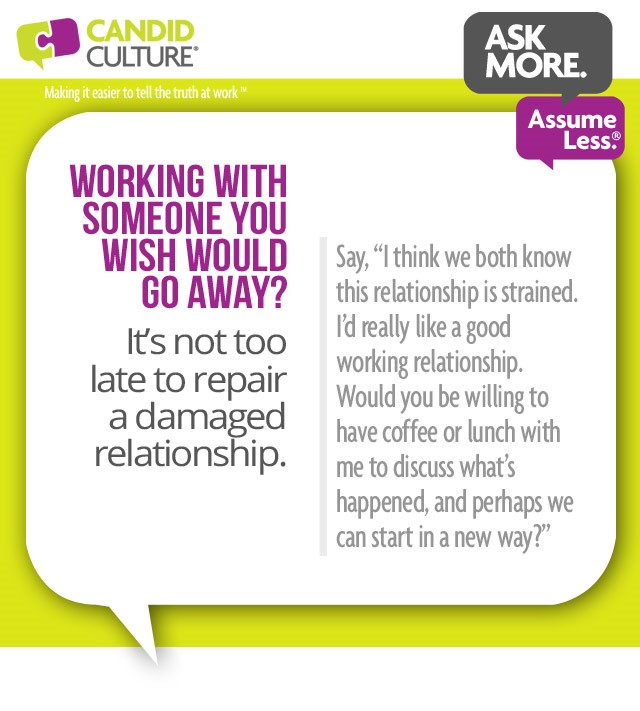
Tell the person, “Our relationship is strained. I don’t think I’m saying anything we’re not both aware of. I’d really like a good working relationship. Would you be willing to have coffee or lunch with me, and we can talk about what has happened and perhaps start in a new way?”
Step four for resolving conflict in the workplace: Ask for a meeting to work on the relationship up to three times. If, after the third time, the person hasn’t made time, stop asking. You can’t work with someone who won’t work with you. If the person doesn’t make time to meet, be polite, professional, and inclusive, but stop trying to nurture the relationship. Inclusive means: cc’ing them on necessary emails, inviting them to appropriate meetings, and providing necessary data.
Step five for resolving conflict in the workplace: If the person makes time to meet, speak candidly, be yourself, and be vulnerable. I don’t mean be a doormat. I do mean be authentic.
Ask for feedback about how you’ve damaged the relationship.
Listen to what you hear, and resist the urge to defend yourself.
Ask for permission to tell him how he’s damaged the relationship.
Give small amounts of feedback, with a few specific examples.
Make agreements of what each of you will do differently in the future.
Thank the person for the conversation and schedule another meeting.
Step six for resolving conflict in the workplace: Build in follow-up. Most people have one conversation and expect things to be fixed forever. Relationships don’t work that way. Agree to meet monthly, for the first few months, until you’ve rebuilt trust and learned how to communicate and work together. During the monthly meetings, give each other permission to give candid feedback about how you’re working together. I call these Relationship Inventory Meetings.
During monthly Relationship Inventory Meetingsask:
What’s working about how we work together?
What’s not working?
What working agreements did we keep?
What working agreements did we break?
Which working agreements are helpful?
What working agreements need to change?
You might be thinking, “I don’t like this person. I don’t want to work with them. And I definitely don’t want to have these uncomfortable conversations.”
If the nature of your relationship is impacting your ability to do your job, your professional reputation, or your happiness, all of those consequences are far worse and more long-lasting than any conversation will be.
The conversations won’t be as bad as you think. No one will tell you anything you can’t handle, because for the most part, they’re afraid of your reaction and they know they’ll be next.
Conflict in the workplace and damaged relationships keep people up at night, reduce job satisfaction, and often motivate people to leave jobs. If you’re experiencing any of these things, all of them are worse than any conversation will be. The anticipation of the conversation is far worse than the conversation itself.
Decide if you want to strengthen the relationship.
Plan the conversation.
Ask for time to meet.
Have the conversation. Speak honestly, but responsibly.
Plan to have another conversation before ending this conversation.
Congratulate yourself for being courageous and picking happiness over anxiety and frustration.
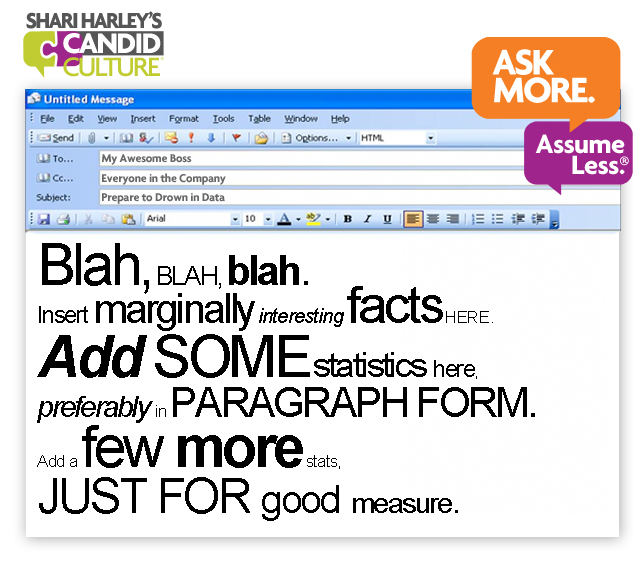
When I get an email that has multiple paragraphs I look at it, decide I don’t have time to read it, and close it out, promising to go back to it later when I have more time, which never happens.
If you want your emails read, shorter is better.
Here are a few tips for writing effective emails that are more likely to be read:
Put a specific subject in the subject line that says what the email is about.
This does not include your name. We already know your name.
Example: “Meeting” (that’s not specific). Instead try: “Meeting to agree upon February goals.”
Highlight and bold important parts of the email.
Limit this practice so what’s bolded and highlighted stands out.
If everything is bold, nothing stands out.
Use bullets.
Use the fewest number of words possible.
Use links that send readers to relevant information.
Offer to provide additional information, if desired.
The shorter your emails are, the more likely they are to get read. You can always offer additional information, but readers won’t get to the detail if they never read the email. When it comes to writing effective emails, shorter is better.
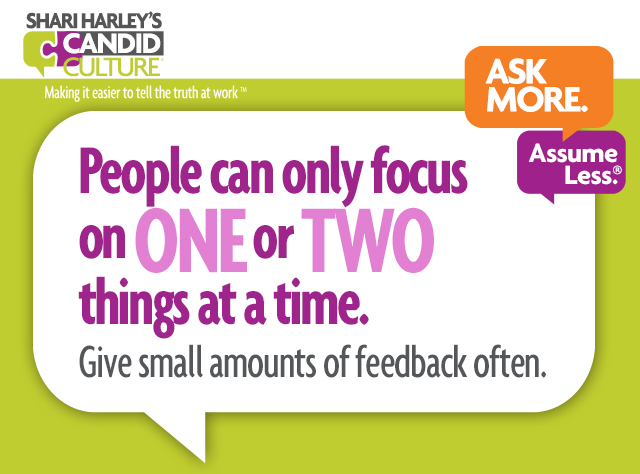
When you use GPS in your car for driving directions, the GPS only provides one direction at a time. GPS tells you what to do now and what to do next. Your car can only go one direction at a time. And humans can likely only remember one or two directions at a time. When you coach people, you are their GPS, supporting them in achieving a desired goal efficiently.
Coach and give feedback like your GPS. Give one or two pieces of feedback at a time. Then give the person time to make changes and improve before giving more feedback.
What I hear every day, and every day it makes me shudder:
Manager: “One of my employees has been making a lot of mistakes. He seems disengaged (p.s. “disengaged” is Cap’n Crunch, vague and thus not real feedback). I’m not sure what’s happening.”
Most people hoard feedback. We wait for the right time, aka when we’re comfortable. That time will never come. The right time to give feedback is when something happens or shortly thereafter. Practice the 24-hour guideline and the one-week rule. Wait 24 hours to give feedback if you’re mad, but not longer than a week. Give feedback when you’re not upset, but soon after the event occurs, so people remember what you’re talking about.
Feedback is hard on the ego. The more feedback we receive in one conversation, the harder it is to hear. People need to feel successful. Receiving too much feedback at one time makes us feel we can’t be successful, so why bother. Pick the biggest and most impactful behaviors. Wait. And then give more feedback.
When it comes to feedback, keep this mantra in your head – recency, frequency. Recency, frequency. Short, weekly, feedback conversations – five minutes long – are better than sixty-minute feedback conversation once a month or quarter. You’ll see more behavior change and protect team member’s ego. Shorter and more frequent is better.
It’s not unusual to ask who is at fault when mistakes in an organization are made. We want to know who was to blame. Before asking who is accountable for a mistake, I’d ask what lead to the mistake. Was the error a people or a process issue?
If a document with mistakes is shared with people outside of an organization, there is a process issue.
Yes, someone made a mistake. Someone wasn’t careful or knowledgeable enough to catch the error. But if a document’s accuracy is important, more than one person should be looking at that document before it leaves the organization. When only one person looks at an important document, there is a process issue.
Processes include: The practices followed and the tools used when creating, proofreading, saving, and storing work.
William Ury, author of the negotiation books Getting to Yes and Getting Past No, said, “Be easy on the people and hard on the process.” When mistakes happen, evaluate the processes surrounding that work. What allowed the mistake to go out the door unchecked? Would a different process with more checks and balances and more eyes on the work have prevented the error?
After evaluating the processes or lack thereof, coach the person who made the mistake. Fill the gap that allowed the mistake to happen, but first, evaluate your processes.
My son’s first soccer coach would frequently tell the kids, “You get what you get and you don’t throw a fit.” As adults receiving performance appraisals, I think we can do better.
Performance appraisals are, for many, the most dreaded day of the year. Most employees anticipate the meeting, wondering what their manager will say. In addition to hearing about the situations your manager and others in your organization observed throughout the year, why not tell your manager what you’d like to know?
It’s perfectly appropriate to tell your manager if you’d like feedback about a specific aspect of your performance or about your work on a certain project or piece of work. And the time to ask for this feedback is at least one month BEFORE your appraisal meeting.
Most people don’t like to be caught off guard or feel that they can’t answer a question. Asking for feedback in the moment, that your boss can’t address, may embarrass your manager. Don’t put managers on the spot. Set your boss and yourself up for success by asking for specific feedback BEFORE meetings, and give your manager a chance to observe you doing that kind of work.
If you want to know how you manage telling internal or external clients “no”, give your boss a chance to see or hear you do this. If you want feedback on how you built relationships with peers virtually this year, give your boss a chance to observe that behavior or time to ask your peers for input.
Ask a vague question, get a vague answer. Ask a specific question, get a specific answer. If you want specific feedback, let your manager know and give her time to observe you doing the actions you’re asking about BEFORE the feedback conversation.
A few years ago, I facilitated a company-wide training program for an 80-person organization. Early in the program, we were talking about career deal breakers and I asked someone in the group to share a deal breaker, so I knew that everyone was clear on what is and is not a true deal-breaker. An employee spoke up. She said, “I’ve been here six weeks. I’m overwhelmed and exhausted. If I don’t get some help soon, I’m leaving.” People in the room gasped audibly. And everyone surely thought the same thing – “She’s done. She’ll be gone by Friday.”
I ran into the organization’s CEO at the Denver airport two weeks later and we had dinner together. Over dinner, I asked if I could give him some advice. I said, “That woman who spoke up during the training did you a huge favor. You spent time and money to become a more candid organization; she gave you the opportunity to demonstrate whether or not you really mean it. Make sure nothing (bad) happens to her.”
It can be really hard when people disagree with us. Leaders institute a new practice, employees resist. Employees say they agree with a policy during a meeting but managers hear otherwise after the meeting.
It may feel easier to introduce a practice and ask employees to follow it without asking what they think. And sometimes it makes sense to do that. You don’t need to involve employees in every decision. But in an organization, it has to be safe to offer a counter-point-of-view. It must be safe to disagree.
Disagreement is hard. But silence and the fear of speaking up is dangerous. Organizations full of yes people don’t innovate. They don’t solve problems or find new ways to save costs. They don’t grow, develop, or change. Hearing the truth takes courage and persistence. Put your ego aside and ask – again and again and again.
Every time I work with a new organization, at least one employee pulls me aside and tells me about the organization’s “list”. Employees who speak up and say things the leadership team disagree with get put on the “list”. And employees who make the “list” disappear from the organization. Mind you, no one has ever seen this “list”, but employees everywhere are convinced it exists. And this is a challenge for leaders.
Even leaders who do all the right things regarding asking for and being open to all kinds of input are up against the belief that it isn’t safe to tell the truth at work. There may be no consequences whatsoever for speaking up, but the perception of the negative consequence is what matters. And this perception is powerful and pervasive across organizations.
So what is to be done? How do leaders get the truth when employees are afraid, disbelieving, and perhaps cynical?
Below are seven practices for leaders and managers to get more truth in their organization:
Put your ego aside. It hurts when people disagree with our beliefs or approach, and we’ll be fine. Let curiosity rather than your ego run the show.
Ask for input. Ask again and again and again. Employees may eventually believe that you really want their input.
Ask for input in different ways – in-person roundtable discussions, email, and surveys.
Ensure there are no negative consequences for speaking up. You can coach employees on how they spoke up and make suggestions for diplomacy, but reward the courage it took to speak up.
Share what you learn after gathering data. Don’t be a black hole. Give more information than you think you need to.
Tell employees the ideas you’re accepting and those you’re rejecting and why. It’s ok not to accept and act on all feedback. But close the loop and explain the rationale for decisions.
Be human. Admit failure, fear, worry, and wins. People trust leaders who are human, and humans have feelings and make mistakes. I’ll follow a humble leader further than a polished and seemingly perfect one.
One of managers’ and employers’ biggest complaints is the inability to hire critical thinkers – employees who question. I hear this complaint all the time. Yet we often find the people who ask questions irritating and bothersome. “Why do they have to look for what’s wrong? Why can’t they just say, “ok”?
Questioners are often seen as boat rockers, challenging the status quo. They are ‘difficult’.
We can’t have it both ways. We can’t hire people who think critically, who don’t question.
I’m not talking about people who can’t make a decision and are constantly asking managers to validate their solutions or employees who use managers as google rather than doing their own research. I’m talking about squelching the counter-point-of-view.
If you want employees who identify and solve problems and create new products and ways of working, then you need to reward those who question.
One of the reasons employees may not ask questions is the fear of appearing as if they don’t know. Who likes to admit they don’t know something at work? It takes strength to admit, “I don’t know.” Managers and leaders need to model the behaviors they want to see. We need to ask our own questions visibly and regularly. We need to admit when we don’t know. We need to be willing to be wrong and to let others see it.
There is an old workplace adage, you get what you reward. Does your organization have an award for the employee who asks the most questions? If not, create one. Do you recognize employees publicly who are willing to point out inefficient processes and costly systems? Do you have a reward system in place for employees who fail trying to fix a problem or create something new? If we get what we reward, what are we rewarding?
I’m embarrassed how often I do things I don’t want to do because I’m afraid of looking bad. I agree to things I don’t want to do. I even suggest doing things I don’t want to do, because I think it will look bad if I don’t. Then I have deep regrets.
If I’m aware of this practice, why do I keep doing it, over and over and over? I suspect the need to look good and be liked is so pervasive, it over-powers reason and self-talk. Telling myself, “Don’t do it. You will regret this,” doesn’t help. The need for approval is all-powerful (to me).
My old boss told me many years ago, “Your need to be liked will kill you as a manager,” and he was right. It’s why I can’t interview my own candidates. I want them to like me too.
I suspect I’m not alone here. I lot of us say yes when we want to say no. We extend ourselves and regret it later.
What can be done, at an organizational level, to prevent ourselves and fellow employees from over-extending?
Sanction, at a team and organizational level, that sometimes it’s ok to say no.
Suggest that at times people take 24-hours before agreeing to take on a new task or project.
Make room for negotiation, so people can say yes on terms that work for them.
Authenticity wins. Speak your truth and know that it’s ok.
I recently interviewed a candidate who asked for a lot of ‘stuff’ during the interview process. She wanted compensation, perks, accommodations, and benefits that were way outside the norm. I’m assuming she was employing the adage we’ve all heard, that “it can’t hurt to ask.” Unfortunately, it can hurt to ask.
When forging new relationships, we watch (judge) people. We’re trying to figure out who they are and how they are. Are they the person they claimed to be during the interview process? Are they trustworthy? Did I make the right decision in bringing this person into my team, organization, and life?
Requests always make an impression. When we’re building new relationships, requests make an even bigger impression. Candidates who said the commute wouldn’t be an issue, but complain about it two weeks into the job, cause managers to doubt their hiring decision. Coworkers who consistently ask for extensions to deadlines, appear unreliable.
People watch us and silently judge, making assessments about our commitment, reliability and even character. Don’t make people question you. Make reasonable asks.
Five ways to make reasonable requests:
Vet your requests with people who know your company, manager, and/or industry, before making them. A reasonable request in one organization, might not be reasonable in another.
If something is important to you, ask for it during the interview process or at the onset of new projects and relationships. Don’t wait. Waiting to ask for things until after you’ve started a job can damage your relationships and reputation. Managers don’t like bait and switch, even when it’s unintended.
Once you’ve received an emphatic “no”, accept it. I worked with someone who asked for something during the interview process. I said “no” and explained why. He asked again after being hired. This annoyed me and made me feel like he didn’t listen.
If you aren’t sure that what you’re asking for is reasonable, say so. Tell the person what you want and to please tell you if it isn’t a reasonable request.
Ask for feedback on your requests. If you’ve seen me speak, you know I’m a proponent of telling people, “If I do anything that damages our working relationship or makes you question me, I hope you’ll tell me. I promise I’ll take your feedback graciously and say, “thank you.”
Ask for what you want, within reason, be upfront when relationships begin, and build your relationships rather than break them.
Frustrated by a control freak, micromanager, or a high-need-to-know type? Controlling behavior stems from a need that isn’t being met. Identify the need, meet it, and your life gets easier.
If someone wants more updates, information, or involvement than you’re comfortable with, the person has a need that isn’t being met. When you meet the need, the person will likely back off.
I ask the people who work for me to not make me ask for anything twice. Meaning, if I ask for an update the week before a speaking engagement, anticipate that I’ll want that information for all engagements. Confirm by asking me and then provide the data without being asked for all future engagements. Getting the information regularly without having to ask builds trust and credibility.
Here are six tips for working with control freaks:
1. If you don’t know, ask:
The person’s work-related goals. What are they working on this quarter and year?
What the person is concerned about at work? What are they worried about?
How do they like to communicate – in-person, email, phone, video, voicemail, or text?
How often do they want information, in what format, and with how much detail?
2. Provide more information than you think you need to, and then ensure the person wants that information in the future.
3. If you’re asked for information, ask why the person wants it, and if they want it in the future. Then provide the information before you’re asked.
4. If someone is overly involved in your work and you feel you have no freedom, state your observation and ask for information. That could sound like, “You’ve been involved with each major decision with this project. I’m used to working with less oversight. Do you have a concern about my approach?” Then you negotiate. Everything is a negotiation.
5. The approach in number four will likely put the other person on the defensive. A less confrontational approach is to discuss and agree upon levels of involvement and supervision when projects begin. That could sound something like, “What kind of involvement do you want to have in this project? What do you want to do? What do you want me to do? What kind of updates would you like, how often, and with how much detail?” It’s always easier to prevent a problem than to fix one.
6. Lastly, don’t take anything personally. Oversight and involvement may be a reflection of how someone feels about your performance, but it might not. When in doubt, ask.