Posted under Uncategorized on August 12, 2024 by Shari Harley. 0 Comments
Employees leave managers not jobs. We’ve all heard this 100 times.
One of the most prevalent reasons for employee turnover is boredom and lack of growth. We’ve also heard this many times.
We know why employees leave jobs. The question is what must managers do to engage and retain their best people. The answer is actually quite simple, although not necessarily easy to execute.
Employees want to know that their manager:
Knows them
Cares about and is invested in their careers
Gives feedback so they can improve
Provides opportunities so they can develop
In other words, employees need attention, and attention requires time – time many managers may not feel they have.
Here is a five-step formula for employee retention and employee engagement:
Get to know employees better and differently.
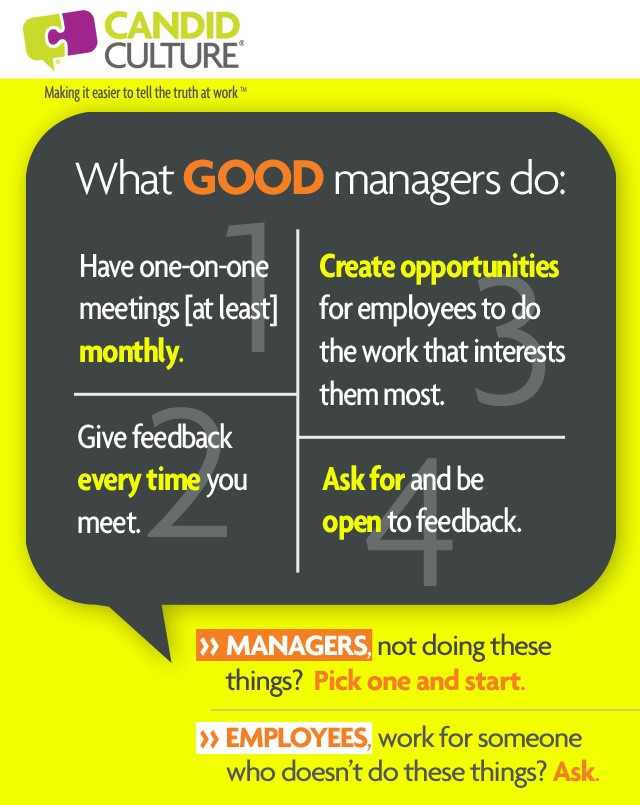
Have meaningful, one-on-one meetings [at least] monthly.
Give balanced feedback as work is done.
Ask for and be open to feedback.
Create opportunities for employees to do the work that interests them most.
Managers, how do you make time for these meetings when you are busy and have several direct reports?
Meet for 15-30 minutes.
Ask direct reports to create an agenda and run the meetings.
Ask direct reports to send follow-up notes of decisions and plans made during meetings. Give some of the accountability away.
If meetings get cancelled, reschedule as soon as possible. Direct reports take cancelled meetings personally. Cancelled meetings that are not rescheduled send the message that managers don’t care about employees and their careers.
Employees, if your manager doesn’t schedule meetings with you:
Ask permission to put a monthly meeting on your manager’s calendar.
Provide rationale for why you want to meet – to get your manager’s feedback and ensure you’re focused on the right work.
Ask permission to reschedule meetings when they get cancelled.
Don’t take cancelled meetings personally.
Offer to meet with your manager via the phone when it’s convenient for them. Leverage commute and travel time, if applicable.
Employees need time with their managers. Meaningful discussions and work, result in employee engagement and employee retention. So managers, make the time, even when you don’t feel you have it. Ask questions you don’t ask now. Give feedback, even when it’s uncomfortable. Give your employees an opportunity to do the work that interests them most. And watch your employee engagement and employee retention improve. And if your manager doesn’t do these things, politely and persistently ask. You won’t get what you don’t ask for. We are all 100% accountable for our careers.
When the people we work with don’t do their jobs, we might find ourselves saying, “They should be more on top of things.” “They shouldn’t make commitments they can’t keep.” “They don’t know what they’re doing, and that’s not my problem.” The challenge is, when your coworkers don’t perform, it is your problem.
When your coworkers don’t get you the information you need in a timely way, you miss deadlines. When you work from incorrect information, your reports are wrong. When others don’t work with you, you look bad. So, you can be right all day about how others perform, and your reputation will still be negatively impacted.
I don’t suggest you enable your coworkers by doing the work others don’t. I do suggest you help your coworkers be successful by holding them accountable.
Here are a few things you can do to manage your career and get what you need from your business relationships:
Don’t assume others will meet deadlines. Check in periodically and ask, “What’s been done so far with the XYZ project?” Notice, I didn’t suggest asking, “How are things going with the XYZ project.” “How are things going” is a greeting, not a question.
Set iterative deadlines. If August 25th is your drop-dead deadline, ask to see pieces of work incrementally. “Can I see the results of the survey on August 10th, the write-up on August 15th, and the draft report on August 20th?” One of the biggest mistakes managers and project managers make is not practicing good delegation by setting iterative deadlines and reviewing work as it’s completed.
Don’t just email and ask for updates. The people you work with are overwhelmed with email, and email is too passive. Visit people’s offices or pick up the phone.
You might be thinking, “Holding my coworkers accountable is awkward. I don’t have the formal authority, and I don’t want my coworkers to think I’m bossy or damage my business relationships.”
It’s all in the how you make requests.
If you’ve seen me speak or have read the business book How to Say Anything to Anyone, you know I believe in setting clear expectations at the beginning of anything new. That could sound something like, “I’m looking forward to working with you on the XYZ project. How would you feel if we set iterative deadlines, so we can discuss work as it is completed? You’ll get just-in-time input, making any necessary adjustments as we go, and we’ll stay ahead of schedule. How does that sound? How are the 10th, 15th, and 20th as mini deadlines for you?”
Many people put large projects off until the last minute. People procrastinate less when large projects are broken into smaller chunks with correlating deadlines. You strengthen your business relationships and support people in meeting deadlines and not procrastinating when you agree on completion dates when projects begin. Also, most of us unfortunately know what it’s like to put a lot of work into a project, have someone review our completed work, and then be told we went down the wrong path and need to start over.
Ask more. Assume less. Don’t assume your coworkers will do what they’re supposed to do. Ask upfront to see pieces of work on agreed-upon dates. Pick up the phone versus rely on email to communicate and know that the people you work closely with are a reflection of you. Get people working with you, and everyone will look good.
Last week I had lunch with a friend. When I returned from lunch, I noticed I had something stuck in my teeth. I was embarrassed and wondered why my friend hadn’t told me.
It’s quite possible she hadn’t noticed. But we all know people who notice and say nothing. We could walk around all day with toilet paper on our shoe, lipstick on our teeth, or our fly down, and the people around us won’t tell us.
If you read my blog weekly, you already know that people have been trained not to tell you the truth.
But I think there is more preventing people from telling us the truth. Complete this sentence: “If you have nothing nice to say, _________________________________. Who told you that? Your mother!!!
I do think there’s something to this. We’re raised to believe that it’s not nice to say something to another person that isn’t positive. And in the past, when we did speak up, it’s likely the other person got defensive, so it’s no wonder that we don’t readily give people bad news.
Here are five tips for getting feedback from the people around you:
Establish a core team of people who will always tell you the truth. These can be friends, coworkers, clients, vendors, your boss, etc.
Give people permission, to be honest with you. “Let’s make a deal. I always want you to tell me the truth. If I have something stuck in my teeth, or I’m inappropriately dressed for a meeting, or I’m doing something that damages my reputation, I want you to tell me.”
Make it easy to tell you the truth. “I promise no matter what you tell me and how hard it is to hear, I will say thank you. I won’t get defensive. And if I do, I’ll apologize and try to do better next time.”
Offer to do the same for them. “And if you want me to do the same thing for you, I’m happy to do it.”
Periodically check in with people and ask for feedback. “A few months ago I asked you to tell me anything I said, did, or wore that got in the way of my success. Is there anything you’ve seen that you want to tell me?”
Every time you ask for feedback and take it graciously, you train the person to give you more feedback. On the contrary, every time you get defensive, you make it hard for people to give you feedback, making it likely they won’t do it again.
If you don’t want to walk around looking silly all day, create a safe environment where friends and co-workers can tell the truth.
You receive a meeting request for August 5th. Your calendar is open, so you accept the request. You get asked to visit an out-of-state client on August 12th. Your calendar is open, so you say yes. You’re asked to make a presentation in place of a team member who is out of town, on August 14th. You want to be a team player, so you say yes. And soon what was a relatively slow month is booked with meetings, travel, and other commitments. Mid-month you’re tired, over-extended, and resentful. You want to be a good team member and a responsive professional. How do you do both without feeling tired and resentful?
One of the best pieces of advice I heard many years ago was to decide how to handle something before the situation presents itself. For example, if you’re trying to lose weight and you’re going to an event that will have an amazing buffet, decide what you will and won’t eat before you arrive. Choosing not to eat the desserts will be much easier if you’ve made that decision before the event rather than when you’re standing in front of temptation. Managing commitments and schedules can work the same way.
Before having a child, I worked 80 hours a week and traveled up to six days a week. And I loved every second of it. After having my son, I realized that I didn’t want to keep that kind of schedule anymore. I needed to cut back. So, I created clear and specific boundaries for myself. I decided how many days a month I would travel, by what time I needed to arrive home from each trip so I could see my son before he went to sleep, and how many speaking engagements I would commit to each month. When I receive speaking requests, I honor my pre-established boundaries. If I am already on the road the maximum number of days I told myself I would travel, I ask if the client can do a different month or if I can speak virtually. If the answer is no, I turn the work down.
I rarely deviate from my established boundaries. And when speaking requests come in, the decision-making isn’t a struggle. I don’t have to decide if accepting a request will be too much. I’ve already made the hard decisions about the schedule I will keep. So, each incoming request either fits into my already-decided-schedule or it doesn’t.
I work for myself. I have latitude to make decisions about my schedule that I might not if I still had a regular, corporate job. So how do you make and share decisions when you’re not your own boss?
Decide what you want your schedule to look like. How many hours do you want to work a week? What time would you like to start and stop working on most days? How much travel are you willing and able to do? How many meetings can you attend a day and still get your work done, so you’re not working each evening or weekend?
Then communicate your desired schedule to the person you work for. Tell your manager how much travel you would like to do and the hours you would like to work. Then negotiate. You may not be able to maintain the schedule you want all the time, but you certainly won’t if you don’t make your desires known.
The time to tell your manager that you want to reduce your travel is before you’re asked to take a trip, not after. But it’s never too late. If you find yourself too busy or on the road too much, you can always have a conversation and renegotiate.
When people send me an email with five paragraphs, my eyes glaze over. I close the email promising to read it later, but don’t until the sender asks if I received their email. People are busy and have to choose where to invest time. When it comes to communication, often, less is more. The question is, how to be succinct and still be thorough? How do you make sure people know what’s expected without providing so much information that nothing gets read?
I’m going to admit, I struggle with this.
I wrote a repair person, who worked in my house, a two-page, single spaced list of all the things that needed addressing. I don’t want people to have to guess what they have to do. I want to be thorough. It feels like the right and helpful thing to do.
The problem? The repair person didn’t read my list. It was too long. I would have been better off speaking to him live.
I’ve decided to create some communication rules for myself. I’m hoping they’ll be helpful to you as well.
Draft communications and save them as a draft. Read them again a few minutes later and ask, “Can I say this in half as many words? Is all of this information necessary?”
Think communications through rather than communicating impulsively. I’m someone who operates with a high sense of urgency. I suspect my sense of urgency has helped me to be successful personally and professionally, but it also has me send messages before I’ve thought everything through, which leads to seven text messages, rather than one.
Limit yourself to one or two messages. When you know you can send only one email or text message, you’ll likely be more thoughtful about your communications.
Draft succinct instructions and then ask the person what they’re planning to do. This is a delegation technique. Require the person, to whom you’ve delegated, to tell you what they know or don’t know. Then you know how to help.
I suspect that providing the right amount of detail will be something I’ll struggle with forever. The key take aways are this:
People often don’t read long communications. If you can say it in fewer words, do so. Shorter is better. Be complete, but don’t go overboard. Make sure things are said only one time. If you’re not sure someone read or understood what you said or wrote, ask them what they heard or read. Don’t ask, “Do you have any questions?” Or “Does that make sense?” Both are waste-of-time, non-questions.
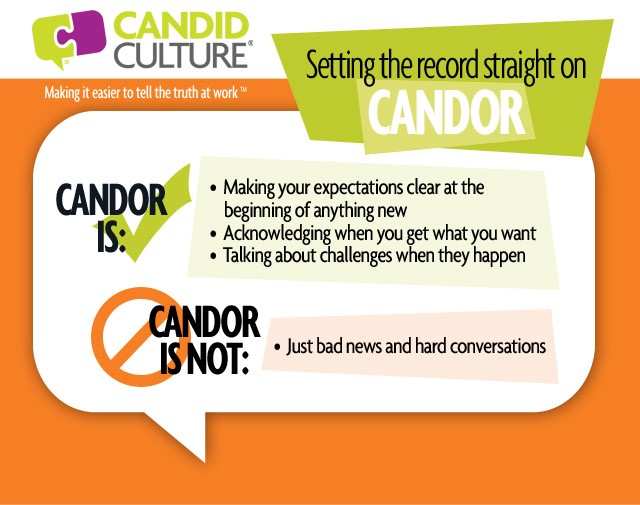
The word candor is not being used on a regular basis. Some people may not know what it means. And, in my experience, people who are familiar with the word often misinterpret candor to mean bad news. Most people expect bad news to come after the question, “Can I be candid with you?”
The definition of candor is, to be honest, truthful and forthright. We at Candid Culture define candor differently. The Candid Culture definition of candor: Telling people what you need before challenges occur. Anticipating everything that can take a project or relationship off track and talking about potential pitfalls before they happen.
Think about the projects and processes in your office – hiring someone new, sourcing a vendor, training people on new software. The potential breakdowns are predictable. You know the pitfalls that can happen when starting anything new because you’ve experienced them.
What if candor sounded like, “We want this project to be smooth. There are a couple of things that will make our work together go well and a few things that may delay the project and have it cost more than we budgeted. Let’s talk about what needs to happen for things to go smoothly, ways to prevent missed deadlines, and how we’re going to handle breakdowns when they happen.”
Some call a conversation like this setting expectations, others call it planning. In my world, these conversations are called candor –talking about what you need when projects begin, rather than letting the anticipatable train wreck happen.
Candor isn’t bad news. It’s telling people how to win with you vs. making them guess.
Examples of candor at work and at home:
“Here a few of my pet peeves… What are your pet peeves? I’ll do my best to avoid doing them.”
“What will frustrate you?”
“I turn off my cell phone alerts off after 9:00 pm, so feel free to text or call me anytime. I’ll respond to all messages in the morning.”
“I respond to text messages mostly quickly, then voicemail, then emails. If you don’t get a reply to an email within two or three days, don’t take it personally. Chances are I haven’t read the message. Feel free to follow up with a text or voicemail.”
“I work best by appointment. Drop by’s are hard because they interrupt my flow. Email or text me if you need something, and I’ll tell you when I can swing by. Does that work for you?”
For the most part, we treat people as we want to be treated. Other people aren’t us. They don’t do things as we do and don’t know what we want. Don’t make people guess how to work with you, what you need, and what you expect. Be candid and tell them! Then ask what the people you work and live with expect from you.
No one likes to make mistakes. We want to do good work and have people think well of us.
The key to maintaining your relationships and reputation, when you make a mistake, is to take responsibility and make things right as soon as possible. Saying something wasn’t your fault or becoming defensive will only damage your reputation and relationships. As counterintuitive as it sounds, you will gain respect and credibility by taking responsibility and correcting problems.
I often get asked if people lose credibility by being humble – asking for feedback and admitting to making mistakes. It takes strength to ask for and be open to feedback and to admit when you drop the ball. So, while it may seem counterintuitive, the more you ask for and respond to feedback, and admit when you make mistakes, the stronger you will appear.
I made a mistake at work. Now what?
When you make a mistake say something like:
“I dropped the ball on that. I apologize. I’ll fix it and let you know when it’s been handled.”
Or, “Thank you for the feedback. This clearly didn’t go as planned. I’ll make those changes and let you know when they’re done.”
Also, let people know the steps you’ll take to avoid similar challenges in the future.
You could say something like:
“Thanks for letting me know that our process is causing your department challenges. We certainly want the process to be smooth. My team will fix this month’s report, so your team doesn’t have to invest more time. We’ll update the process for next month and walk you through the changes before the report is due next month.”
Don’t provide a bunch of reasons for breakdowns. No one cares. Telling people why something occurred can sound like excuse management. People just want to know things will be made right.
Asking for feedback, taking responsibility, and telling people how you will correct errors may not be your natural or first reaction. The more you can train yourself to do these things, the easier you will be to work with and the better your reputation and business relationships will be.
Companies want people who make things happen, and to make things happen, you have to speak up. Anticipating the train wreck and commenting after the train goes off the tracks, doesn’t count.
What if you said what you thought, in a way other people could hear you, when you had the right to do so? Meaning, you have the relationship with the other person to tell the truth and you’ve asked permission to be candid?
6 Courageous Steps to Advance Your Career:
Look for opportunities to make things better.
Ask for permission to take the ball and run with it.
Find a way to say no, while engaging the other person in a conversation so a new approach is generated.
Be willing to go out on a limb, work hard, and fail.
Here’s how to speak up for change without being labeled as the problem person who finds flaws in everything:
Look for and present solutions, not just problems.
Offer to do the work to move towards a better way of doing things. Don’t drop problems at other people’s doors.
Ask questions versus overtly say that something is wrong. That could sound something like, “I’d love to help. Tell me more about how this works. Maybe we can insert a step to make the process better. What do you think of trying ________?” No one likes to be told they’re wrong. Asking questions elicits participation more than overtly saying, “This is broken. We need to fix it.”
Many people are afraid to speak up at work and believe that people who speak up get fired. I haven’t found this to be the case. People who work hard and produce results are typically the last people to be let go.
Say what you think in a way that is not critical. Offer solutions, not just problems. Be a force for good and take an active role in making things better, and my hunch is your career will accelerate faster than you ever thought possible.
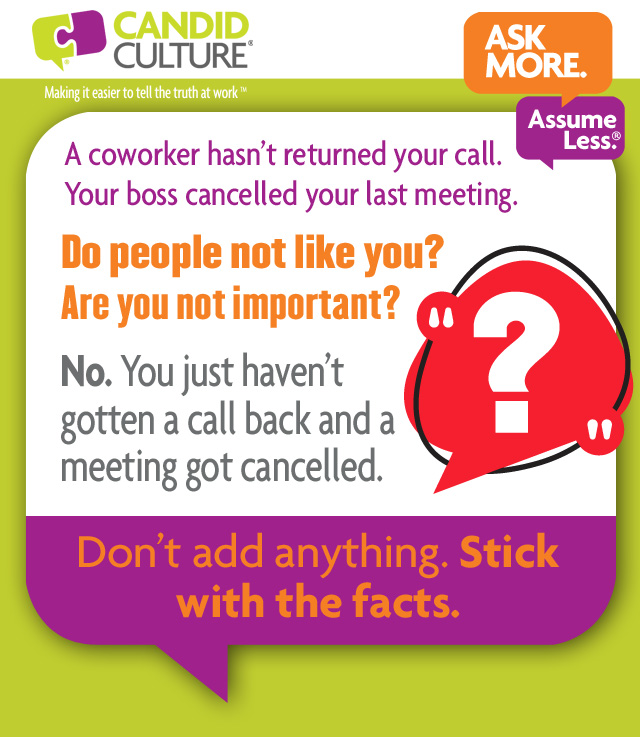
You interviewed for a job four weeks ago but haven’t heard back from the recruiter. You asked a coworker to have lunch, no reply. You asked a team member for a document, but after three emails, two texts messages, and a voicemail, still no reply.
It’s normal and natural to go to a dark place when we don’t get the response we’re expecting. We wonder, “Maybe they don’t like me? Perhaps they don’t want me involved in the project? Did I step on their toes? Maybe I asked in the wrong way?”
Wondering why we haven’t heard from people and inventing reasons for the lack of communication is normal and natural. It’s also exhausting and draining.
I’ll admit, I am on pins and needles after I deliver a training program, until I connect with my client to hear how they felt about the program. Even when I know I did a great job, I need to get the feedback and I’m on edge until I get it.
I’ve had enough training on communication and interpersonal relationships to know that others’ responses are usually not personal. People are busy taking care of themselves, as they should. They’re thinking about their own deadlines, deliverables, and the demands on their own time. Ninety-nine percent of the time they’re not thinking about us.
People are wired for self-preservation, and this very good and important. If you don’t take care of yourself, who will? The question, is how do we get our own needs met when we don’t get the response we’re expecting or the communication we need?
The most powerful approach is to remember that people’s response or lack thereof has nothing to do with us, and to let it go. Don’t be consumed with the lack of communication. Move on. You’ll hear back from the person when you hear back. This would be a powerful position to take, and it’s very difficult, at least for me.
The next approach could be to make up an interpretation that empowers you. If you’re inventing a reason you haven’t heard from the person; you might as well invent a reason that makes you feel good. For example, “The person participated in an escape room this past week and hasn’t made it out yet. They don’t have an Apple watch and have no way to communicate.”
Another approach is to set expectations when you begin working with people. Ask the recruiter, “If I haven’t heard back from you and a few weeks have passed, is it ok if I call to check in?” Ask your boss, “Is it ok if I reschedule meetings that get cancelled?” Ask your coworkers, “If I need information but haven’t heard back after three attempts, what should I do? Who else can I ask rather than wait?” Having a plan in place when you don’t get the communication you need will give you a clear course of action, rather than guessing.
But ultimately the most powerful – even if it’s the most difficult – response is to know deep down that the lack of communication is not about us.
Yoga, wellness programs, and mindfulness will not prevent or eliminate burnout. Burnout is an organizational issue. If you want to prevent and eliminate burnout, focus on your organization, not individuals.
Burnout comes from a lack of role clarity and employees feeling like they can’t be successful at work, either because they consistently have more work than can be done in a regular work week or because they work for a manager who is a perfectionist, and nothing is ever good enough. Employees who constantly feel pressured at work or feel like they’re failing, regardless of the amount or level of work they produce, are susceptible to burnout.
Have you ever gone on vacation, had a relaxing time, and two days after you returned to your regular life, forgot all about that vacation? That’s like burnout. When the yoga class or vacation is over, you go back to your job with unrealistic expectations. Nothing has been solved.
Companies try to make employees’ experience more manageable with programs and perks, but what employees really need is a manager who clarifies roles so everyone knows who does what, helps employees manage their workload, and creates open relationships so employees feel comfortable saying when they’re overwhelmed.
Train your managers to do these three things to prevent and reduce burnout:
Clarify roles so people know what they’re accountable for and to eliminate redundancy. It’s very frustrating to feel overwhelmed, only to find that someone else on your team or in another department is working on the same project as you.
Manage workload and set realistic deadlines. If an employee regularly has more to do than can be done in a 40-hour work week, eliminate something – change deadlines, reallocate work, and evaluate if everything being done is necessary. If you can’t eliminate a project, evaluate if it can be scaled back. Is every bell or whistle necessary?
Create an atmosphere of psychological safety so employees are comfortable asking for help prioritizing work. Most employees suffer in silence until they’re so overwhelmed and exhausted, they quit. Finding employees’ resumes circulating on LinkedIn is predictable and thus preventable.
You can get employees talking by scheduling a short, weekly debrief – 10 minutes – of what’s working and not working.
Help employees prioritize responsibilities by assigning each priority a letter – A, B, or C – in order of urgency.
Ensure there are no consequences for asking for support. Word gets around. If an employee is penalized for asking for help, other employees will learn not to speak up when they need support.
Allocate work to allow employees to be successful, focus on the projects that really matter and eliminate the rest, and create an organization in which it’s safe to tell the truth. That will solve burnout.