How many times have you sent someone five emails and become frustrated when none were returned, or thought an employee was happy, only to be surprised when they quit, or needed to talk with someone but couldn’t get their attention, so you walked by their office throughout the day, wondering if it was ok to knock? Working with other people doesn’t have to be so hard.
Taking the time to ask team building questions is much faster than recovering from missteps with other people. Ask the questions at the beginning of anything new – when you hire a new employee, get a new customer, or start a new project. You can ask questions in person, via video, or over the phone. Always ask live versus via email or a survey. And keep asking the questions as you work with people.
I use the Candor Questions below, when I onboard a new team member at Candid Culture. The questions help the entire team get to know each other better and learn how to work together.
What will keep you working here and what would make you want to leave?
What’s the best way to get information to you – voicemail, text, or email?
What time is too early to contact you?
What time is too late?
Do you leave your email and/or text alerts on at night/when you go to sleep?
Would you prefer I send all emails and text messages during regular business hours?
What frustrates you at work?
What are your pet peeves?
What’s something you want to learn, skill or business wise, that you haven’t had a chance to do?
What’s something you wish I would start, stop, or continuing doing?
We move so fast at work and are so focused on completing goals, we often don’t take the time to really get to know the people we work with. I feel very strongly that asking the team building questions above will help people work better together. We’ll make fewer ‘mistakes’ with each other, and get more done with less stress and more ease. As William Ury said in his book, Getting to Yes, “Go slow to go fast.”
Asking questions about working style preferences and goals is an ongoing process, and it’s never too late. You can ask the team building questions during meetings or just slip them into your conversations. The process doesn’t have to be formal or time consuming. The point is simply, don’t guess what people need and are expecting from you, ask.
Most people avoid giving feedback because they’re concerned about (don’t want to deal with) the other person’s defensive response. It’s easier to say nothing than deal with someone’s defensiveness, so we say things are fine when they’re not.
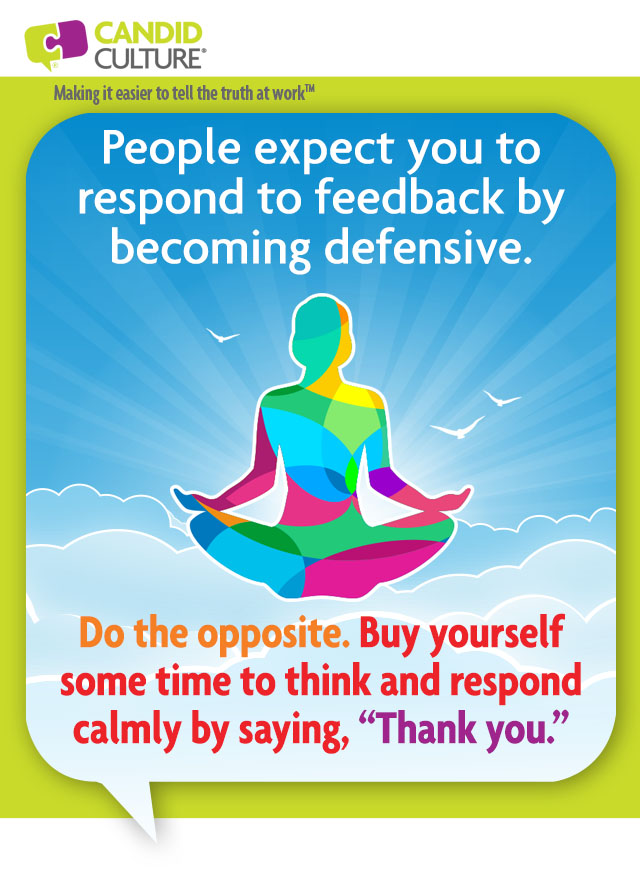
If you want people to tell you the truth, do the opposite of what they expect when responding to feedback. Rather than become defensive, take a breath and say, “thank you.”
Saying “thank you for the feedback” is not intended to be a Pollyanna response, nor does it mean you agree and that the person is right. Saying “thank you” catches the other person off guard (in a good way) and buys you time to think and respond calmly, making it more likely that you’ll get feedback in the future.
Each of us wants to be thought well of and be seen as competent. Negative feedback calls both into question and the brain responds defensively. The challenge is that defensive responses scare other people into silence, and you only need to get defensive once for people to believe that you can’t handle feedback.
Don’t underestimate the power of your emotions and ego. You are likely to respond to feedback defensively, even if you don’t see yourself do it. A seemingly benign ‘explanation’ of why you did something is seen as defensive and is thus off putting to others.
Here are six strategies for responding to feedback well:
Have feedback conversations when you have the time to listen and are rested. If you’re tired, on a deadline, or rushing to your next meeting, the conversation will not go well.
If someone catches you off guard with feedback and you know you won’t respond well, interrupt the person. Tell them that you appreciate them bringing this to your attention and you want to give the conversation the attention it deserves, but now isn’t a good time. Schedule a time to finish the conversation within a few days.
Have a plan for how you’re going to respond to scheduled/planned feedback conversations before the conversations start. Tell yourself, “I will say thank you, end the conversation, and ask for another time to talk.”
If you receive feedback that doesn’t feel accurate, ask others, who you trust, what they think. Just be prepared to hear what they have to say, and, of course, respond with “thank you.”
Don’t respond to negative feedback in the moment, even if the other person wants you to and you think you can do so without being defensive. Don’t underestimate the power of your emotions. You will likely be upset, even if you don’t feel upset, and your response will be better after you’ve had time to process. Tell the person who gave you feedback that you take their feedback seriously and want to respond thoughtfully, and thus you’re going to think about what they said before responding. People may be frustrated with this response at first, but they’ll be appreciative later.
Be sure to get back to the person who gave you feedback within a few days. Tell them you thought about what they said and then tell them how you feel. You can speak candidly. Your words will be calmer and more thoughtful than when you received the initial feedback.
We know people are hesitant to give feedback. Make giving you feedback easier by responding calmly. No one expects to hear “thank you for the feedback.” Your unemotional response will strengthen your reputation and relationships and make it more likely that you get more feedback in the future.
I’m not sure why, I wish I could give you a good reason, but the vague phrases above are what most people say when attempting to give feedback. To prevent giving vague, unhelpful (a.k.a. fake) feedback, you need to prepare.
There is a reason you think the person is awesome or has a bad attitude. What did they do that created that impression? Until you can describe what the person did to create an impression, you’re not ready to give feedback. You’re better off saying nothing.
All of the phrases above are opinions with no facts. Opinions are judgments. Feeling judged makes people defensive. When people are defensive, it’s hard to listen.
The purpose of feedback is to help another person. Give the person enough information they know what behaviors to replicate and what to change. Before you give feedback, write down three things the person did that created your impression. If you can’t give an example, wait to have the conversation until you can. It’s better to say nothing than to say something vague.
Vague, positive feedback sounds inauthentic. Vague, negative feedback is judgmental. Neither vague positive or negative feedback strengthens relationships or helps the recipient.
If you want to be heard and helpful, provide an example. No example, no feedback.
One of managers’ and employers’ biggest complaints is the inability to hire critical thinkers – employees who question. I hear this complaint all the time. Yet we often find the people who ask questions irritating and bothersome. “Why do they have to look for what’s wrong? Why can’t they just say, “ok”?
Questioners are often seen as boat rockers, challenging the status quo. They are ‘difficult’.
We can’t have it both ways. We can’t hire people who think critically, who don’t question.
I’m not talking about people who can’t make a decision and are constantly asking managers to validate their solutions or employees who use managers as google rather than doing their own research or people who tend to complain and find something wrong with everything. I’m talking about squelching the counter-point-of-view.
If you want employees who identify and solve problems and create new products and ways of working, then you need to reward those who question.
One of the reasons employees may not ask questions is the fear of appearing as if they don’t know. Who likes to admit they don’t know something at work? It takes strength to admit, “I don’t know.” Managers and leaders need to model the behaviors they want to see. We need to ask our own questions visibly and regularly. We need to admit when we don’t know. We need to be willing to be wrong and to let others see it.
Also, put simple and regular structures in place to tease out employees’ point of view. Conduct short, regular debriefs. Ask what’s working and what can be improved one-on-one and in larger meetings regularly – mid-project and after new actions and decisions. Wait for positive and upgrade responses. Don’t move on until you get both types of feedback. Demonstrate appreciation for positive and negative input. Ensure there are no negative consequences for speaking up. Keep asking. Over time, employees will get more comfortable giving real feedback and will trust it’s safe to tell the truth.
Lastly, there is an old workplace adage, you get what you reward. Does your organization have an award for the employee who asks challenging questions? If not, create one. Do you recognize employees publicly who are willing to point out inefficient processes and costly systems? Do you have a reward system in place for employees who fail trying to fix a problem or create something new? If we get what we reward, what are we rewarding?
You open an email (or a few hundred) telling yourself you’ll reply later, but never do. Feeling ambitious, you agree to a deadline you can’t meet. Needing a break, you take a few days off but don’t put an out-of-office message on your email.
We’ve all taken too long to reply to an email, missed a deadline, or simply taken too long to provide someone with information. It’s ok to take time to respond, not to have all the answers, and take time off. We simply need to provide timely and accurate status updates.
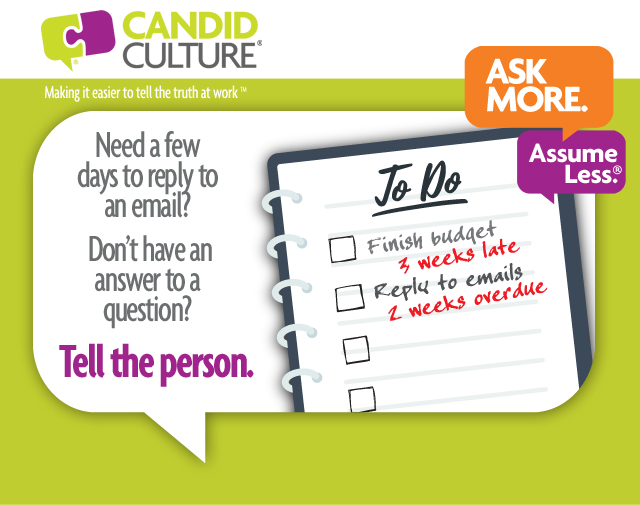
When people don’t hear back from us in what they consider a timely way, they start to wonder (at best), and judge us (worse), or tell others we’re non-responsive and unreliable (worst). Don’t make people wonder if you received their message, send a timely status update and tell the truth.
If you’re behind and need more time than usual to respond to emails, tell people that. Respond to emails within 24-hours and tell senders you received their message and it will be (fill in the blank) before they hear back from you. When you get an email that requires research, respond within 24-hours and tell the person how long it will take to find the information. If you’re out of the office and don’t plan to read or respond to emails, tell people the dates you’re out.
In the absence of knowledge people make stuff up, and it’s never good. Filling in the blanks isn’t malicious. People simply have a need to know what’s happening. And when they don’t know, they invent stuff. It’s how the brain works. When we don’t hear back from people in what we consider a timely way, we start to wonder. “Did they get my message? Why aren’t they responding? What’s wrong?”
It’s ok to need time to respond. It’s ok to be running behind. It’s ok to take time off. Simply let people know the true status. Manage your reputation and business relationships. Don’t make people guess.
Sign Up
Career tips you won't get elsewhere. Sign up to get a free tip card.