I always want to do things right and hate making mistakes. When I say or do things I wish I hadn’t done, I relive those scenarios way more than I care to admit, also known as obsessing. But maybe life isn’t about doing everything right. What if our primary job in life is to be happy?
Lots of people will set 2025 personal goals. If setting specific personal goals works for you, do it. Just don’t set yourself up to fail. You’re not likely to lose 30 pounds, save 20% of your income, start a not-for-profit, visit five new countries, and become a fantastic cook in one year. Maybe dial those 2025 goals back and pick two of them, but only if you enjoy working towards those goals.
Perhaps life isn’t about getting more done. Perhaps life is really about enjoying more.
If you want to set 2025 personal goals, I would love if they were:
Have a job you love.
Spend time with people who make you feel good.
Speak your truth (nicely).
Have a job you love. You don’t need to keep a job that doesn’t allow you to do work you enjoy and are good at. There are lots of jobs out there. Go get one you like.
Spend time with people who make you feel good. Stop spending time with people you don’t like or feel good with. Your discretionary time is limited.
Speak your truth (nicely). People are more likely to quit a job and a relationship than to say what isn’t working and to ask for what they want. Fear less; speak more. When you speak from a desire to make things better and to strengthen relationships, there is little you can’t say, so start talking.
I won’t tell you not to save money, travel more, or become a gourmet cook. But what if your job in 2025 isn’t to do more? What if your primary job is to be happy? What would your 2025 goals be then?
As someone who writes and teaches about effective communication in the workplace, I suspect the people I work and live with are expecting me to model good communication skills all the time. The good news: I try really hard to always do the right thing and impact people positively. The bad news, I’m human and sometimes I don’t get it right.
One of the things I’m proud of about Candid Culture, is that we are real people, working with real people. We work very hard to practice effective communication in the workplace and to always model what we’re teaching. And yet, like all people, we get busy, rushed, and tired. We read emails we intend to reply to but then forget to do so. We occasionally send emails, when we should pick up the phone.
In my world, a good communicator is not someone who always communicates perfectly.
A good communicator who practices effective communication in the workplace is someone who:
Cares about people and consistently works to communicate in the way others need.
Asks for and is open to feedback about how they impact people.
Listens and watches other people’s verbal and non-verbal communication.
Alters their communication style to meet other people’s needs.
Takes responsibility when things don’t go well.
I advocate for picking up the phone, even when you want to do everything but, being patient, even when you’re frustrated, and asking questions, versus accusing. And I’m going to admit, I’m working to do these things too. Sometimes I get it right, and sometimes I don’t. I’m in the trenches with you, working to say and do the right things every day.
I promised you five tips to practice effective communication in the workplace and to be generous with people:
Only call people when you have adequate time, attention, and patience to have whatever conversation needs to be had.
If you need a few days to return a call, say so. Let the person know when you’ll call.
Prepare for conversations. Plan what you’re going to say and how you’re going to say it.
Don’t have hard conversations when you’re frustrated, tired, or busy. They won’t go well.
If the conversation goes poorly, call back later and clean it up.
Being a good communicator doesn’t mean being perfect. It means caring enough to notice when you miss the mark, cleaning up your messes, and working to do it better next time. I’m working on the above recommendations too. And when I screw it up, you can be assured that my mistakes will become examples in our training programs of what not to do, followed by a new technique that will hopefully work for all of us.
Every time I ignore the red flags I see when interviewing a candidate, or when I feel an employee is struggling, or a project is off track, I pay the price. Every single time.
You interview a candidate who has had three jobs in the last year. You think, “Maybe this one will work out.” No, it won’t. Move on. You haven’t gotten an update from a project team in over a month. You think, “This group is typically reliable. Things are probably fine.” Check in. Even the most diligent employees need accountability and attention.
They call them red flags for a reason. If you suspect a problem, there likely is one. Don’t just wait and ‘see how things go.’ Make a hard decision, get more information, or get involved. Wait and see is often a recipe for disaster.
Sometimes we don’t get involved because we don’t have the time or want to focus on other things. Other times we just don’t trust or listen to our gut.
Trust yourself.
Here are six steps you can take to help listen to yourself and ensure you don’t overlook or ignore red flags:
1. Become very clear about your desired outcome. Decide what you want.
2. Eliminate distractions. Get quiet, aka, still your mind.
3. Think about the situation at hand. Weigh the facts and your options.
4. Decide without belaboring.
5. Act on your decision.
6. Don’t look back. Your initial decision is usually the right one.
Trusting and listening to ourselves can be hard. Perhaps it’s the fear of making a mistake or being wrong. Chances are you’re right, so pay attention to the red flags, trust yourself, and listen to your gut.
Most people would rather get a root canal than participate in an annual employee performance appraisal.
The reasons employee performance appraisals are so difficult is simple:
Many managers don’t deliver timely and balanced feedback throughout the year.
Many employees don’t ask for regular feedback.
Too much information is delivered during the annual employee performance appraisal.
And as crazy as it sounds, managers and employees haven’t agreed to give and receive regular and candid feedback.
Here are four steps to ensure employee performance appraisals are useful and positive:
Managers and employees must agree to give and receive balanced, candid feedback. Don’t assume the agreement to speak honestly (throughout the year) is implicit, make it explicit.
Managers, be honest and courageous. Don’t rate an employee a five who is really a three. You don’t do anyone any favors. Employees want to know how they’re really doing, no matter how much the feedback may sting.
Managers, focus on three things the employee did well and three things to do more of next year. Any more input is overwhelming.
Managers, schedule a second conversation a week after the employee performance appraisal, so employees can think about and process what you’ve said and discuss further, if necessary.
The key to being able to speak candidly during an employee performance appraisal is as simple as agreeing that you will do so and then being receptive to whatever is said. And don’t make feedback conversations a one-time event. If you do a rigorous workout after not exercising for a long time, you often can’t move the next day. Feedback conversations aren’t any different. They require practice for both the manager and employee to be comfortable. Speak regularly, even just for a few minutes. And remember, the right answer to feedback, in the moment, is “thank you.” Make it easy to tell you the truth.
Posted under Uncategorized on December 2, 2024 by Shari Harley. 0 Comments
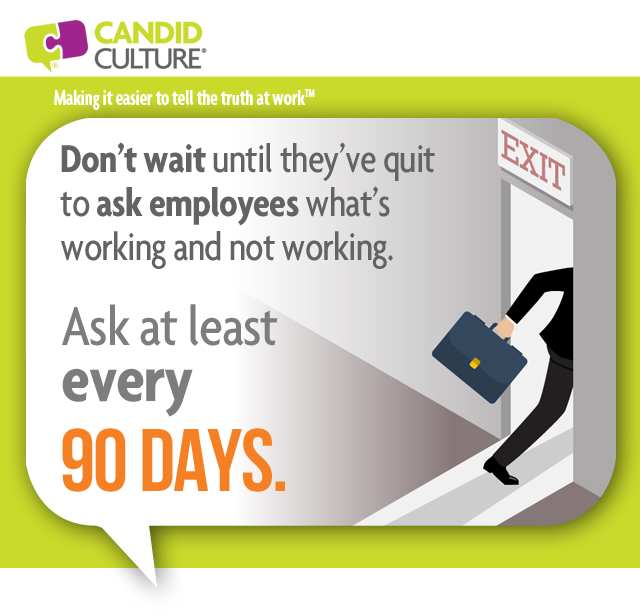
Lots of organizations do exit interviews after employees give notice. Exit interviews can be a source of helpful information. Employees have little to lose after they’ve quit, so they’re likely to speak candidly about their work experience. But asking for feedback after an employee has quit is a little (a lot) too late. The time to ask about an employee’s working experience is every 90 days, if not more frequently.
Employees quit. It’s a natural part of doing business. And some turnover is healthy and helpful. Surprises, however, are not helpful and are unnecessary. Turnover should rarely, if ever, be a surprise. The writing is always on the wall, if you ask the right questions and make it easy to speak freely.
Most employees are concerned about giving feedback when their input is negative. Employees at almost every company believe there is “a list,” and those who speak up, end up on it, and then mysteriously disappear from the organization. Mind you, no one has ever seen the list, but employees at all types of organizations are certain it exists.
If you want to reduce the turnover in your organization and increase employee engagement and satisfaction, ask for feedback regularly, and make it easy to speak candidly.
Five ways to get your employees talking before they quit:
Ask for feedback at the end of every meeting. Simply ask, “What are you enjoying about your job? What are you not enjoying?” Or ask, “What makes your job easier? What makes your job harder?”
Manage your responses to feedback. The easier it is to tell you the truth, the more truth you’ll get. Employees are afraid of their manager’s reactions. Resist the urge to become defensive (which is very difficult to do). Saying, “I’m sorry that was your experience. Thank you for telling me,” goes a long way. Employees will breathe a sigh of relief and are more likely to speak candidly in the future.
Replace one satisfaction survey with roundtable discussions during which a leader or manager asks a small group of employees for feedback. Live conversations build trust and loyalty. Written surveys do not.
Help employees who aren’t a good fit, exit the organization. Don’t allow poor performers or employees who aren’t a good culture fit to drag down other employees. Help misplaced employees find a better match. The right employees raise performance and morale, the wrong employees destroy both.
Don’t be afraid to ask for feedback. Just because you asked for feedback, doesn’t mean you have to act on that information. Employees don’t typically expect all of their requests to be met. It’s often enough just to be able to speak and be heard.
Keep doing exit interviews, and add quarterly or monthly requests for feedback. Talk with people over the phone, via video, or in person. Ask one or two simple questions to get the other person talking. Manage your face and body language. Say “thank you” for the feedback, and watch your employee engagement and satisfaction rise.
Sign Up
Career tips you won't get elsewhere. Sign up to get a free tip card.