Archive for September, 2024
People don’t like the phrase “negative feedback” because it is, well, negative. So, someone came up with “constructive feedback”, i.e., “I have some constructive feedback for you.” I don’t particularly like that either. The definition of constructive is useful, and I think all feedback should be useful. I like the word “upgrade” instead. Upgrade implies the need for improvement, but it isn’t negative. The question is, which comes first, positive or upgrade feedback?
I always give positive feedback first. Not to make people feel better, but to ensure they hear the positive feedback. Most people want to be perfect. We want others to think well of us. Negative feedback calls our perfection into question and thus is hard to hear. When people get negative feedback, they naturally become defensive. It’s hard to listen when you’re defending yourself. If positive feedback comes after negative feedback, the positive feedback isn’t even heard. The negative feedback is all consuming.
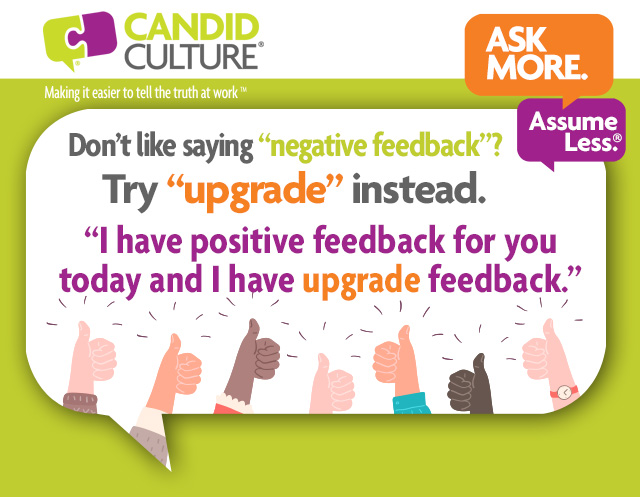
When giving feedback, I tell people, “I have positive and upgrade feedback for you today. I’m going to give you the positive feedback first.” I give positive feedback, then I give upgrade feedback, and then I remind the person about the positive feedback, because I know the person is now consumed thinking about the negative feedback.
Think about yourself. If you receive seven pieces of positive feedback and one piece of upgrade feedback, what do you think about for the rest of the day? If you’re like most people, the rest of your day is about the upgrade feedback. We want to do good work and be thought well of, and negative feedback calls all of that into question and is thus, hard to hear.
Give positive feedback first, then give upgrade feedback, then remind the person about the positive feedback. People can handle feedback when it’s delivered by a trusted person in an objective way.
You will be passed over for jobs, projects, and opportunities, and never know why. Being passed over isn’t necessarily a bad thing, not knowing why you were passed over is problematic. If you don’t know why you’re being passed over, how can you be prepared next time?
Organizations are political. People talk. You’ve undoubtedly already experienced this.
If you want to manage your professional reputation, one thing you must know is who talks about you and what they say. How decisions get made in organizations isn’t always obvious. There are the obvious channels of decision making, like your boss and your boss’s boss. But there are also the people who talk to your boss and boss’s boss and have an opinion about you, who you may not be aware of.
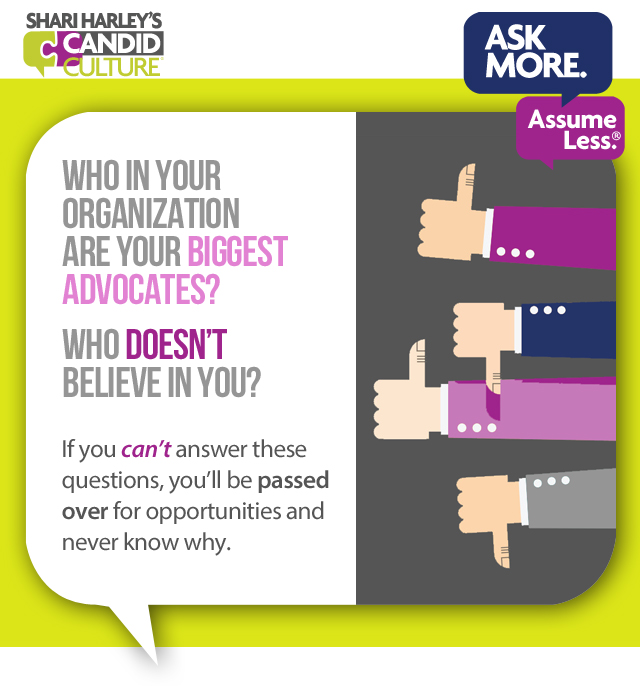
Everyone in an organization has people they trust, who they listen to and confide in. Who those trusted people are isn’t always obvious. When you’re being considered for a new position or project, the decision makers will invariably ask others for their opinion. Knowing who does and doesn’t support you in a future role is essential to managing your professional reputation and career.
I don’t want you to be nervous, paranoid, or suspicious at work. I do want you to be savvy, smart, and aware.
It’s not difficult to find out who can impact your professional reputation at work, you just need to ask the people who know. Start with your manager. Your manager likely knows and will tell you, if you ask.
To ensure you know who can impact your professional reputation, tell your manager:
“I really enjoy working here. I enjoy the people, the work and our industry. I’m committed to growing my career with this organization.”
Then ask two or three of these questions:
- Who in the organization should I have a good relationship with?
- Who/what departments should I be working closely with?
- Who impacts my professional reputation and the opportunities I have?
- What skills do I have that the organization values most?
- What contributions have I made that the organization values most?
- What mistakes have I made from which I need to recover?
Your manager doesn’t walk around thinking about the answers to these questions. If you want thoughtful answers, set a time to meet with your manager. Tell your manager the purpose of the meeting – to get feedback on your professional reputation so you can adeptly manage your career – and send the questions in advance, giving your manager time to prepare for the meeting. You will get more thoughtful and complete answers if your manager has two weeks to think about the questions and ask others for input.
Don’t be caught off guard by a less-than-stellar professional reputation. Take control of your reputation and career. Ask more. Assume less.
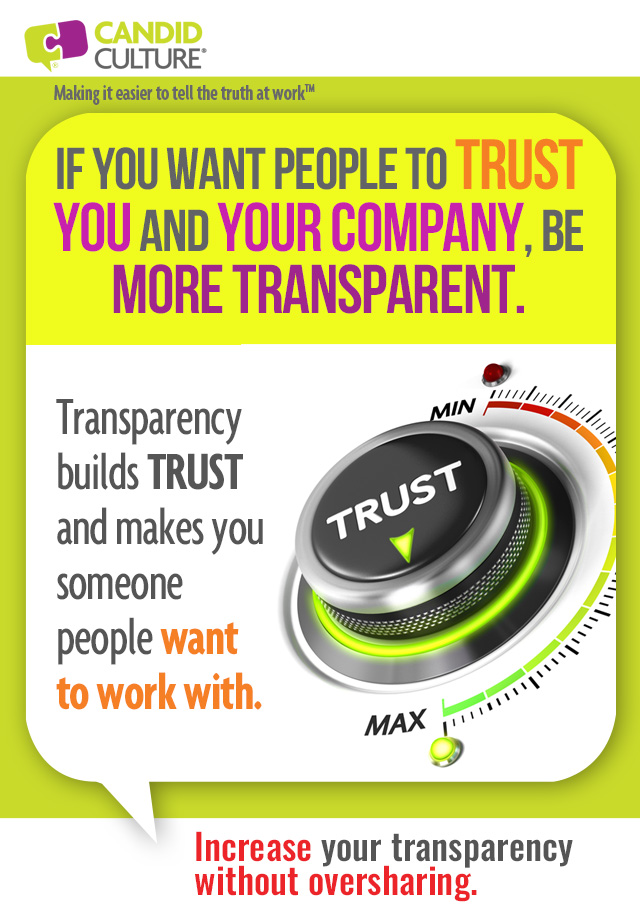
Hire people using whatever legal criteria you like. Compensate employees however you like. Charge for your products and services however you like. Run your business however you like. But be transparent about your practices. People want to work with those they trust. Transparency builds leadership trust.
A few weeks ago, one of our vendors gave me a bill that was higher than what I expected, so I asked for an itemized invoice. I never heard from the company again. Poof: they disappeared. Not a great way to build leadership trust nor a reputation.
Another vendor was very delayed in filling our product orders. When I asked questions about how such a thing could happen, I got a vague answer. “I guess we have communication issues, and you got lost in the shuffle.” It was an insufficient and thus bad answer that didn’t instill confidence in the company. Instead, it created doubt that they could reliably meet our needs, and we’re going to replace them.
One of my friends recently got turned down for an internal job. She was told, “You’re just not the right fit – an unhelpful and yet typical way to decline an internal candidate.
You don’t owe your employees or customers answers, but if you want people to want to work with you, have confidence in you, and trust you, you’ll provide more information than you think you need to.
Employees and customers can handle the truth. And while you may not think you need to provide it, people want to work with those they trust. We trust people who give us the whole truth, or at least more of it than, “I guess you got lost in the shuffle.”
Increase business trust: Be clear and transparent about your pricing.
Increase corporate trust: Tell employees how and why you make the hiring decisions you do. They’ll refer friends to work for you, even when you decline them.
Increase leadership trust: Tell employees how the organization makes money, the feedback you’re getting from prospects and customers, and why you’re making the business decisions you’re making. Employees will feel more connected and thus committed to the organization.
Knowledge makes people feel comfortable. The people who work for and with you want to understand how and why decisions are made. If you want your customers and employees to trust you, give them a little more truth than you might think necessary.
I’ve wanted to be an introvert my whole life. It’s going poorly. Introverts think, then speak. What an amazing quality. Extroverts, like me, wake up talking and then spend much of the day apologizing for what we’ve said.
While I covet introverts’ thoughtful communication style, they are at a disadvantage at work. The people we work with are busy and have limited exposure to coworkers. As a result, others judge us very quickly. If we don’t speak up in meetings or find another way to express our thoughts, people are likely to think we have little to offer. Regardless of your communication style, if you want people to know the value you provide, find a way to share it.
You can’t, won’t, and shouldn’t become a different person to get ahead at work. You have to be yourself. Trying to be someone you’re not, will be painful, frustrating, and short lived. Rather than trying to become someone or something else, find ways to express yourself within your natural style.

Here are four tips to communicate powerfully as an introvert:
Being introverted communication tip one: If you know you’re hesitant to speak up in a meeting, perhaps share your views with the meeting attendees individually – verbally or in writing – before the meeting happens.
Being introverted communication tip two: Make sure the people who can impact your career know your accomplishments. You don’t need to wear a billboard advertising what you’re doing, sending a monthly list of accomplishments and priorities to your boss and boss’s boss (clear this with your boss first) will do the trick.
Being introverted communication tip three: Find your own way of talking about what you think is important. Maybe your conversations will be over lunch with one or two people. Perhaps you’ll periodically email key people with ideas. The point is to find a way to express yourself that resonates with your personal style. Don’t keep all your ideas to yourself.
Being introverted communication tip four: Push yourself to speak up in meetings more than you might naturally be inclined to do so. Being prepared will help you speak up.
Know what’s on meeting agendas. When you feel strongly about a topic, prepare what you want to say. Take notes and consider practicing out loud. Do whatever you need to feel comfortable expressing yourself in front of a group. And if speaking up in a meeting feels too uncomfortable, remember, people who don’t get a lot of exposure to you are evaluating you based on your contributions during meetings. Find a way to make your views known.

People sometimes leave giving and receiving feedback training confused. Armed with the skills to be candid, they think they have the right to say anything they want. Not the case. Feedback isn’t a weapon or a license to dump your opinion on people. Unsolicited and unwelcome feedback is like fish you left on your countertop for too long. It stinks.
You have the right to ask for and accept the feedback you want from peers and customers and reject the feedback you don’t. Help people know the feedback you want by providing clear parameters on what type of input you do and don’t want. You are not a dumping ground.

Follow these steps to manage the feedback you get from others:
Giving and receiving feedback tip one: Don’t ask for feedback because you think you’re supposed to. There are lots of leadership books and training programs that tell leaders to be open to and ask for others’ input. Only ask for input you want. If you’ve made a decision or don’t want others’ input, don’t ask for it. While you might get more buy in by asking people for their input on decisions that impact them, you’re allowed to decide without forming a committee.
Giving and receiving feedback tip two: When you ask for input, be very specific about the type of input you want. Guide people. Tell them, “I’m specifically looking for input on ____________. I’m not looking for input on ____________.” And if you still receive unwanted feedback, remind people about the input you are and aren’t looking for. In the spirit of being helpful, people can overstep their bounds.
Giving and receiving feedback tip three: Don’t be afraid to shut people down who provide unsolicited feedback. The words, “Thank you for your concern. I’m not looking for input on that at this time” will do the trick. Yes, you really can say that.
Giving and receiving feedback tip four: Don’t take feedback personally. While most people don’t think about it in this way, giving feedback subtly tells you that you’re doing something wrong, or at least not how the other person would do it. There are lots of ways to achieve a result. Their way may or may not be better than yours.
Giving and receiving feedback tip five: Trust yourself. You likely know what you want to do a lot of the time. If you find yourself asking for input when you know what you want to do, stop asking. Listen to your gut and decide.
Feedback has a time and a place. I ask for and listen to a lot of feedback, but not all the time and not about everything. Sometimes, you know best.