If you’ve gotten courageous and given someone negative feedback or questioned a decision or action, you probably didn’t get a shiny, happy reply in return. The normal and natural reaction to negative feedback is to defend ourselves. It’s human. Defending yourself when receiving negative feedback is an act of self-preservation, not unlike hitting your brakes when the person driving in front of you unexpectedly slams on their brakes.
The problem with reacting defensively to negative feedback is that it’s scary and off-putting to others. As normal as a defensive reaction is to negative feedback, it makes others so uncomfortable that they’ll be hesitant to give you negative feedback again. And this lack of knowledge of what others really think is dangerous. Silence inhibits career growth and leads to bad business decisions. You want people to tell you the truth, as they see it, so you need to make it easy to speak freely.
If you want more of what others see as the truth, do the opposite of what people expect. Rather than defending or going silent, say “thank you.” “Thank you for telling me that. I’ll think about what you said and will likely come back to you to discuss further,” buys you time and puts the other person at ease.
Here are five ways to make it easier to say thank you for the feedback:
Only accept feedback when you’re ready to listen. You’re allowed to request a conversation at a time that works for you. Bad days, when you have five minutes between meetings, or are about to leave for a vacation, are not the times to accept negative information. Set up a time to talk, as soon as you have the bandwidth to listen.
Take breaks during hard conversations. You’re allowed to say, “I need a few minutes.” Go get coffee. Take a walk. Go outside. Regain your composure. Then continue the conversation.
Have feedback conversations when you’re rested and have eaten. Everything seems bigger and more difficult when we’re tired or hungry.
Accept that “thank you” isn’t the same as telling the other person they are right or that you agree. “Thank you” is a mere acknowledgment that you heard. It buys you time and gives you a chance to gather your thoughts and respond when you’re not emotional.
Don’t have conversations when you’re upset, and we often don’t know when we’re upset. Your emotions will run the show. Give yourself time to get through your emotional response, and then talk.
People are more hesitant than you think to tell you when they disagree. Make it easy to speak up. Do the opposite of what others expect. Say “thank you” rather than reacting, and you’ll get more data than you do now.
There was way too much guessing at work before most people began working from home. Without visual cues, figuring out how to work with people is even harder. You may find yourself thinking, “I’m going to miss this deadline. I wonder what the consequences will be?” Or perhaps, “They said they wanted input on this project. I wonder if they really meant that, and how much feedback is ok to provide?” Or maybe, “They asked for a proposal. Are they expecting something elaborate, or will a one-pager do?”
We often don’t know what others are expecting from us, so we guess. The problem with guessing is that we may do more work than we actually need to, and not in the way the other person wants it. Even worse, when we don’t work according to others’ expectations, they aren’t likely to tell us. Instead, they tell others and make decisions about us that aren’t positive.
I’m a fan of asking lots and lots of questions, preferably at the beginning of anything new. Anticipate all that can happen, get in front of breakdowns, and set clear expectations by asking questions. The people who participate in virtual and in-person training with me get an entire box of questions to ask. And the homework is to go ask more questions of the people they work most closely with. Asking questions will always be easier than recovering from violated and often unstated expectations.
If you want fewer breakdowns and frustrations at work, ask the following questions of the people you work with:
What do you want to do, on this project, and what do you want me to do?
What does a good job look like?
What will be different in the organization when this project is finished?
How would I frustrate you and not even know it?
How often do you want to receive updates from me?
Do you want to receive all the details or just big picture information?
Do you want to receive the information in bullet form or paragraphs?
It’s never too late to ask questions like these. It’s ideal to ask the question at the beginning of a piece of work. But asking in the middle or even towards the end is fine too. People will appreciate that you asked, whenever you ask.
Posted under Uncategorized on August 12, 2024 by Shari Harley. 0 Comments
Employees leave managers not jobs. We’ve all heard this 100 times.
One of the most prevalent reasons for employee turnover is boredom and lack of growth. We’ve also heard this many times.
We know why employees leave jobs. The question is what must managers do to engage and retain their best people. The answer is actually quite simple, although not necessarily easy to execute.
Employees want to know that their manager:
Knows them
Cares about and is invested in their careers
Gives feedback so they can improve
Provides opportunities so they can develop
In other words, employees need attention, and attention requires time – time many managers may not feel they have.
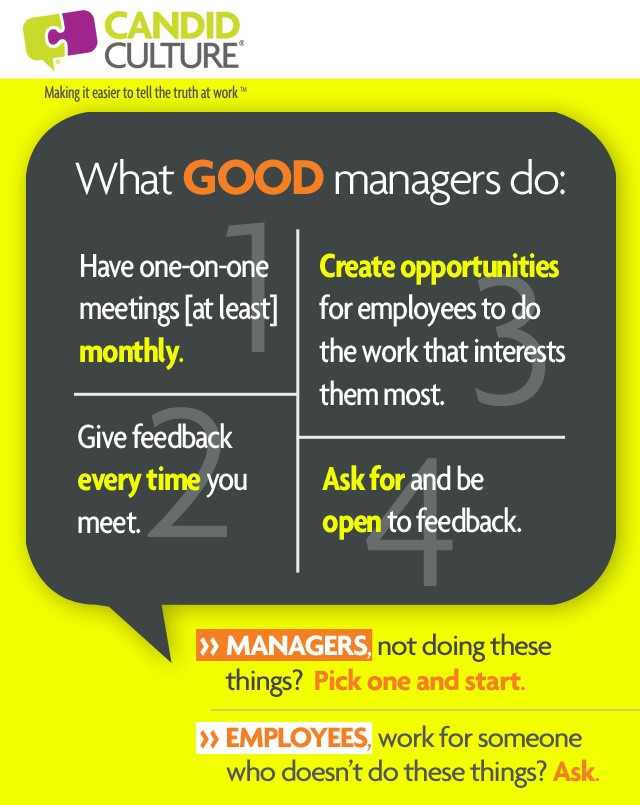
Here is a five-step formula for employee retention and employee engagement:
Get to know employees better and differently.
Have meaningful, one-on-one meetings [at least] monthly.
Give balanced feedback as work is done.
Ask for and be open to feedback.
Create opportunities for employees to do the work that interests them most.
Managers, how do you make time for these meetings when you are busy and have several direct reports?
Meet for 15-30 minutes.
Ask direct reports to create an agenda and run the meetings.
Ask direct reports to send follow-up notes of decisions and plans made during meetings. Give some of the accountability away.
If meetings get cancelled, reschedule as soon as possible. Direct reports take cancelled meetings personally. Cancelled meetings that are not rescheduled send the message that managers don’t care about employees and their careers.
Employees, if your manager doesn’t schedule meetings with you:
Ask permission to put a monthly meeting on your manager’s calendar.
Provide rationale for why you want to meet – to get your manager’s feedback and ensure you’re focused on the right work.
Ask permission to reschedule meetings when they get cancelled.
Don’t take cancelled meetings personally.
Offer to meet with your manager via the phone when it’s convenient for them. Leverage commute and travel time, if applicable.
Employees need time with their managers. Meaningful discussions and work, result in employee engagement and employee retention. So managers, make the time, even when you don’t feel you have it. Ask questions you don’t ask now. Give feedback, even when it’s uncomfortable. Give your employees an opportunity to do the work that interests them most. And watch your employee engagement and employee retention improve. And if your manager doesn’t do these things, politely and persistently ask. You won’t get what you don’t ask for. We are all 100% accountable for our careers.
When the people we work with don’t do their jobs, we might find ourselves saying, “They should be more on top of things.” “They shouldn’t make commitments they can’t keep.” “They don’t know what they’re doing, and that’s not my problem.” The challenge is, when your coworkers don’t perform, it is your problem.
When your coworkers don’t get you the information you need in a timely way, you miss deadlines. When you work from incorrect information, your reports are wrong. When others don’t work with you, you look bad. So, you can be right all day about how others perform, and your reputation will still be negatively impacted.
I don’t suggest you enable your coworkers by doing the work others don’t. I do suggest you help your coworkers be successful by holding them accountable.
Here are a few things you can do to manage your career and get what you need from your business relationships:
Don’t assume others will meet deadlines. Check in periodically and ask, “What’s been done so far with the XYZ project?” Notice, I didn’t suggest asking, “How are things going with the XYZ project.” “How are things going” is a greeting, not a question.
Set iterative deadlines. If August 25th is your drop-dead deadline, ask to see pieces of work incrementally. “Can I see the results of the survey on August 10th, the write-up on August 15th, and the draft report on August 20th?” One of the biggest mistakes managers and project managers make is not practicing good delegation by setting iterative deadlines and reviewing work as it’s completed.
Don’t just email and ask for updates. The people you work with are overwhelmed with email, and email is too passive. Visit people’s offices or pick up the phone.
You might be thinking, “Holding my coworkers accountable is awkward. I don’t have the formal authority, and I don’t want my coworkers to think I’m bossy or damage my business relationships.”
It’s all in the how you make requests.
If you’ve seen me speak or have read the business book How to Say Anything to Anyone, you know I believe in setting clear expectations at the beginning of anything new. That could sound something like, “I’m looking forward to working with you on the XYZ project. How would you feel if we set iterative deadlines, so we can discuss work as it is completed? You’ll get just-in-time input, making any necessary adjustments as we go, and we’ll stay ahead of schedule. How does that sound? How are the 10th, 15th, and 20th as mini deadlines for you?”
Many people put large projects off until the last minute. People procrastinate less when large projects are broken into smaller chunks with correlating deadlines. You strengthen your business relationships and support people in meeting deadlines and not procrastinating when you agree on completion dates when projects begin. Also, most of us unfortunately know what it’s like to put a lot of work into a project, have someone review our completed work, and then be told we went down the wrong path and need to start over.
Ask more. Assume less. Don’t assume your coworkers will do what they’re supposed to do. Ask upfront to see pieces of work on agreed-upon dates. Pick up the phone versus rely on email to communicate and know that the people you work closely with are a reflection of you. Get people working with you, and everyone will look good.
Sign Up
Career tips you won't get elsewhere. Sign up to get a free tip card.