Archive for June, 2024
No one likes to make mistakes. We want to do good work and have people think well of us.
The key to maintaining your relationships and reputation, when you make a mistake, is to take responsibility and make things right as soon as possible. Saying something wasn’t your fault or becoming defensive will only damage your reputation and relationships. As counterintuitive as it sounds, you will gain respect and credibility by taking responsibility and correcting problems.
I often get asked if people lose credibility by being humble – asking for feedback and admitting to making mistakes. It takes strength to ask for and be open to feedback and to admit when you drop the ball. So, while it may seem counterintuitive, the more you ask for and respond to feedback, and admit when you make mistakes, the stronger you will appear.

I made a mistake at work. Now what?
When you make a mistake say something like:
“I dropped the ball on that. I apologize. I’ll fix it and let you know when it’s been handled.”
Or, “Thank you for the feedback. This clearly didn’t go as planned. I’ll make those changes and let you know when they’re done.”
Also, let people know the steps you’ll take to avoid similar challenges in the future.
You could say something like:
“Thanks for letting me know that our process is causing your department challenges. We certainly want the process to be smooth. My team will fix this month’s report, so your team doesn’t have to invest more time. We’ll update the process for next month and walk you through the changes before the report is due next month.”
Don’t provide a bunch of reasons for breakdowns. No one cares. Telling people why something occurred can sound like excuse management. People just want to know things will be made right.
Asking for feedback, taking responsibility, and telling people how you will correct errors may not be your natural or first reaction. The more you can train yourself to do these things, the easier you will be to work with and the better your reputation and business relationships will be.

Companies want people who make things happen, and to make things happen, you have to speak up. Anticipating the train wreck and commenting after the train goes off the tracks, doesn’t count.
What if you said what you thought, in a way other people could hear you, when you had the right to do so? Meaning, you have the relationship with the other person to tell the truth and you’ve asked permission to be candid?

6 Courageous Steps to Advance Your Career:
- Look for opportunities to make things better.
- Ask for permission to take the ball and run with it.
- Build relationships with other people who are making things happen.
- Don’t say yes, when you mean no.
- Find a way to say no, while engaging the other person in a conversation so a new approach is generated.
- Be willing to go out on a limb, work hard, and fail.
Here’s how to speak up for change without being labeled as the problem person who finds flaws in everything:
- Look for and present solutions, not just problems.
- Offer to do the work to move towards a better way of doing things. Don’t drop problems at other people’s doors.
- Ask questions versus overtly say that something is wrong. That could sound something like, “I’d love to help. Tell me more about how this works. Maybe we can insert a step to make the process better. What do you think of trying ________?” No one likes to be told they’re wrong. Asking questions elicits participation more than overtly saying, “This is broken. We need to fix it.”
Many people are afraid to speak up at work and believe that people who speak up get fired. I haven’t found this to be the case. People who work hard and produce results are typically the last people to be let go.
Say what you think in a way that is not critical. Offer solutions, not just problems. Be a force for good and take an active role in making things better, and my hunch is your career will accelerate faster than you ever thought possible.

You interviewed for a job four weeks ago but haven’t heard back from the recruiter. You asked a coworker to have lunch, no reply. You asked a team member for a document, but after three emails, two texts messages, and a voicemail, still no reply.
It’s normal and natural to go to a dark place when we don’t get the response we’re expecting. We wonder, “Maybe they don’t like me? Perhaps they don’t want me involved in the project? Did I step on their toes? Maybe I asked in the wrong way?”
Wondering why we haven’t heard from people and inventing reasons for the lack of communication is normal and natural. It’s also exhausting and draining.
I’ll admit, I am on pins and needles after I deliver a training program, until I connect with my client to hear how they felt about the program. Even when I know I did a great job, I need to get the feedback and I’m on edge until I get it.
I’ve had enough training on communication and interpersonal relationships to know that others’ responses are usually not personal. People are busy taking care of themselves, as they should. They’re thinking about their own deadlines, deliverables, and the demands on their own time. Ninety-nine percent of the time they’re not thinking about us.
People are wired for self-preservation, and this very good and important. If you don’t take care of yourself, who will? The question, is how do we get our own needs met when we don’t get the response we’re expecting or the communication we need?
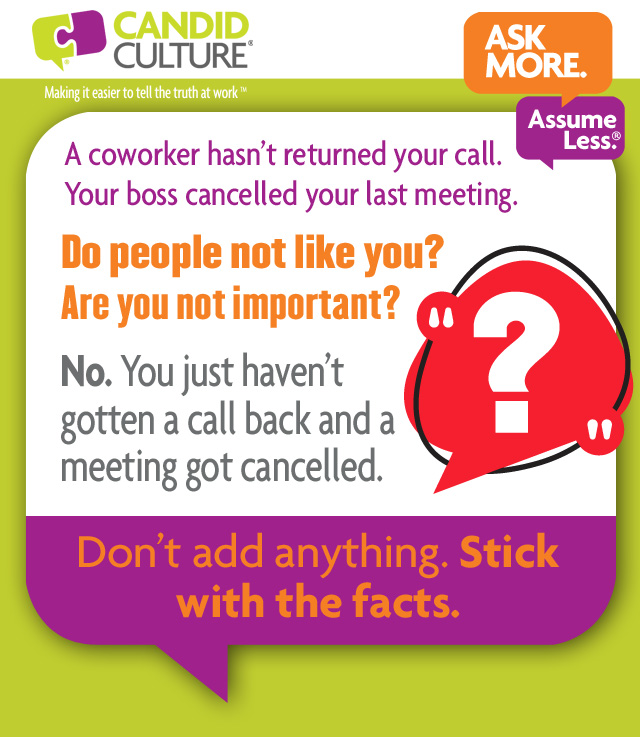
The most powerful approach is to remember that people’s response or lack thereof has nothing to do with us, and to let it go. Don’t be consumed with the lack of communication. Move on. You’ll hear back from the person when you hear back. This would be a powerful position to take, and it’s very difficult, at least for me.
The next approach could be to make up an interpretation that empowers you. If you’re inventing a reason you haven’t heard from the person; you might as well invent a reason that makes you feel good. For example, “The person participated in an escape room this past week and hasn’t made it out yet. They don’t have an Apple watch and have no way to communicate.”
Another approach is to set expectations when you begin working with people. Ask the recruiter, “If I haven’t heard back from you and a few weeks have passed, is it ok if I call to check in?” Ask your boss, “Is it ok if I reschedule meetings that get cancelled?” Ask your coworkers, “If I need information but haven’t heard back after three attempts, what should I do? Who else can I ask rather than wait?” Having a plan in place when you don’t get the communication you need will give you a clear course of action, rather than guessing.
But ultimately the most powerful – even if it’s the most difficult – response is to know deep down that the lack of communication is not about us.
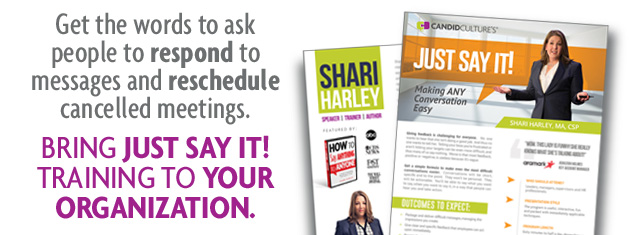
Yoga, wellness programs, and mindfulness will not prevent or eliminate burnout. Burnout is an organizational issue. If you want to prevent and eliminate burnout, focus on your organization, not individuals.
Burnout comes from a lack of role clarity and employees feeling like they can’t be successful at work, either because they consistently have more work than can be done in a regular work week or because they work for a manager who is a perfectionist, and nothing is ever good enough. Employees who constantly feel pressured at work or feel like they’re failing, regardless of the amount or level of work they produce, are susceptible to burnout.
Have you ever gone on vacation, had a relaxing time, and two days after you returned to your regular life, forgot all about that vacation? That’s like burnout. When the yoga class or vacation is over, you go back to your job with unrealistic expectations. Nothing has been solved.
Companies try to make employees’ experience more manageable with programs and perks, but what employees really need is a manager who clarifies roles so everyone knows who does what, helps employees manage their workload, and creates open relationships so employees feel comfortable saying when they’re overwhelmed.
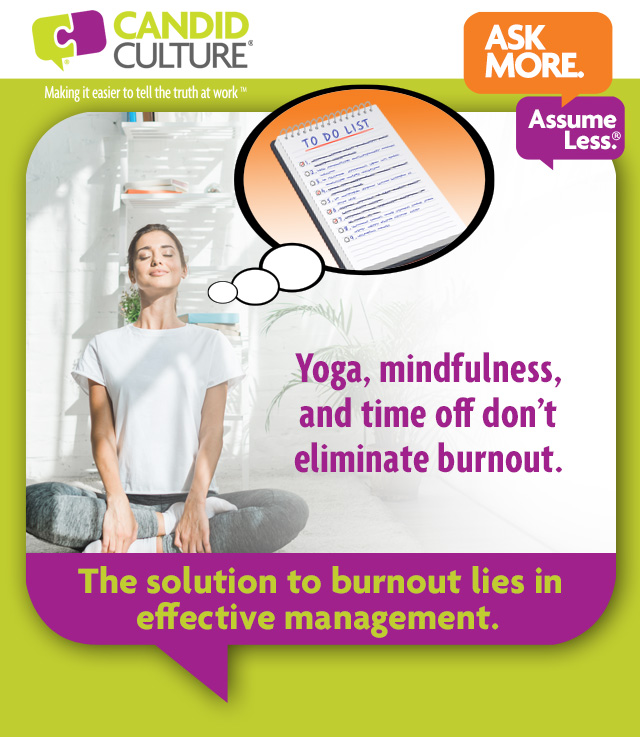
Train your managers to do these three things to prevent and reduce burnout:
- Clarify roles so people know what they’re accountable for and to eliminate redundancy. It’s very frustrating to feel overwhelmed, only to find that someone else on your team or in another department is working on the same project as you.
- Manage workload and set realistic deadlines. If an employee regularly has more to do than can be done in a 40-hour work week, eliminate something – change deadlines, reallocate work, and evaluate if everything being done is necessary. If you can’t eliminate a project, evaluate if it can be scaled back. Is every bell or whistle necessary?
- Create an atmosphere of psychological safety so employees are comfortable asking for help prioritizing work. Most employees suffer in silence until they’re so overwhelmed and exhausted, they quit. Finding employees’ resumes circulating on LinkedIn is predictable and thus preventable.
-
- You can get employees talking by scheduling a short, weekly debrief – 10 minutes – of what’s working and not working.
- Help employees prioritize responsibilities by assigning each priority a letter – A, B, or C – in order of urgency.
- Ensure there are no consequences for asking for support. Word gets around. If an employee is penalized for asking for help, other employees will learn not to speak up when they need support.
Allocate work to allow employees to be successful, focus on the projects that really matter and eliminate the rest, and create an organization in which it’s safe to tell the truth. That will solve burnout.