Archive for May, 2024
Most training programs about giving feedback focus on negative feedback, because giving negative feedback is hard and makes us uncomfortable. But most people aren’t any better at giving positive feedback.
Most of the positive feedback people get at work really isn’t feedback at all. It’s vague, fluffy, and unhelpful. Aka, Cap’n Crunch – sweet but useless.
“Great job.” “You’re awesome.” “You’re great to work with.” None of this qualifies as real feedback.
The purpose of positive feedback is to make people feel valued and appreciated and to get them to replicate a behavior. Telling someone, “great job” or “you’re doing great work” will make the person feel good (momentarily), but won’t tell them what to replicate. These phrases are vague, and vague positive comments come across as inauthentic at best and unhelpful at worst.
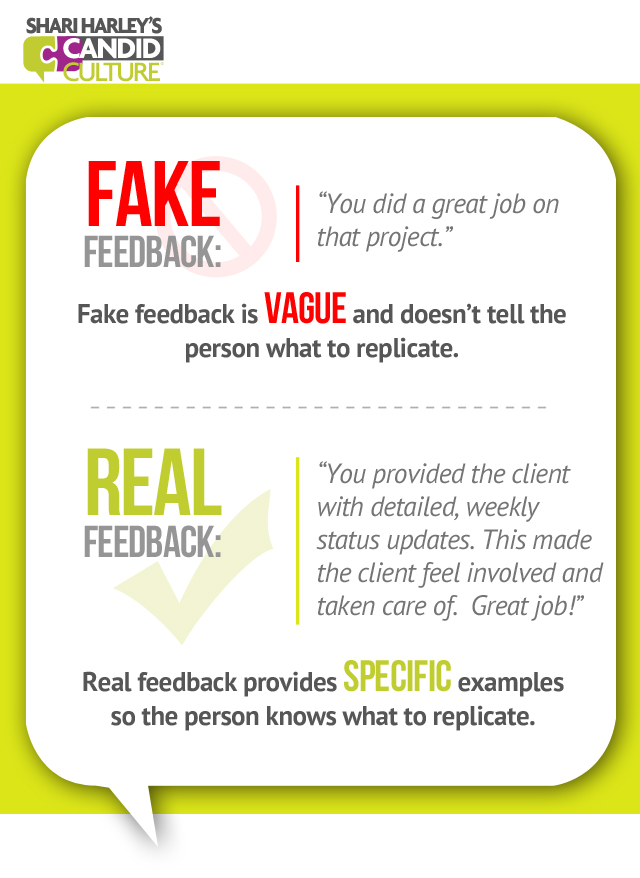
Here are a few examples of what I refer to as real vs. fake feedback:
Example of positive feedback:
Fake feedback: “Great job.”
Real feedback: “You researched three vendors when making a proposal of who we should choose to manage our payroll operations. You included all the necessary information for us to make a decision and presented the information in a one-page table that was easy to read. Your work made it really easy to make a decision.”
Example of positive feedback:
Fake feedback: “You’re really reliable.”
Real feedback: “I know that whatever I give you to do will get done the first time I ask and will be accurate. I don’t have to ask again or check your work. You check your work for typos and mistakes before submitting it.”
Example of positive feedback:
Fake feedback: “You make my job easy.”
Real feedback: “Last week you noticed an invoice that didn’t seem accurate. You researched the invoice and got the mistake corrected before I even knew there was a problem.”
Example of positive feedback:
Fake feedback: “You’re awesome.”
Real feedback: “You always do what’s right for the company. Last week you called a vendor whose service has been spotty. You provided them with feedback and asked for their plan to improve their service levels. This added a lot of value to our organization.”
The guidelines for giving positive feedback are the same as giving negative feedback:
- Be specific.
- Give an example.
- Give feedback close to the time an event happens.
To give specific and meaningful positive comments, you will have to observe performance, and that takes time. But if you want someone to replicate a behavior, tell the person specifically what they did well.

Many years ago, before starting Candid Culture, during my annual performance review, my manager said, “You had a great year. You rolled out 18 new training programs and got more participation in those programs than we’ve ever seen in the past. But you’re all substance and no sizzle. You’re not good at sharing the work you’re doing, and as a result my boss doesn’t know enough about what you’re doing to support a significant salary increase for you, so I can’t even suggest one.”
That happened to me ONCE, and I swore it would never happen again.
Too many people believe that if they do good work, the right people will notice, and they will be rewarded appropriately. Part of this thinking is accurate. To be rewarded appropriately, you need to be doing good work. But the people in a position to reward you also need to know what you’re doing and the value you’re adding.

You need to find a way to share the value you’re providing without going over your boss’s head, sucking up, or alienating your coworkers.
Here are three ways to manage up while strengthening your business relationships.
All of these practices work whether you’re working virtually, hybrid, or in the office full-time.
Manage up tip number one: Ask your manager’s permission to send them a monthly update of what you accomplished during the month. The update should be a one-page, easy-to-read, bulleted list of accomplishments or areas of focus.
Your boss is busy doing their own work. As a result, you need to let managers know about the work you’re doing. Don’t make them guess.
Manage up tip number two: Periodically share what you’re doing with the people your manager works for and with. That can sound like, “I just wanted to share what my department is accomplishing. We’re really excited about it.” Ask your manager’s permission to do this and tell them why you want to do it (to ensure that the senior people in your organization are in-the-know about what your department’s accomplishments).
If you’re not sure who can impact your career and thus who you should inform about your work, ask your manager. Managers know and will tell you, if you ask.
Manage up tip number three: Use the word “we” versus “I.” “We accomplished…..” “We’re really excited about….” Using the word “we” is more inclusive and makes you sound like a team player versus a lone ranger.
Don’t assume people know what you’re doing or the value you’re adding to your organization. Instead, assume people have no idea and find appropriate ways to tell them. You are 100% accountable for your career.

There are three reasons people say “that’s above or below my paygrade” or “that’s not my job” – they don’t feel empowered to make decisions, they think they’re being unfairly compensated for the challenges at hand, or they aren’t particularly motivated.
“That’s not my job” (aka, I don’t do things that are outside of my job description) is a mindset, and if someone has it, I’d suggest not hiring that person. People who think they should only have to do what’s on their job description aren’t utility players, and your organization is likely too lean to afford employees who only want to perform in a narrow box.
“That’s not my job” can also be an outcome of leaders and managers who can’t let go and let employees take risks and make decisions. If that’s your management style, hire people who will follow directions and don’t want to create new things and solve problems. Problem solvers will be frustrated if they only get to follow instructions.

Here are six steps to steer clear of “that’s not my job” syndrome and advance your career, regardless of your current role in your organization:
- Never say the words “that’s above or below my paygrade” or “that’s not my job.” Even if it’s true.
- If you don’t have the latitude to solve certain problems, ask the people you work for how they want you to handle those types of issues when you see or hear about them. That’s a subtle way to provide feedback that you don’t have the latitude you need to solve certain problems.
- When you see an impending train wreck, say something. I see lots of very capable employees see the train wreck coming, comment to themselves or others who can’t do anything about the problem (aka gossip), and then nod knowingly when the *&#@ hits the fan. Don’t be that person. Look out for your organization and the people you work with.
- If you see a broken or lacking process, raise the issue with someone who can do something about it, and offer to take a stab at fixing the problem. One of managers’ biggest complaints is employees who dump and run – “I’ve identified a problem. I’m leaving it for you to fix.”
- Go out of your way to do the right thing, even if you are uncomfortable or don’t want to. If it’s easier to email someone, but you know the right thing to do is to pick up the phone, pick up the phone. If an internal or external customer express concerns and you can’t solve the problem, find someone who can. There are lots of ways to make an impact.
- Ask more questions. Find a non-judgmental way to ask, “Why do we do this this way?” “Have we considered…?” “Would you be open to trying…?” Status quo can be the right thing and what’s necessary. It can also be the death of organizations.
Make stuff happen. Don’t pass the buck. And if you are going to pass the buck, don’t announce it. It only makes you look disempowered and uncommitted.