Posted under Uncategorized on February 25, 2024 by Shari Harley. 0 Comments
If you work with other people, there is likely at least one business relationship you wish was stronger. If only that person included you on necessary communications, didn’t gossip about you, or gave you honest feedback, versus telling you everything is fine and then working around you.
What often makes work hard isn’t the work at hand, it’s the people we work with – the power struggles, cc-reply-to-all when everyone doesn’t need to know, and the gossip that pervades most organizations.
You need to communicate and work well with the people you work with. And like any relationship, business relationships require work. But what happens when someone doesn’t return your efforts for a positive working relationship? They don’t return emails or voicemails, ignores requests, or goes above you instead of coming to you when issues arise?
Make three attempts at strengthening a business relationship.
I’ll attempt to strengthen a business relationship three times before giving up. Phone calls, video, and in-person meetings count as an attempt to improve a relationship, emails and text messages don’t. Emails and texts are passive, one-sided communications. If you’re serious about strengthening a relationship, talk with the person, either in person or via video or the phone.
The conversation could go something like, “We’re going to be working together a lot this quarter, I thought it would be helpful to talk through how we both like to communicate and who will do what. When is a good time for us to connect via phone?”
Or, you could say, “A lot has happened this year – good and bad. I thought it would be helpful to talk about what did and didn’t work, so the rest of the year is smooth. Can we schedule a call to talk about it?”
Or, perhaps, “I want to talk with you about how we work together. I think we both know that this year has been hard. I’d love for us to have a good working relationship. Can we talk about how we want to work together going forward?”
I’ll make attempts like those above three times (with the same person). If the person doesn’t reach back, says no, or cancels three scheduled meetings, I give up. Don’t chase people. The people who are interested in fostering a good working relationship will make the time and be willing to be uncomfortable.
What does it mean to give up? You are not the Golden Retriever of the workplace. Nor are you the 7-11 – always open. If someone isn’t interested in talking with me about how we can improve our relationship, I don’t keep asking. After the third no, I’m polite. I include the person in all necessary meetings and communications. I’m professional. But I don’t keep inviting. You can’t work with someone who won’t work with you.
Extend an olive branch. Be forthcoming, brave, and yourself. And if you get three nos’, work on other business relationships and leave this one be.
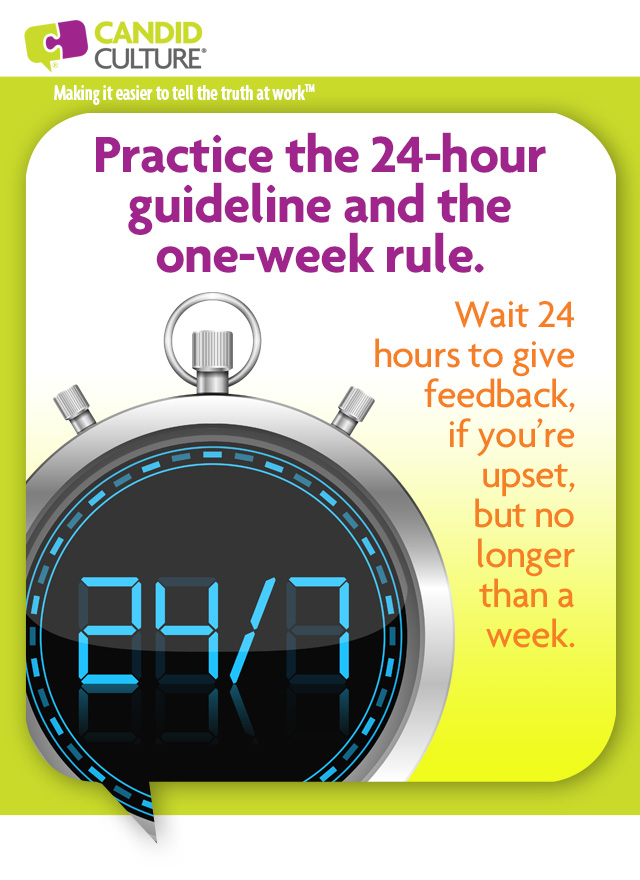
Most of us wait to give negative feedback until it’s the right time, aka the recipient won’t get upset. Or we wait, hoping the situation will resolve itself. If something is really an issue, the likelihood of either happening is pretty slim. The right time to give feedback is shortly after something happens. I’ll offer up the 24-guideline and the one-week rule. Wait 24-hours to give feedback, if you’re upset. But don’t wait longer than a week.
The purpose of giving positive or negative feedback (I like the word upgrade feedback) is to motivate someone to replicate or change a behavior. That’s it. Feedback is supposed to be helpful. If you wait longer than a week to give either positive or upgrade feedback, the person isn’t likely to remember the situation you’re referencing, and the purpose of giving feedback – to change or replicate a behavior – will be lost.
Here are four practices to make negative (upgrade) feedback conversations shorter, less painful, and more useful:
Giving feedback practice one: Agree to give and receive feedback at the onset of relationships. Do this with everyone you work with – direct supervisors, direct reports, peers, internal and external customers, and vendors.
Giving feedback practice two: Prepare for feedback conversations by writing down what you plan to say and then delivering the feedback to a neutral person. Ask that person to tell you what they heard and what their expectations would be, based on what you said. Confide in someone either at your level or above at work or someone outside of work, to keep the gossip to a minimum. Ask for confidentiality.
Giving feedback practice three: Tell a neutral person about your situation, and ask what they would say to address the situation. Everyone but you will do a better job at giving feedback. Feedback conversations become hard when we’re emotionally involved. The guy working at the 7-11 will do a better job than you. Seriously. It’s our emotions and concern about the other person’s reaction that makes feedback conversations challenging.
Giving feedback practice four: Agree to do a weekly debrief with the people you work closely with, and follow-through. Answer the questions – what went well this week from a work perspective and what would we do differently if we could? Answer the same questions about your working relationship. Giving feedback about your relationship will be hard at first. It will be easier the more you do it. Be sure to say “thank you” for the feedback, regardless of what you really want to say. One of the reasons giving negative feedback is so hard is we wait too long. Shorter, more frequent conversations are better than long, infrequent discussions.
Giving negative feedback doesn’t have to be so hard. Follow the suggestions above and remind yourself that the purpose of giving feedback is to be helpful. If you were doing the wrong work, you’d want to know. And others do too.
Years ago, a guy I was dating asked, “We don’t really need to do anything for Valentine’s Day, do we?” I was taken aback by his question (which was really a statement) and replied, “No, we don’t.” But I didn’t mean it. And when he blew off the ‘holiday’, I was furious and let him know it. Instead of having dinner on Valentine’s Day, we had an ugly conversation and a lousy rest of the week. Asking for what I wanted upfront would have been much less painful.
Why is it so hard to ask for what we want, especially from the people who love us? Learn how to get what you want on Valentine’s Day and every day.
We aren’t likely to get what we don’t ask for. The people in our lives can’t read our minds. They don’t know what we want. This is true at home and at work. If you want a report to look a certain way, sketch it out for your employees. If you want a meeting handled in a certain fashion, give detailed instructions. For the most part, we expect things to go well and thus we delegate insufficiently at work and hope to be pleasantly surprised at home.
I hope the people who love you are intuitive enough to give your heart what it wants on Valentine’s Day, and every day. But if they don’t, make it easy for them to please you by telling them what you want. For example, tell the person you love, “I’d love to spend the day together. I don’t care what we do, as long as we’re together.” Or, “I don’t care what you do for Valentine’s Day, but please do something to mark the day.” And if you want something specific, ask for it. “I’d love flowers, despite that they’ll die and are impractical. Anything but roses and carnations would be lovely.”
There is one job interview question recruiters and hiring managers must ask. And the answer should be a deal-breaker.
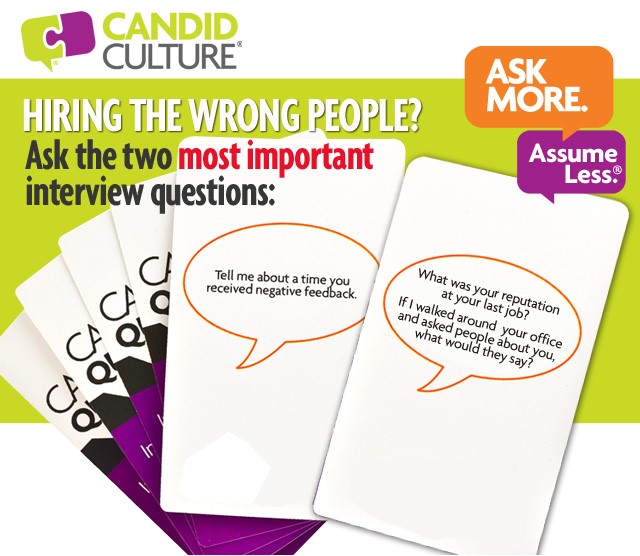
The most important job interview question for any role in every organization: Tell me about a time you received negative feedback.
This is NOT the same question as tell me about a weakness. Or tell me about a time you made a mistake at work. Those are also important job interview questions to ask. But they’re not the most important question.
Let’s assume everyone you interview is age sixteen and older. Unless your candidates live in a cave, never speaking to anyone, it’s not possible to arrive at age 16 without having received negative feedback. The feedback can come from a friend, teacher, or parent. It doesn’t need to be work-related.
The point of the question is to discover whether the candidate is open to feedback. People who are not open to feedback are extraordinarily difficult to work with. They aren’t coachable. Any type of feedback they receive will result in resistance and defensiveness.
Employees who aren’t open to feedback won’t change or improve their behavior, regardless of how effective a manager is. Instead of listening to feedback and taking corrective action, employees who are not open to feedback will tell managers why they are wrong.
Everyone you interview has received negative feedback at some point. The question is whether or not candidates were receptive to the feedback. People who aren’t open to feedback won’t be able to answer your question.
If candidates can’t tell you about a time they received negative feedback, ask a follow-up question. Your job as the interviewer is to give candidates every possible opportunity to be successful. If you don’t get the answer you’re looking for, ask the interview question in two different ways, until you’re certain the candidate can’t or won’t answer the question.
If candidates can’t tell you about a time they received negative feedback, ask what their reputation is at their current job or was at a previous job. Candidates probably won’t be able to answer this question either. Most people don’t know their reputation at work.
Even if a candidate doesn’t know with certainty their reputation at work, the answer they provide will give you a sense of how self-aware they are. People who are self-aware are more open to feedback and are easier to coach and manage than people who are not self-aware.
I eliminate candidates who demonstrate they aren’t open to feedback, whether I’m hiring for Candid Culture or for one of my clients. I don’t care how credentialed or experienced the candidate is. If candidates aren’t receptive to feedback, they don’t get a job offer.
Sign Up
Career tips you won't get elsewhere. Sign up to get a free tip card.