Archive for October, 2023
At some point in our career, most of us have taken a class that told us to give feedback that sounds like, “I felt ___________ when you ___________.” I couldn’t disagree more.
Most people get defensive when they receive negative feedback. Becoming defensive is a normal and natural response to upgrade (my word for negative) feedback. It’s the ego’s way of protecting us. Defensiveness kicks in when the recipient feels judged, and it’s difficult to listen when we’re defensive.
If you say to someone, “I felt embarrassed when you yelled at me in front of the team,” defensiveness kicks in at the word “embarrassed”. The recipient is now defensive (and is likely no longer listening) but does not yet know what they did to upset the person. Instead, lead with the facts, so when the listener becomes defensive, at least they know what they did.
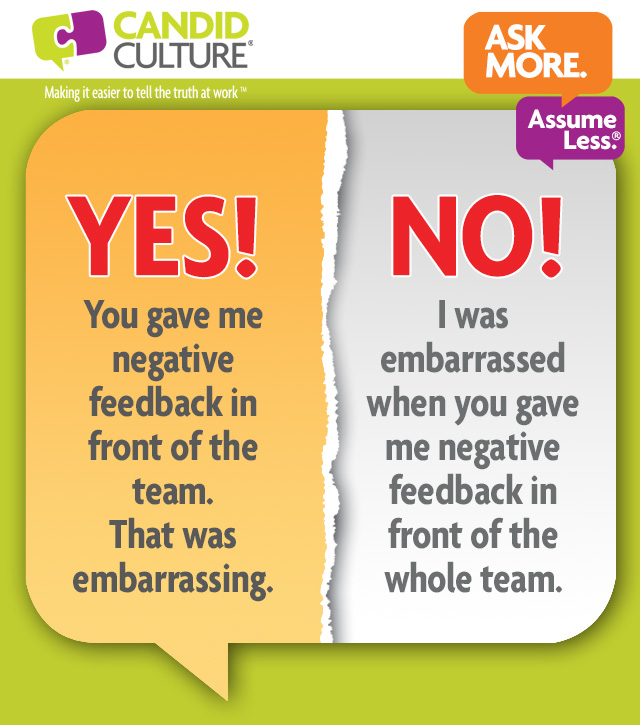
If you say, “You yelled at me in front of the team. That was embarrassing,” at least when the defensiveness kicks in, the listener knows what they did that was upsetting. Then there is a chance that after processing the feedback, the person will change their behavior.
Yes to this:
“I need more regular feedback to stay on track with projects. Can we touch base weekly for ten minutes?”
No to this:
“You don’t make time for me. “I need more regular feedback to stay on track with projects.”
Lead with the facts. Tell the person what happened. Follow with why that matters. What happened, what’s the impact.
Factual, objective feedback may lead to change. Judgments lead to upset and damaged relationships.

Someone asks if you can (fill in the blank). You look at your calendar. That hour is open. You say, “yes.” You forgot that hour was designed for something you’ve been meaning to do, for yourself. You’re angry (with yourself) for forgetting. You promise to do better tomorrow.
The next day… repeat.
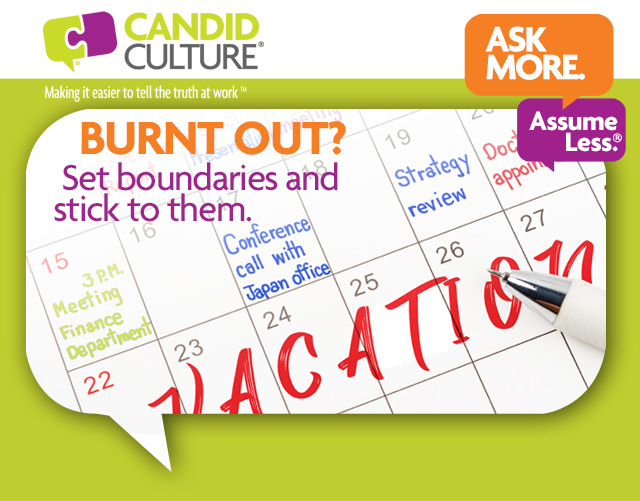
The only way I know out of tired-induced-people-pleasing is to set boundaries and stick to them. And this is hard, for me.
Examples of boundaries: Putting an hour in your calendar during the day to exercise; blocking 30-minutes between meetings to work; limiting one day each weekend to kids’ sports. Boundaries are parameters that guide our behavior. Putting a boundary in place doesn’t mean saying no. Boundaries create the conditions that tell us, without struggle, when to say yes.
Before I had my son, I traveled for work constantly. Some weeks I was on the road for six consecutive days, in three different states. And I loved every second of it. Audience + microphone = happiness. When I had a child, I knew that schedule wasn’t going to work. So, I set boundaries. I decided how many nights per week I would travel, the time I needed to be home from each trip, and how many hours I was willing to fly. And I didn’t violate those boundaries for 8 years. If a piece of work would require me to violate my travel boundaries, I said no without struggle, no matter how much I wanted to do that piece of work. The boundaries made the decisions easy. There was no deliberating or debating.
I’ll admit, I’m not as effective as setting boundaries in other areas of my life. Last week, I had a yoga class on my calendar. When I learned a repair person was able to be at my house during that hour, the yoga class was quickly deleted from my calendar. Yesterday, I asked my son what he wanted for breakfast, before flag football. He wanted scrambled eggs and a smoothie. I made both, knowing there wasn’t time. We were late for flag football. What was missing in both situations? Boundaries.
How does this apply to work? The key to preventing tired, burnt-out employees is to make it safe to speak up. As I wrote earlier in the year, burnout is a systemic issue, not a personal one. Burnout at work comes from too much to do, over time. One way out – make it safe to tell the truth at work.
For the most part, no one wants to admit to their boss that they are overextended or overwhelmed. Doing so feels like failure, and who wants to admit failure? If you want employees who are energized versus exhausted, focus on making it safe to tell the truth at work.
Five ways to make it safe to tell the truth at work:
- Leaders and managers share their own truth. See the top of this blog for what that could sound like.
- Ask employees meaningful questions. “How’s it going?” is not a meaningful question. Try: “What are your preferred working hours? What times a day would you prefer not to be contacted?”
- Show appreciation when employees risk and say hard things.
- Reward the truth. Make employees who are willing to say hard things a positive example.
- Help employees problem solve to manage their time and priorities. Be ‘in it’ with them.
The good news about violating boundaries is you will get another chance to do it differently tomorrow. You can always reset a boundary. This time, tell the other people in your life about your boundaries. Tell your coworkers if you don’t do happy hours after meetings, 7:00 am Zoom calls, and back-to-back meetings, and tell them why. Then offer an alternative. Everything in life is a negotiation.
When my son asked that I not be on my phone on his birthday, I cried. I was surprised. I’m a very attentive parent. I spend a lot of time with my son. And apparently, as he has noticed, I also spend a lot of time with my phone.
There is always a good reason (excuse) for looking at my phone. I’m self-employed. I run a business. It’s important to be responsive to current and potential clients. But is every message timely? Urgent?
It’s become obvious – I’m addicted to my phone. I take it everywhere. I check it constantly. It’s such a habit, I don’t even see myself pick up the phone and check for messages.
Many people’s response to Covid was to move cities, switch jobs, continue working from home, and possibly work less. People are yearning for more balance and freedom. Yet, we are addicted to our phones, attached like they are a lifeline.
I regularly get calls from clients telling me that employees are tired and over extended – burnt out. They want a way out. Burnout is an organizational issue that begins and stops with strong management and leadership. One thing individuals can do to protect their time and separate work from their personal lives, is to put the phone away. By the way, next week’s tip is about how to prevent burn out.
The phone takes our attention and a lot of time, I suspect more time than we realize. When I’m focused and working during the day and hear that little ping of a text message, I stop working to check my phone. It’s a quick message, so I reply. Then the sender replies. Then I reply. Soon it’s been 20 minutes. Where was I with my work again?
These distractions can happen a few times a day. Then I pick my son up from school and lament how little I got done that day, and wonder when I’ll have time to finish my work? After my son’s asleep? In the morning before he wakes up? Instead of doing something I enjoy at night and sleeping in the morning, I’m trying to regain lost time.
Burnout is a systemic, organizational issue. But we can create boundaries with our phones today and regain some time and focus.

Here are the things I’m trying:
- I leave the phone face down when I’m working and only turn it over if it rings. My son’s school doesn’t text when there is an emergency, they call.
- My phone is on silent if my son is home and I’m not expecting a timely call or message.
- I put my phone in another room when he is home, so I’m not tempted to look at it.
- I leave the phone on another floor during my son’s bedtime routine, so that time is uninterrupted.
I don’t always do these things consistently, but I’m more aware of my addiction now. I’m conscious and I’m trying.
The key to taking back our time and having a balanced life is boundaries. A clear boundary (a rule you create for yourself) makes decision-making easier. There is no struggle, no internal fight. You are simply following the guidelines you put in place for yourself.
For example, if you decide to quit eating sugar for 30 days and go to a party where the sweets look really amazing, that experience will be stressful without a clear boundary. “I’m not eating sweets.” Not, “I’m not eating sweets unless they look really good.”
The same is true for the hours we work and work travel. If I set a boundary that I only travel one night a week and never miss two consecutive bedtime routines with my son, it’s easy to say no to work that doesn’t fit those boundaries, no matter how much I’d like to do that work.
Our phones can be the same. If you want to be less tied to your phone, set boundaries. “I only check my phone at the top of the hour. Then I put it on silent until the next hour.” “I’m available via phone, email and text until 5:30 pm each day, then I don’t check or respond to message until 8:30 am the next day.” Whatever boundaries you establish, tell the people around you who are impacted.
If your boss is used to getting responses at 8:00 pm, tell them the change you’re making and tell them why. If friends or family are used to hearing back from you within minutes, adjust their expectations.
You don’t have to be tied to your phone like it’s a member of the family. It’s a tool, not an extremity.
We’ve all received work from another person that wasn’t what we were expecting, hit reply, and told the other person what we thought. Then we dealt with the consequences.
A few tips for giving feedback to get more of what you want and less of what you don’t:
Don’t give feedback via email. Ever. You can’t manage your tone or see the person’s reaction.
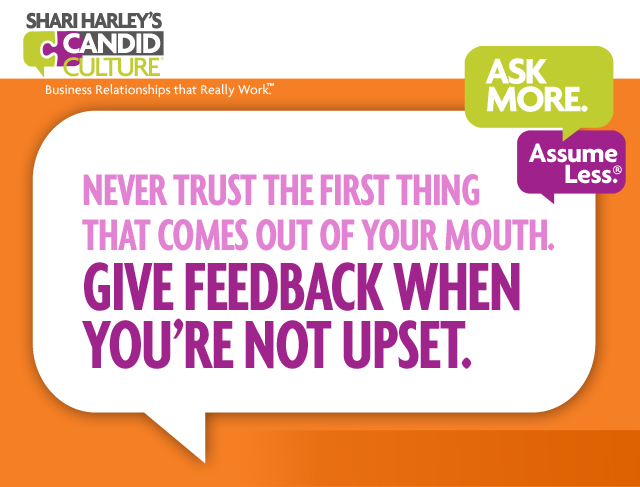
Practice the 24-hour rule and the one-week guideline. Wait until you’re not upset to give feedback, but don’t wait longer than a week.
It’s almost impossible to give feedback without putting the other person on the defensive. Becoming defensive when receiving feedback is normal and natural. It’s a way to protect ourselves when we feel judged.
When people are defensive, it’s hard to listen and respond. The less defensive the other person becomes, the easier it is to communicate with that person. People will be less defensive if you give feedback when you’re calm and choose your words carefully.
Communicate in a way that the relationship needs versus what you need in the moment.
When we give feedback when we’re upset, we’re really communicating for us, not for the other person. I didn’t get what I want. I’m upset. And I’m going to tell you about it. Then the other person gets upset and now, in addition to you not getting what you wanted in the first place, you have to do damage control.
Communicating in a way the relationship needs means choosing the timing, words and method of communication that is likely to produce the result you want – the other person being able to hear you, while becoming minimally defensive, and taking action. Giving feedback when you’re upset, especially via email, will not produce the result you want. You’ll only damage your relationship.
Being an effective communicator and maintaining good business relationships requires patience and self-discipline. Wait to give feedback until you’re not upset. Don’t send an email. Pick up the phone or walk to the person’s desk. Deliver the feedback in a way the other person can hear you. Be ready for the person to become defensive. It’s human to become defensive. You can’t eliminate defensiveness, but how you deliver feedback can greatly reduce defensiveness. And you’ll get more of what you want and less of what you don’t.
Meetings go long; attendees stealthily text under the table like no one can see them; one person talks the whole time, while everyone else rolls their eyes. All the while, the facilitator does nothing.
Sound familiar?
The amount of time wasted in unproductive meetings and the degree of frustration meeting participants feel is astronomical.
The solution is simple but may not feel easy.
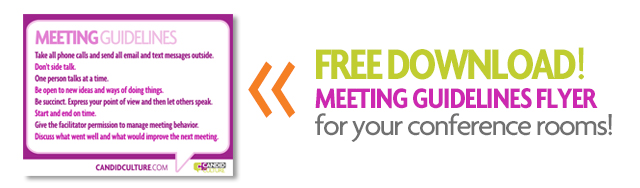
Set clear meeting expectations at the beginning of EVERY meeting and hold people accountable when they violate the guidelines.
Most meeting facilitators don’t set expectations at the beginning of meetings. Instead, facilitators expect attendees to follow the unstated, assumed guidelines. And when the meeting facilitator’s boss, peers, or customers are on their phone, it’s too hard to say something, so facilitators ignore the behavior, hoping it will stop without intervention.
The key to getting what you want in meetings (and in life) is to ask, which for the most part, we don’t. We assume people will do things as we do.
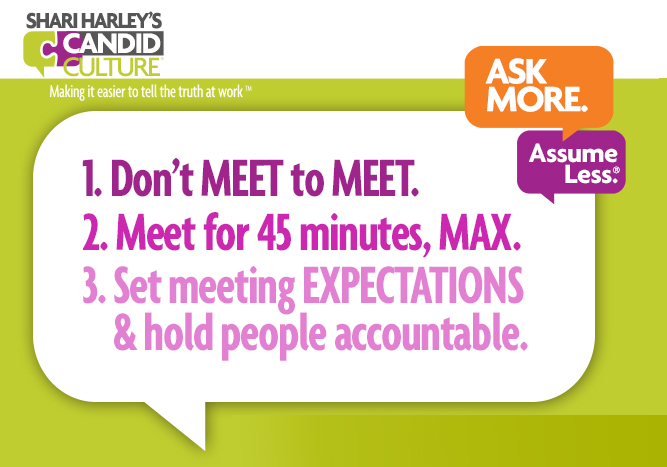
Tips for Running an Effective Meeting:
1. Set meeting expectations at your next meeting.
2. Write the expectations on a flip chart or in the chat and hang them up/post them in the chat at the beginning of every meeting.
3. Review the meeting expectations every time you meet, even with groups who meet weekly.
4. Ask meeting participants’ permission to manage meeting behavior. Your role as the meeting facilitator gives you the right to address bad meeting behavior. Asking for permission and letting people know you will say something if you see their phone etc., makes it easier to speak up.
5. Tell participants they are expected to hold themselves and each other accountable.
6. Then hold people accountable for following the meeting expectations. If you ask people not to side talk, address side talking when you hear it. If you ask people not to be on their laptops or phones, ask people to put them away. If one person talks too long, interrupt them. You will have no credibility if you set expectations but don’t hold people accountable.
The reason facilitators don’t hold people accountable is that they feel uncomfortable. It’s hard to tell your peers, boss, and coworkers to be more succinct. It’s almost impossible if you don’t set expectations about meeting behavior and set the expectation that you will say something when the meeting expectations are violated. The simple act of setting meeting expectations and asking people’s permission to manage to those expectations makes managing ‘bad’ meeting behavior easier. Not easy, but easier.
You may be thinking, “I don’t run these meetings. I’m an innocent victim.”
As a meeting participant, it is frustrating to go to poorly run meetings. But it’s also your role to speak up when you see things going poorly. Talk with the meeting facilitator.
The conversation could go something like this:
Express empathy: “That Wednesday team meeting is tough. I wouldn’t want to run it.”
Ask permission to give feedback: “I’d like to help. I’ve got a few observations and suggestions. Is it ok if I share them?”
Give feedback: “I’ve noticed that several people have been missing the meeting and others are on their phones and laptops during meetings. This definitely limits what we can get done and must be frustrating to you. What are your thoughts?”
Make a suggestion: “What do you think of setting meeting expectations at the next meeting and then telling people you’re going to hold them accountable?”
Offer help: “You’re not alone in this meeting. I’d be happy to tee up this discussion and explain why we need to set meeting expectations. What do you think?”
The facilitator knows the meetings aren’t going well. She just doesn’t know what to do. Offer to help. Don’t judge. She might be more receptive than you think. And you can stop suffering through poorly run meetings.