The daily monologue in my house sounds like, “I am not your housekeeper. My job in life is not to clean up after you.” I am, of course, talking to my six-year-old son who picks up nothing. Instead, he throws everything on the floor. My expectation is that he will pick up after himself, and when he doesn’t (ever), I am very frustrated.
Violated expectations are at the root of disappointment, frustration, and broken relationships. We think, “I expect you to do or be a certain way and you’re not, so I’m unhappy.” If you want to be more satisfied and less frustrated, change your expectations. I don’t mean lower your expectations. I really do mean change them.
When I had my son, I had no idea how difficult it would be to have someone I barely knew (our first nanny) take care of him. It was tortuous until I got the sage advice, “You’re not going to get everything you want. Pay attention to the big things and be ok with good enough.” That’s hard for me. I want things done a certain way (my way). But I also don’t want to do everything myself. So, I find myself altering my expectations and being ok with good enough. And it is very, very difficult.
You likely want each of your employees, coworkers, boss, clients, and vendors to do things a certain way. Sometimes they’ll meet those expectations and sometimes they won’t. Decide what you must have, communicate those expectations (repeatedly if necessary), and let the rest go.
Here are four steps for setting expectations at work:
Setting expectations step one: Consider everything you need or want from a person. Make a list, even if you’ll be the only person who sees it.
Setting expectations step two: Determine what that person is capable of providing. What’s realistic given who they are and the constraints they’re under (time, skills, experience, etc.)?
Setting expectations step three: Reset your expectations, if necessary.
Setting expectations step four: Ask for what you want and be specific about your requests. Telling someone, “This needs to get better,” will accomplish nothing. Telling someone, “I’d like to be included in each meeting that relates to this project and cc’d on all pertinent emails,” may just get you what you need.
As William Ury said in his book Getting to Yes, be hard on the problem and easy on the person. When you address violated expectations, simply share what you expected to have happen and what actually did happen. That could sound like, “I thought we agreed I would be invited to each meeting pertaining to this client. There was a meeting last week I wasn’t invited to. What happened?” Watch your tone of voice when asking this question. Be neutral and curious.
Changing your expectations will likely be a daily occurrence. People won’t necessarily do things your way or even the way you hoped. Decide what you must have, and let the rest go. Just think of all the time and aggravation you’ll save.
No one likes giving people negative feedback. Giving negative feedback often makes both the feedback deliverer and the recipient feel badly. To make everyone feel better, we dress negative feedback up with pickles and relish, otherwise known as The Empathy Sandwich.
The Empathy Sandwich in action: “You’re doing really great. Now you did almost cost the company $50,000, but in general, things are going great.”
The Empathy Sandwich leaves people unclear, wondering if there is a problem. Instead of softening negative feedback with positive platitudes on both ends, tell people you’ll be providing positive and negative feedback as things happen, and then separate both types of feedback.
Giving feedback to people you manage: “As your manager, my job is to help you be successful. As a result, I’ll tell you what I see, as I see it. I’ll give you both positive and upgrade (negative) feedback in a timely way. Because if I don’t, you won’t grow as a result of working with me.”
Paving the way to give feedback to peers and those at a higher level: “We see each other work and are in a unique position to provide each other with feedback. If you see me do something positive or not so positive, I’d like to know. I promise I’ll be receptive.”
Delivering feedback and avoiding The Empathy Sandwich: When you give feedback, separate the positive from the negative. You could say something like, “I want to talk about a few things today. Here are some things that are going well… Now, I also have something to talk with you about that is not going as well… After you deliver the negative feedback, say something like, “I know there is a tendency to dwell on negative feedback. I want to remind you of the positive things we talked about today.”
People can handle negative feedback. They won’t quit if you’re honest about their performance. They will likely become defensive and get upset for a time. That’s ok! Your job when giving feedback is to be clear, timely, and specific. Prepare and practice your delivery out loud. Ensure you have the relationship to deliver the feedback. Don’t worry so much about the response.
Posted under Uncategorized on May 15, 2022 by Shari Harley. 6 Comments
It’s hard to believe that it’s been 15 years since I left my corporate job to launch a not-yet-fully-formed business.
People ask me regularly, “Who do you typically work with?” Even after 15 years, the answer still surprises me. Our clients are incredibly diverse. Candid Culture clients range from small family-owned businesses to school districts, towns and cities, associations, universities, hospitals, not-for-profits, and huge, global corporations. The things all of these organizations have in common – the organizations’ leaders want to create a work environment in which employees can speak freely without fear. They want to create a place where people genuinely want to work and can do their best work.
So, what are a few things I have learned these past 15 years?
I’ve learned that almost-worldwide people are afraid to say what they really want to at work (and in life). Almost universally, people feel like they will be disliked and disapproved of for providing feedback others don’t like.
When I started Candid Culture, it was with the premise that it’s hard to speak up in most relationships because we haven’t set the expectation that it’s ok to do so. We haven’t laid the groundwork, letting people know we genuinely want their input and there won’t be a negative consequence for saying unpopular things. My views on this haven’t changed. If you’ve read How to Say Anything to Anyone you know that the book’s title makes it seem like the book is about feedback, but it really isn’t. The first eight chapters are how to create environments and relationships in which it’s safe to speak up.
I’ve learned to let people save face. Negative feedback is hard to hear, it bruises the ego. Say just enough to get the desired actions. Give small amounts of feedback at a time, saying just what you need to. And never give feedback when you’re upset. The time to fix a problem or a relationship is when nothing is wrong, aka, no one is upset.
I’ve learned that people really are doing the best they can. If they knew another way, they would do it that way. But that doesn’t mean a person’s approach is good enough (for me). I can request more from a person or walk away from a relationship and still grant the other person grace.
I’ve learned it’s ok to renegotiate. “I know I said I would do this, but I’m realizing I can’t in our agreed time frame. Here’s what I can do.” Being upfront is scary in the moment but feels better than silently disappointing people.
The last thing I’ll say is that I’m still working on and will probably forever be working on feeling ok making requests. I tell myself regularly, it’s ok to ask for help, to ask for what I need, and to ask for a change. Asking will always be easier than giving negative feedback. And it’s ok to ask.
What do I hope for in the next 15 years? I wish us all the courage to ask for what we need and know that we deserve to have those things.
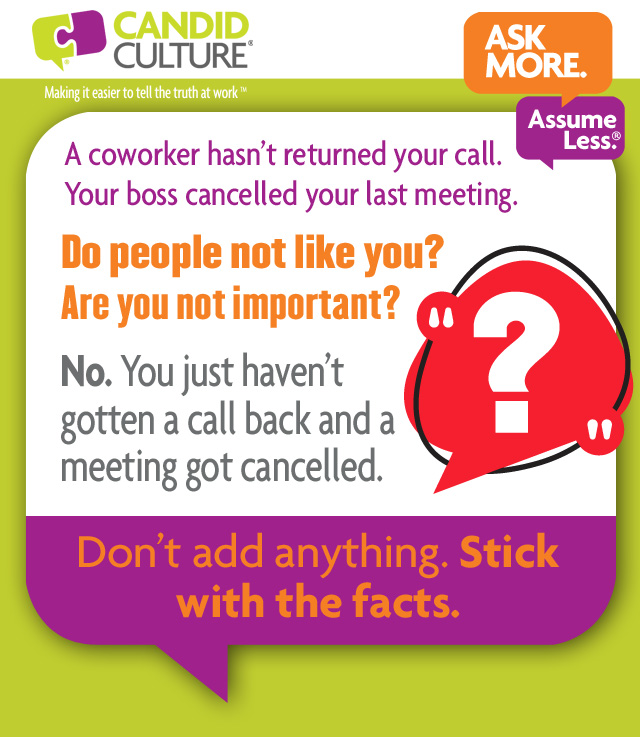
You interviewed for a job four weeks ago but haven’t heard back from the recruiter. You asked a coworker to have lunch, no reply. You asked a team member for a document, but after three emails, two texts messages, and a voicemail, still no reply.
It’s normal and natural to go to a dark place when we don’t get a response we’re expecting. We wonder, “Maybe they don’t like me? Perhaps they don’t want me involved in the project? Did I step on their toes? Maybe I asked in the wrong way?”
Wondering why we haven’t heard from people and inventing reasons for the lack of communication is normal and natural. It’s also exhausting and draining.
I’ll admit, I am on pins and needles after I deliver a training program, until I connect with my client to hear how they felt about the program. Even when I know I did a great job, I need to get the feedback and I’m on edge until I get it.
I’ve had enough training on communication and interpersonal relationships to know that others’ responses are usually not personal. People are busy taking care of themselves, as they should. They’re thinking about their own deadlines, deliverables, and the demands on their own time. Ninety-nine percent of the time they’re not thinking about us.
People are wired for self-preservation, and this very good and important. If you don’t take care of yourself, who will? The question, is how do we get our own needs met when we don’t get the response we’re expecting or the communication we need?
The most powerful approach is to remember that people’s response or lack thereof has nothing to do with us, and to let it go. Don’t be consumed with the lack of communication. Move on. You’ll hear back from the person when you hear back. This would be a powerful position to take, and it’s very difficult, at least for me.
The next approach could be to make up an interpretation that empowers you. You’re going to invent a reason you haven’t heard from the person, you might as well invent a reason that makes you feel good. For example, “The person participated in an escape room this past week and hasn’t made it out yet. They don’t have an Apple watch and have no way to communicate.”
Another approach is to set expectations when you begin working with people. Ask the recruiter, “If I haven’t heard back from you and a few weeks have passed, is it ok if I call to check in?” Ask your boss, “Is it ok if I reschedule meetings that get cancelled?” Ask your coworkers, “If I need information but haven’t heard back after three attempts, what should I do? Who else can I ask rather than wait?” Having a plan in place when you don’t get the communication you need will give you a clear course of action, rather than guessing.
But ultimately the most powerful – even if it’s the most difficult – response is to know deep down that the lack of communication is not about us.
Sign Up
Career tips you won't get elsewhere. Sign up to get a free tip card.