Archive for May, 2021
I think Instacart is a brilliant idea. I make a grocery list online, someone else goes shopping for me, and drops my groceries on my porch. What a great way to save time, unless I want a certain brand of canned tomatoes with no rosemary, and two green bananas, three that are almost ripe, and one that is ripe right now. Meaning, if I want my groceries a certain way, I need to go shopping myself. No one else will pick precisely what I will. And delegating work and managing people is the same.
No one will do something just like you will. They might do it better or worse, but either way, work won’t be done just as you would do it. If you want something done precisely your way, you’re likely going to need to do it yourself.

There is little more demoralizing than working hard on a document and having your manager red line it with edits that aren’t wrong, they’re just not her way. This kind of feedback makes employees wonder why they bothered doing the work in the first place. Employees find themselves thinking and possibly saying, “If you’re going to change my work to be more your way, you should just do it yourself.”
This isn’t to say that if you have a vision for how work should be done that you shouldn’t delegate. Managers need to delegate work or they will be focused on the wrong things, exhausted, and resentful, and employees won’t grow, develop, and be properly utilized.
Managers need to set clear expectations, follow up to review work, provide regular feedback as the work is in process, and then expect and accept that completed projects won’t look just like what they would have done. Even when employees produce great work, that work likely won’t be a mirror image of what the manager would have done herself.
If getting work that is slightly askew from what you would have done works for you, delegate the work. If work produced must be a certain way, you should likely do it yourself, or risk both you and your employees’ frustration.
Here are six steps on how to delegate, a skill I think most managers can strengthen:
How to delegate step one: Provide clear instructions to the person to whom you’re delegating. If you have an image of what something should look like, provide a sample document.
How to delegate step two: Ask the person to whom you delegated to tell you what you’re expecting. Don’t ask, “Do you have any questions?” The right answer to that question is, “No,” and gives you no insight about the person’s understanding of your expectations. Instead, ask, “So I know I’ve been clear, what am I asking you to do?” Or you could ask, “Based on what I’ve said, what do you think I’m looking for?” There are lots of ways to assess a person’s understanding. You simply need to get the person talking.
How to delegate step three: Don’t assume people know what to do. We have all left someone’s office with a new project thinking, “I have no idea where to start.” And then that project goes on the bottom of the pile.
Ask the person, “What are you going to do first?” If they give you an answer that tells you they know what to do, step back. They’ve earned some freedom. If they give you an answer that will not lead to the results you want, step in and offer help.
How to delegate step four: Ask to see work as the work is completed versus reviewing all of the work when the project is done. Giving a lot of upgrade feedback after work is completed is demoralizing to employees and wastes a lot of time. Tell employees, “I’d like to see your progress every Friday (or whatever interval is appropriate depending on the length and complexity of the project). This isn’t to micromanage you, it’s to ensure you don’t do a bunch of work that I will want changed. I don’t want you to waste your time.”
How to delegate step five: Give candid feedback when you review work. Don’t say something is fine if it’s not. Ask for changes while the work is in its early stages versus when it’s almost complete.
How to delegate step six: Resist the temptation to edit work or give feedback on work that is correct but wasn’t done your way. Remember, if you want something done your way, sometimes it makes sense to do it yourself.
When it makes sense to do something yourself: When you must have something a certain way and you’re the only person who can and will do it that way. If you’re ok with things not having the same words, formatting or flavor you’d put on them, delegate. If you need your bananas to look a certain way, go pick them up yourself. And both options are right answers. It’s ok to want what you want.

If you were on a diet and stepped on a scale that said, “Pretty good. Keep up the good work,” you’d return the scale, claiming it didn’t work. Likewise, if your GPS told you that it “seemed you were going the right way,” you’d probably use a different app. Scales and GPS provide us with feedback, but vague feedback is unhelpful. It doesn’t tell us what to do more, better, or differently, which is the purpose of feedback.
Vague, positive feedback is also inauthentic, and inauthenticity smells. Hearing you did a great job is nice, but utterly unhelpful because the feedback recipient doesn’t know what he did well and what to replicate. If you want people to replicate a behavior, tell them precisely what they did well that you want them to do again.
Most feedback training focuses on giving negative feedback, because it’s so hard to do, but we’re not much better at giving positive feedback. Giving useful, positive feedback takes attention, observation, and timely communication. In short, it’s difficult.

I too find myself telling my team members, “You did a great job on…” I know vague words like these serve as a short pick-me-up. My team probably smiles and appreciates the recognition, but I also know I haven’t given them substantive direction of what actions I want them to replicate. Those of you who have participated in feedback training with me know that I call vague input Cap’n Crunch – all of the sweetness, with none of the nutrients.
To give effective, positive feedback, simply state one or more specific actions you want the person to replicate.
Here are a few examples of positive feedback:
Cap’n Crunch: “You did a great job on……”
Positive feedback example one: “You did a great job onboarding our new analyst. You outlined what he needed to do during his first 90-days to be successful. He now knows precisely what he has to do and won’t have to guess.”
Cap’n Crunch: “Thanks for being so committed to our business.”
Positive feedback example two: “Thanks for calling in to today’s team meeting on a day you had off. Your participation helped us make a decision that would have taken much longer without your participation. I appreciate your commitment to our business.”
Cap’n Crunch: “Thanks for paying attention to the things that may impact us negatively in the marketplace.” This is not terrible, but not as effective as it could be.
Positive feedback example three: “Thanks for paying attention to the things that may impact us negatively in the marketplace. I appreciate you tracking the new products our competitors are launching. It helps me know where we are ahead and behind.”
Don’t assume people know what they did well and that they will replicate positive behavior without receiving positive feedback. Watch people’s actions and tell them, shortly after they do something, what they did well. And watch those positive behaviors be repeated.

Every time I ignore the red flags I see when interviewing a candidate, or when I feel an employee is struggling, or a project is off track, I pay the price. Every single time.
You interview a candidate who has had six jobs in the last year. You think, “Maybe this one will work out.” No it won’t. Move on. You haven’t gotten an update from a project team in over a month. You think, “This group is typically reliable. Things are probably fine.” Check in. Even the most diligent employees need accountability and attention.
They call them red flags for a reason. If you suspect a problem, there likely is one. Don’t just wait and ‘see how things go.’ Make a hard decision, get more information, or get involved. Wait and see is often a recipe for disaster.

Sometimes we don’t get involved because we don’t have the time or want to focus on other things. Other times we just don’t trust or listen to our gut.
Trust yourself.
Here are a six steps you can take to help listen to yourself and ensure you don’t overlook or ignore red flags:
1. Become very clear about your desired outcome. Decide what you want.
2. Eliminate distractions. Get quiet, aka, still your mind.
3. Think about the situation at hand. Weigh the facts and your options.
4. Decide without belaboring.
5. Act on your decision.
6. Don’t look back. Your initial decision is usually the right one.
Trusting and listening to ourselves can be hard. Perhaps it’s the fear of making a mistake or being wrong. Chances are you’re right. So pay attention to the red flags, trust yourself, and listen to your gut.

Companies want people who make things happen. And to make things happen, you have to speak up. Anticipating the train wreck and commenting after the train goes off the tracks doesn’t count.
What if you said what you thought, in a way other people could hear you, when you had the right to do so? Meaning, you have the relationship with the other person to tell the truth and you’ve asked permission to be candid?
 6 Courageous Steps to Advance Your Career:
- Look for opportunities to make things better.
- Ask for permission to take the ball and run with it.
- Build relationships with other people who are making things happen.
- Don’t say yes, when you mean no.
- Find a way to say no, while engaging the other person in a conversation so a new approach is generated.
- Be willing to go out on a limb, work hard, and fail.
Here’s how to speak up for change without being labeled as the problem person who finds flaws in everything:
- Look for and present solutions, not just problems.
- Offer to do the work to move towards a better way of doing things. Don’t drop problems at other people’s doors.
- Ask questions versus overtly say that something is wrong. That could sound something like, “I’d love to help. Tell me more about how this works. Maybe we can insert a step to make the process better. What do you think of trying ________?” No one likes to be told he’s wrong. Asking questions elicits participation more than overtly saying, “This is broken. We need to fix it.”
Many people are afraid to speak up at work and believe that people who speak up get fired. I haven’t found this to be the case. People who work hard and produce results are typically the last people to be let go.
Say what you think in a way that is not critical. Offer solutions not just problems. Be a force for good and take an active role in making things better. And my hunch is your career will accelerate faster than you ever thought possible.

Unless you never interact with other people, there’s probably someone in your life who repeatedly engages in a behavior that annoys you. You’ve probably made requests about what you’d like the person to do differently, and hopefully you’ve given feedback. But the behavior hasn’t changed.
At some point, we have to accept that people are who and how they are. People can and will change certain behaviors, if their motivation is high enough. But other behaviors won’t change, and if you want to have the person in your personal or professional life, you have to accept the behavior and the person as they are. Accepting frustrating behaviors can be very difficult, at least it is for me. I admit, I often have this conversation myself, “Why won’t he…? I don’t get it. It’s not that hard. How many times do I have to ask?”
Here are five strategies for working with difficult people:
Working with difficult people strategy one: Decide on the behaviors you absolutely must have from others. We want certain things. We need other things. Get clear on what you need.
Working with difficult people strategy two: Make a request and ask the person to do what you want. It’s always easier to make a request than to offer negative feedback. Be sure you are being explicitly clear in your request. For example, “Please include me in meetings” is too vague. Instead, try, “Please invite me to all client meetings so I can stay connected to the clients and projects.”
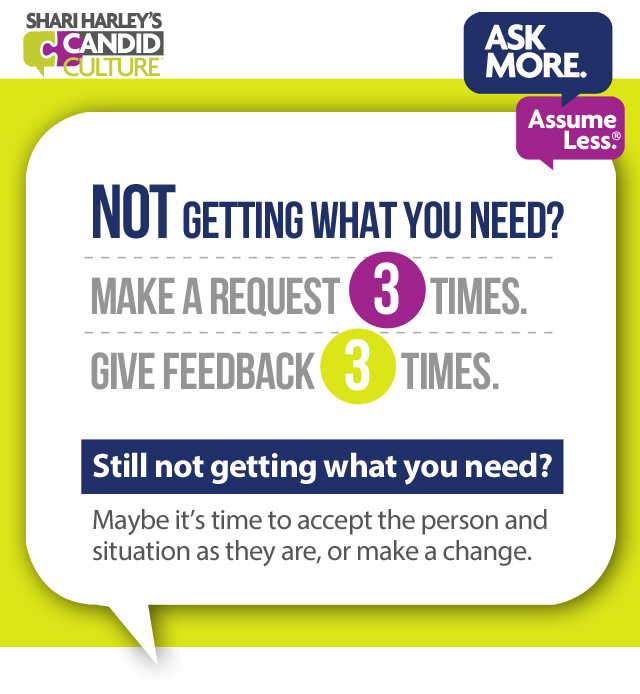
Working with difficult people strategy three: Make requests at least three times. With each successive request (nicely) remind the person that you’ve made this request in the past and it still isn’t happening. For example, “We’ve talked about this in the past. Help me understand what’s happening.”
Working with difficult people strategy four: If you’ve made a request at least three times, give feedback as to what isn’t happening and why that causes challenges. For example, “We’ve talked about inviting me to client meetings a few times. It’s still not happening. I’m getting calls from clients with questions I can’t answer because I’m not included in the meetings. Can you help me understand why I’m not being invited to meetings?” Read chapters nine through eleven and chapter thirteen of How to Say Anything to Anyone to get more examples of how to give clear and specific feedback.
Working with difficult people strategy five: Know when to give up and accept the person and behavior as they are. If you’ve made a request and have given feedback three times, you likely aren’t going to get what you want. The person either can’t do what you’re asking or doesn’t want to. Now you have a decision to make.
Decide how important the behavior is. Is it a deal breaker? If it’s not a deal breaker, stop expecting the behavior to happen and accept that it won’t. When you accept that you won’t get what you want from someone you’ll suffer less.
Strategy five is really the crux of this blog. Knowing when to stop expecting something and coming to peace with that decision will give you great freedom. In order to let go of the expectation you have to decide that it’s really ok for you not to get what you want. Ask yourself, “Can I live with this behavior as it is?” If you can’t, you have a hard decision to make. If you can, then stop expecting and asking for the behavior. You’ll feel better.