You open an email (or a few hundred) telling yourself you’ll reply later, but never do. Feeling ambitious, you agree to a deadline you can’t meet. Needing a break, you take time off over the holidays but don’t put an out-of-office message on your email.
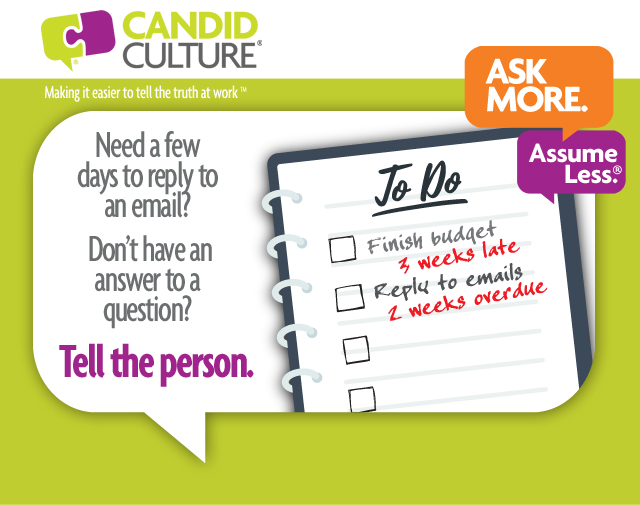
We’ve all taken too long to reply to an email, missed a deadline, or simply taken too long to provide someone with information. It’s ok to take time to respond, to not have all the answers, and to take time off. We simply need to provide a timely and accurate status update.
When people don’t hear back from us in what they consider a timely way, they start to wonder (at best), and judge us (worse), or tell others we’re non-responsive and unreliable (worst). Don’t make people wonder if you received their message, send a timely status update and tell the truth.
If you’re behind and need more time than usual to respond to emails, tell people that. Respond to each email within 24-hours and tell the person you received their message and it will be (fill in the blank) a week or two before they hear back from you. When you get an email that requires research, respond within 24-hours and tell the person it will take however long it will really take to find the information. If you’re out of the office and don’t plan to read or respond to emails, tell people the dates you’re out.
In the absence of knowledge people make stuff up. And it’s never good. Filling in the blanks isn’t malicious. People simply have a need to know what’s happening. And when we don’t know, we invent stuff. It’s how the brain works. When we don’t hear back from people in what we consider a timely way, we start to wonder. “Did she get my message? I haven’t heard back. She must not like me. Maybe she’s out of the office? Maybe she doesn’t work here anymore?”
It’s ok to need time to respond. It’s ok to be running behind. It’s ok to take time off. Simply let people know the true status. Manage your reputation and business relationships. Don’t make people guess.
Covid-19 has shown many of us our edge – working from home for many months, not traveling, missing people we’re used to seeing, and for me, being silent when I would normally speak up.
Earlier in the fall, a friend came to bring my son a birthday present. We hadn’t seen my friend for many months. We visited outside. He didn’t wear a mask, gave Grayson a high five, and then a hug. It seemed like terrible judgment and it happened so fast before I could say anything. Then he went into my house to get a glass of water without wearing a mask while we stayed outside.
I was shocked by all of this. It didn’t seem smart or respectful. And I didn’t say anything. I still haven’t said anything. I could give you ten similar examples of instances in these past months when I was uncomfortable but didn’t say anything – sometimes with people I know, sometimes with people I don’t know.
It feels risky to write this because wearing masks and physical distancing has been so politicized. This blog post isn’t about the coronavirus and anyone’s personal choices. It’s about when we don’t speak up and why.
I think the way to handle potentially tough situations is to anticipate the unexpected and have a setting-expectation conversation before a challenge occurs. What I could have said to my friend, before he visited, was, “We are excited to see you. Let’s stay outside and let’s all wear masks.” I should have set expectations before being confronted with a difficult and awkward situation. Setting expectations is always easier than addressing behavior after it has happened.
Sometimes you can’t anticipate another person’s behavior or how a situation might go. You can’t plan for everything. And telling someone you don’t know in a store, office, or elevator that you’re uncomfortable may feel risky.
Here are four practices for making harder conversations easier and for taking care of yourself when you don’t know what to say:
Anticipate everything that can happen.
Decide how you want to manage situations before they happen.
Set clear expectations before seeing people or going someplace. My son knows that if we go to a park and it’s crowded, we will leave. I tell him this before we go so, he isn’t surprised.
Set boundaries. It’s ok to ask people in line at the grocery store to back up a few feet. “I’m trying to keep a six feet distance. Would you mind stepping back a few feet?” Yes, this likely feels very hard in the moment.
I worry about what people will think of me. I want people to like me. I’m consumed by both of these thoughts way more than you would ever guess. But what’s more important – protecting ourselves and our family or not offending a person in line at the grocery store you’ll never see again?
It needs to be ok to respectfully and kindly speak up on our own behalf. And speaking up starts by opening our mouths and saying what makes us uncomfortable again and again and again.
I read a quote a few months ago that struck me – “It’s so hard to change yourself, what makes you think you can change someone else?” This seems so true. And yet, how much energy do we invest trying or at least hoping other people will change? We want our not-so-forthcoming manager to give regular and helpful feedback, our Halloween candy stuffed selves to prefer celery over chocolate, our not-so-affectionate partner to become a cuddler.
People are who and (largely) how they are. Even with lots of effort, coaching, and even counseling, it’s hard to change.
As someone who leads a training and development company, it feels risky to write this. I’m concerned that my words will be misunderstood. So I want to be sure I’m clear. People can learn new skills. Managers can learn to coach and give feedback. People at all levels and in all roles can learn to communicate differently. Everyone can learn to use new technology. But we don’t fundamentally change who and how we are. People who hate to public speak aren’t likely to wake up tomorrow clambering to give presentations to thousands of people. People who don’t like crowds aren’t likely to want to spend every weekend at large sporting events when they resume.
What I’m really trying to say is, stop trying to get something from someone who can’t give that to you. If you work for someone who never provides feedback, no matter how often you ask, get input from someone else. Lots of people can provide you with helpful information if you ask for it and make it safe to tell you the truth. If you’re chastising yourself for not being more athletic, accept that you like to read, and buy yourself a new book.
Instead of trying to get something from someone who can’t give it to you, get what you can from that relationship and get the rest of your needs met elsewhere. And tell others to do the same. I had someone working for me a few years ago who was extremely sensitive and didn’t do well receiving feedback. I tried to accommodate her needs and preferences, softening my messages, picking my battles, and in the end, giving less and less feedback. And it was exhausting. Eventually, I said to her, “I’m not the right manager for you and this is the not right company for you. It’s not a good fit. You won’t be happy here, and I want you to be happy. Let’s help you find another home.”
I’m not telling you to get a new job. I’m telling you to be realistic in your expectations of yourself and others. The most powerful thing you can do is to be yourself and let others be themselves. And if you don’t like how or who someone is, hang out with someone else.
You get an email that annoys you, hit reply, type up your thoughts, hit send, and feel instant regret. We’ve all done this. We’re frustrated and we let the other person know.
Feedback via email is always a bad idea. You don’t know how the recipient will read and interpret your message. You can’t manage the tone of the message or give the person a chance to respond. And more often than not, he’ll reply equally frustrated. And now the non-conversation begins –back and forth, back and forth.
Email is for wimps and voicemail isn’t any better! No texting either. End the madness and pick up the phone or take a shower and meet via video. Things are resolved most quickly and easily by talking about them.
I’m consistently surprised at how much feedback is delivered via email. And it’s only gotten worse with people working virtually. I’ll admit to occasionally being guilty of it too. I’m in a hurry and I want to get something done quickly. Or my emotions get the best of me and I feel compelled to respond to a situation quickly. So I send an email or a text message that I know I shouldn’t send. Then I regret it and spend the rest of the day apologizing and feeling badly for communicating impulsively.
If we want people to want to work with us and perform, we need to consider how our actions impact them. Yes, it’s easier to send a quick email or text. But it invariably annoys the other person and damages your relationship. People can work with you, around you, and against you. If people want to work with you, they’ll work harder and produce better work.
Never underestimate the human ego, which is easily bruised. You are ALWAYS dealing with someone’s ego. When someone (anyone) calls our competence into question, we get defensive. Becoming defensive when receiving negative feedback or when someone questions us is a gut reaction. Not becoming defensive takes a great deal of self-management and is unusual.
Slow down. When you need to give feedback, ask yourself what you want the other person to do. Then ask yourself, how do I need to communicate to get the result I want? Then pause, breathe, and pick up the phone.
Sign Up
Career tips you won't get elsewhere. Sign up to get a free tip card.