Sometimes people take credit for our work. It happens, sometimes purposefully, sometimes not. The key is what we do when things like this take place.
I’m going to suggest that you use the lowest level of intervention possible to resolve challenges.
When a coworker takes credit for your work, you could say:
1) “I noticed that when talking about project X during last week’s department-wide meeting, my name wasn’t mentioned in conjunction with the project. Why is that?”
Or you could say:
2) “Thanks for highlighting the X project during last week’s department-wide meeting. I’m glad the project got some exposure. I noticed that my name wasn’t mentioned in conjunction with the project. I want people to know they can come to me with questions about this project. In the future, will you tell people that I wrote the plan?”
Feedback can be given directly, “You did X and it frustrated me.” Or feedback can be given by asking a question and making requests, “Will you be sure to mention my name when you talk about X project?”
Some might call option one passive and even disingenuous. Both methods produce the desired result – the other person knows that you know what happened, and you’ve requested different behavior. One method may incite conflict, one most likely won’t.
Be as direct as your relationship will allow. There are people with whom you can be very direct, without consequence. And there are some relationships that can’t withstand direct feedback.
Most of the people I talk with in organizations believe they can’t give feedback without negative consequences. The only way to know how direct you can be is by trial and error. Give a little feedback, see how it goes. Give some more, see how it goes. You might be surprised at how honest you can be. And when there is backlash for giving direct feedback, next time, give less. Ask a question or make a request instead. Asking questions is another form of feedback. It’s just less direct and thus less confrontational.
We train people to treat us as they treat us. You will get both what you ask for and what you allow. What are you allowing?
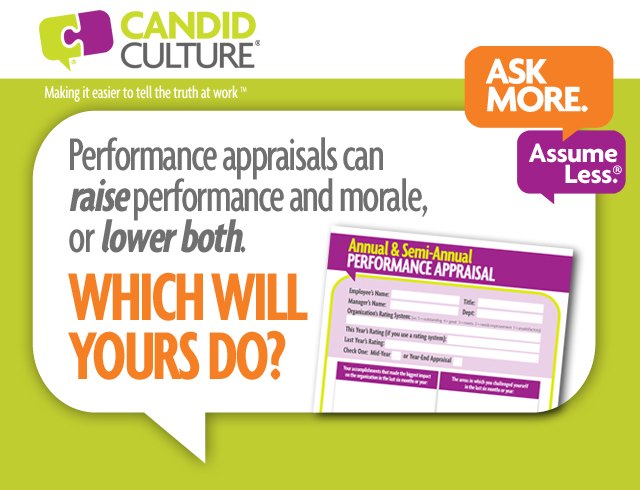
Most people would rather get a root canal than participate in an annual employee performance appraisal.
The reasons employee performance appraisals are so difficult is simple:
Most managers don’t deliver timely and balanced (positive and negative) feedback throughout the year.
Many employees don’t ask for regular feedback.
Too much information is delivered during the annual employee performance appraisal.
And as crazy as it sounds, managers and employees haven’t agreed to give and receive regular and candid feedback.
Employee performance appraisals don’t have to be the worst day of the year.
Here are four steps to ensure employee performance appraisals are useful and positive:
Managers and employees must agree to give and receive balanced, candid feedback. Don’t assume the agreement to speak honestly is implicit, make it explicit.
Managers, be honest and courageous. Don’t rate an employee a five who is really a three. You don’t do anyone any favors. Employees want to know how they’re really doing, no matter how much the feedback may sting.
Managers, focus on three things the employee did well and three things to do more of next year. Any more input is overwhelming.
Managers, schedule a second conversation a week after the employee performance appraisal, so employees can think about and process what you’ve said and discuss further, if necessary.
The key to being able to speak candidly during an employee performance appraisal is as simple as agreeing that you will do so and then being receptive to whatever is said. And don’t make feedback conversations a one-time event. If you do a rigorous workout after not exercising for a long time, you often can’t move the next day. Feedback conversations aren’t any different. They require practice for both the manager and employee to be comfortable.
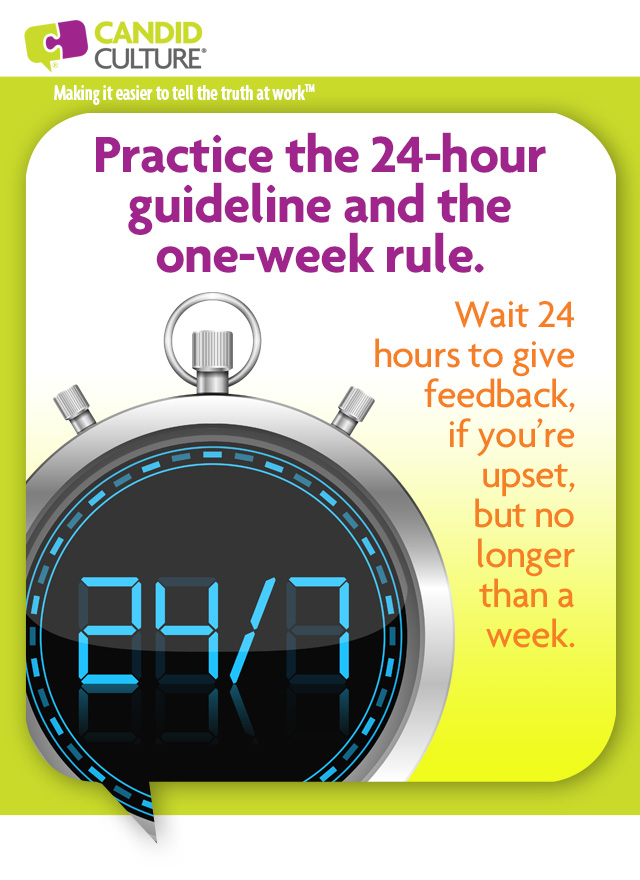
Most of us wait to give negative feedback until it’s the right time, aka the recipient won’t get upset. Or we wait, hoping the situation will resolve itself. If something is really an issue, the likelihood of either happening is pretty slim. The right time to give feedback is shortly after something happens. I’ll offer up the 24-guideline and the one-week rule. Wait 24-hours to give feedback, if you’re upset. But don’t wait longer than a week.
The purpose of giving positive or negative feedback (I like the words upgrade feedback) is to motivate someone to replicate or change a behavior. That’s it. Feedback is supposed to be helpful. If you wait longer than a week to give either positive or upgrade feedback, the person isn’t likely to remember the situation you’re referencing and the purpose of giving feedback – to change or replicate a behavior – will be lost.
Here are four practices to make negative (upgrade) feedback conversations shorter, less painful, and more useful:
Giving feedback practice one: Agree to give and receive feedback at the onset of relationships. Do this with everyone you work with – direct supervisors, direct reports, peers, internal and external customers, and vendors. If we’ve doneHow to Say Anything to Anyone training for your organization or you’ve read the book, you got the specific language to have this conversation.
Giving feedback practice two: Prepare for feedback conversations by writing down what you plan to say and then delivering the feedback to a neutral person. Ask that person to tell you what she heard and what her expectations would be, based on what you said. Confide in someone either at your level or above at work or someone outside of work, to keep the gossip to a minimum. Ask for confidentiality.
Giving feedback practice three: Tell a neutral person about your situation, and ask what she would say to address the situation. Everyone but you will do a better job at giving feedback. Feedback conversations become hard when we’re emotionally involved. The guy working at the 7-11 will do a better job than you. Seriously. It’s our emotions and concern about the other person’s reaction that makes feedback conversations challenging.
Giving feedback practice four: Agree to do a weekly debrief with the people you work closely with, and follow-through. Answer the questions – what went well this week from a work perspective and what would we do differently if we could. Answer the same questions about your working relationship. Giving feedback about your relationship will be hard at first. It will be easier the more you do it. Be sure to say “thank you” for the feedback, regardless of what you really want to say. One of the reasons giving negative feedback is so hard is we wait too long. Shorter, more frequent conversations are better than long, infrequent discussions.
Giving negative feedback doesn’t have to be so hard. Follow the suggestions above and remind yourself that the purpose of giving feedback is to be helpful. If you were doing the wrong work, you’d want to know. And others do too.
Too many people sit at their laptops doing their minimal best while begrudging their boss, organization, and current job, hoping that something better will come along. Or people do good work and think that someday someone will notice and they’ll get the role and recognition they deserve.
If you want to advance your career, you must know how to ask for more responsibility at work.
You may be rolling your eyes thinking, “More? I can’t do more. I already work evenings and weekends. I sleep with my phone and haven’t taken a vacation in two years, and you want me to do more?!?!?” Actually, I want you to stop sleeping with your phone and take a staycation. But that’s a post for a different day.
When I say do more, I don’t mean to do anything anyone asks nor anything your organization needs. Offer to take on more work that is aligned with what you want to do AND is important to the leaders of your organization.
Before starting Candid Culture, I ran an operations unit for a career college. Four years into my tenure with the company, one of my peers left, and his role wasn’t refilled. I felt his department was important to our organization’s success, so I offered to run it, in addition to my already big job.
My new department was a change agent’s dream. I outlined a strategic plan and long and short-term goals. I re-wrote job descriptions and org charts. But six months into taking on the department, I couldn’t get one change approved. I was confused and frustrated.
I had initially been hired to turn another department around, and I’d been very successful at getting changes approved. Yet this time, I could get nothing approved. After six months of banging my head against a wall, I finally ‘got it.’ The owners of the company didn’t see the department as valuable, thus they weren’t willing to invest in it.
I’m embarrassed at how long it took me to see this. When my colleague’s senior-level job wasn’t refilled and there was no freeze in hiring, I should have known the department wasn’t seen as important.
If you want to know what’s important in your organization, look at where the money is being spent. Who is getting resources?
When I say ask for more, I mean be strategic about what you ask for.
Ask yourself these questions:
What do I want to do?
Where in the organization are there opportunities to do that kind of work – that is important to the organization’s leaders?
Who will support me in doing this work? Who won’t?
How to ask for more responsibility at work. Tell your boss and/or department leader:
I really enjoy working here. I enjoy the people, the work and our industry.
I’m committed to growing my career with this organization.
I’m interested in learning more about ________________________.
I’d love to run ___________________________.
I think we have some opportunities to make improvements in _____________________.
How could I get some exposure to ____________________.
A project is starting in ______________. I’d love to be on the team. What are your thoughts about that? Would you be comfortable supporting my participation? If yes, how can we make it happen? If not, what would you need from me in order to support it?
The work you take on does not need to be high level. Everyone in an organization does grunt work. Just be sure that whatever you offer to do is seen as integral to the future of the organization. You’re not likely to get what you don’t ask for.