At some point in your career, you will likely get feedback that doesn’t feel accurate. When receiving feedback you question, rather than dismiss it, vet the feedback with the people who know you best. Assemble a core team of people who know you well, love you, and have your back. The relationships may be personal or professional. These are people who will tell you the truth (as they see it) if you ask.
You might think that you’re a different person at home and at work, thus your friends’ and family’s input isn’t valid in the workplace. That’s untrue. You are who you are, and you’re not a completely different person at home and at work. It’s just not possible to be your real self and turn it on and off at work. Sure, you might have a communication style that you only use at work. You may make decisions at work differently than you do personally. And you are likely to dress differently at work than at home. But you’re not a completely different person after 5:00 pm. If you’re often late, don’t keep confidences, talk too much and too long, or wear clothing that is not your friend, your personal relationships can tell you that.
It’s important to know how you come across, your reputation, and your wins and losses at work. Having this information allows you to manage your reputation and in turn, your career.
So the question is, with whom should you vet feedback that doesn’t feel quite right?
Receiving feedback criteria one: Your core team should be made up of a small number of people (five or fewer) who know you well, love you, and have your back.
Receiving feedback criteria two: You should respect core team members’ opinions.
Receiving feedback criteria three: You must trust them and their motives, in relation to your well-being.
Receiving feedback criteria four: You must be open to rather than dismissive of core team members’ feedback.
The right answer to feedback is always, “Thank you for telling me that,” regardless of how much the feedback stings. The easier it is to give you feedback, the more you’ll get when you ask in the future.
Core team members don’t need to be told they’re on your core team. Simply call these people individually when you need input. Tell them the feedback you’ve received and then ask for their opinion.
It’s easy to dismiss feedback that’s hard to hear. And the feedback might just be that person’s opinion. But people talk. And one person’s experience of you can impact your career greatly. Manage your career assertively and powerfully by knowing your reputation. Find out the impressions you create. Then you can make decisions about changes you will and won’t make.
I’m consistently shocked and embarrassed by what comes out of my mouth when I’m mad. It’s like reason and self-control go out the window. Emotion and the need to be right takes over. Every time I react in the moment, I regret it. Every single time.
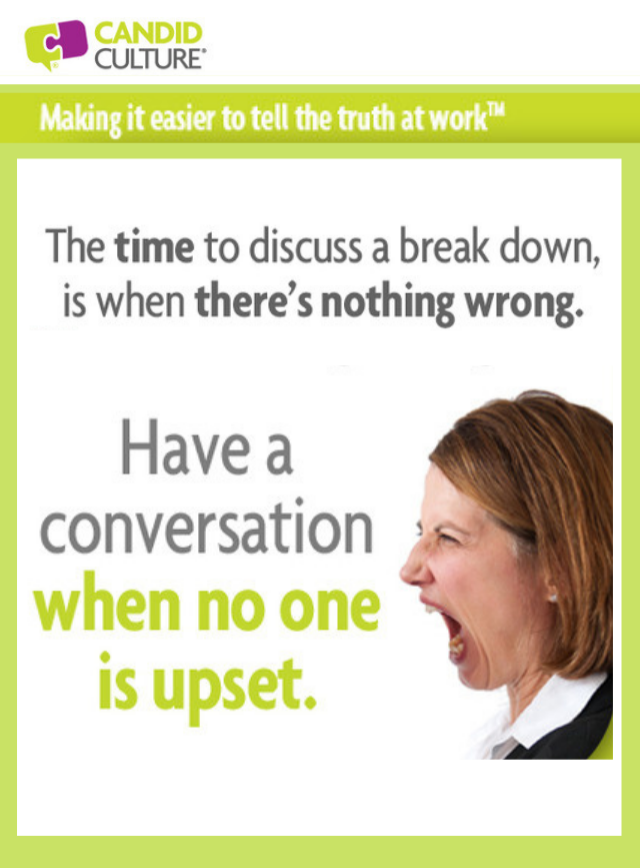
Talking with another person when we’re upset, often leads to more upset. Emotions and conversations escalate quickly. The more upset we are, the more likely we are to say things we’ll regret. The time to alter how we work, live, and communicate with someone, is when there is nothing wrong.
If you want something in a relationship to change, pick a time when things are calm and when no one is upset to have a conversation. Tell the other person that you want to talk about how you work together, manage disagreements, make decisions, handle disappointments, etc. Share what you have observed in the past and make requests. Brainstorm solutions together. You’ll have a much better conversation when you’ve had time to calm down from whatever happened to create the need for the conversation.
Waiting to have a conversation until you’re not upset creates the risk of waiting too long to address concerns. The right time to talk about a breakdown is as soon after an event as you can. When both people are calm and have time to have the conversation, usually within a few days of a challenge.
There is no talking to my five-year-old about why I impose certain limits in the moment. He’s too upset. I need to wait to talk to him about why I did what I did and what I want him to do next time when he’s calm. Typically, that’s later the same day. Adults may take a little longer. But this isn’t a pass to wait six weeks, which is what we often do. The conversation won’t be as hard or as bad as you think if you talk when you’re calm and speak from what the relationship needs.
Speaking from what the relationship needs is saying just what you need to, not more and not less, to resolve the challenge and create a better way to handle things in the future. And communicating in a kind and direct way, so the other person can take in what you have to say.
Agree upon better ways of handing challenges when no one is upset. Speaking directly, calmly, caringly and with the desire to make things work, typically has a positive result.
When I started training managers 20 years ago, I recommended managers meet with their employees weekly for 45-60 minutes. Over time I stopped recommending that because long, weekly meetings didn’t seem feasible and most managers weren’t doing them.
Many managers replaced the weekly one-on-one with the desk-drop-by and team meetings. Managers would tell me, “I talk with my employees daily and have a regular team meeting. I don’t need to do individual one-on-ones. Well, you do now. Employees need to talk to you on a regular basis. It’s time to go old school.
Many employees are still working from home and will be for the next several months, if not indefinitely. Some people love working from home and do it successfully, others hate it and struggle. Whatever you and your employees’ preference for working remotely, people need regular, one-on-one contact.
The questions I’m getting more frequently than any others these days are, “How do I work with others virtually” and “how do I manage remotely?”
Managing Up:
If you work for a manager who doesn’t reach out much, it’s fine to ask for a phone call. Tell your manager, “I’d like to talk with you individually each week. Can we schedule that? Is it ok to reschedule if we have to cancel?”
Don’t wait for your manager to ask for an update on your work progress. Send your manager a monthly, bulleted list (or more frequently if she would like) of what you’re working on, what you’re accomplishing, items you’d like help with, and anything else you want her to know. Keep the bullets short and focused. Your manager can use these updates to write your annual review.
Managing Peer Relationships:
Pick up the phone or have video calls. Either one works. People need contact.
If you’ve exchanged three emails on one topic, it’s time to pick up the phone. Talking live is quicker, prevents assumptions being made, and preserves relationships.
Ask how your peers are doing personally and professionally. Most people are struggling in some area. It helps when others care enough to ask how we are doing. But don’t ask just because you think you’re supposed to. If you don’t really want to hear a personal update, don’t ask for it. Just tell people you hope they’re doing well and move on to the business at hand.
Talk about how you agree to work together from a distance. If could sound like, “How do you want to manage this project? What parts do you want to manage? How should we handle it if we haven’t heard from a team member or if someone is falling behind and missing deadlines?” Talking about how you’ll handle potential breakdowns before they happen is ALWAYS easier than addressing breakdowns after they happen.
Set agreed-upon deadlines and talk about how you’ll track progress and milestones. You don’t need a manager to do these things.
My main message regarding working virtually is to talk to people more than you think you need to. Pick up the phone. Check-in. Ask how people are doing. Do everything you would do in person, just do it via the phone or video.
Don’t assume people are fine. Don’t assume everything will get done according to your expectation. Pick up the phone and talk about it.
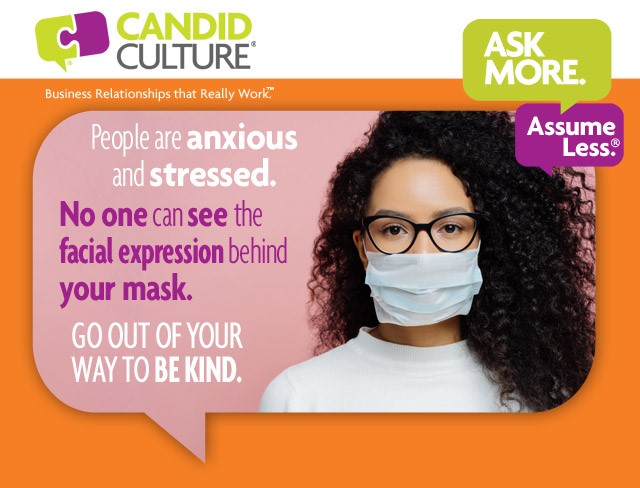
We are living in a weird, crazy time. It may feel scary to go into a restaurant or a store, let alone to work. People are wondering if it’s safe to fly, return to their offices, or visit family and friends. There is so much uncertainty and so many unknowns. People are anxious and stressed.
I can see and feel the stress when I go to the grocery store. My neighborhood store didn’t feel particularly friendly before Covid. Fellow shoppers would run you over with their cart if it appeared you were going to beat them to the last bag of organic, gluten-free, paleo-friendly, vegan, sustainably-sourced chips. But now it’s much worse. People shopping in the store understandably want to get in and out as soon as possible. Other people are obstacles, like moving, orange cones pushing carts. Long lines are stressful. You can’t tell if a masked person smiles or silently growls at you.
During these uncertain, scary, and unpredictable times I think we need to go out of our way to demonstrate kindness.
I’ll admit that I am the person always in a rush, often on the phone at the checkout counter (I hate when people do that, even though I do it too), sometimes not making meaningful eye contact. But lately I’m making more of an effort – saying hello to strangers I pass, when I normally wouldn’t, making it obvious I’m smiling at a person under my mask, even telling people, “I know you can’t tell, but I’m smiling at you.” I’m asking hospitality workers how they’re doing, what it’s like to be working in a coffee shop or a grocery store, and what makes a customer respectful during this scary and uncertain time. And I’m listening more closely to their answers.
It’s harder to see kindness right now because a mask conceals so much. It also allows me not to wear makeup, which I’m grateful for. But people can’t interpret my intentions behind my mask. They can’t see if I’m friendly, happy, or irritated. I have to go out of my way to demonstrate how I feel and what I mean in ways I never have before.
Here are five ways you can demonstrate kindness:
Tell people you appreciate that they’re working (in an environment that may feel risky from a health perspective).
Ensure your tone is friendly and patient.
Tell people overtly how you feel. “I’m not irritated, this mask just makes me look cranky.” “I’m smiling at you. Thank you for the good service.”
Wait patiently, versus sighing and rolling your eyes, if there is a long wait for customer service or an answer to a question.
Follow the posted rules for distancing and masks. Following the posted guidelines makes everyone feel more at ease.
Be overt. Make your positive feelings known. Put someone else at ease. And this ‘thing’ will feel better.
Coming next week: You asked. We answered. Next week’s tip and blog: How to work well with others virtually.
Sign Up
Career tips you won't get elsewhere. Sign up to get a free tip card.