Posted under Career Management on December 30, 2019 by Shari Harley. 3 Comments
I always want to do things right and hate making mistakes. When I say or do things I wish I hadn’t done, I relive those scenarios way more than I care to admit, also known as obsessing. But maybe life isn’t about doing everything right. What if our primary job in life is to be happy?
I’m not making a list of 2020 personal goals, although I don’t think doing so is bad. Lots of people will set 2020 goals. If setting specific goals works for you, do it. Just don’t set yourself up to fail. You’re not likely to lose 30 pounds, save 20% of your income, start a not-for-profit, visit five new countries, and become a fantastic cook in one year. Maybe dial those 2020 goals back and pick two of them, but only if you enjoy working towards those goals.
Perhaps life isn’t about getting more done. Perhaps life is really about enjoying more.
If you want to set 2020 goals, I wouldn’t be opposed if they are:
Have a job you love.
Spend time with people who make you feel good.
Speak your truth (nicely).
2020 Goal: Have a job you love. You don’t need to keep a job that doesn’t allow you to do work you enjoy and are good at. There are lots of jobs out there. Go get one you like.
2020 Goal: Spend time with people who make you feel good. Stop spending time with people you don’t like or who you don’t feel better after leaving their presence. Your discretionary time is limited. “I should maintain this friendship because we’ve known each other for so long.” Or, “I should spend time with family members I don’t enjoy because it’s the right thing to do” is diminishing your happiness. Text those people occasionally and spend your time elsewhere.
2020 Goal: Speak your truth (nicely). People are more likely to quit a job and a relationship than to say what isn’t working and to ask for what they want. Fear less; speak more. When you speak from a desire to make things better and to strengthen relationships, there is little you can’t say, so start talking.
I won’t tell you not to save money, travel more, or become a gourmet cook. But what if your job in 2020 isn’t to do more? What if your primary job is to be happy? What would your 2020 goals be then?
Several years ago, a guy I was dating asked, “We don’t really need to do anything for your birthday do we?” I was taken aback by his question (which was really a statement) and replied, “No, we don’t.” But I didn’t mean it. And when he blew off the ‘big day’ I was furious and let him know it. Instead of having dinner on my birthday, we had an ugly conversation and a lousy rest of the week. Asking for what I wanted upfront would have been much less painful.
Why is it so hard to ask for what we want, especially from the people who love us? Learn how to get what you want on your birthday and every day.
We aren’t likely to get what we don’t ask for. The people in our lives can’t read our minds. They don’t know what we want. This is true at home and at work. If you want a report to look a certain way, sketch it out for your employees. If you want a meeting handled in a certain fashion, give detailed instructions. For the most part, we expect things to go well and thus we delegate insufficiently at work and hope to be pleasantly surprised at home.
I hope the people who love you, know you well enough and are intuitive enough to give your heart what it wants on your birthday, and every day. But if they don’t, make it easy for them to please you by telling them what you want. For example, tell the person you love, “I’d love to spend the day together. I don’t care what we do, as long as we’re together.” Or, “I don’t care what you do for my birthday, but please do something to mark the day.” And if you want something specific, ask for it. “I’d love flowers, despite that they’ll die and are impractical. Anything but roses and carnations would be lovely.”
A few weeks ago, a college student introduced me before I spoke at a conference. I heard him practicing out loud shortly before he was to read my introduction on stage. As he practiced, I heard him struggle with the word candor. Initially, he pronounced it as can-door vs. can-dor. He’d never seen the word and didn’t know what it meant.
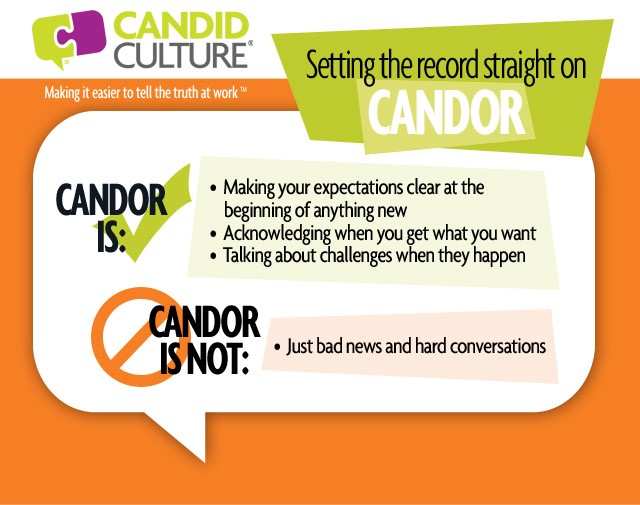
The word candor is not being used on a regular basis. Younger people may not know what it means. And, in my experience, people who are familiar with the word often misinterpret candor to mean bad news. Most people expect bad news to come after the question, “Can I be candid with you?”
The definition of candor is, to be honest, truthful and forthright. We at Candid Culture define candor differently. The Candid Culture definition of candor: Telling people what you need before challenges occur. Anticipating everything that can take a project or relationship off track and talking about potential pitfalls before they happen.
Think about the projects and processes in your office – hiring someone new, sourcing a vendor, training people on new software. The potential breakdowns are predictable. You know the pitfalls that can happen when starting anything new because you’ve experienced them.
What if candor sounded like, “We want this project to be smooth. There are a couple of things that will make our work together go well and a few things that may delay the project and have it cost more than we budgeted. Let’s talk about what needs to happen for things to go smoothly, ways to prevent missed deadlines, and how we’re going to handle breakdowns when they happen.”
Some call a conversation like this setting expectations, others call it planning. In my world, these conversations are called candor –talking about what you need when projects begin, rather than letting the anticipatable train wreck happen.
Candor isn’t bad news. It’s telling people how to win with you vs. making them guess.
Examples of candor at work and at home:
“Here a few of my pet peeves… It would be great if you could avoid them.”
“What will frustrate you?”
“I turn off my cell phone alerts at night, so feel free to text or call me anytime. I’ll respond to all messages in the morning.”
“I respond to text messages mostly quickly, then voicemail, then emails. If you don’t get a reply to an email within two or three days, don’t take it personally. Chances are I haven’t read the message. Feel free to follow up with a text or voicemail.”
“I work best by appointment. Drop by’s are hard because they interrupt my flow. Email or text me if you need something, and I’ll tell you when I can swing by. Does that work for you?”
For the most part, we treat people as we want to be treated. Other people aren’t us. They don’t do things as we do and don’t know what we want. Don’t make people guess how to work with you, what you need, and what you expect. Be candid and tell them! Then ask what the people you work and live with expect from you.
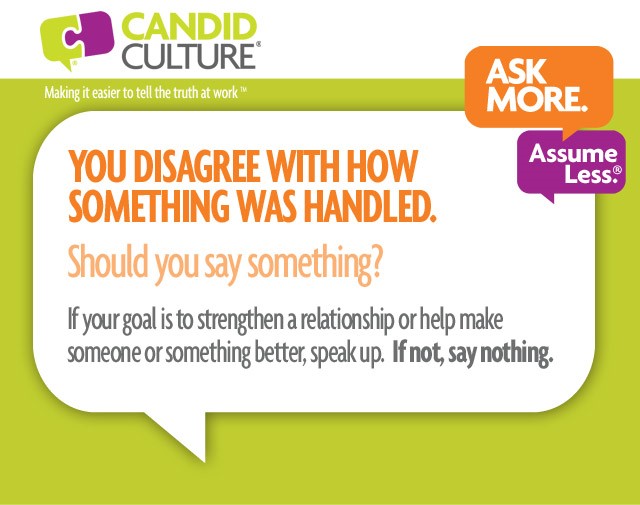
Most of us grapple with whether or not we should give feedback when someone else does or says something frustrating.
Here are a few criteria to help you decide whether or not you should give feedback or say nothing:
Do you have a relationship with the person? Do you know each other well enough to share your opinion? Aka, have you earned the right?
Has the other person requested your opinion? Unsolicited feedback is not typically received well.
If the other person has not requested your opinion, does he appear open to hearing feedback?
Are you trying to make a difference for the other person or just make him look or feel bad?
Do you want to strengthen the relationship?
Before you give feedback, do something I call, ‘check your motives at the door.’ If your motives are pure – you want to strengthen the person or the relationship, and you have a good enough relationship that you’ve earned the right to speak up — then do it.
People are more open to feedback when they trust our motives. If we have a good relationship with the person and he knows we’re speaking up to make a difference for him or for the relationship, you’ll be able to say way more than if your motives are questionable – aka you want to be right.
When I interviewed for my last job, before starting Candid Culture, the CEO put a mug in front of me with the company’s values on it and asked if I could live by those values at work. He was smart. Hiring someone with the skills to do a job is one thing. Hiring someone who fits into the organizational culture, is another.
Determining if a prospective employee will fit your organizational culture is much harder than determining if someone has the skills to do a job. Often when an employee leaves a job, only to take the same role at another company, they left for fit. They just didn’t feel comfortable. They weren’t a good fit with the organizational culture.
You’ve probably heard discussions about employees who deliver results at the expense of relationships. Or about employees who fellow employees really like, but they just can’t do the job.
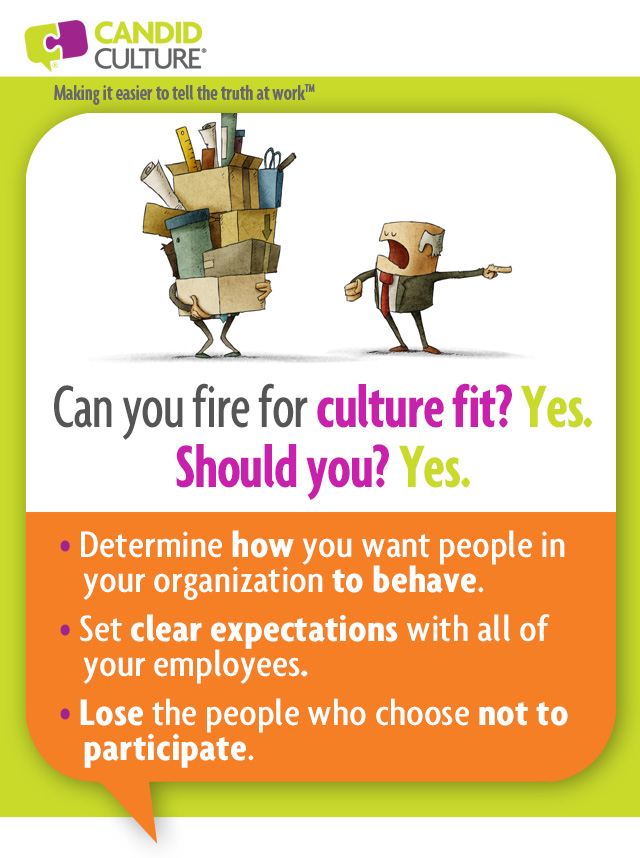
Leaders of organizations need to decide what’s important: What people do? How they do it? Or both. I’m going to assert that both the work employees deliver and how they deliver that work is equally important. I think you should hire and fire for fit.
Work hard to hire people who will fit into your organizational culture. Get rid of people who don’t fit. The impact on your organization’s reputation and on internal and external relationships depends on hiring people who behave consistently with your brand and how you want your organization’s culture to feel.
At Candid Culture, we teach people to have open, candid, trusting relationships at work. Thus we must hire people who are open to feedback and communicate honestly. And we fire people who don’t model those behaviors.
If you want a high service organizational culture, you can’t hire people who don’t care about others or who don’t want customers to feel good about working with you.
Here are a few ways to ensure you hire people who are a good organizational culture fit:
Share your current or desired culture with job candidates early, often, and clearly.
Work to assess how candidates fit the culture. Use practical interviews, job shadowing, and reference checks to assess organizational culture fit.
Talk about the culture when onboarding employees.
Make behaving according to the culture part of your performance appraisal process.
Reward behavior that matches the culture.
Have consequences for not acting according to the culture. A negative feedback conversation is a consequence.
Ensure your leaders and managers live the culture. Get rid of leaders and managers who aren’t a good culture fit. This takes courage.
When people leave an organization, they don’t often take copies of reports they produced or work they created. And if they do, they rarely look at that work. What they do take, remember and find meaning in, are the relationships they built at work. Relationships are dependent on organizational culture.
Determine the organizational culture you want. Talk about regularly. Require people to act according to the culture. Reward the ones who do. Get rid of the ones who don’t. Make working in your organization feel as you want it to feel.
Sign Up
Career tips you won't get elsewhere. Sign up to get a free tip card.