My four-year-old son Grayson likes to narrate. He gives instructions
to people he doesn’t know, tries to be “helpful” and keeps everyone informed.
Today we rode a miniature train Grayson has ridden many
times. He has the instructions memorized. “Keep your arms and legs inside the
train. Stay seated while the train is in motion, etc. etc.” While we were
waiting to ride the train he informed everyone standing in line of the rules. The
other parents were patient and indulged him, smiling and asking questions. When
we got on the train Grayson continued to give instructions, and I became
embarrassed. Self-conscious that my son
was irritating other passengers, I told him to be quiet. He looked at me and wisely
asked, “Why are you shushing me?” And then I was even more embarrassed.
He was right to ask. Why, indeed, was I shushing him?
Before I had children, I always hoped my child would be one
of those kids who wore superhero costumes everywhere, who didn’t care what anyone
thought, who was unabashedly himself. And I wondered, at what age do kids
become self-conscious? When do they begin to lose this level of self-expression?
And then I had one answer, when adults tell them to.
I imposed an old ‘rule’ on my son, “children are meant to be
seen and not heard.” Sit quietly. Don’t stand out and don’t inconvenience others.
Where are you sitting silent, stifling your views? What do
you know a lot about, but keep your skills or expertise under wraps? When do
you have a solution or a better way to approach a problem, but you don’t share?
Share your ideas. Do it in a way that doesn’t tell others they are wrong. It’s ok to have the answer. You can be right without being righteous. It’s ok to speak up.
No one likes
giving people negative feedback. Giving negative feedback often makes both the feedback
deliverer and the recipient feel badly. To make everyone feel better, we dress negative
feedback up with pickles and relish, otherwise known as The Empathy Sandwich.
The Empathy
Sandwich in action: “You’re doing really great. Now you did almost cost the
company $50,000, but in general, things are going great.”
The Empathy Sandwich
is plain wrong, wrong, wrong. It leaves people unclear, wondering if there is a
problem. Instead of softening negative feedback with positive platitudes on
both ends, tell people you’ll be providing positive and negative feedback as things
happen and then separate both types of feedback.
Here’s
how you can set the expectation that you’ll be providing balanced feedback:
Giving
feedback to people you manage: “As your manager, my job is to help you be successful. As a
result, I’ll tell you what I see, as I see it. I’ll give you both positive and upgrade
(negative) feedback in a timely way. Because if I don’t, you’ll learn nothing
from working with me.”
Paving
the way to give feedback to peers and those at a higher level: “We see each other work and are in a unique position
to provide each other with feedback. If you see me do something really great or
not so great, I’d like to know. I promise to be receptive.”
Delivering
feedback and avoiding The Empathy Sandwich: When you give feedback
separate the positive from the negative. You could say something like, “I want
to talk about a few things today. Here are some things that are going well… Now,
I also have something to talk with you about that is not going as well… After you
deliver the negative feedback, say something like, “I know there is a tendency to dwell on
negative feedback. I want to remind you of the positive things we talked about
today.”
People can
handle negative feedback. They won’t quit if you’re honest about their performance.
They will likely become defensive and get upset for a time. That’s ok! Your job
when giving feedback is to be clear, timely and specific. Worry about your
delivery. Ensure you have the relationship to deliver the feedback. Don’t worry
so much about the response.
How many times have you been sitting at your desk wondering, “Why won’t he ___________ ?’ Perplexed, you talk with your buddy at work. The conversation goes something like, “I’ve got this person, and I can’t figure out why he won’t ______________.” Or perhaps you talked directly to the person, but after several conversations, he still hasn’t done what you asked him to do.
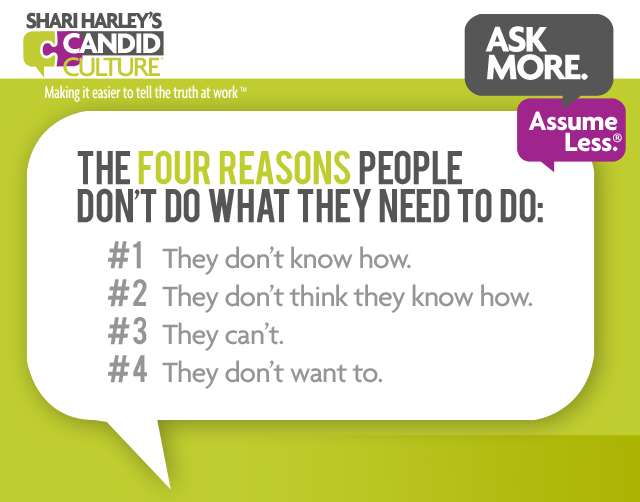
There are four reasons for a lack of employee performance and why people don’t do what you want them to do:
They don’t know how.
They don’t think they know how.
They can’t.
They don’t want to.
Reason number one for a lack of employee performance, they don’t know-how, is the easiest to solve. People who don’t know how to do something need training, coaching, a mentor, a job aid or some other form of instruction. The hope is that with the right training and exposure, he will be able to do what you’re asking.
Reason number two for a lack of employee performance, they don’t think they know how, can be improved over time with patience and consistent coaching. You aren’t working with clean slates. Most people are recovering from or reacting to a past relationship or situation. If a person worked for a controlling manager who never let him make a decision or worked for someone who invoked punitive consequences for making mistakes, the person will be hesitant to make decisions. Hence why he does drive-bys on you, repeatedly checking in, but never pulling the trigger on anything.
If you work with someone who doesn’t think he knows what to do, but you know that he has the answer, encourage him to trust himself. When he comes to you for validation or approval, ask questions, don’t give answers. Tell the person you trust his judgment and encourage risk-taking. Tell him that you’ll support his decision, even if it proves to be the wrong one. And encourage him to make the decision next time without consulting you. And then keep your word. If he makes the wrong call, you have to have his back and can’t invoke negative consequences.
Reason number three for a lack of employee performance, they can’t, is challenging but clear-cut. People who can’t do a task their brains aren’t wired for will never do that responsibility well, regardless of how much coaching, training, and assistance you provide. If you have repeatedly AND EFFECTIVELY, coached, trained, and provided support, remove that responsibility and give the person something he can do well. If that responsibility is a large part of the job, you have someone in the wrong job. It’s time to make a change.
Reason number four for a lack of employee performance, they don’t want to, is annoying but manageable. There are lots of reasons people don’t do things they don’t want to do. Those reasons include, but aren’t limited to, boredom, lack of buy-in as to why something is important, insufficient time, feeling like a task is beneath them, etc. If you’ve got someone who can but doesn’t want to do something, you can either take the responsibility away, incent him to do it, or give feedback EVERY TIME the task doesn’t get done.
Giving negative feedback isn’t fun for the giver or the receiver. No one wants to hear that he isn’t meeting expectations and most people don’t want to tell him. But the discomfort of receiving negative feedback EVERY TIME the person doesn’t do what he needs to do will create behavior change. He will either begin doing what you ask, quit, or ask for a transfer. Either way, your problem is solved.
The first step in getting people to do what you want them to do is to discover why they’re not doing what you ask. It’s impossible to appropriately manage employee performance if you don’t know why someone isn’t doing what he needs to do. And the person to ask why a responsibility isn’t getting done isn’t you or your buddy, it’s the person not doing the work. So get out of your head, leave your office, and go talk to the person not doing the work.
Here’s how to start an employee performance conversation:
“I’ve noticed you’re not doing ___________. Help me understand what’s happening.” Watch your tone, inquire from a place of genuine curiosity, and identify the reason he isn’t doing what he needs to do. Then you can intervene appropriately and hopefully get what you want.
Conference calls taken on speakerphone, listening to music without headphones, and a posse of visitors, make people working in an office with an open floor plan want to permanently work from home.
The key to being able to ask your coworkers to move the conversation to a conference room is the same as giving any type of feedback –set expectations and ask for permission to speak candidly.
Working in an open-office environment is challenging. Here is some language to make it easier to ask your coworkers to pipe down:
Get the people who sit in your work area together to talk about your working environment.
That conversation could sound like this, “It’s often pretty loud in our work area. I was wondering if we could set some guidelines of how we’ll manage our workspace, so it works for everyone? What do you think of establishing some practices we all agree to follow? For example, when making or taking phone calls, everyone will either use the handset or a headset. We won’t take or make phone calls on speakerphone. We’ll always use earphones if listening to music or watching videos. If a conversation at someone’s desk lasts longer than five minutes, people will take the conversation to a conference room. And when these guidelines are broken, and they will because we’re human, it’s ok to say something. We could even have a system to let people know it’s getting loud and that a guideline is being broken. With everybody’s agreement, we could throw a nerf ball into the loud cube, put a note in front of the person, or simply walk over and ask the person to take the conversation elsewhere. I want our work environment to work for everyone and make it easy for us to speak up without being concerned that we’re going to hurt someone’s feelings or damage relationships. What do you think?”
You DON’T need to be a manager to do this. Take control of your working environment by asking for what you want. Initiating this conversation may feel odd and uncomfortable, but I assure you most of the people you sit with will be grateful you dared to start the conversation.
You can say anything to anyone at work when you have permission to do so. Suffering is optional. Make requests today and follow up when things get loud. You can do it!
You’ve heard countless times that you never get a second chance to make a first impression. So when something not-so-positive happens – a customer is upset, you missed a deadline, or made an error – don’t let your boss find out about it from someone else. Manage your professional reputation and get there first to create the first impression of what happened.
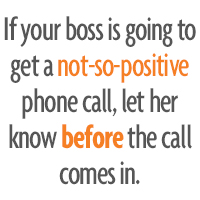
Managers don’t like surprises. If your manager is going to get a call about something that isn’t positive, let her know before the call comes in. You will create her perception of the situation, and perceptions are hard to change. Don’t wait for the s*** to hit the fan. Get ahead of the problem by coming forward and giving your manager and other stakeholders a heads up.
It could sound something like this, “I just had a tough conversation with John in IT. You may get a call. Here’s what happened… I didn’t want you to be surprised.”
Or, “I told Brian at Intellitec that we’re raising our prices in the second quarter. He wasn’t happy. You may get a call.”
Or let’s say you’re going to work on a strained relationship. Tell your manager before you take action. It could sound something like this, “I want to work on my relationship with Julie. Our relationship has been strained since we worked together on the software project last year. I’d like to approach her, tell her that I know our relationship is strained, and that I’d like a good working relationship with her. Then I’d like to ask if she’s willing to have lunch with me, talk about what’s happened, and see if we can start again in a more positive way. What do you think of me doing that? Would you approach the conversation differently? I don’t know how it’s going to go, so I wanted you to know what I’m planning to do, just in case it backfires and you get a call.”
Manage your professional reputation assertively by taking responsibility for mistakes, working on damaged relationships, and telling your manager before someone else does!
Sign Up
Career tips you won't get elsewhere. Sign up to get a free tip card.







 Working in an open-office environment is challenging. Here is some language to make it easier to ask your coworkers to pipe down:
 You’ve heard countless times that you never get a second chance to make a first impression. So when something not-so-positive happens – a customer is upset, you missed a deadline, or made an error – don’t let your boss find out about it from someone else. Manage your professional reputation and get there first to create the first impression of what happened.
 It could sound something like this, “I just had a tough conversation with John in IT. You may get a call. Here’s what happened… I didn’t want you to be surprised.”
 she’s willing to have lunch with me, talk about what’s happened, and see if we can start again in a more positive way. What do you think of me doing that? Would you approach the conversation differently? I don’t know how it’s going to go, so I wanted you to know what I’m planning to do, just in case it backfires and you get a call.”