Archive for June, 2019
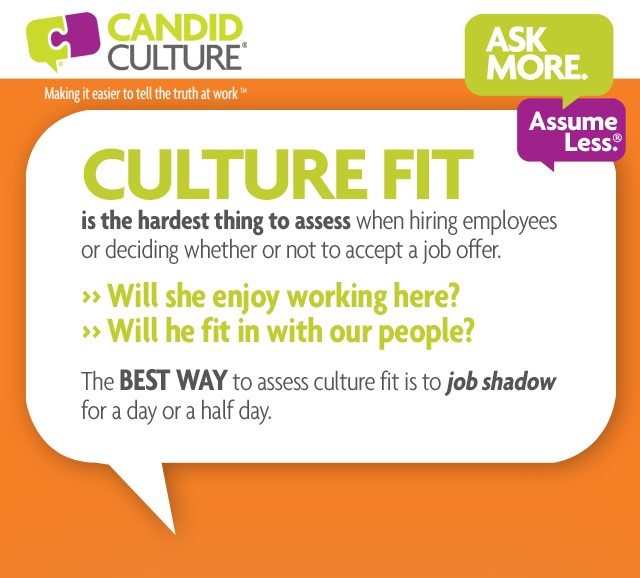 Figuring out if a candidate will like and can do a job is fairly straight forward, figuring out if a candidate will like working in your organization is much harder.
A clear and specific job description should tell a candidate whether or not a job’s responsibilities are things she can and wants to do. What’s much harder to determine is whether or not the candidate is a good culture fit with the organization. Will she be comfortable working with the organization’s employees and in the organization’s culture, and will other employees be comfortable working with her? It’s hard to figure that out during a 60 or 90-minute conversation, during which both interviewers and interviewees are on their best behavior.
Some companies use personality assessments to assess culture fit. Others have lots of people meet with candidates. I’m fond of the job shadow interview, which very few companies do.
If you’re really serious about a candidate, why not invite her to spend a day or a half day in your office participating in a job shadow interview. Candidates can attend meetings, have lunch, hang out in the break room and hallways, and meet fellow employees during the job shadow interview. Candidates and employees are more likely to let their guard down and be themselves outside of a formal job interview. You want to know the person you hire as well as possible. You don’t want to hire someone who turns out to be very different once she actually starts.
Hiring and training new employees is the most costly thing most businesses do, so slow down and invest more time. Before you make a candidate an offer, ask the candidate if she would be willing to spend half a day in your office participating in a job shadow interview. That invitation could sound something like, “We really like you and think you’d be a great fit. Before we make you an offer, we wonder if you’d be willing to spend an afternoon (or a day), sitting in on some meetings and job shadowing a potential peer. Would you be interested in doing that?”
Candidates, you’re interviewing and assessing an organization just as the people in the organization are interviewing and assessing you. You won’t be successful or stay in a job very long if you don’t feel at home in the culture. If a hiring manager makes you an offer and you are seriously considering it, ask to job shadow interview for a half or full day. That request could sound something like, “Thank you so much for the job offer. I’m very excited about the possibility of working for you! I want to be sure that I’m a great fit and vice versa. How would you feel if I spent a morning or afternoon attending a few meetings and job shadowing someone on the team? This will give me an even better sense of the organization and make sure this is a great decision for both of us. What do you think?” I can’t imagine any employer outside of those working on government, classified information saying no.
Taking the wrong job and hiring the wrong candidate is costly. Slow down and make better hiring decisions by giving candidates a chance to experience your culture with a job shadow interview, when people aren’t on their best behavior. You’ll make better hiring decisions and save lots of time and money in the process.

Get the words to say the hardest things in two minutes or less. If you work long enough, you’ll eventually be confronted with these situations. Giving feedback doesn’t have to be hard.

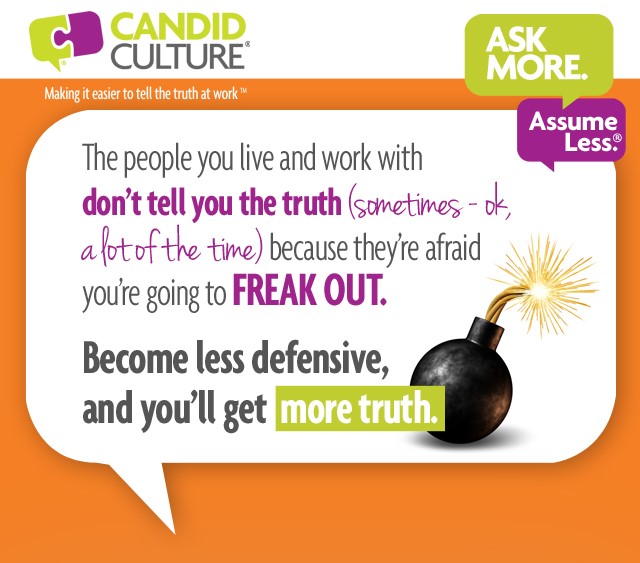 The people you live and work with are hesitant to give you negative feedback. They’re afraid you’ll freak out, and they don’t want to deal your freak out. It’s easier to say nothing.
When I started teaching how to give and receive feedback, I provided elaborate explanations as to the predictable response to feedback and the rationale for that response. Now I’ve boiled the natural response to receiving feedback into three words: The Freak Out.
Every person you know – personally and professionally – wants to be liked and approved of. Even the people in your office who you think are lazy want you to think they do good work. And when anyone calls another person’s competence into question, that person is likely to freak out (become defensive).
It’s very difficult not to get at least a little bit defensive when receiving feedback. A defensive response often sounds something like, “Thanks for the telling me that. Can I tell you why I did it that way?” The problem with that slightly defensive response is that what the other person hears is, “You’re not listening. I am wasting my time talking to you.” Then the conversation quickly ends. People want to feel heard. And when the feedback recipient becomes defensive, the person giving feedback doesn’t feel heard.
Don’t feel badly about becoming defensive when you receive negative feedback. Becoming defensive when receiving bad news just means you’re a living, breathing human being with feelings. That beats the alternative. But The Freak Out scares people. They don’t want to deal with your mild, moderate, or very defensive reactions.
Because people want to avoid The Freak Out, they keep negative feedback to themselves, or worse, tell someone else. If you want more truth, you need to make it clear there won’t be negative repercussions for speaking up.
Here are seven steps to get others comfortable giving you negative feedback:
1. Ask for feedback.
2. Be specific about the type of feedback you want.
3. Tell the person from whom you’re asking for feedback when and where she can observe you in action.
- A bad example of asking for feedback: “I really want your feedback. Feel free to give it anytime.” This is too vague and doesn’t demonstrate seriousness on your part.
- A good example of asking for feedback: “I really want your feedback on the pace of the new-hire-orientation program. Will you sit through the first hour next Wednesday at 9:00 a.m. and tell me what you think of the pace and why?” This request tells the person specifically what you want and demonstrates you’re serious about wanting her feedback.
4. When you receive feedback, say, “Thank you for telling me. I’m going to think about what you’ve said and may come back to you in a few days to talk more.”
5. Don’t respond to negative feedback immediately. Walk away instead of responding.
6. If you’d like more information or want to tell the person you disagree with what she said, wait until you’re calm to have that conversation. That can be minutes or a few days later.
7. You can express a counterpoint of view, you just can’t do it immediately after you receive the feedback.
No matter what a person’s role in your life – your boss, a peer, external customer, or even spouse – it takes courage to give you feedback. When a conversation requires courage, the speaker’s emotions are heightened. If the feedback recipient’s emotions rise in response to the feedback, conversations escalate. This is how arguments start. If you want to put the other person at ease and get more feedback in the future, do the opposite of what she is expecting. Rather than getting even the slightest bit defensive, do the opposite. Say, “Thank you for the feedback. I’m sorry you had that experience. I’m going to think about what you’ve said, and may come back to you to talk more.” Then walk away.
Walking away, when all you want to do is react, is very difficult. Walking away will require a good deal of self-control, but the rewards are great. You will build trust, strengthen your relationships, and get more information than you have in the past – information you need to manage your career, reputation, and business.

 You’ve either seen the video or heard about the group think that happened before NASA’s Challenger exploded in 1986. One engineer felt strongly that there was a defect in the Challenger’s design. He spoke up, others disagreed. He continued to speak up, until it became very uncomfortable to do so.
Most employees don’t even get that far. Many employees are afraid to speak up at all, feeling that it’s not ok to have a counter point of view, and that those who disagree with ‘management’ are eventually fired. I honestly am not sure where this comes from. It hasn’t been my experience, and yet the fear of speaking up is pervasive. I hear it in almost every organization with which I work.
If it’s not ok to express different opinions, your organization will deliver the same-old products and services you always have. If staying the same works in your industry, great. But stagnation is a killer to most organizations.
If you want more innovation in the workplace, you have to make it safe to speak up and offer a different point of view. Saying new, different, and even controversial things must be encourage and rewarded.
Five Ways to Encourage Innovation In the Workplace:
- Ask for new ideas and different points of view.
- Wait until you get both. Don’t allow a meeting or discussion to move on until you get new, opposing, and different points of view.
- Positively acknowledge people who risk and say something new or different from the norm.
- Ensure people with new ideas and different points of view are allowed to finish speaking before they’re interrupted or before someone else tries to negate their ideas.
- Create a few new awards in your organization and announce winners publicly and with great fanfare. You get what you reward.
Create Awards to Encourage Innovation In the Workplace:
- Acknowledge the person who fails massively trying something new.
- Award the person who brings new ideas to the table, regardless of what happens to those ideas.
- Celebrate the person who willingly gives you the worst news.
The fear of speaking up and saying something new or different will kill your innovation efforts. It will also kill your employees’ ambition and ability to be creative. Make it safe to tell the truth, even when the truth is hard to understand or unpopular, and see what happens to innovation, creativity, and employee productivity and morale.
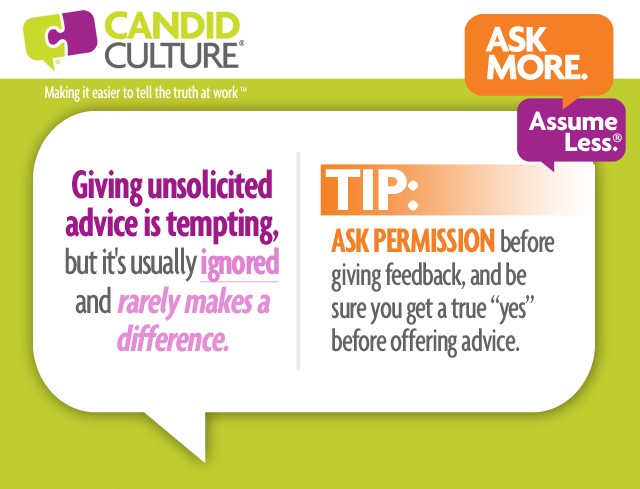 It’s hard to watch people do things that damage them – personally or professionally. And yet, if they haven’t asked for feedback, people likely won’t listen to unsolicited advice, so don’t bother giving it.
If you really want to give unsolicited advice, ask for permission and make sure you get a true “yes” before speaking up.
The conversation could go something like this:
“I noticed we’re getting behind on the XYZ project. I have a couple of ideas about what we can do. Would you be interested in talking about them?” Or, “That Monday meeting is rough. I feel for you. I used to run meetings like that. Would you be interested in talking about some meeting management strategies? I’d be happy to share what I’ve learned.”
After you offer to talk (aka, give your opinion), listen and watch the response you get. Do the person’s words and body language portray a true “yes, I’d like your opinion” or what seems like an “I know I’m supposed to say yes, but I’m really not interested” reply? If you get the latter, you’re likely just giving unwanted advice that won’t be heard. If that’s the case, let it go. But if the person appears generally interested and open, proceed.
You could also say something like:
“Last week we were talking about your frustrations about not being promoted. I have a couple of ideas about that. Do you want to talk about them? Either way is fine, but I thought I’d offer.”
Or, “That was a tough conversation during today’s staff meeting. It’s hard to present ideas and not have them be embraced. I have a couple of thoughts about ways you can approach the conversation during the next meeting. Do you want to talk about them?”
If you extend the invitation to talk, the other person has to be able to say no. An invitation is only an invitation if “no” is an acceptable answer. You can’t ask if the person wants your input and then keep talking if he verbally or physically said no.
Be brave. If you care about someone personally or professionally and you see him doing something that gets in the way of his success, ask permission to say something. If you get the go ahead, proceed. If you get a “no thank you,” accept that and move on. You’ve done your part.