Archive for February, 2018
Many organizations have moved from cubeland to open plan offices in which employees sit in rows of desks with no barriers between them.
 There’s considerable research on the workability of open plan offices. Some of what’s written says that introverts do worse than extroverts in an open plan office. I disagree. I’d say that how a person learns/takes in information determines how well she’ll do in an open plan office.
If you’re a visual or kinesthetic learner who learns by seeing or doing, you’ll be less distracted by noise than an auditory learner who learns by hearing. Auditory learners hear everything and are easily distracted by talking, music, and other noise. Visual and kinesthetic learners often don’t hear distractions, so they do better in an open plan office.
Here are seven steps to make an open plan office a more productive environment:
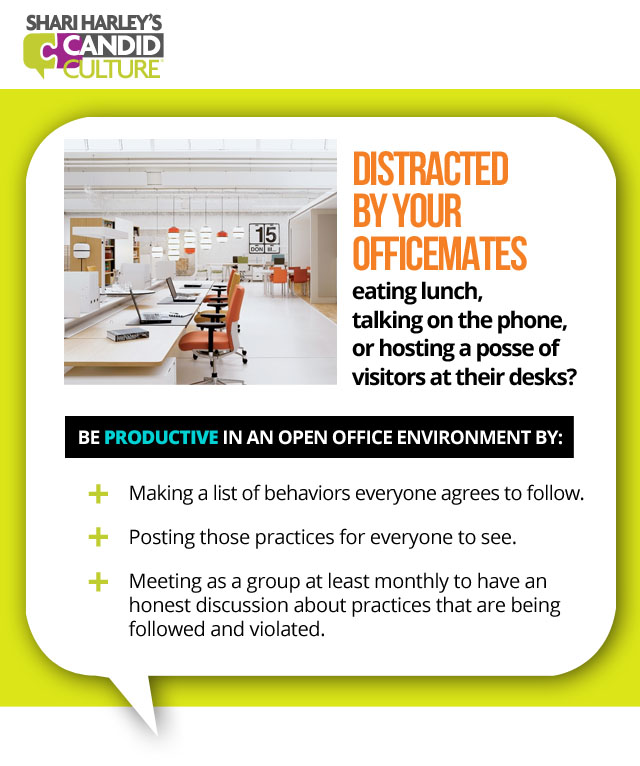
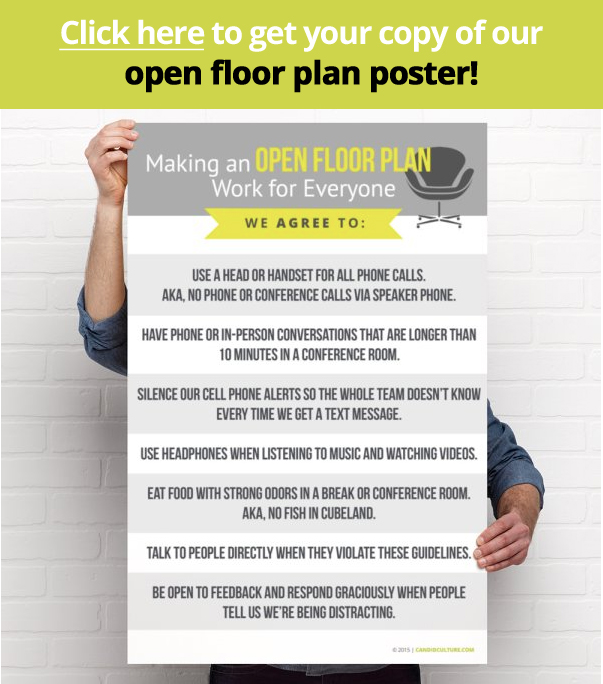
- Schedule a meeting during which people sitting together can discuss the working environment they need to be satisfied and productive. Then facilitate a discussion during which the group creates 5 – 7 behavior guidelines each person agrees to follow when at their desks.
- Post the list of agreed-upon behaviors on a poster that is large enough to be read from any place in the work environment. Leave the poster up indefinitely.
- Give each person in the group permission to talk to individuals who violate the guidelines. This is very, very important. For the most part, employees won’t tell another person she is talking too loudly, eating food that smells, has too many visitors at her desk, listens to music or videos without headphones, or takes phone calls via speaker phone. People will suffer in silence and choose to work from home or in an empty office or conference room rather than speak up about the behaviors that frustrate them. Ask the group to grant each other permission to speak up when guidelines are violated. Giving each other permission to speak up will make future conversations possible – difficult but possible. Without permission and these agreed-upon behaviors in place, people will suffer in silence or talk about each other, not to each other.
- Ask everyone in the work group to take feedback graciously, responding with “thank you for telling me,” rather than with defensiveness.
- Two weeks after making the list of guidelines, get the group together to review the list and make any necessary changes to it. Discuss behaviors that were omitted, aren’t realistic, and are realistic but aren’t being followed.
- Then follow up by facilitating a monthly conversation during which group members give honest feedback about which guidelines are being followed and which are not, and problem solve as a group. These conversations aren’t a chance to embarrass or call people out in a group setting. If one person is violating a guideline, that conversation should happen individually.
- You will need a strong facilitator for the group discussions. The facilitator must tease out people’s thoughts, while making sure no one gets blasted in front of the group. Don’t let concerns that you know exist be brushed under the rug. Group members must openly and regularly discuss what is and isn’t working about their work environment, or frustrations will build and unhappiness and dissension will ensue.
It’s not too late to put these practices in place, even with a group who has been sitting together for a long time. Just schedule the conversation and explain why you’re having it. People will be relieved and grateful.
Working in an open plan office is challenging. It requires good communication and compromise. Don’t wait for problems to occur and frustrations to build. Have a conversation today.
People often hoard feedback until a situation becomes so frustrating that they can’t help but speak up. And because they waited too long to say what they think, many more words come tumbling out than is either necessary or helpful.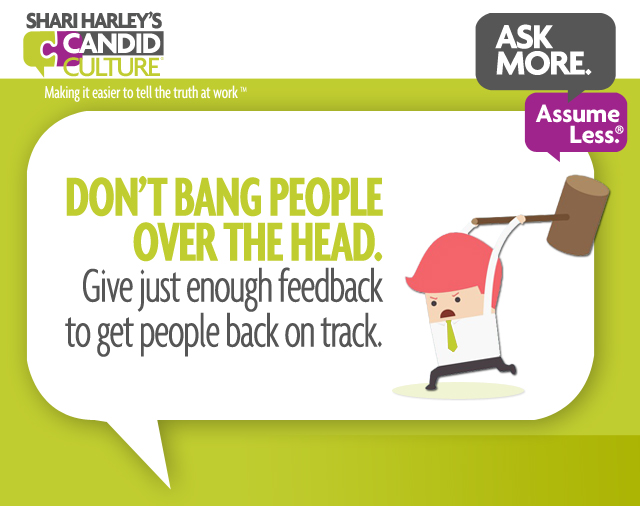
When it comes to giving feedback, less is more. Be specific, give an example or two, and stop talking.
If you want people to be receptive to your feedback, make it easier to hear by saying less. By saying less, I don’t mean don’t tell the truth or provide enough information that the person knows precisely what to do differently. I do mean, don’t provide more information than is necessary.
You are likely familiar with the phrase “let someone save face.” Allowing someone to save face requires saying just enough that the person knows what to do differently, but not so much that the person feels attacked.
Here are two examples of giving feedback do’s and don’ts:
Too much feedback: Last week you turned in a report that had five typos and had important pieces of information missing. I’m surprised you’d be so careless. It made our entire department look bad. I’m perplexed that you’d submit work without checking it first. What is leading you not to check your work and submit incomplete reports?
Don’t repeat feedback. Say it once and move on. And remove unnecessary judgments (careless) and share just the facts.
Just the right amount of feedback: The report you gave me last week had a few typos and was missing some important information. The report went to the client with those errors which didn’t reflect well on our department. What happened?
Too much feedback: I noticed you didn’t speak up during last week’s department meeting. People won’t know the value you provide if you don’t share what you’re working on. You need to be more vocal. People’s only exposure to you is often during our team meetings. If you don’t speak up, you won’t establish yourself as a leader in your department. People really need to know what you’re working on and the impact you’re making.
Too much feedback sounds like nagging. Most people don’t want to work with their parents.
Just the right amount of feedback: I noticed you didn’t speak during last week’s department meeting. Often, team members’ only exposure to you is during our weekly meetings. How can I help you feel comfortable speaking up so you can establish yourself as a leader in the department?
It’s easy to get carried away when giving feedback. We’re likely frustrated. And when our emotions run the show, it’s easy to say too much.
Here are three practices for giving feedback:
- Practice the 24-hour guideline and the one-week-rule. If you’re upset, wait 24-hours to give feedback, but not longer than a week after an event.
- Plan what you’re going to say both in writing and out loud. Practicing a conversation in your head is not the same as speaking it.
- Let someone you trust hear what you’re planning to say and ask that person how you can improve the feedback. Ask what you can remove without losing any of the message.
Planning a conversation is like packing for a trip. When packing for a trip, many people put their clothes on the bed, then put the clothing in a suitcase. Realizing they have way more than they need, they start taking things out of the suitcase. Eventually they arrive at their destination with much less than they initially packed, but still more than they need.
Use the same principles when planning a feedback conversation. Put every thought you have on paper, and then remove what you don’t need, leaving only the necessary points that tell the person just what he needs to do differently.
When giving feedback, less is more. Tell the person what happened, why it’s a problem, and what she needs to do differently. Then stop talking and let her save face.
I’m going to admit that I’m terrible at what I’m recommending today – taking time for yourself. Often my weekly blog is something I too am working on, and this week is no exception.
Many of you know that I have a small child and run a business. I work, travel, parent, and attempt to cook and keep my house clean. I’ll admit, I haven’t seen a gym or any form of real exercise since my son was born. I haven’t had lunch with a friend without my son in tow, haven’t seen a movie, and only talk to friends when I’m traveling.
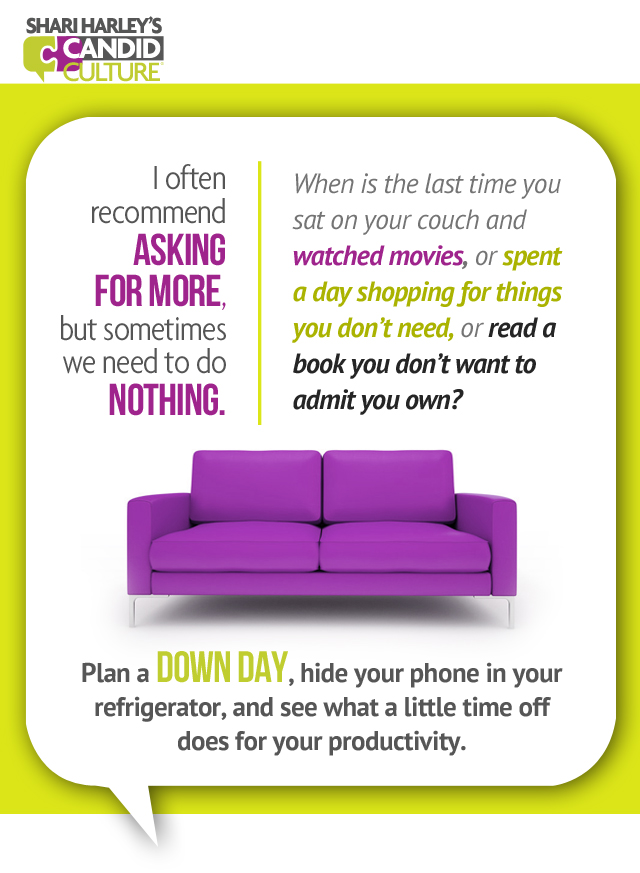
The value of downtime and taking time for yourself is well documented. There is a lot written on the need to take breaks to recharge, rejuvenate, and avoid burn out. The question is how to do so without feeling like something else is getting short shrift.
Here are seven tips for taking time for yourself:
Taking time for yourself tip one: Give yourself permission after a really busy few days or week(s) to take a day and do nothing. If you’ve been on the road for four days or worked really long hours, plan to sleep in on the fifth day. Don’t schedule early morning meetings and a full day. Know that you won’t be productive on day five anyway, so you might as well plan to do very little, which is what you’re likely to do anyway.
Taking time for yourself tip two: Plan a day doing non-work-related things you really want to do. When is the last time you did something you really love to do, just because? You’re more likely to dedicate time off to doing something you love than just lying around. But, if a day of planned recreational activities feels like another ‘to do,’ you’re better off doing nothing and not feeling badly about it.
Taking time for yourself tip three: Plan time to see one or two friends a week. I’ll admit that I have to schedule phone calls to catch up with friends and schedule time to see people I care about. Yes, I admit, this seems wrong. But do whatever it takes. If you have to put lunch or a phone call with a friend in Outlook for it to happen, do it.
Taking time for yourself tip four: Don’t feel badly about taking time off. Many employees don’t take their allotted vacation time – for a variety of reasons. Just do what you need to feel rested and refreshed. Stop judging yourself.
Taking time for yourself tip five: If you take a day off or sleep late, don’t work until two in the morning the next day to compensate. Doing so defeats the purpose and will put you in a hole the next day.
Taking time for yourself tip six: Watch where your time goes when you’re ‘working.’ I know that I squander lots of time while I’m ‘working.’ I allow myself to get distracted reading emails as they come in, texting, and chatting in our office. You could work fewer hours if you reduced these distractions.
Taking time for yourself tip seven: Decide what you really want your life to be about and what’s really important to you. Do you want work to be your focus or do you want an equal balance of friendships, family, and community activities? You likely have what it is that you really want.
If what you really want is a career-centric life, then just admit that and don’t judge yourself for it. But do take enough time off that you are rested, productive, and don’t resent your work.
Most of us avoid giving negative feedback  because we don’t want to deal with the recipient’s defensive behavior. We’re waiting for what I call, The Freak Out. The Freak Out is the predictable response to negative feedback.
Everyone wants to be seen as competent and adding value. When we give people negative feedback, we call those two things into question and the brain instinctively reacts. It’s as if you were driving down the road and the person in front of you slammed on their brakes. As an act of survival, you’d hit your brakes too. Becoming defensive when receiving negative feedback is the same instinctual response. We (almost) can’t help ourselves. So rather than dread and avoid others’ defensive behavior, expect it and have a plan.
Here are five ways to deal with defensive behavior:
- Plan your conversation by writing notes and bringing them to your conversation. I’m a fan of typed, double-spaced bullets that are easy to follow.
- Practice what you want to say out loud. What you say in your head is often different than what comes out of your mouth.
- Ask others for help. Change names and details to protect the feedback recipient and ask how someone else might deliver the feedback. Someone who is not emotionally involved will likely handle the conversation better.
- When the feedback recipient exhibits defensive behavior, take a breath and pause. Remember that you expected this. Don’t retract what you’ve said. Just let the person speak.
- Stay on track. Defensive behavior is designed to derail conversations. Keep the conversation focused on the feedback. Don’t become distracted.
What to say when people respond to feedback defensively:
Defensive behavior: “Why are you talking to me? I’m not the only one doing this.”
Appropriate response: “If others are doing this, be assured that I’m managing it. Right now we’re talking about you. I know this is difficult. Let’s stay focused.”
Defensive behavior: “You’re wrong. Everyone else thinks I’m awesome.”
Appropriate response: “I know this is difficult. I’m asking you to __________. Please do that.”
Defensive behavior: “You don’t like me and you’re picking on me.”
Appropriate response: “I’m sorry you feel that way. The reason I’m asking you to ________ is _______.”
Defensive behavior: “I disagree.”
Appropriate response: “I know that we disagree. And I’m asking you to __________.”
The key is not to get baited by defensive behavior. This is why I suggest preparing and bringing notes. When I’m having a particularly difficult conversation and the other person becomes defensive, I often become flustered and either forget what I want to say or back pedal. Do neither. Expect defensive behavior. Don’t get distracted. Stay on track. You can handle anything someone says.