Archive for November, 2017
Keeping with the theme of happiness and well-being during this holiday season, I’m hoping you’ll steer clear of the people and things that don’t make you feel good.
If you have a friend who talks only about herself, even after you’ve repeatedly given her this feedback, perhaps stop hanging out with her.
If you have a habit that you know isn’t in your best interest, perhaps break it.
The suggestions above are hard to do, but even harder is navigating relationships with people you can’t avoid. These are the people who when they show up on your caller ID, you often think, “not today,” and let the call go to voicemail.
Here are eight techniques for managing challenging relationships and conflict resolution in the workplace:
Conflict Resolution in the Workplace Technique #1: Know that there are difficult people in every organization. You can leave your job to get away from the person who makes you crazy. But I promise you, he will be waiting for you at the next organization in a different body.
Conflict Resolution in the Workplace Technique #2: Don’t ignore challenging relationships and expect things to get better without your intervention. They won’t. Deal with strained relationships head on.
Conflict Resolution in the Workplace Technique #3: Work on relationships in person or over the phone, not via email.
Conflict Resolution in the Workplace Technique #4: The time to fix a relationship is when there’s nothing wrong. Have hard conversations when things in your relationship are calm and you’re not upset, otherwise the conversations are likely to quickly escalate.
Conflict Resolution in the Workplace Technique #5: Give people the benefit of the doubt. People are doing the best they can. If people knew another way to do something, they would do it that way.
Conflict Resolution in the Workplace Technique #6: Let the other person save face. The more critical we are, the more the other person will feel compelled to defend himself. It’s almost impossible to have a useful conversation with someone who is in defense mode.
Conflict Resolution in the Workplace Technique #7: Ask for what you want. Rather than telling people everything they do wrong, make requests. That could sound something like, “Would you be willing to talk with me directly when my team is frustrating your team? I’ll do everything I can to make things right.” Or, “If you need something from me that you’re not getting, will you give me a call? I’d rather hear about challenges directly from you than from someone else.”
Conflict Resolution in the Workplace Technique #8: Be vulnerable. If you want a better relationship with someone, tell her. If a relationship is strained or broken, chances are, the other person knows. You could say something like, “I think we both know this relationship is strained. I want you to know that I’d really like a good working relationship with you. If you’d like to get together for lunch or coffee and talk about what has gone on, I’d really like that. Perhaps we can start in a new way.”
If you don’t want to be that direct, perhaps considering saying something like, “I just want you to know that I really want a good working relationship with you. What can I do to ensure you and your department get what you need from me? What’s one change I can make that would make the biggest difference for you?”
Damaged and strained relationships won’t get better without your intervention. Ask for what you want. Be positive, be yourself, and be honest. And if the person doesn’t play ball with you, you’ll know that you’ve done what you can.

Just because you can say something, doesn’t mean you should.
There can be too much candor and feedback.
A few guidelines to consider before giving feedback:
- Ask yourself, was the feedback solicited? Unsolicited feedback rarely goes over well.
- Assess if you have the relationship to give feedback. I’m offered all sorts of feedback from people I don’t even know. People I don’t know haven’t earned the right to give me feedback.
- Determine if you’re trying to strengthen the person or the relationship. If you aren’t trying to help someone improve, AND the feedback isn’t requested, AND you don’t have the rapport to give feedback, say nothing.
Feedback recipients don’t have to accept unsolicited input or advice. It’s perfectly acceptable to put limits and boundaries on the input you’re open to from peers, friends and family.
Here are two tips for how to handle negative feedback:
How to handle negative feedback tip one:
When you ask for feedback, be very specific about what type of feedback you want.
For example, you could say something like, “We’re picking a new software application to track leads. I’ve already narrowed the choice down to three vendors and vetted what each software application can and can’t do. I want to know about things I may not be aware of, like software that’s being phased out and won’t be supported and potential bankruptcies.”
There’s nothing wrong with asking for targeted feedback. Simply tell people what kind of feedback you want and why. And avoid asking open ended questions like, “What do you think?” If you ask a broad question, you’ll likely get a broad answer.
How to handle negative feedback tip two:
Tell people if you aren’t looking for feedback.
For example, you could say something like, “Thank you so much for your concern. I really appreciate it. I’m actually not looking for feedback at this time. But I really appreciate your concern.”
There’s NOTHING wrong with setting limits and boundaries about what kind of input you’re seeking. And when you do set those limits, intrusive people will think twice before offering unsolicited advice in the future.

During the holidays we often see people we haven’t seen in a long time. Your family and friends care about you and want to hear what’s happening in your life. Caring and curiosity can lead people to ask questions that you don’t want to answer.
Friends and family don’t need to know everything that’s happening in your life. None of your business – said a bit differently – is a perfectly acceptable reply. You decide what to share.
Here are a few possible replies to questions you don’t want to answer:
Question: “What’s happening with that nice young man/woman you’ve been dating?”
Answer: “Things are going great. Thanks for asking.”
Question: “Are you guys serious?”
Answer: “We like each other a lot. If it goes further, I’ll let you know.” Aka, this conversation is over.
Here’s another scenario:
Question: “Are you dating anyone?”
Answer: “No, not right now.”
Question: “You know, I met my husband on Match.com. Have you tried online dating?”
Answer: “That’s great that you met online. I don’t really want to talk about my dating life. What else is happening?”
The next thing she says, “You really should try it. You need to be open. You just never know.”
Answer: “I really appreciate your interest. I’m not looking for dating advice right now, but I really appreciate your concern.” Aka, shut up.
The examples above are about romantic relationships but they could have been about careers, kids, or finances. Your response can be the same. You don’t need to tell anyone anything you don’t want to. It’s ok to tell people to back off and that something is none of their business. You can say it nicely. Just don’t let yourself get cornered into giving information you don’t want to share.
An appropriate answer to almost any personal question is, “I don’t have anything to report on this front, but I’ll let you know when I do.”
An appropriate response to any type of unsolicited advice is, “Thanks so much for your concern. I’m not looking for advice on _____, but I really appreciate you caring.”
Telling someone to back off is perfectly appropriate. S/he’ll get the point and your personal life will remain personal. Boundaries are your friend.
Read How to Say Anything to Anyone, and be ready to manage intrusive questions and unsolicited advice this holiday season.

Last week I was chased down in the hallway by a conference participant. She told me that she and her husband bickered about (his) driving all the way to the conference. After three hours of bickering, she knew she needed to discuss how to handle driving disagreements in the future, and asked me how. I told her, “The time to fix a relationship, is when there is nothing wrong.”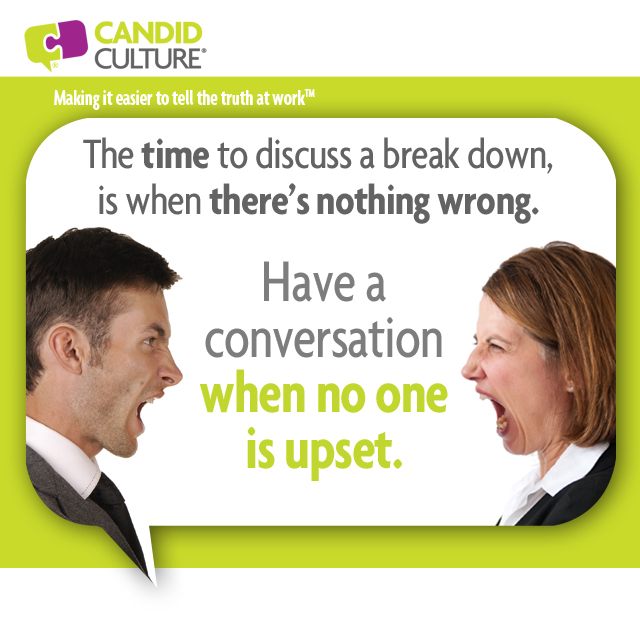
Talking with another person when you’re upset, often leads to more upset. Emotions and conversations escalate quickly. The more upset you are, the more likely you are to say things you’ll regret. The time to alter how you work, live, and communicate with someone, is when there is nothing wrong.
Pick a time when things are calm and when no one is upset. Tell the other person that you want to talk about how you work together, manage disagreements, make decisions, handle disappointments, etc. Share what you have observed in the past and make requests. Brainstorm solutions together. You’ll have a much better conversation when you’ve had time to calm down from whatever happened to create the need for the conversation.
Waiting to have a conversation until you’re not upset creates the risk of waiting too long to address concerns. The right time to talk about a breakdown is as soon after an event as you can. When both people are calm and have time to have the conversation, usually within a few days of a challenge.
There is no talking to my two-year old about why I took away a toy when I do it. He’s too upset. I need to wait to talk to him about why I did what I did and what I want him to do next time, when he’s calm. Typically, that’s later the same day. Adults may take a little longer. But this isn’t a pass to wait six weeks, which is what we often do. The conversation won’t be as hard or as bad as you think, if you talk when you’re calm and speak from what the relationship needs.
Speaking from what the relationship needs is saying just what you need to, not more and not less, to resolve the challenge and create a better way to handle things in the future. And communicating in a kind and direct way, so the other person can take in what you have to say.
Men get a bad rap for going to the man-cave and coming out to talk when they’re ready. This has a lot of wisdom. Don’t talk if you’re not ready.
Agree upon better ways for handing challenges when no one is upset. Speaking directly, calmly, caringly and with the desire to make things work, typically has a positive result.

If you work with other people, there is likely at least one business relationship you wish was stronger. If only that person included you on necessary communications, didn’t gossip about you, or gave you honest feedback versus telling you everything is fine and then working around you.
What often makes work hard isn’t the work at hand, but the people we work with – the power struggles, cc-reply-to-all when everyone doesn’t need to know, and the gossip that pervades most organizations.
You need to communicate and work well with the people you work with regularly. And like any relationship, business relationships require work. But what happens when someone doesn’t return your efforts for a positive working relationship? S/he doesn’t return emails or voicemails, ignores requests, and/or goes above you instead of coming to you when issues arise?
Make three attempts at strengthening a business relationship.
I’ll attempt to strengthen a business relationship three times before giving up. Phone calls and in-person meetings count as an attempt to improve a relationship, emails and text messages don’t. Emails and texts are passive, one sided communications. If you’re serious about strengthening a relationship, talk with the person, either in person or over the phone.
The conversation could go something like, “We’re going to be working together a lot this quarter, I thought it would be helpful to talk through how we both like to communicate and who will do what. When is a good time to spend a few minutes to discuss?”
Or, you could say, “Lots has happened in the past year – good and bad. I thought it would be helpful to talk about what did and didn’t work this year, so next year can be smooth. Would you be interested in having that conversation?”
Or, perhaps, “I want to talk with you about how we work together. I think we both know that this past year was hard. I’d love for us to have a good working relationship. Would you be willing to have lunch with me to discuss how we want to work together next year?”
It doesn’t so much matter what you say, as long as you start the conversation. Relationships don’t just improve by chance.
I’ll make attempts like those above three times (with the same person). If the person doesn’t reach back, says no, or cancels three scheduled meetings, I give up. Don’t chase people. The people who are interested in fostering a good working relationship with you will make the time and be willing to be uncomfortable.
What does it mean to give up? You are not the Golden Retriever of the workplace. Nor are you the 7-11 – always open. If someone isn’t interested in talking with me about how we can improve our relationship, I don’t keep asking. After the third no, I’m polite. I include the person in all necessary meetings and communications. I’m professional. But I don’t keep inviting. You can’t work with someone who won’t work with you.
Extend an olive branch. Be forthcoming, brave, and yourself. And if you get three nos’, go to lunch with someone else.