Archive for September, 2017
Consider the things other people do that frustrate you. Now consider what you’re asking for.
You aren’t likely to get what you don’t ask for, but most people don’t ask for very much. We assume that the people in our lives will do the right thing without prompting. We’ll get the recognition and compensation we deserve at work because it’s the right thing to do. Our friends will remember our birthday because how couldn’t they know that’s important to us? And no one will come to our home empty handed for dinner because we would never do that.
If you read this blog regularly, you already know that I’m a proponent of setting clear expectations and asking more questions before problems occur. Consider what you want and need, anticipate what can go wrong, and plan accordingly before problems happen. Doing that sounds great in theory, but how does it work in practice?
 Here are five ways to increase your job satisfaction:
Increasing your job satisfaction tip one: Be honest with yourself about what you need to be happy at work. Rather than tell yourself you won’t get what you need or try to convince yourself that you shouldn’t need something, just admit your needs to yourself.
Increasing your job satisfaction tip two: Share your needs with people who can help you get those needs met. Don’t make people guess. Chances are they won’t guess at all or will guess wrong.
Increasing your job satisfaction tip three: Don’t assume things will go well and just wait and see what happens. Instead, set clear expectations at the beginning of new projects and working relationships.
Here’s how that could sound: “We’re going to be working together for the next six months. Let’s talk about how everyone likes to communicate, what people’s pet peeves are, and the kind of information each person wants to receive.”
Here’s another example of how that could sound: “I’m excited to work on this project with you. There are a few things to know about me that will help us work well together and deliver timely results. I ask a lot of questions. Let me know if this frustrates you. I’m not questioning you; I just have a need to understand why we do what we do. And I work best with a deadline. I am happy to be available off hours, but you probably won’t hear from me before 9 am. You will get messages and work from me at night and on the weekends. Just let me know if you’d prefer I schedule messages to go out during regular business hours.”
People might give you what you need if you ask, but they likely won’t if you don’t. Train others how to work with you.
Increasing your job satisfaction tip four: Agree to talk about things as they happen. Don’t wait until you’re about to explode to speak up.
That could sound like, “I want us to work well together, and things will go wrong. Can we agree that we’ll provide feedback as things happen so we can make timely adjustments?”
Increasing your job satisfaction tip five: Renegotiate when you need to. If you realize you need or want something that you didn’t ask for, go back and ask. It’s never too late.
Here’s how that could sound, “We touch base about once a month and I’m realizing that if we could talk for about 20 minutes once a week, I’d be able to get more done. Can we make that happen?”
Job satisfaction and happiness at work (and at home) don’t just happen. The people you live and work with are not you and they don’t know what you need. Make a regular practice of identifying what you need, making those needs known, and then speaking up when things go array. You won’t get what you don’t ask for. But you will get whatever you allow.

When I was leading Leadership Development for OppenheimerFunds I told my boss, the head of HR, that one of my career goals was to be an HR generalist. He said, in his lovely British accent, “Shari, you’re very good at what you do, and you would be a terrible generalist. You will never be a generalist here.” At the next company, I also told the he ad of HR that one of my career goals was to be an HR generalist, and he too said, “You would be a terrible generalist. You won’t have that role here.” I could have left that company and chased my desire to be a generalist, or I could have listened to people who saw something I didn’t. I listened.
Sometimes others can see things we can’t and it makes sense to listen. That’s actually my definition of a coach – someone who can see things that we can’t, and they’re willing to tell us.
If you’re serious about achieving your career goals, consider these six practices:
- Identify what you want to do.
- Share your career goals with people who can help you achieve them.
- Ask people you trust and those in a position to help you achieve your career goals what may prevent you from having what you want. Obstacles might be organizational (i.e. the job you want doesn’t exist at your company) or they might be personal (i.e. you don’t have the skills, acumen, or temperament for the job you want).
- Work to develop skills you’re missing.
- Accept things that might prevent you from getting what you want, i.e. I don’t have the temperament to be an effective HR generalist, and I never will.
- Decide when to stop pursuing a goal. Make peace with that decision. And move on to something equally, if not, more compelling.
Most of us were raised to believe that quitting is taking the easy way out and that to quit is bad. I don’t know about that. Sometimes you have to listen to the feedback the world gives you and act accordingly.

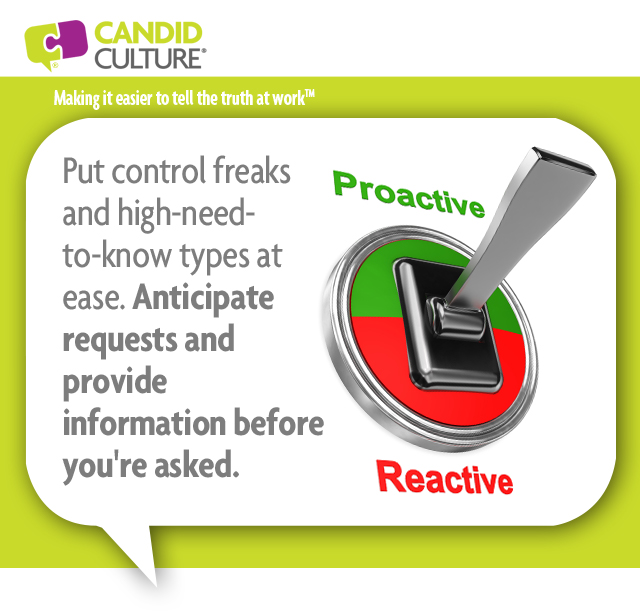
Frustrated by a control freak, micromanager, or a high-need-to-know type? Controlling behavior stems from a need that isn’t being met. Identify the need, meet it, and your life gets easier.
This is similar to what sales people learn during good sales training. The customer wants to buy the car but doesn’t. She visits the dealership three times, but just can’t pull the trigger. She has some sort of a concern. If the sales person can identify the concern, he can possibly resolve it, and sell the car. Working with control freaks is the same.
If someone wants more updates, information, or involvement than you’re comfortable with, he has a need that isn’t being met. When you meet the need, the person will likely back off.
I ask the people who work for me to never make me ask for something twice. Meaning, if I ask for an update the week before a speaking engagement, anticipate that I’ll want that information for all engagements. Confirm by asking me and then provide the data without being asked for all future engagements. Getting the information regularly without having to ask builds trust and credibility.
Here are six tips for working with control freaks:
- If you don’t know, ask:
- Their work-related goals.
- What the person is concerned about at work.
- How s/he likes to communicate – in-person, email, phone, voicemail, or text.
- How often s/he wants information, in what format, and with how much detail.
2. Provide more information than you think you need to, and then ensure the person wants that information in the future.
3. If you’re asked for information, ask why the person wants it, and if s/he wants it in the future. Then provide the information before you’re asked.
4. If someone is overly involved in your work and you feel you have no freedom, state your observation and ask for information. That could sound like, “You’ve been involved with each major decision with this project. I’m used to working with less oversight. Do you have a concern about my approach?” Then you negotiate. Everything is a negotiation.
5. This will put the other person on the defensive. A less confrontational approach is to discuss and agree upon levels of involvement and supervision when projects begin. That could sound something like, “What kind of involvement do you want to have in this project? What do you want to do? What do you want me to do? What kind of updates would you like, how often, and with how much detail?” It’s always easier to prevent a problem than to fix one.
6. Lastly, don’t take anything personally. Oversight and involvement may be a reflection of how someone feels about your performance, but it might not. When in doubt, ask.
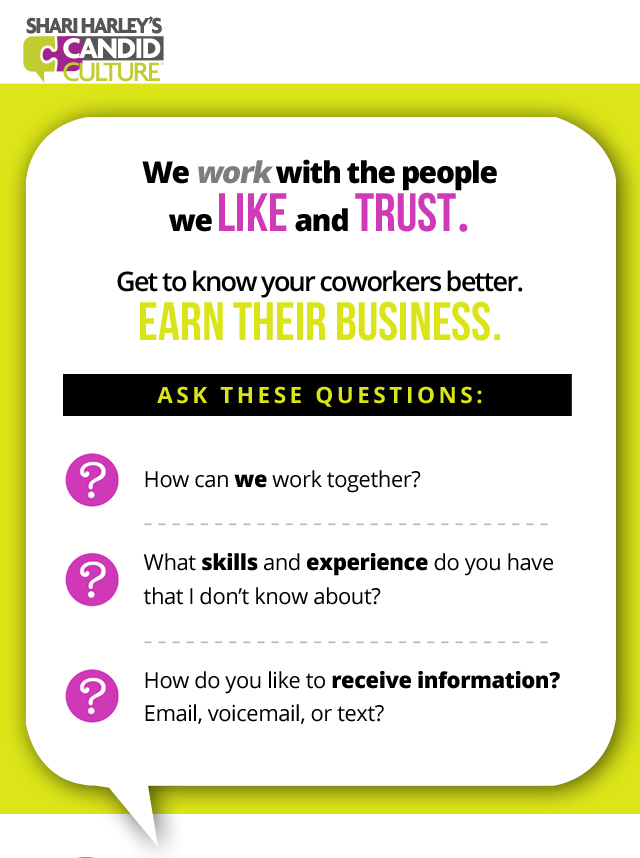
Regardless of who your company’s org chart says you should work with, people work with the people they want to work with and around those they don’t. One way to get people working with you (by choice) is to get to know your coworkers better, and I don’t mean personally.
Most people don’t know the people they work with very well. Coworkers often don’t know what fellow team members are tasked with doing for the company, their past work experience, education, or working style preferences. They often don’t know how fellow team members like to receive information, but get annoyed when they don’t return unopened emails.
If you’ve had any team building training with me, you know I advocate getting to know people better by asking more questions.
Organizations spend a lot of money on team building. Teams go bowling, out to happy hour, and have pot luck lunches, etc. All of those activities are fun and build comradery, and that’s important. But comradery and enjoying spending time together outside of work won’t help a team learn to communicate or overcome challenges.
If you’re really committed to team building and working well with people, ask more questions at the onset and throughout working relationships.
Here are five team building questions coworkers should be asking each other:
- What are your pet peeves? How would I frustrate you and not even know it?
- Are you a big picture or detail oriented person? Should I send you information in bullets or paragraphs?
- What are you best at doing? What type of work could you be doing that you’re not doing now?
- What are you working on now? What are your priorities for the next six months?
- What’s something I could do differently that would make your job easier? (You will survive the answer. I promise)
Your manager may coordinate an activity that gives your team the ability to ask questions like this, and s/he might not. Either way, ask the questions and be forthcoming if others ask you for this information. It’s not just your manager’s job to get your team working well together.
Your daily experience at work – how much you get done, how easily you get that work done, and how much fun you have along the way – is largely dependent on the people you work with. Don’t leave your working relationships to chance. Be assertive. Get to know people better. Ask more questions and offer information about yourself.