Archive for May, 2017
When I interviewed for my last job, before starting Candid Culture, the CEO put a mug in front of me with the company’s values on it and asked if I could live by those values at work. He was smart. Hiring someone with the skills to do a job is one thing. Hiring someone who fits into the organizational culture, is another.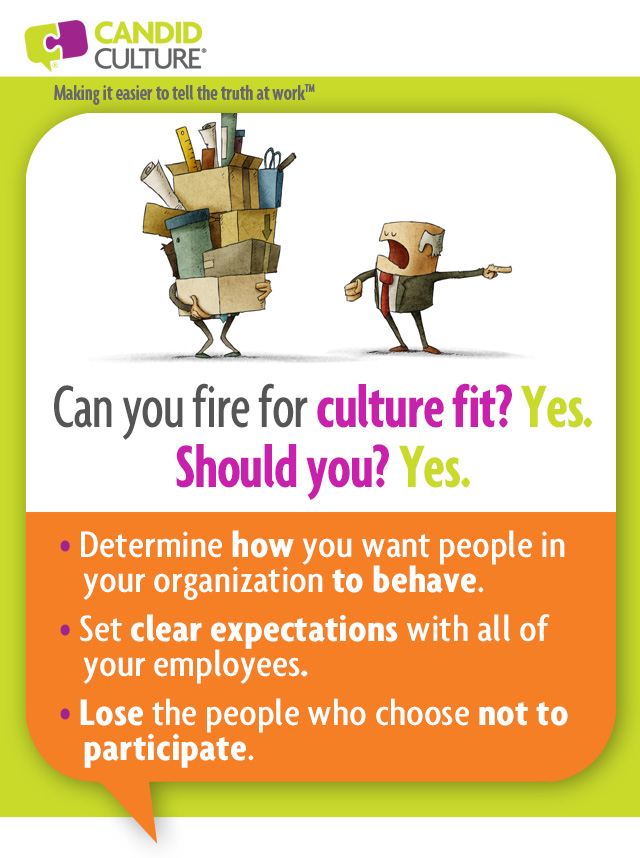
Determining if a prospective employee will fit your organizational culture is much harder than determining if someone has the skills to do a job. Often when an employee leaves a job, only to take the same role at another company, they left for fit. They just didn’t feel comfortable. They weren’t a good fit with the organizational culture.
You’ve probably heard discussions about employees who deliver results at the expense of relationships. Or about employees who fellow employees really like, but they just can’t do the job.
Leaders of organizations need to decide what’s important: What people do? How they do it? Or both. I’m going to assert that both the work employees deliver and how they deliver that work is equally important. I think you should hire and fire for fit.
Work hard to hire people who will fit into your organizational culture. Get rid of people who don’t fit. The impact on your organization’s reputation and on internal and external relationships depends on hiring people who behave consistently with your brand and how you want your organization’s culture to feel.
At Candid Culture, we teach people to have open, candid, trusting relationships at work. Thus we must hire people who are open to feedback and communicate honestly. And we fire people who don’t model those behaviors.
If you want a high service organizational culture, you can’t hire people who don’t care about others and want customers to feel good about working with you.
Here are a few ways to ensure you hire people who are a good organizational culture fit:
- Share your current or desired culture with job candidates early, often, and clearly.
- Work to assess how candidates fit the culture. Use practical interviews, job shadowing, and reference checks to assess organizational culture fit.
- Talk about the culture when on boarding employees.
- Make behaving according to the culture part of your performance appraisal process.
- Reward behavior that matches the culture.
- Have consequences for not acting according the culture. A negative feedback conversation is a consequence.
- Ensure your leaders and managers live the culture. Get rid of leaders and managers who aren’t a good culture fit. This takes courage.
When people leave an organization, they don’t often take copies of reports they produced or work they created. And if they do, they rarely look at that work. What they do take, remember and find meaning in, are the relationships they built at work. Relationships are dependent on organizational.
Determine the organizational culture you want. Talk about regularly. Require people to act according to the culture. Reward the ones who do. Get rid of the ones who don’t. Make working in your organization feel as you want it to feel.

When I’m not sure what to do, I do nothing. And my hunch is I’m not alone. When something feels big, it’s easier to do nothing than something.
Time management experts will tell you to divide a big project into small pieces, to make it manageable. That’s good advice. The universe – as woo-woo as it sounds – rewards action. Momentum, like inertia, is very powerful. As we know, a body that’s in motion is likely to stay in motion. A body at rest is likely to stay at rest.
The key to getting through anything large, scary, or intimidating is to start. Any action will do. The key is simply taking action.
Here are five keys to make taking action more likely:
Taking action key #1: What often stands in the way of taking action is that we aren’t sure what to do. Perhaps we aren’t sure we can do the task at hand. Or we can’t see what the end result should look like. Or the project feels so big that even thinking about starting is tiring. Ask questions and ask for help.
Most managers aren’t great delegators. When assigning a project, managers often ask, “Do you have any questions?” This is an ineffective question because few people want to admit to having questions about a project that feels so big, all they want to do is avoid it and take a nap. Or managers ask, “What do you need from me?” when most people have no idea what they need.
Don’t be afraid to ask questions until you’re clear about what a good job looks like, and ask for help.
Taking action key #2: Do one small thing, anything, towards achieving the goal. And do it now. Don’t wait until the right time. There is no right time.
Taking action key #3: Then do one more thing. Don’t wait six weeks or months to take another action. Momentum is very powerful. Keep things moving.
Taking action key #4: Give yourself small windows of time to work on a project. If you give yourself 30 uninterrupted minutes to work, you’re likely to invest that time. If you dedicate a day, you’re likely to get distracted and fill the time with other things.
Taking action key #5: Trust that you can do what’s in front of you. Someone wouldn’t have asked you to do something if they’d didn’t have confidence that you could do it. And if this is a goal you set for yourself, and it’s something you really want, deep down, you know you’re capable of doing it.
If you’re overwhelmed or don’t believe you can do something, call someone who has more faith in you than you have in yourself, at this present moment. Let that person fill you with confidence until you can generate it for yourself. When I started Candid Culture, I was filled with fear and quite honestly, was convinced I was going to fail. But everyone around me believed I could do it. And their confidence carried me until I could generate my own.
The way out is always through. Ask for help. Take one small action, then another. Dedicate small pieces of uninterrupted time to work on a large project. Trust that you can do it. Things don’t get done without your action. Take one action, then the next, then the next.

Ten years ago today I left my corporate job and launched Candid Culture, business communication training. I’ll admit to being terrified and being pretty convinced I would fail. I thought about starting the business for 12 years, but was paralyzed by fear. The only thing that finally motivated me to act, was that at the time, I worked for someone who didn’t believe me when I said I didn’t want the internal opportunity he was giving me. Don’t give a woman who can barely use Excel, leadership over the Finance department.
The training and keynote speaking I do have evolved over the past ten years, as organizations’ needs have changed. A few things have remained constant.
Here’s what I’ve learned in the past ten years:
- People struggle more than I ever realized when receiving negative feedback. People care about the work they do, want to do a good job, and want to be thought well of. Negative feedback calls all of that into question.
Most people question themselves when receiving negative feedback, and that’s a very painful process.
What do to: Give very small amounts of feedback at a time. Share one or two things the person can work on. More negative information sends our brains to a dark place, where we feel we can’t be successful, and performance actually drops.
Provide feedback on the positive changes or lack thereof, that you see. Don’t let people work in a vacuum. After you’ve seen some improvement, give one or two additional pieces of feedback.
- Most of us get almost no feedback at work – positive or negative. “Good job” doesn’t qualify as feedback. But that’s almost all the ‘feedback’ most people get.
- Even if you ask for feedback, you probably won’t get much, because the other person is concerned about your potential negative reaction.
- Managers are afraid employees will quit if they give negative feedback or report them to HR or the Union.
- People really want to know how they’re doing – good and bad – even if they don’t want to hear the message.
- Giving negative feedback requires courage and a trusting relationship, in which the feedback recipient trusts that the person’s motives are pure.
So what to do with all of this information? Be courageous and clear. Remember that the purpose of feedback is to be helpful. Care enough to be uncomfortable. Specific is helpful. Giving feedback will always be challenging. If you want to give less feedback, get better at making specific requests. You get what you ask for.

Many people worry about giving feedback because they fear they don’t have the ‘right’ words. They’re concerned they’ll say ‘it’ wrong and damage their relationships.
Feedback is hard enough to give without worrying about saying everything perfectly. Worry less about having all the right words and more about whether or not people trust your motives.
When people trust your motives – why you’re giving feedback – you can say almost anything. When they don’t trust your motives you can say almost nothing.
Getting negative feedback is hard. It’s easier to listen to feedback when we trust the person who’s giving us the feedback – we know their intentions are to help versus to judge or hurt us.
Speak from the heart, be authentic, and worry less. Be yourself. If you’re nervous to say what you want to say, tell the other person you’re nervous. If you’re struggling to find the right words, say so. If you’re worried you’ll damage the relationship or that it isn’t your role to give the feedback, say that. Authenticity goes a long way.
How’s how to give feedback you’re apprehensive about:
How to give feedback phrase one: Consider saying, “There’s something I need to talk with you about but I’m concerned that I won’t use the right words and will damage our relationship.”
How to give feedback phrase two: “There’s something I want to talk with you about, but I’m concerned how it will come across. Is it ok if I say what I need to say?”
How to give feedback phrase three: “I want to give you my thoughts on something but I’m concerned that it’s not my place to do so. Is it ok if I share my ideas about _________?”
Other people aren’t expecting you to be perfect. But they do want to know they’re working with a human being. And human beings are fallible. We have fears. We make mistakes. And sometimes we don’t say things perfectly.
You don’t have to be perfect, you just have to be real.
Think about all the people and situations that frustrate you. Now consider what you’re asking for. My hunch is, you’re getting what you ask for.
While most of us aren’t great at telling people when they violate our expectations, we’re not any better at asking for what we want. You might be afraid of appearing demanding or may not feel you have the right to make requests. When you tell people what you expect, you make their lives easier. Think about when someone invites you to their house for dinner. If you have any manners (and I’m sure you do), you ask what you can bring. When the other person says nothing, it makes your job (to be a good guest) harder. Now you have to guess what the other person wants. It would be so much easier if he would just tell you. This also applies to birthday gifts and where to meet for lunch. When people tell you what they want as a gift and where they want to eat, you don’t have to guess and they are easier to please.
It’s much easier to live and work with people when we know what they expect from us. And setting expectations is always easier than giving negative feedback. Negative feedback implies someone did something wrong. And no one likes to be told he is wrong. Setting expectations provides a road map to success, making it easier to win with you.
Here are a few phrases to make setting expectations easier:
Setting expectations example one: Consider saying, “I need time to get settled when I come in in the morning. Will you hold all questions and requests until 10:00 am?” You’re not telling someone she barrages you with questions before you’ve even gotten to your desk in the morning; you’re simply asking for what you need.
Setting expectations example two: You could say, “I like to have things done well before they are due. Will you send me all input for the weekly status report by Wednesday of each week so I have a few days to review your input before I have to submit it?” You’re not telling the person that working with him requires a weekly fire drill; you’re simply making a non-judgmental request.
Setting expectations example three: You could ask, “Would it be possible to touch base once a week via phone during your morning commute so I can get your input on projects?” You’re not telling the person she is impossible to get time with; you’re simply proposing an idea.
One of the keys to getting what you want is make requests in a neutral, non-judgmental way. The more you ask for and the more specific your requests, the easier you are to work with. What you need and want will be clear; there will be no guessing. People may choose to ignore your requests and violate your expectations, and then you’ll provide feedback. But start with making clear and specific requests, and see how many fewer feedback conversations you need to have.

Fourteen years ago, during my annual performance review, my manager said, “You had a great year. You rolled out 18 new training programs and got more participation in those programs than we’ve ever seen in the past. But you’re all substance and no sizzle. You’re not good at sharing the work you’re doing, and as a result my boss doesn’t know enough about what you’re doing and to support a large raise for you, so I can’t even suggest one.”

That happened to me ONCE, and I swore it would never happen again.
Too many people believe that if they do good work, the right people will notice and they will be rewarded appropriately. Part of this thinking is accurate. To be rewarded appropriately, you need to be doing good work. But the people in a position to reward you also need to know what you’re doing and the value you’re adding.
You need to find a way to share the value you’re providing without going over your boss’s head, sucking up, or alienating your coworkers.
Here are four ways to manage up while strengthening your business relationships:
Manage up tip number one: Ask your manager’s permission to send him a weekly update of what you accomplished during the week. This should be a one-page, easy-to-read, bulleted list of accomplishments or areas of focus.
Your boss is busy and most likely doesn’t follow you around all day. As a result, you need to let him know about the work you’re doing. Don’t make him guess.
Manage up tip number two: Periodically share what you’re doing with the people your manager works for and with. That can sound like, “I just wanted to share what my department is accomplishing. We’re really excited about it.” Ask your manager’s permission to do this and tell her why you want to do it (to ensure that the senior people in your organization are in-the-know about what your department’s accomplishments).
If you’re not sure who can impact your career and thus who you should inform about your work, ask your manager. She knows and will tell you, if you ask.
Manage up tip number three: Use the word “we” versus “I.” “We accomplished…..” “We’re really excited about….” Using the word “we” is more inclusive and makes you sound like a team player versus a lone ranger.
Manage up tip number four: If you work remotely and don’t see your coworkers and manager often, make sure you’re keeping people informed about what you’re doing. Likewise, if you work flexible hours – leave early, come in late, and work at night – people will assume you’re working fewer hours than them and will talk about it to whoever will listen. So while the hours you work shouldn’t be anyone’s business, people in organizations talk about stuff like this.
Don’t assume that people know what you’re doing or the value you’re adding to your organization. Instead, assume people have no idea and find appropriate ways to tell them. You are 100% accountable for your career.