Archive for April, 2017
There are three reasons people say “that’s above or below my paygrade” or “that’s not my job” –they don’t feel empowered to make decisions, they think they’re being unfairly compensated for the challenges at hand, or they aren’t particularly motivated (read lazy).
“That’s not my job” (aka, I don’t do things that are outside of my job description) is a mindset, and if someone has it, I’d suggest not hiring that person. People who think they should only have to do what’s on their job description aren’t utility players, and your organization is likely too lean to afford employees who only want to perform in a narrow box.
“That’s not my job” can also be an outcome of leaders and managers who can’t let go and let employees take risks and make decisions. If that’s your management style, hire people who will follow directions and don’t want to create new things and solve problems. Problem solvers will be frustrated if they only get to follow instructions.
Here are six steps to steer clear of “that’s not my job” syndrome and advance your career, regardless of your current role in your organization:
- Never say the words “that’s above or below my paygrade” or “that’s not my job.” Even if it’s true.
- If you don’t have the latitude to solve certain problems, ask the people you work for how they want you to handle those types of issues when you see or hear about them. That’s a subtle way to provide feedback that you don’t have the latitude you need to solve certain problems.
- When you see an impending train wreck, say something. I see lots of very capable employees see the train wreck coming, comment to themselves or others who can’t do anything about the problem (aka gossip), and then nod knowingly when the *&#@ hits the fan. Don’t be that person. Look out for your organization and the people you work with.
- If you see a broken or lacking process, raise the issue with someone who can do something about it, and offer to take a stab at fixing the problem. One of managers’ biggest complaints is employees who dump and run – “I’ve identified a problem. I’m leaving it for you to fix.”
- Go out of your way to do the right thing, even if you are uncomfortable or don’t want to. If it’s easier to email someone, but you know the right thing to do is to pick up the phone, pick up the phone. If an internal or external customer expresses concern and you can’t solve the problem, find someone who can. There are lots of ways to make an impact.
- Ask more questions. Find a non-judgmental way to ask, “Why do we do this this way?” “Have we considered…?” “Would you be open to trying…?” Status quo can be the right thing and what’s necessary. It can also be the death of organizations.
Make stuff happen. Don’t pass the buck. And if you are going to pass the buck, don’t announce it. It only makes you look disempowered and uncommitted.

Our company got a shipment of products this week that were partially defective. When I called our vendor to tell him about the defective products, he sighed knowingly. He knew part of our order was imperfect and waited for me to find the problems versus telling me himself.
What?!?!
I love surprise gifts, trips, and discounts. But I don’t like surprise errors and your internal and external customers don’t either.
Everyone makes mistakes at work. Making a mistake is not necessarily a problem. It’s how you deal with the error that matters more. Letting those who are impacted by a mistake be surprised damages your reputation and working relationships much more than coming clean as soon as you realize the error. Rather than waiting to get caught, tell your customers about mistakes and work together to make things right.
Here are a few ways to tell people you made a mistake, while saving face:
Fessing up to making mistakes at work tip #1: When you realize you’ve made a mistake, pick up the phone and tell the person live, as soon as you know. Don’t wait.
Fessing up to making mistakes at work tip #2: Apologize and work with your customer to develop a solution. Be part of the process. Don’t leave your internal or external customer holding the bag.
Fessing up to making mistakes at work tip #3: Don’t give a bunch of reasons or justifications for what happened. It sounds like excuse management and no one cares. Your customers just want to know how you’re going to solve the problem.
Fessing up to making mistakes at work tip #4: Say something like, “I realized we sent you a report with incorrect information. I’m so sorry. I’d like to work with you to make this right. Here are a couple of ideas of what we can do… Would any of these suggestions work for you?”
Or you could say, “I realized parts of your order are imperfect. I’m so sorry. Here’s how we’d like to make things right. Are these solutions satisfactory to you?”
Or consider saying something like, “I’ve realized we can’t fulfill your order by the date we promised. I’m so sorry. Here’s what I suggest we do to get you what you need in a timely way. Does this work for you?”
We all make mistakes. How you handle mistakes determines how your internal and external customers view you and how much they trust you. Come clean quickly. Take responsibility. Don’t provide a bunch of reasons for a mistake. Help make things right. And you’ll likely preserve your reputation and business relationships.

If an employee quits and the manager is surprised, shame on the manager. Employee turnover – literal turnover (he quits and leaves the building) or figurative turnover (he quits but continues to come in everyday and do his minimal best) – are extremely predictable.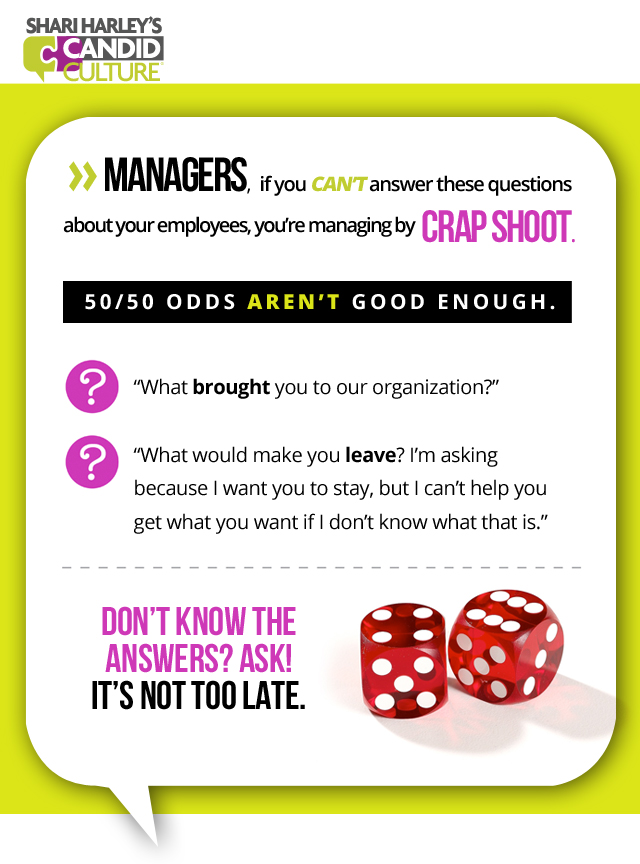
Most employees need only a handful of things to be satisfied and productive at work. The key is getting employees to tell you what those things are. And they might just tell you, if you ask.
An employee’s first few weeks at a new job often involve a lot of training. Managers tell employees what they need to do and hopefully why they need to do those things. I recommend balancing telling with asking.
Effective management involves asking the seven questions below during the interview process, after an employee starts, and again 90-days to six months into the job.
Effective management question number one: “What brought you to this company? Why did you accept this job? What are you hoping the job will provide?” Ask one of these three questions. Pick the one you like best.
Effective management question number two: “What would make you leave this job? What are your career deal breakers, things you just can’t tolerate at work?” Ask either of these questions.
Effective management question number three: “What type of work, skills, and/or areas of our business do you want to learn more about?”
Effective management question number four: “Tell me about the best manager you ever had. What made him/her the best manager?” This will tell you what the employee needs from you as a manager and is a much better question than, “What do you need from me as your manager?” That is a hard question to answer. Telling you the best manager s/he ever had is easy.
Effective management question number five: “Tell me about the worst manager you ever had? What made him/her the worst manager?”
Effective management question number six: “What are your pet peeves at work? What will frustrate you?” Why find out the hard way what frustrates employees when it’s so easy to ask. This question demonstrates that you want your employees to be happy and that you will flex your own preferences, when possible, to meet employees’ needs.
Effective management question number seven: “How do you feel about being contacted via cell phone or text outside of business hours? How do you feel about receiving emails during the evenings and weekends?”
If you’ve participated in one of our effective management trainings and received a box of Candor Questions for Managers, you know I could go on. But these seven questions are a good start.
Regardless of age, gender, or work and educational background, all employees have a few things in common. Employees want to:
• Work for someone who takes an interest in and knows them
• Feel valued and appreciated for their contributions
• Be part of and contribute to something greater than themselves
• Feel respected as a person. Managers respect their time, expertise, and needs
Taking the time to get to know employees throughout your working relationship accomplishes many employee needs.
If you have long time employees, it’s never too late to ask these questions. Regardless of for how long employees have worked for you, they’ll appreciate you asking. There is no need to feel that employees will raise an eyebrow and wonder why you’re asking now. They’ll just be happy you’re asking. You can simply say, “I realized that I’ve never overtly asked these questions. I just assume I know. But I don’t want to do that. You’re too valuable to me and to the organization. During our next one-on-one meeting I’d like to ask you these questions and you can ask me anything you’d like.”
If you have a manager who will never ask you these questions, provide him/her the information. Don’t wait to be asked. You’re 100% accountable for your career. Tell your manager, “There are a few things about myself I want to share with you. I think this information will make me easier to manage and will help ensure I do great work for the organization for a long time.”
Managers, the better your relationship with your employees and the more you know about what your employees need from you, the organization, and the job, the easier employees are to engage, retain, and manage. Stop guessing and start asking.

There’s when things end and then there’s when we physically leave, and the two rarely coincide. Sometimes it takes six months, a year, or even longer for our body to catch up with our brain.
Knowing when to leave a job, a relationship, and even a party is a skill. If you’re unhappy at work, have asked for what you want, and know you can’t it where you are, develop an exit strategy and act on it quickly.
When you’re checked out, people know. Unhappiness shows up in our performance, attitude, and body language. And quitting and staying is bad for your career, reputation, and business relationships.
If you’re unhappy at work and are ready to make a change, there are a few actions you should take to keep your reputation intact while you make a transition:
- Make sure you’ve fully investigated your options at your current place of work before deciding to move on. Share your desires in a positive way, with people who can help you get what you want. Saying, “I’d really like to do _________, or I’d really like to work in the ______ department” will get you much further than saying, “I’m underutilized, undercompensated, and unappreciated.”
- Do your job and do it well. Don’t go missing in action.
- Only commit to things you know you can and will do, and keep your commitments.
- Confide in people about your unhappiness and future plans who are outside your current place of work. People talk. Assume anything you tell someone at work will be told to someone else.
- Take at least one action every day towards getting what you want. It can be easy to get into a rut when job hunting. Stay in action.
If you’re unhappy at work, it’s probably time for a change – either within or outside your company. Ask for what you want in a positive way. Do a great job on a daily basis, regardless of how you feel. Confide in people outside of your workplace. And take one action every day towards getting what you want.
Know when to go.