Archive for September, 2016
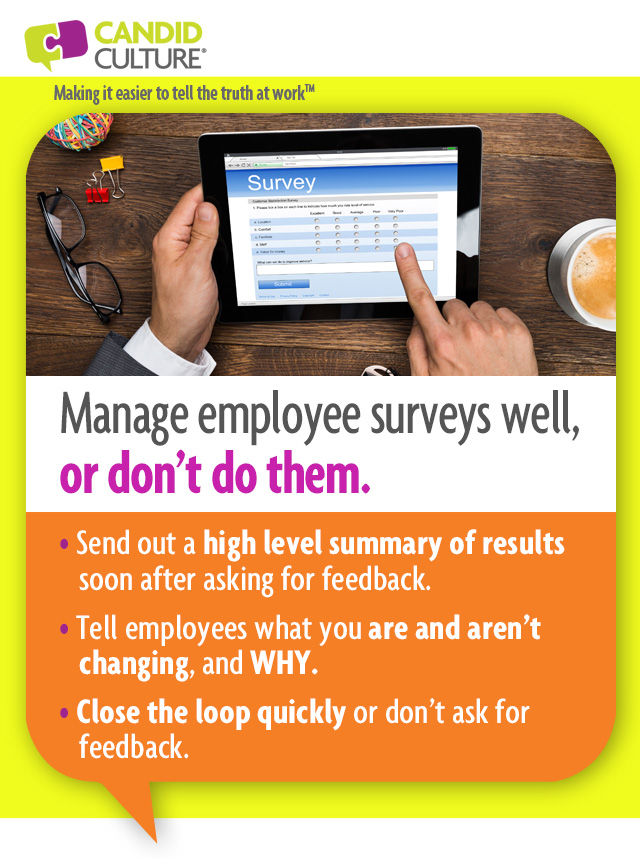 Lots of organizations send out employee engagement surveys with the desire of improving employee engagement and retention; unfortunately they often damage both in the process.
There are a few employee engagement survey pitfalls that are luckily easy to avoid.
Here are three practices to follow when sending out employee engagement surveys:
- Shorter is better. I hate to say this, but no one wants to fill out your employee engagement survey. It’s time consuming, employees doubt the survey will yield results, and employees worry that their feedback isn’t really confidential.
Make your employee engagement survey easy to fill out by making it short. And by short, I mean 10 questions or fewer. You’ll get a better response rate to a 10-question survey than a 65-question one. And do you really need more information than the answers to ten well-written questions?
- Provide employees with survey results quickly. Most organizations ask for too much information. Leaders are overwhelmed by the survey information, so they spend months and months reviewing it, while employees comment on yet another employee survey with no communication.
Send out a communication sharing the top few learnings – the good and the not-so-good — within a few weeks of sending out the survey. You don’t need to take action at the same time. Simply keep employees in the loop by communicating a quick summary of what you learned. If you wait too long to share the feedback, it often never gets communicated. And the next time you send out a survey, employees will remember the absence of information and be hesitant to fill it out.
- Within 90-days, tell employees what you will and won’t be changing, based on the survey feedback, and tell them why. Employees don’t need or expect all of their input to be utilized. Closing the loop with clear communication about what you are and aren’t changing, and why, is often sufficient.
All of that being said, I’m going to recommend you send out fewer surveys. Employee engagement surveys are a good way to quickly collect lots of information. Engagement surveys are not a good way of building trust and relationships with employees, which is what leads to employee engagement and retention. Employees don’t feel closer to an organization’s leadership team after filling out an employee engagement survey. Trust isn’t built. Instead of sending out so many surveys, I’d suggest cutting the number in half and have leaders and managers hold roundtable discussions with groups of 6-8 employees a few times a year instead. Roundtable discussions achieve several goals at once—they give leaders visibility, which builds trust, they help leaders build rapport and relationships, and gather the same data that a written survey provides.
When leaders participate in our Be a Best Place to Work program, we teach the five things leaders need to do to engage and retain employees. Holding roundtable discussions and asking these questions is a key recommendation of the training. Sending out written surveys is not. Engage and retain employees by talking with employees. Ask employees for their input. Listen. And watch your employee engagement survey scores sky rocket.

As crazy as it sounds, your manager is afraid of you – afraid of your defensive reaction to feedback.
The normal reaction to feedback is to get upset. The problem is, no one wants to deal with our upset. It makes them uncomfortable. So managers and peers alike start to pick and choose what to tell us. Not wanting to deal with our reaction, they start to pick their battles. The more defensive we are, the less feedback we get. The less feedback we get, the less information about our performance we have. The less information we have about our performance, the less control we have over our career.
All of us have been passed over for an opportunity at work – a promotion, raise, project, etc. – and for the most part, we have no idea why, because no one wants to risk our defensive response to tell us. This lack of knowledge makes it hard to manage your career. And to be frank, defensive people are extraordinarily difficult to work with. Having to watch every word, walk on egg shells, and be choosy about what to address and what to avoid is exhausting. Be receptive and thus easier to work with.
I teach managers to screen out candidates who aren’t coachable and receptive to feedback. Work is hard enough without hiring people who aren’t coachable. Being open to feedback makes you easier to work with.
Here are three ways to be open to feedback and increase receptiveness:
Tip one to be open to feedback and increase receptiveness: Don’t underestimate the power of your emotions and the intrinsic drive to defend yourself when receiving feedback. Not defending oneself is extremely challenging. And even the most minor reaction sounds defensive. I.e., “Thank you for the feedback. Here’s why we did it that way…”
Tip two to be open to feedback and increase receptiveness: Wait a few minutes, hours or days, and respond to feedback when you’re calm. That could sound like, “Thanks for telling me. I’m sorry that happened. I’m going to think about what you said and get back to you by the end of the day.”
Tip three to be open to feedback and increase receptiveness: Come from a place of curiosity when seeking feedback versus thinking “there’s something wrong here” and “I’m bad.” Be curious about how you impact others and the impression you make. Seek feedback to understand both.
When I landed my first ‘real’ job after graduating from college I was so scared, I almost turned  the job down. It took me five years to finish my first book, How to Say Anything to Anyone, in part because I was afraid no one would like it.
It seems anything worth doing is worth fearing.
I’m not talking about taking risks for the sake of risk – driving as fast as your car can take you, not paying your bills to see what will happen, or offering a counter point of view at work for the sake of doing so. I’m talking about pursuing the things you really want, that speak to your true purpose.
Being afraid doesn’t mean you can’t do something, nor does it mean that you shouldn’t. Feeling some fear just means what you want is outside of what you know you can do. But it’s the edge and the unknown that is juicy and rich.
During the past few years I’ve pursued things I’m terrified of, that I don’t know I can do. Yet I want these things, so I pursue them in the face of fear. And I have to admit, that as I get closer to getting what I want, the fear doesn’t dissipate, it actually gets worse. As I can almost taste having what I want, I get more scared. And sometimes I pull back, thinking, maybe I don’t really won’t those things. Maybe I was wrong. Then I remember why I want what I want and step back into the pursuit, despite the fear.
Don’t misinterpret fear as a reason not to do something.
A few suggestions for how to face your fears at work:
1. Write your desires down and/or tell people what you want.
- You’re more likely to get what you talk about wanting.
2. Take one step towards having what you want.
- Talk to someone who either has what you want or can help you get what you want.
3. Put yourself in the place of most potential, where you can get what you want.
- If you want to work in a certain department, express interest in working on a project that serves that department.
- Tell your boss and people in leadership in your desired work area of your interest.
- Apply for a job in that area.
4. Be positive and persistent.
- No one wants to give a complainer an opportunity, and it takes time to make a shift.
The key is to take one step, then another, then another. And when you feel fear, don’t let it stop you. Fearing the next job or opportunity doesn’t mean you can’t do it well, it just means you haven’t done it yet.
When you need encouragement to face your fears, hang our inspiring magnets at your desk. You have to believe in yourself just as much as the people around you believe in you.

We added to our team at Candid Culture a few weeks ago, so we did what I teach other organizations to do –used Candor Questions to onboard our new team member, and help the entire team get to know each other better.
I sent my team the Candor Questions below and asked them to pick a few additional team building questions for everyone on the team to answer.
- What will keep you working here and what would make you leave?
- What’s the best way to get information to you – voicemail, text, or email?
- What time is too early?
- What time is too late?
- Do you leave your email and/or text alerts on at night/when you go to sleep?
- Would you prefer I send all emails and text messages during regular business hours?
- What frustrates you at work?
- What are your pet peeves?
- What’s something you want to learn, skill or business wise, that you haven’t had a chance to do?
- What’s something you wish I would start, stop, or continuing doing?
We run so fast at work and are so focused on completing goals, we often don’t take the time to really get to know the people we work with. I feel very strongly that asking the team building questions above will help people work better together. We’ll make fewer ‘mistakes’ with each other, and get more done with less stress and more ease. As William Ury said in his book, Getting to Yes, “Go slow to go fast.”

How many times have you sent someone five emails and become frustrated when none were returned? Or you thought an employee was happy, only to be surprised when she quit? Or you needed to talk with someone but couldn’t get her attention, so you walked by her office throughout the day, wondering if it was ok to knock? Working with other people doesn’t have to be so hard.
Taking the time to ask team building questions is much faster than recovering from missteps with other people. Ask the questions at the beginning of anything new – when you hire a new employee, get a new customer, or start a new project. And keep asking the questions as you work with people.
Asking questions about working style preferences and goals is an ongoing process, and it’s never too late. You can ask the team building questions during meetings or just slip them into your conversations. The process doesn’t have to be formal or time consuming. The point is simply, don’t guess what people need and are expecting from you, ask.

Most people wait way too long to give feedback. We wait for the right time, aka when we’re comfortable. That day will not come.
Instead of waiting to give feedback until you’re about to explode in frustration, or until a formal review, give feedback every time you meet with someone.
Managers, make it a practice to meet with each of your employees at least once a month. Twice a month or weekly would be better. But if you’re not doing one-on-one meetings now, start meeting monthly. If you’re meeting monthly, start meeting twice a month. Employees need face time with their boss. Team meetings and casual conversations do not replace individual meetings.
Direct Report One-on-One Meeting Agenda:
The direct report comes to the meeting ready to discuss:
1. What she’s working on that is going well.
2. What she’s working on that is not going well.
3. What she needs help with.
4. Then the manager gives feedback on what went well since the last meeting and what could be improved.
5. And the employee gives the manager feedback on what has gone well since the last meeting and what could be improved.
Feedback goes both directions. Managers, if you want your employees to be open to your feedback, ask for feedback from your employees on what they need from you. Give feedback on both the work and your working relationship. A poor working relationship often motivates employees to leave a job, but it’s the last thing that gets discussed.
Feedback discussions should be short. You can say anything in two minutes or fewer. No one wants to be told she isn’t cutting it for 20 minutes. Say what you need to say and end the conversation or move on to another topic.
If you’re not giving your employees regular feedback, you can use this language to start:
“I’m realizing that I’m not giving you enough feedback. I want to be helpful to you. If I don’t provide regular, timely feedback, I’m not being as helpful as I could be. I’d like to start a regular practice of meeting monthly, getting an update from you on how things are going, and giving each other feedback on what went well and what could be improved since our last meeting.”
 If you work for someone who is not forthcoming with feedback, ask for feedback. You’re 100% accountable for your career. Don’t wait for your manager, customers or peers to give you feedback. Ask for feedback on a regular basis.
Here’s how you can ask for feedback from your manager:
“Your feedback helps ensure I’m focused on the right work. Can we put a monthly meeting on the calendar, and I’ll tell you what I’m working on, where I do and don’t need help, and we can discuss how things are going?”
If meetings get cancelled, reschedule them. If your manager says these meetings aren’t necessary or she doesn’t have time, tell her, “Your regular input is helpful to me. What’s the best way to ensure we catch each other for a few minutes each month?” Meaning, push the issue.
If your manager still doesn’t make time for the meetings or doesn’t provide clear and specific feedback, even when you ask for examples, ask your internal and external customers and coworkers for feedback. The people you work closely with see you work and will likely give feedback, if asked.
No news is not necessarily good news. Waiting six months or a year to receive performance feedback is like going on a road trip from St. Louis to Los Angeles but not consulting a map until you arrive in New York, frustrated and far from your desired destination.
Managers: Meet with employees monthly, semi-monthly or weekly, and give feedback every time you meet.
Employees: Ask your managers, customers, and coworkers for regular feedback, and take control of your career.