Archive for May, 2016
 Many of us are hesitant to give peer feedback. We worry that giving peer feedback will damage our relationships. We wonder if we have the right and if it’s our place to give peer feedback. And we are concerned about what the consequences of giving peer feedback will be.
Giving peer feedback isn’t so different from giving feedback to a friend or even a direct report. While you have an implicit ‘right’ to give a direct report feedback, doing so without building trust will ensure your feedback falls flat.
People respond to feedback in predictable ways. Most people get upset and defend themselves. This is normal and natural. Negative feedback conflicts with our desire to be thought well of, which all people (despite what they might say) want. People are more open and less defensive when they trust the source of the feedback and trust the sources’ motives. Follow these practices when giving peer feedback and your feedback will hopefully be well received.
Four practices for giving peer feedback:
- Think about why you want to give feedback. Really think about this. Is your desire to help the person change a behavior, or are you just being judgmental? If your intention isn’t to help someone replicate or change a behavior, say nothing. It’s not feedback you’re planning to give, it’s only your opinion you want to disseminate. One of my friends recently told me she felt my son’s name was waspy. Her comment wasn’t feedback as there was nothing I could do with the information. She simply gave me her judgmental opinion, which annoyed me.
Also consider why you want to give feedback. Do you simply want something done your way, or do you feel strongly that what the person is doing is having a negative impact on him/her or the organization? I worked with a business leader who red lined every document his staff created. He didn’t only change language that was wrong, he edited documents so they were written more akin to his writing style. This made his staff feel that they couldn’t do anything right and it wouldn’t matter what they produced, he’d revise even the most ‘perfect’ work. So they stopped trying. Evaluate your true motive. Just because something wasn’t done your way, doesn’t mean it wasn’t done well.
- Provided your motives are pure – you’re trying to make a difference for someone and his/her behavior is causing real challenges, it’s ok to speak up. Be sure you have the relationship to give peer feedback. Does the person know you have his/her back? If you speak up, will s/he trust it’s because you care about her or the organization, versus you just want to express your opinion and be right.
- Provided you are giving feedback to alter a behavior and you have the relationship to give feedback, it’s important that you ask for permission. A peer relationship is a lateral one. You each have the same ‘power’ (at least by title) in the organization, thus you don’t intrinsically have the ‘right’ to give feedback. You earn the right to give feedback by asking for permission and being willing to hear, “No, thank you.”
Asking for permission to give feedback might sound something like, “I’ve noticed a few things that I think are making ________ project harder than it has to be. Would you be willing to talk with me about it?”
Or, “Our weekly team meetings are tough. It’s a challenging group. I have a couple of ideas that might make the meetings easier to run. Would you be interested in talking about them?”
Or, “I have something I want to share with you. I feel awkward bringing this up because we’re peers and I’m not sure it’s my place to do so. But I care about you and want you to be successful. Would it be ok if I shared? Feel free, of course, to say no.”
- Lastly, don’t worry about giving peer feedback perfectly. You might follow our feedback formula to a tee. You might not. There is no one right way to give feedback. Speak from the heart. If you’re nervous to have a conversation, say so. If you’re not sure it’s your place to give a piece of feedback, say so. If you’re worried you won’t deliver the feedback well, say that. Saying how you really feel, being human and vulnerable builds trust, relationships, and credibility. People want to work with other real people, and real people have concerns. It’s ok to share them.
Giving peer feedback doesn’t have to be hard. Evaluate your motives. Ensure that what you plan to share is really feedback versus merely your opinion. Build trust, ask for permission, and speak from the heart. If you make a mess, you can always clean it up. Simply repeat the steps by saying something like, “I’m sorry if I hurt your feelings. I hope it’s ok I said something. I really want this project to go well for both you and the team. How could I have done that better for next time?”

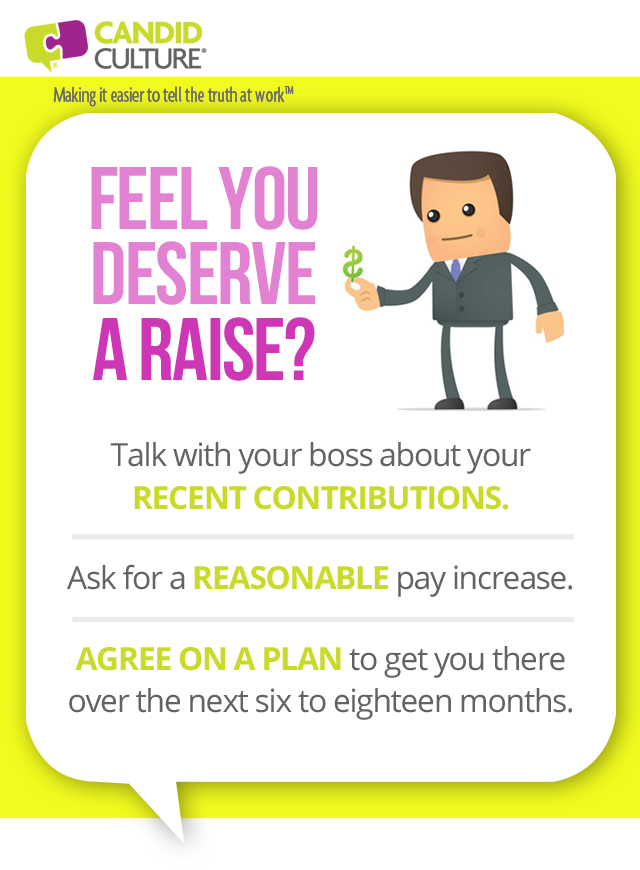 The best way to get your next job is to be great at your current job and ask for more. And the same goes for asking for a raise. Do a great job, make your contributions known, and work with your boss to create a plan to help you get to the salary you want.
Saying or acting as if you’ve been treated unfairly and that your talents aren’t being recognized may be true, but it may also get you the reputation as a negative whiner. People want to work with positive and appreciative people. Demonstrate both when asking for more.
Below are eight steps for asking for a raise:
How to ask for a raise step one: Write down the accomplishments you’re proud of since your last significant pay increase.
How to ask for a raise step two: Find out what your job pays on the open market. Jobs are assigned a value and a pay zone that is often transferable across industries. For example, if an entry level accountant at a big four accounting firm is earning $60,000, the pay zone is likely $50,000 – $70,000. If said employee asks for $64,000, that’s realistic. If s/he asks for $85,000, she’ll be seen as out to lunch. If s/he wants to earn $85,000, with her current level of education and experience, she’ll have to switch careers.
How to ask for a raise step three: Learn your company’s philosophy on compensation. Companies often deliberately decide to pay in the top, middle, or lower part of pay zones. For example, if an industry like sports or entertainment is glamorous and lots of people want to work in that industry, jobs are likely to pay less. Perhaps a company has great perks and benefits and a really nice culture, and in exchange, pays less. Alternatively, some companies want to be known as providing the highest compensation and will pay for it. Knowing where your company falls on the compensation spectrum will help you determine a realistic number to ask for. Your Human Resources representative can answer these questions.
How to ask for a raise step four: Be prepared to present and talk about the impact you’ve made on your organization. Focus on accomplishments and how you’ve changed the business, not on how hard you’ve worked. Results get rewarded.
How to ask for a raise step five: Don’t give an ultimatum, unless you’ve already discussed a pay increase a few times, nothing has changed, and you’re ready to leave. Instead, work with your manager to create a realistic plan to get you to an agreed-upon pay rate. Put the plan, with specific milestones you need to hit, in writing and agree to discuss results quarterly. Managers may be hesitant to promise a future pay increase, but will support written work-related goals, which will help you make the case for a pay increase.
How to ask for a raise step six: Don’t be afraid to ask for a raise. You may not get the raise you want, but nothing bad will happen for asking, providing you do so appropriately. The initial conversation could sound something like, “I love working here and am really enjoying my job. Because of my contributions to our organization, I feel I’m worthy of a pay increase. Can we schedule a time to talk about what might make sense? And with your permission, I’d like to send a list of my most recent accomplishments. Would that be ok?”
How to ask for a raise step seven: Discover who needs to support your pay increase. Your boss may not have the ability or authority to give you an increase. Subtly ask what s/he can do. That could sound something like, “Who needs to participate in the decision to grant me a pay increase? Is there anything I can do to assist with sharing my accomplishments or making the case for an increase?”
How to ask for a raise step eight: Once you know what your job pays across industries and your company’s philosophy on compensation, ask for a realistic number that will make you happy. If you’re asking for large increase, consider incremental raises over a period of months. Ask for something that’s easy to say yes to.
If you think you deserve a pay increase, don’t be afraid to ask. Ask in a positive way, focusing on the value you’re adding to the business. Be patient and work with your boss to create a plan to get where you want to be. The worse you’ll hear is “no.” And if the answer is no, you’ve planted a seed and opened the door to the next conversation.
 I’ve wanted to be an introvert my whole life. It’s going poorly. Introverts think, then speak. What an amazing quality. Extroverts, like me, wake up talking and then spend much of the day apologizing for what we’ve said.
While I covet introverts’ thoughtful communication style, they are at a disadvantage. The people we work with are busy and have limited exposure to coworkers. As a result, others judge us very quickly. If we don’t speak up in meetings or find another way to express our thoughts, people are likely to think we have little to offer. Regardless of your communication style, if you want people to know the value you provide, find a way to share it.
You can’t, won’t, and shouldn’t become a different person to get ahead at work. You have to be yourself. Trying to be someone you’re not, will be painful, frustrating, and short lived. Rather than trying to become someone or something else, find ways to express yourself within your natural style.
Here are four tips to communicate powerfully as an introvert:
Being introverted communication tip one: If you know you’re hesitant to speak up in a meeting, perhaps share your views with the meeting attendees individually – verbally or in writing – before the meeting happens.
Being introverted communication tip two: Make sure the people who can impact your career know your accomplishments. You don’t need to wear a billboard advertising what you’re doing, sending a monthly list of accomplishments and priorities to your boss and boss’s boss (clear this with your boss first) will do the trick.
Being introverted communication tip three: Find your own way of talking about what you think is important. Maybe your conversations will be over lunch with one or two people. Perhaps you’ll periodically email key people with ideas. The point is to find a way to express yourself that resonates with your personal style. Don’t keep all your ideas to yourself.
Being introverted communication tip four: Push yourself to speak up in meetings more than you might naturally be inclined to do so. Being prepared will help you speak up.
Know what’s on meeting agendas. When you feel strongly about a topic, prepare what you want to say. Take notes and consider practicing out loud. Do whatever you need to to feel comfortable expressing yourself in front of a group. And if speaking up in a meeting feels too uncomfortable, remember, people who don’t get a lot of exposure to you are evaluating you based on your contributions during meetings. Find a way to make your views known.

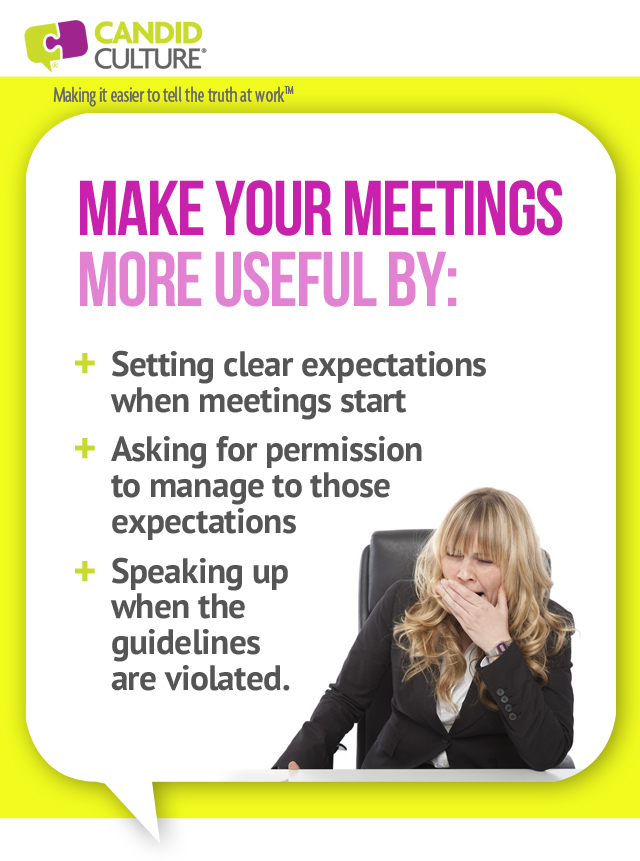
Running effective meetings is hard. It takes courage. Who wants to tell their boss, peers, and customers to put away their phones, stop side talking, and laser their communication? No one. But if you don’t manage ‘bad’ meeting behavior, you look bad and you won’t get the results you want.
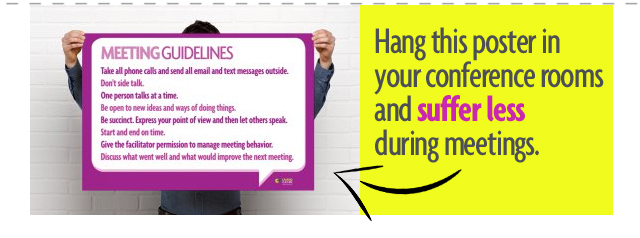
If you run meetings, work with the meeting participants to set expectations everyone agrees to follow. Standard meeting guidelines for running effective meetings include not side talking, putting away or silencing electronics, tabling tangents, not interrupting others, speaking succinctly, etc. You can set any behavior guidelines you like as long as the meeting participants agree to those expectations. Ask meeting participants what behavior guidelines they want to follow. The more control you give people, the more buy in you’ll get.
Possibly even more frustrating than running a meeting in which participants break all the ‘rules’, is participating in inefficient meetings when you aren’t the facilitator. It’s difficult to sit through a poorly run meeting feeling there isn’t anything you can do to make it better.
Luckily, there are things you can do to improve the meetings you don’t run. None of my suggestions will be comfortable. But think of all the time you’ll save.
Conversation one – running effective meetings: If you want to impact the meetings you attend, approach the facilitator(s), empathize about what a challenging meeting it is to run, tell the person you want to be supportive, and ask if s/he wants to discuss some different ways to manage the meeting. That conversation could sound something like, “Wednesday’s staff meeting is tough to run. I empathize with you. Would you be interested in talking through some different ways to manage participant behavior? I have some ideas and would be happy to discuss. I’d like to be supportive.”
Conversation two – running effective meetings: If you want to be more direct, you could say something like, “Can we talk about Wednesday’s staff meeting? It can’t be an easy meeting to run. I empathize with you. Key decision makers are missing meetings and a few people tend to take over the conversation and take us off track. Can I make a few suggestions that might help? What do you think of working with the group to set some expectations people agree to be managed to and then holding people to those agreements? We can share the facilitation responsibilities by assigning jobs during the meeting – back up facilitator, note taker, time keeper, etc. – so all of the responsibility doesn’t fall to you. What do you think?”
The person running the meetings knows they’re not going well. They just don’t know what to do about it. Offer support. Don’t judge. Be helpful and possibly they’ll be receptive.
The key to running an effective meeting is to set clear expectations people agree to follow and be managed to, hang up and review those expectations at the beginning of every meeting, and speak up when the expectations are violated. All of these things take courage. But meeting participants will be grateful to you for being strong.
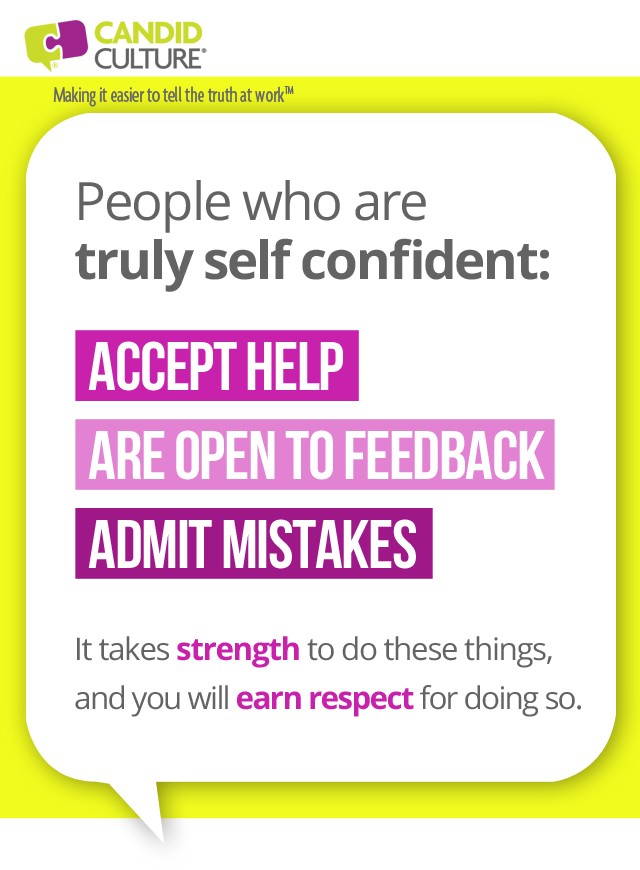
Most of us aren’t eager to admit when we don’t know something, need help, or make a mistake. We fear these things will damage our reputation and make us appear less than to others. But neither are true. It takes strength and self confidence to admit mistakes, accept feedback, and ask for help. Strong, self confident people do all of these things.
When someone who works for me is willing to admit mistakes, I think more of them. When employees ask for help rather than spin their wheels unnecessarily, I’m appreciative. When they’re open to feedback, I’m grateful they’re easy to work with. And the same is likely true for you.
Arrogance masquerades as self confidence. People who are arrogant come off as strong and self confident, but it’s a façade.
It may seem like your personal power and reputation will be diminished by admitting mistakes and accepting help. But this couldn’t be further from the truth. It takes strength to say we don’t know how to do something, to embrace feedback that stings, and to admit bad choices. And strong, self confident people do all of these things, regularly.
You won’t lose credibility or damage your reputation by being humble, instead you’ll be seen as real, relatable and willing to admit a lack of perfection. And all of those things take strength that ingratiate you to others. So be yourself. Don’t pretend you’re better or more knowledgeable than you are. Authenticity goes a long way.