Archive for April, 2016

The approach of summer and summer office attire can make even the most seasoned HR person weary. No one wants to tell an employee that her belly button isn’t for public viewing or to leave the flip flops at home.
Like any behavior you want to generate, it’s much easier to set clear expectations of what is and isn’t acceptable summer office attire before the season begins. So this spring, do some prevention before you have to give an employee feedback for wearing something that fits better at the beach than at work.
Most organizations have a written dress code. I recommend making it visual. Like the image here, post pictures of summer office attire do’s and don’ts in visual form. A picture makes a lasting impression employees are likely to remember; bullet points are easy to forget. If employees are wearing flip flops, tank tops, sheer blouses, spaghetti straps, wrinkled capris, etc., simply post photos of those articles in the no category. Don’t make employees guess if something is appropriate, make it visually clear.
I also recommend hosting a fashion show. Order food, have employees model summer office attire do’s and don’ts. Make it fun. Watching your peers walk ‘the runway’ in both appropriate and inappropriate summer office attire will make a much bigger impact than any ‘memo’ will.
But let’s say you already have a summer dress code violater and you know you need to say something to the person. Addressing inappropriate office attire is just like any other feedback conversation. Make it short. Tell the person why you’re speaking – because you care about him and want to help him manage his reputation – and be direct.
Here are a few examples of how to tell someone she is violating the summer dress code:
Preface each example below with something like, “I care about you and I care about your career. I’ve got some input about your summer office attire. Please take my feedback in the spirit it’s intended, which is to be helpful to you.” This language is appropriate for any type of relationship – peer, manager, and direct reports.
- Summer casual dress code scenario one: “Those are super cute shoes, but they violate our company dress code of no open toed shoes. Please don’t wear them again at work.”
- Summer casual dress code scenario two: “I can see your bra straps under that shirt. Please wear an additional layer under the shirt, the next time you wear it.” Women should have this conversation, men should not. If a man manages a female who needs to alter her summer attire, ask another female she has a good relationship with to have that conversation for you.
- Summer casual dress code scenario three: “Those pants are too tight for work. Please wear looser fitting clothing.”
Effective feedback is short and clear. You can do it. Unless you hire and manage life guards, simply tell the people you work with the truth about the impression their clothing makes and why that’s important. But it’s always easier to set clear expectations before challenges occur, so start there.
 Nothing will help you with time management more than having a baby. Since having my son, deciding what to say yes and no to has become very easy. I do just what I have to and really, really want to, and say no to everything else. Work that wasn’t where I should be spending my time is now done by someone else. Social events that I didn’t really want to attend get declined.
Time is the only thing in life you can’t get back. You can make friends and lose friends. You can make money and lose money. You can gain weight and lose weight. But you never ever get back your time.
So where is your time going? What are you doing that you know someone else should be doing? What are you doing out of obligation that is devoid of enjoyment? Where do you invest more time than you need to, requiring you to give short shrift to another priority?
It may seem odd that a communications expert is writing about time management. I don’t speak or train on time management. But I am knowledgeable and passionate about people loving the work they do, where they do it. And it’s hard to love what you and do your best work when you don’t allocate your time well.
Here are five time management questions:
Time management question one: What are you doing that you know someone else could or should do?
Time management question two: If you invested a few hours training someone, what could you give up to create room for something new?
Time management question three: What personal relationships do you invest time in because you think you’re supposed to?
Time management question four: Which family events are you attending out of obligation?
Time management question five: What do you give 110% percent to that 70% would be more than sufficient, leaving more of your time and energy for something more important?
You only have so much time and energy. Where are you going to put it – on the things that matter most or on distractions that seem important?
I’m not suggesting you skip every family event you don’t want to go to. But perhaps go for less time or skip every third event. I’m not advocating cutting corners or doing mediocre work. But sometimes we spend much more time on things than we need to, when investing less time would deliver the same result.
Here are a few examples of what I mean by 70% being more than enough:
- You spend 25 hours on the formatting of a presentation when the content is what’s really important. You create gorgeous tables and graphs when five bullets were what the client really wanted.
- You host a party and make hand painted table tents describing each food, when your guests will have a great time with typed descriptions or no descriptions at all.
- You maintain friendships you know should have ended long ago because it seems like the right thing to do.
- You avoid calling friends if you don’t have an hour to talk instead of calling and saying, I only have ten minutes but really want to talk with you.
Invest your time in what produces the greatest results and maximizes your enjoyment. Work hard, do great work, invest in your family and friends, and know when “no thank you” is the right answer.
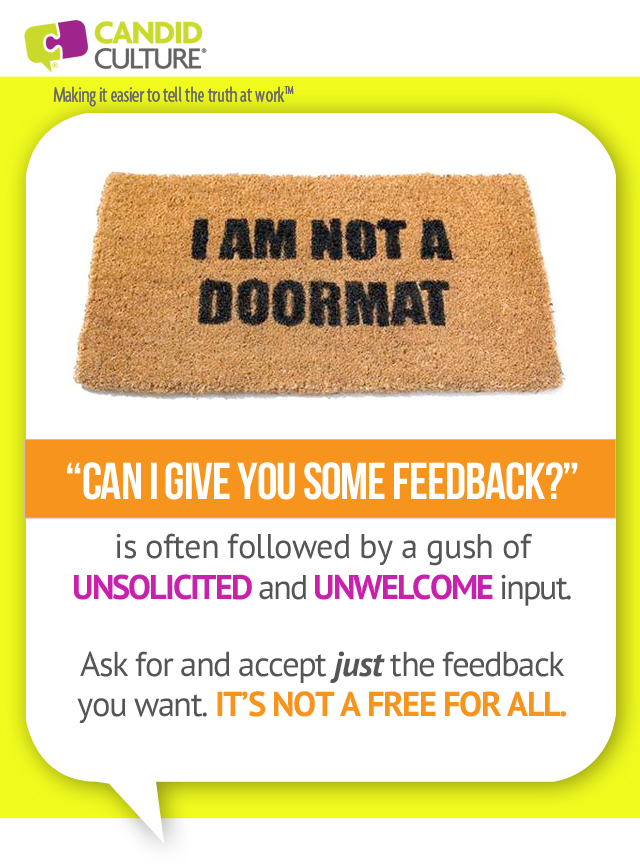 People sometimes leave feedback training confused. Armed with the skills to be candid, they think they have the right to say anything they want. Not the case. Feedback isn’t a weapon or a license to barf your opinion on people. Unsolicited and unwelcome feedback is like fish you left on your counter top for too long. It stinks.
You have the right to ask for and accept the feedback you want and reject the feedback you don’t, from peers and customers. Help people know the difference by providing clear parameters on what type of input you do and don’t want. You are not a dumping ground.
Follow these steps to manage the feedback you get from others:
Giving and receiving feedback tip one: Don’t ask for feedback because you think you’re supposed to. There are lots of leadership books and training programs that tell leaders to be open to and ask for others’ input. Only ask for input you want. If you’ve made a decision or don’t want others’ input, don’t ask for it. While you might get more buy in by asking people for their input on decisions that impact them, you’re allowed to decide without forming a committee.
Giving and receiving feedback tip two: When you ask for input, be very specific about the type of input you want. Guide people. Tell them, “I’m specifically looking for input on ____________. I’m not looking for input on ____________.” And if you still receive unwanted feedback, remind people about the input you are and aren’t looking for. In the spirit of being helpful, people can overstep their bounds.
Giving and receiving feedback tip three: Don’t be afraid to shut people down who provide unsolicited feedback. The words, “Thank you for your concern. I’m not looking for input on that at this time” will do the trick. Yes, you really can say that.
Giving and receiving feedback tip four: Don’t take feedback personally. While most people don’t think about it in this way, giving feedback subtly tells you that you’re doing something wrong, or at least not how the other person would do it. There are lots of ways to skin a cat. Their way may or may not be better than yours. To “skin a cat” is a terrible expression, by the way.
Giving and receiving feedback tip five: Trust yourself. You likely know what you want to do a lot of the time. If you find yourself asking for input when you know what you want to do, stop asking. Listen to your gut and decide.
Feedback has a time and a place. I ask for and listen to a lot of feedback, but not all the time and not about everything. If I listened to everything everyone in my life suggested, I wouldn’t own a business or have a baby. Sometimes you know best.

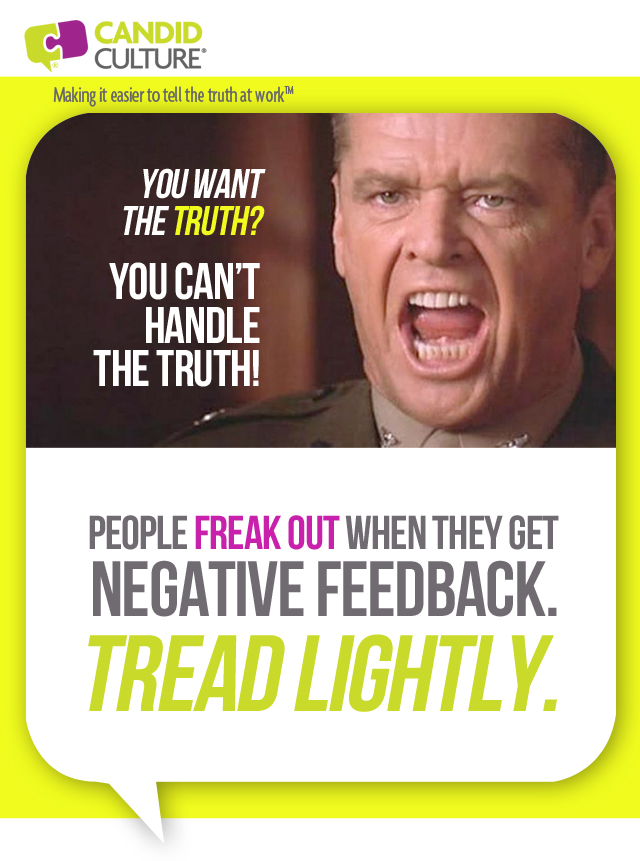
Last week I was talking with a friend who works for a large investment bank. He said, “I don’t believe in the premise of your book. There is no place for negative feedback in the workplace. It’s just not possible.” And I’m seeing firsthand how hard it is for people to receive negative feedback. All kinds of people – sensitive people and less sensitive people, Type A and laid back types. No one wants to hear she made a mistake, could have done something better, or any other type of negative feedback. It’s just too hard.
This is a massive conflict for me. At Candid Culture, we teach people how to give and receive feedback and yet, here I am wondering if it’s even possible.
We need to be able to tell people what they can do better. And the truth, is, while people may not want to hear negative feedback, most people do want to know what they can do to improve their performance and get ahead, hence the quandary. Give negative feedback and evoke others’ defensiveness or say nothing and put up with whatever isn’t working? I, of course, would prefer that you give the feedback, believing that it empowers people to make better personal and professional choices. The question is how?
Here are six steps to make giving negative feedback possible:
- Set the expectation at the onset of working relationships that you will give and receive balanced (positive and negative) feedback regularly. If you’ve worked with people for years and have not set this expectation, it’s not too late. Simply say, “I realized we don’t give each other a lot of feedback. In the spirit of continuous improvement, I’d like to implement a weekly debrief during which we talk about what’s working and not working. We’ll give each other feedback during the meetings.”
- Assess candidate’s openness to feedback when you interview, and don’t hire people who don’t accept negative feedback. We do practical interviews at Candid Culture. We give candidates a chance to do some of the work they’ll be doing on the job and tell candidates what they can do to improve, during the interview. Then we see how they accept our feedback. We also ask interview questions that help elucidate whether or not candidates are open to feedback and we ask candidates’ references how well the person accepts negative feedback.
- Observe performance regularly and provide balanced feedback from the start. Don’t wait until a problem occurs or until you have time to give feedback. Begin the practice of meeting weekly to review and discuss work, setting the precedent that this is the way you do business.
- Provide positive feedback regularly so people know the good stuff and aren’t solely focused on the negative feedback they receive.
- Ask for and be open to feedback. When you demonstrate being open to feedback, you earn the right to give feedback.
- Lastly, don’t underestimate how hard it is to hear negative feedback. When some people receive negative feedback, they begin to question themselves, their skills, and their value. So tread lightly. Pick your battles. Address only what you really need to and say things gingerly, remembering that you’re talking to a sensitive person, no matter how tough he may seem.