Archive for March, 2016
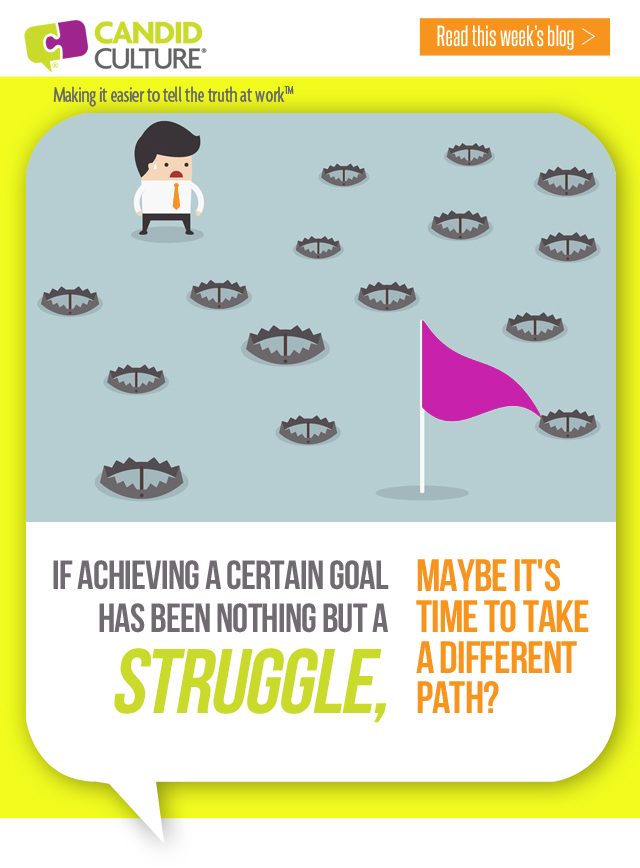 When I was leading Leadership Development for OppenheimerFunds I told my boss, the head of HR, that one of my career goals was to be an HR generalist. He said, in his lovely British accent, “Shari, you’re very good at what you do, and you would be a terrible generalist. You will never be a generalist here.” At the next company, I also told the head of HR that one of my career goals was to be an HR generalist, and he too said, “You would be a terrible generalist. You won’t have that role here.” I could have left that company and chased my desire to be a generalist, or I could have listened to people who saw something I didn’t. I listened.
Sometimes others can see things we can’t and it makes sense to listen. That’s actually my definition of a coach – someone who can see things that we can’t, and they’re willing to tell us.
If you’re serious about achieving your career goals, consider these six practices:
- Identify what you want to do.
- Share your career goals with people who can help you achieve them.
- Ask people you trust and those in a position to help you achieve your career goals what may prevent you from having what you want. Obstacles might be organizational (i.e. the job you want doesn’t exist at your company) or they might be personal (i.e. you don’t have the skills, acumen, or temperament for the job you want).
- Work to develop skills you’re missing.
- Accept things that might prevent you from getting what you want. I.e. I don’t have the temperament to be an effective HR generalist, and I never will.
- Decide when to stop pursuing a goal. Make peace with that decision. And move on to something equally, if not, more compelling.
Most of us were raised to believe that quitting is taking the easy way out and that to quit is bad. I don’t know about that. Sometimes you have to listen to the feedback the world gives you and act accordingly.

 When I was pregnant, I worried that I would gain sixty pounds and never take the weight off. Well, that’s not what happened. I gained 18 pounds (amazing) and most of it was gone when Grayson was a week old. Six months later, I’m fourteen pounds below my pre-pregnancy weight. I can’t explain it. It certainly isn’t a result of eating well or exercising, because I’m doing neither. But it has left me with a problem that’s impacting my professional image. None of my clothing fits. This is a good problem to have, but nonetheless, it’s a problem.
Last week I was at a networking event wearing a suit that was huge. When I put it on, I hoped no one would notice. And they might not have. For all I know, I was the only person who knew I was wearing ill-fitting clothing. But more important than what others saw, is how I felt in the suit. I felt unprofessional, unpolished and silly. Aka, I was uncomfortable. I didn’t trust my appearance and it had me doubt myself. So instead of networking, which was the purpose of the event, I went to an empty room and made phone calls.
We feel more confident and do better work when we feel good in what we’re wearing and know we look good.
Here are four things you can do to elevate your professional image:
Elevate your professional image tip #1: Take photos of yourself wearing your ‘go to’ outfits. Look at the photos and assess how you look in your favorite clothing. I’m often dismayed at how I ‘really look’ in my favorite pieces of clothing. Then start taking photos of how you look in pieces of clothing before you buy them.
Elevate your professional image tip #2: Ask a friend whose judgment you trust to weigh in on your clothing. Specifically ask, “What’s the first impression I make in this outfit? Where should I wear this? Where shouldn’t I wear it?”
Elevate your professional image tip #3: Get a good haircut. You get what you pay for. Utilize the same practice as above. Ask a friend who always looks great to share the first impression your hair makes. Then make friends with your blow dryer. This might be the part of the blog when men check out. Stay with me. This applies to you too.
Elevate your professional image tip #4: Try on old items in your closet and get rid of everything that doesn’t pass the photo and friend evaluations. If you can’t bear to get rid of things you love, box them up so you won’t wear them.
You’ll present yourself more confidently when you have confidence in your appearance.
Note, these suggestions only apply when you’re in front of other people. If you work from home and don’t see anyone during the day but your dog and the occasional neighbor, bring on the spandex or the jammies. There is a school of thought that says you’ll do better work, even at home, if you’re professionally dressed. This isn’t true for me. I do better work when I’m comfortable. So now you know what I’m wearing when you call me. Aren’t you glad we don’t Skype!
You may not impress everyone you meet, hit every deadline, and consistently knock it out of the park. Bad days and breakdowns happen. But there are a few business etiquette practices you can consistently do to make you easy to work with and to present yourself in a professional and credible way.
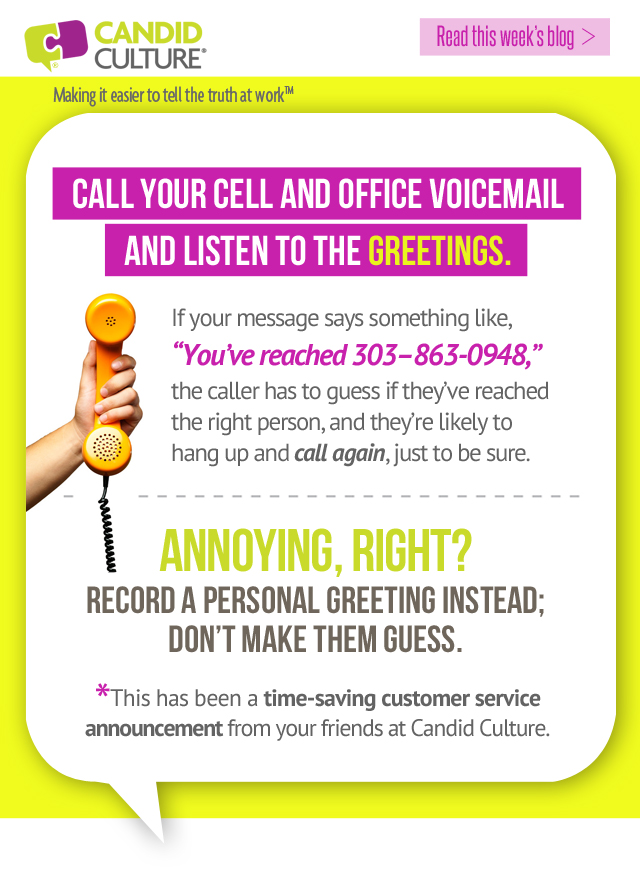
Business Etiquette tip #1: Listen to your cell and work voicemail greetings. Have you recorded a personal greeting that assures callers they’ve reached your phone? If the message says, “You’ve reached 303-863-0948, callers may wonder if they’ve called the right number and are likely to hang up and call back. And make sure the greeting doesn’t sound as if you recorded it while you were outside waiting for a bus, or standing in line at the grocery store, or under water. You get the point.
Business Etiquette tip #2: Make it easy to contact you. Include all of your contact information at the bottom of your outgoing and reply emails, in a clickable format (versus a non-clickable image). Don’t make people search for your contact information. Oh, and spell check your salutation. I’m amazed at how many spelling errors and typos I see in people’s contact information.
Business Etiquette tip #3: Turn off your out-of-office voicemail and email messages when you return from a trip. Telling people that you’ll be back on January 3rd, in March, makes you appear checked out.
Business Etiquette tip #4: Don’t wear perfume or cologne to work. It likely bothers someone but s/he won’t tell you about it.
Business Etiquette tip #5: Want to avoid people asking you, “Did you get my email?” or sending you yet another email? Reply to all emails, letting people know you received their message and letting them know when you’ll respond. That could read something like, “I received your message. I’ll reply with an answer by Friday.”
I could go on – eating smelly food in a cubicle, taking phone calls via a speaker phone from a cubicle, stealing other people’s lunches out of the refrigerator, taking up two parking spots, almost finishing the coffee, but not making more, borrowing someone’s chair and returning it at a different height, leaving conference rooms a mess, ending meetings late so a posse of people wait outside to use the conference room, flushing the toilet while participating in a remote conference call, but this is a good start. I’m looking forward to listening to your personal yet succinct voicemail greeting soon!
Leave a comment and tell us your easily fixed, work-related pet peeve!
Posted under
Uncategorized on March 7, 2016 by Shari Harley. Comments
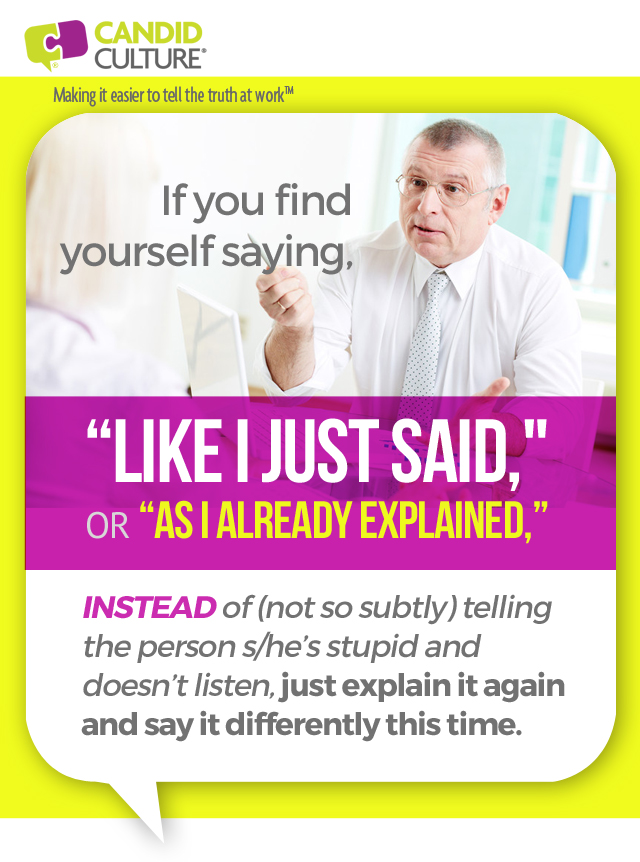
You’re talking with someone. He asks a question demonstrating he didn’t understand or hear what you said. You let out an exasperated silent or audible sigh and say, “Like I just said…” Saying “like I just said” or “as I just explained” tells the person that you think he’s stupid or doesn’t listen. Both might be true, but saying so won’t help your relationship.
I consider myself reasonably smart. And for the most part, I listen. If I ask a question about something you said, consider the possibility that your explanation wasn’t clear and find a way to rephrase what you said the first time. Resist the temptation to tell me and the people you work with that we’re stupid.
Letting people save face is an art that takes patience, good communication, and the desire to have good relationships.
Here are five good communication tips that will strengthen you relationships versus alienate you from others:
Good communication tip number one: Give people the benefit of the doubt. Assume good. People are doing what they know to do.
Good communication tip number two: If someone doesn’t understand what you said, take responsibility for delivering unclear information. It’s easier to change your communication style than alter someone else’s style.
Good communication tip number three: Put your desire to have good business relationships above the desire to be right.
Good communication tip number four: Consider that you may not explain things in the way others learn. Vary your communication methods. Most people don’t learn solely by hearing. Make your explanations hands on and/or visual, and you’ll reach more people.
Good communication tip number five: Bring your patience to work.
It’s tempting to tell people where they’re lacking, but it won’t get you very far. Say what you need to in order to get your point across. And if people are unclear, know the easiest thing is to alter your message. Take the path of least resistance; let people save face.