Archive for March, 2015
 It’s often not the work we do that makes work hard; sometimes it’s the people we work with that makes work harder than it has to be.
Below are seven practices that distinguish people we want to work with from those we wish would go work for a competitor.
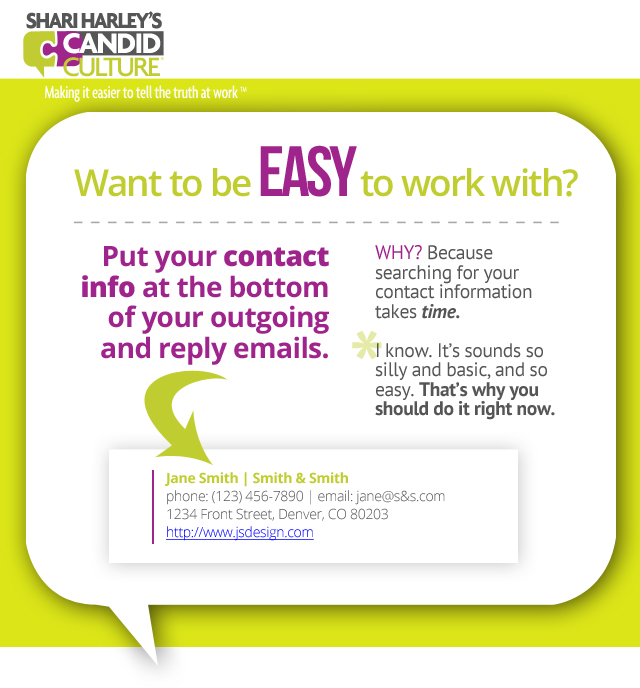
How to Be Easy to Work with Tip Number One: The simplest thing you can do right now to be easy to work with is to put all of your contact information in your email salutation in a format that can be easily copied and pasted or called from a cell phone, aka not an image.
How to Be Easy to Work with Tip Number Two; Update your out-of-office message when you return from a trip.
How to Be Easy to Work with Tip Number Three: Accept and deny meeting requests when you receive them, even if you’re not sure you’ll be able to attend. Knowing who can and can’t attend helps the meeting organizer plan. You can always update your status if something changes.
How to Be Easy to Work with Tip Number Four: Reply to emails within 48-hours, even if you don’t have the information for which you’re being asked. Tell people you got their message and when they can expect to receive the information they asked for.
How to Be Easy to Work with Tip Number Five: Don’t gossip. I could say a lot about this, but you don’t have time to read it. So I won’t. I’ll leave it at this, don’t talk about other people when they’re not present and you’ll be someone people will line up to work with.
How to Be Easy to Work with Tip Number Six: Do the things you say you will do, when you say you will do them. When you realize you can’t keep a commitment, tell people as soon as you know, so they can plan. Most of us don’t want to admit that we’re going to miss a deadline, so we wait until the 11th hour to tell the people who will be impacted. Waiting to renegotiate a deadline puts people in a worse position than telling people as soon as you know.
How to Be Easy to Work with Tip Number Seven: Avoid doing the things that you know annoy others. I’ll get us started with a list of the things that most commonly annoy people at work. Please add a comment to the blog with all the things I missed. It will be fun! Sanctioned venting. Who can turn that down?
- Leaving dishes in the sink like mommy works there
- Taking phone calls from a cubicle via speaker phone
- Almost finishing a pot of coffee, but not making more
- Listening to music and videos without headphones from your desk
- Having lots of regular visitors or loud phone conversations from your cubicle
- Surfing the internet versus working
- Leaving your alerts on your cell phone, so everyone in your vicinity knows each time you get a text message
I could go on, but I’ll leave the rest to you. Add a comment with the simple things people can start or stop doing to be easy to work with!

No one likes to hear people complain, especially people who go on, and on, and on. But there is a reason people complain for longer than may seem necessary. For the most part, the people who sound like a broken record don’t feel heard. And when people don’t feel heard, they repeat themselves, again, and again, and again.
One of the first practices for how to handle customer complaints taught during any decent customer service training class is to acknowledge the other person’s concern. Demonstrate that you listened and heard. We often think that complainers want us to solve their problems. That’s not always the case. Sometimes feeling heard is enough, even if there is no resolution to the complaint.
Last week I had a horrible experience in a hotel. I called the front desk staff to voice my concerns with how an incident was handled. Her response: “Ok….ok….ok.” I wasn’t satisfied. So the next morning I spoke to the front desk manager. She responded by explaining why her staff had done what they did. Still, no apology or demonstration of understanding my frustration. So I went to the hotel general manager, who did all the right things. She listened and apologized. She didn’t defend or explain. And then I stopped escalating my complaint.
Here are a eight tips for how to handle customer complaints:
How to handle customer complaints tip #1: Resist the temptation to defend yourself, your team, or your organization.
How to handle customer complaints tip #2: Watch your tone of voice. If you sound annoyed, the other person will just become more upset and will, you guessed it, continue complaining.
How to handle customer complaints tip #3: Tell the person you’re sorry for his experience. Apologizing doesn’t mean he is right or that you agree. You are simply sorry he had the experience he did.That could sound like, “I’m sorry that was your experience. That sounds frustrating. That’s certainly not the experience we want customers to have.”
How to handle customer complaints tip #4: Ask clarifying questions, if you need to. That could sound like, “Can I ask you a few questions, so I fully understand the situation?”
How to handle customer complaints tip #5: Paraphrase what the person said to ensure you understand his complaint and to demonstrate that you heard. Nothing sounds better to someone who is upset than another person who understands his concerns. That could sound like, “I just want to be sure I understand your concern. You’re concerned that _______ “ (repeat or paraphrase what the person said.)
How to handle customer complaints tip #6: Apologize again for the person’s experience. Often, all the person wants is an authentic apology. An apology doesn’t admit fault or wrong doing. You are simply apologizing for the person’s perception of their experience.
How to handle customer complaints tip #7: Tell the person what action(s) you’ll take, in any. People like to know that they’re complaints aren’t wasted.
How to handle customer complaints tip #8: Don’t be a black hole. Circle back to the person and let him know what action was or wasn’t taken.
The key to getting someone to stop complaining is to make the other person feel heard. Acknowledge the complaint. Watch your tone of voice. Apologize for the person’s experience. And watch people’s complaints dissipate more quickly than you thought possible.


When I’m not sure what to do, I do nothing. And my hunch is I’m not alone. When something feels big, it’s easier to do nothing than something.
Time management experts will tell you to divide a big project into small pieces, to make it manageable. That’s good advice. The universe – as woo-woo as it sounds – rewards action. Momentum, like inertia, is very powerful. As we know, a body that’s in motion is likely to stay in motion. A body at rest is likely to stay at rest.
The key to getting through anything large, scary, or intimidating is to start. Any action will do. The key is simply taking action.
Here are five keys to make taking action more likely:
Taking action key #1: What often stands in the way of taking action is that we aren’t sure what to do. Perhaps we aren’t sure we can do the task at hand. Or we can’t see what the end result should look like. Or the project feels so big that even thinking about starting is tiring. Ask questions and ask for help.
Most managers aren’t great delegators. When assigning a project, managers often ask, “Do you have any questions?” This is an ineffective question because few people want to admit to having questions about a project that feels so big, all they want to do is avoid it and take a nap. Or managers ask, “What do you need from me?” when most people have no idea what they need.
Don’t be afraid to ask questions until you’re clear about what a good job looks like, and ask for help.
Taking action key #2: Do one small thing, anything, towards achieving the goal. And do it now. Don’t wait until the right time. There is no right time.
Taking action key #3: Then do one more thing. Don’t wait six weeks or months to take another action. Momentum is very powerful. Keep things moving.
Taking action key #4: Give yourself small windows of time to work on a project. If you give yourself 30 uninterrupted minutes to work, you’re likely to invest that time. If you dedicate a day, you’re likely to get distracted and fill the time with other things.
Taking action key #5: Trust that you can do what’s in front of you. Someone wouldn’t have asked you to do something if they’d didn’t have confidence that you could do it. And if this is a goal you set for yourself, and it’s something you really want, deep down, you know you’re capable of doing it.
If you’re overwhelmed or don’t believe you can do something, call someone who has more faith in you than you have in yourself, at this present moment. Let that person fill you with confidence until you can generate it for yourself. When I started Candid Culture, I was filled with fear and quite honestly, was convinced I was going to fail. But everyone around me believed I could do it. And their confidence carried me until I could generate my own.
The way out is always through. Ask for help. Take one small action, then another. Dedicate small pieces of uninterrupted time to work on a large project. Trust that you can do it. Things don’t get done without your action. Take one action, then the next, then the next.

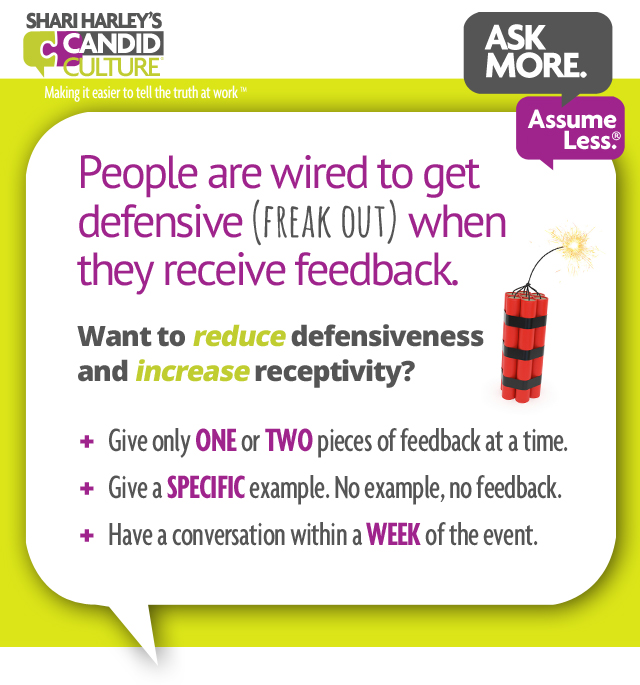 The normal, natural reaction to negative feedback is to become defensive, a response I’ve recently labeled as The Freak Out.
Everyone, even the people you think do little work, wants to be seen as good – competent, hardworking, and adding value. When anyone calls our competence into question, we get defensive. Becoming defensive is an automatic response that we have to train out of ourselves.
Until the people you work with train themselves not to become visibly defensive when receiving feedback, just expect it. And be happy when you get a defensive response. It means the person is breathing and cares enough about what you’re saying to get upset.
While you can’t get rid of a defensive response to feedback, you can reduce it by following a few employee feedback practices. Practice these methods of giving feedback and your input will be heard and acted on, more often than not.
Employee feedback practice one: Don’t wait. Give feedback shortly after something happens. But do wait until you’re not upset. Practice the 24-hour guideline and the one week rule. If you’re upset, wait at least 24-hours to give feedback, but not longer than a week. If the feedback recipient can’t remember the situation you’re talking about, you waited too long to give feedback, and you will appear to be someone who holds a grudge.
Employee feedback practice two: Be specific. Provide examples. If you don’t have an example, you’re not ready to give feedback.
Employee feedback practice three: Praise in public. Criticize in private. Have all negative feedback discussions behind a closed door.
Employee feedback practice four: Effective feedback discussions are a dialogue; both people talk. When the feedback recipient responds defensively, don’t be thwarted by his/her reaction. Listen to what s/he has to say and keep talking. Don’t get distracted.
Employee feedback practice five: Give small amounts of feedback at a time – one or two strengths and areas for improvement during a conversation. People cannot focus on more than one or two things at a time.
Employee feedback practice six: Give feedback on the recipient’s schedule and in his/her workspace, if s/he has a door. It will give the other person a sense of control and s/he will be more receptive.
Employee feedback practice seven: Talk with people – either in person or via phone. Don’t send an email or voicemail. Email is for wimps and will only damage your relationships.
Employee feedback practice eight: Prepare. Make notes of what you plan to say and practice out loud. Articulating a message and thinking about it in your head are not the same thing.
Employee feedback practice nine: Avoid The Empathy Sandwich – positive feedback before and after negative feedback. Separate the delivery of positive and negative feedback, so your message is clear.
Employee feedback practice ten: Offer an alternative. Suggest other ways to approach challenges. If people knew another way to do something, they would do it that way.
You can deal with whatever reaction to negative feedback you get. The other person’s response will not kill you. It might make you uncomfortable, but that’s ok. You’ll survive. Try to practice the guidelines above, and if you don’t, and you ‘do it all wrong,’ at least you said something. Just opening your mouth is half the battle. When you come from a good place of truly wanting to make a difference for the other person, and you have both the trust and permission to give feedback, you really can’t go wrong.

Some people say that you show employees appreciation by giving them a paycheck and that any more thanks is over the top. We call that old school management. And it doesn’t work.
The human brain thrives on recognition. People are more likely to replicate positive behaviors when those behaviors are recognized. If your employees are doing a good job and you appreciate them, don’t make them guess. “Well, my badge still works. So I guess things are going ok,” is not sufficient recognition.
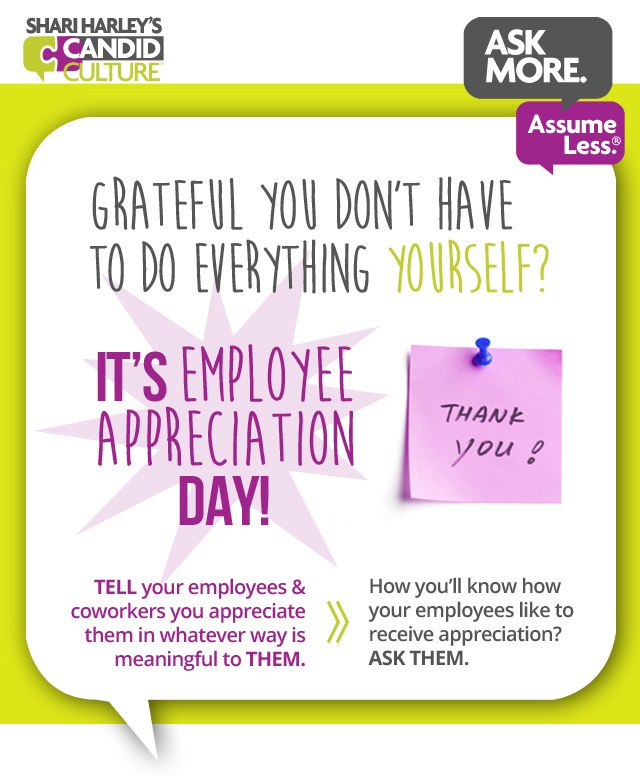
Today is Employee Appreciation Day – a made-up holiday to remind us to say “thank you” to the people we work with, who contribute every day.
Don’t take your employees for granted, or you’ll be finding new ones.
Here are six ways to mark Employee Appreciation Day today and every day:
Employee appreciation ideas 1) Ask employees what’s important to them – why they accepted the job, why they stay, and how they would like to receive recognition.
Most employees will work their entire career without a manager ever asking these questions. Getting to know your employees better and differently costs nothing but a little time.
Employee appreciation ideas 2) Ask employees about the kind of work they want to do in the future and what they want to learn and gain exposure to. Write down what they say (so you don’t have to remember) and give employees exposure to this type of work when it’s appropriate (when there’s a business need and when they’ve earned it by doing good work.)
Employee appreciation ideas 3) Give very specific, positive feedback regularly. Giving specific feedback demonstrates you’re paying attention to employees’ work and noticing the impact they’re making. Employees want to know how they’re doing. As odd as it may sound, feedback is a form of recognition. Taking the time to observe performance and give specific, timely feedback tells employees they matter.
Employee appreciation ideas 4) Tell the senior people in your organization what a great job your employees are doing. Employees have limited exposure to senior leaders. Don’t make the people who can influence your employees’ careers guess who’s doing great work.
Employee appreciation ideas 5) Take the time to write a handwritten note. In my 15 years of working in a corporate environment, I received one handwritten note from one of my managers. I kept it for 10 years.
Employee appreciation ideas 6) Spend time with your employees. Every employee needs face time with his/her boss. Don’t underestimate the value employees place on the time you give them. If you’re not meeting with your employees on a one-on-one basis regularly, start. Meet for 30-minutes once a quarter. Then meet once a month. Employees create the meeting agenda and come prepared to give you an update on their work. You should be prepared to give both positive and upgrade feedback.
Notice not one of the employee appreciation ideas or ways to recognize Employee Appreciation Day above is monetary in nature. Employees want your time and attention. They want to learn and grow. Provided employees feel fairly compensated, money is secondary.
Today, and every day, find a way to say “thank you” that’s meaningful to your employees. And the only way to know what employees will find meaningful is to ask.

In last week’s blog, I advocated for picking up the phone, even when you don’t want to, being patient, and asking questions versus accusing. Admittedly, it’s easier to be generous with some people than with others. Some people are just hard to work with. And no matter how much you want to do the right thing, when difficult people’s names show up on your caller-id, it’s tempting to let them go to voicemail, indefinitely.
There are a few behaviors that make people difficult people to work with. Avoid these communication blunders, and help ensure your calls don’t go to voicemail.
Five tips to be easy to work with:
How to be easy to work with tip 1: Don’t take things personally. Human beings are wired for survival. Most people are so worried about themselves – looking good and doing well – they’re not all that worried about you. When you get overlooked for a project or a meeting, rather than feeling slighted, ask what happened that you weren’t included. Or just be grateful you have one fewer meeting to attend.
How to be easy to work with tip 2: Remember it’s not all about you. People who think everything is about them are exhausting to be with. Be humble. Take an interest in others. And remember that no matter how talented and fabulous you are, you’re not the only one in your organization who is producing results.
How to be easy to work with tip 3: Give other people the benefit of the doubt. Most people are genuinely trying to do the right thing. If you question someone’s motives or actions, ask a question before making a decision about that person.
I like the question, “Help me understand…?” It’s neutral and invites the other person to speak. If you choose to ask this question, watch your tone of voice. If you can safely add the words “you dummy” to a question, you have a tone issue.
How to be easy to work with tip 4: Temper your emotions at work. You’re human and human beings have feelings. But sometimes our feelings can be off putting to others. Most people are uncomfortable when managers and coworkers yell, cry, or give the silent treatment. Manage your emotions at work. Wait to have conversations until you’re not upset. And if you can’t manage your emotions during a conversation, excuse yourself until you can.
How to be easy to work with tip 5: Be introspective and self-aware. The better you know yourself and how you impact others, the more you can work with others how they like to work. Periodically ask people you trust for feedback on the impression you make and what you’re like to work with. Listen to their feedback and adjust your communication habits to be easier to work with.
The bottom line – to be easy to work with you need to be sensitive to how you impact others. People who pay attention to how they impact others and make changes to work better with others, are enjoyable to work with. People who don’t pay attention to how they impact others and aren’t open to altering their working styles get sent to voicemail.