Archive for February, 2015
 As someone who writes and teaches about effective communication in the workplace, the people I work and socialize with are expecting me to model good communication skills all the time. The good news: I try really hard to always do the right thing and impact people positively. The bad news, I’m human and sometimes I don’t get it right.
One of the things I’m proud of about Candid Culture, is that we are real people, working with real people. We work very hard to practice effective communication in the workplace and to always model what we’re teaching. And yet, like all people, we get busy, rushed, and tired. We read emails we intend to reply to, but then forget to do so. We occasionally send emails, when we should pick up the phone.
In my world, a good communicator is not someone who always communicates perfectly.
A good communicator who practices effective communication in the workplace is someone who:
- Cares about people and consistently works to communicate in the way others need.
- Asks for and is open to feedback about how s/he impacts people.
- Listens and watches other people’s verbal and non-verbal communication.
- Alters his/her communication style to meet other people’s needs.
- Takes responsibility when things don’t go well.
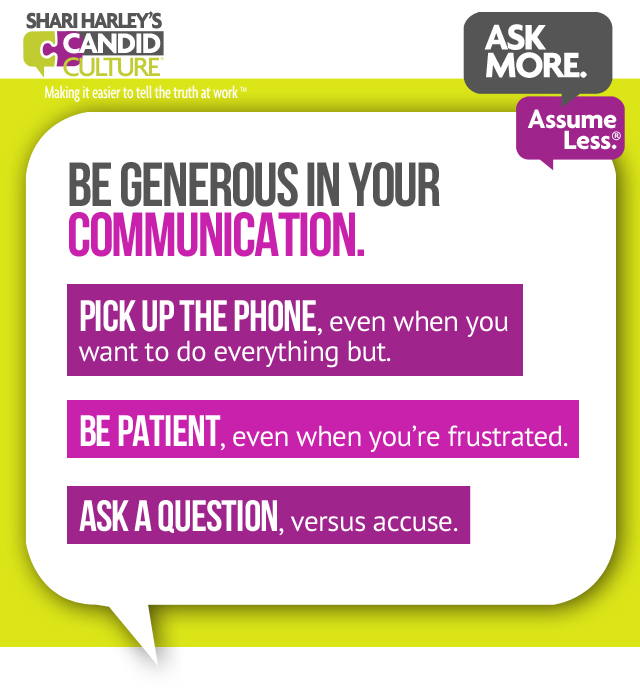
This week I’m advocating for picking up the phone, even when you want to do everything but, being patient, even when you’re frustrated, and asking questions, versus accusing. And I’m going to admit, I’m working to do these things too. Sometimes I get it right, and sometimes I don’t. I’m in the trenches with you, working to say and do the right things every day.
I promised you five tips to practice effective communication in the workplace and to be generous with people:
- Only call people when you have adequate time, attention, and patience to have whatever conversation needs to be had.
- If you need a few days to return a call, say so. Let the person know when you’ll call.
- Prepare for conversations. Plan what you’re going to say and how you’re going to say it.
- Don’t have hard conversations when you’re frustrated, tired, or busy. They won’t go well.
- If the conversation goes poorly, call back later and clean it up.
Being a good communicator doesn’t mean being perfect. It means caring enough to notice when you miss the mark, cleaning up your messes, and working to do it better next time. I’ll be working on the above recommendations too this week. And when I screw it up, you can be assured that my mistakes will become examples in our training programs of what not to do, followed by a new technique that will hopefully work for all of us.

Avoiding having difficult conversations because you’re uncomfortable? Afraid you’ll hurt someone’s feelings? Worried you’ll damage your relationship? Why not just say so?
The people you work with want to work with other human beings. And part of being human is expressing how you feel.
It may seem that admitting that you’re nervous or uncomfortable weakens your position and diminishes your power. This couldn’t be further from the truth. Saying how you feel and being willing to be vulnerable are signs of strength. People with strong egos can admit when they are uncomfortable, people with weak egos feel too threatened to do so. Vulnerability and authenticity help other people see you as human, and make people feel closer to you. And people want to work with other human beings, not emotionless androids who never show their cards.
If you’re nervous, say you’re nervous. If you’re afraid you’ll negatively impact your relationship by speaking up, say so. If you’re not sure it’s your place to raise an issue, say that. You won’t lose anything by stating your concerns. You only stand to gain.
Starting difficult conversations could sound like this:
Having difficult conversations option one: “I’m not sure it’s my place to talk about our department’s Customer Service Survey results, but I care about our reputation and have a few thoughts. Is it ok if I talk about them with you?”
Having difficult conversations option two: “I’ve got some input for you that I’ve been hesitant to share, but I think the information could be helpful to you. I care about you and your career, and I want you to be successful. Is it ok if I share my thoughts?”
Having difficult conversations option three: “I’ve got a few things to talk with you about, but haven’t brought them up because I’m a bit concerned about how you’ll react. Is it ok if I share them with you? I’m saying these things because I care about our department, and I’m noticing a few things I think we can do differently, for better results.”
You probably noticed that in the examples above, I stated that I was concerned about speaking up, asked for permission to do so, and stated the reason I wanted to provide input. Your motive for having difficult conversations is very important. When people trust your motives you can say anything. When they don’t trust your motives, you can say little.
Don’t be afraid to say how you feel. If you’re afraid to speak up, saying so won’t reduce your credibility, it will likely increase it. State your concerns, explain why you’re speaking, and ask for permission to give feedback. Doing those three things will help any message be well received and is likely to make it easier for you to say what you want to say.
 As crazy as it sounds, it can be difficult to get work done at work. There are the drive bys –people who want your opinion on EVERYTHING before they make decisions, the interrupters who have just one question, several times a day, the visitors who want to update you on EVERYTHING happening in their personal lives, and coworkers who host meetings at their workstation, take phone calls on speaker phone, and who listen to music without headphones, while loudly eating potato chips. All of these distractions are enough to make many employees want to find a quieter place to work.
The concept that it can be hard to get work done at work is crazy. We’re at work to work. And yet many employees, with and without a door, get in at 7:00 am, before others arrive, so they can “get some work done” and stay late because they “got nothing done all day.”
Open work environments can be productive and interruptions can be minimized, but managing interruptions at work will require some clear guidelines and direct communication, which many workplaces are missing.
Managing interruptions at work – practices for creating a work environment that works for everyone:
Write workspace practices down, share them with all employees, post the practices in every work area, and discuss them frequently.
Examples of practices for managing interruptions at work:
- Use a headset for all phone calls.
- Pay attention to your volume. Speak as quietly as possible.
- If you have visitors at your desk for business or non-business related conversations that last longer than five minutes, take the conversation to a conference room, empty office, or local coffee shop.
- Use headphones to watch videos and listen to music.
- Avoid prairie dogging—calling down a row, hallway, or over a cubicle wall. Instead, walk to the person’s desk, call, or send an email or text message.
- Turn off all auditory alerts on computers and cell phones, so your coworkers don’t have to hear pinging and ringing all day. The people you sit with don’t need to know every time you receive an email, text, or Facebook message.
- Finally, but MOST IMPORTANTLY, give all employees permission to make requests and give feedback when workspace guidelines are broken. It must not only be acceptable but expected that employees will say something when a guideline is broken and the workspace gets too loud.
Most employees will not speak up when others are being loud. It’s easier to find another location to work than risk a coworker’s defensive response. And no one wants to be ‘that person’ who complains about how loud someone is. If employees aren’t comfortable speaking up and making requests, offer training on how to have these conversations, and provide written examples of what employees can say that is respectful and clear.
Guidelines for dealing with interruptions at work:
You’d think that having a door would make people immune to work place distractions, but that’s not the case. Employees with offices also deal with drive bys and interruptions. The key to dealing with both is communication.
- Don’t wait for problems to occur. Anticipate challenges and talk about them before guidelines are broken. It’s much easier to make a request than to give feedback.
- Each time a new person joins a team, department, or workspace, ask everyone on the team to share their work-related pet peeves, how they like to communicate, and how they prefer to be interrupted. Everyone deals with interruptions, so you might as well express a preference. If you’d prefer people email you and ask when you have time for a quick question, make that request. If you’re ok with people interrupting you without notice, let people know. If you’re not distracted by noise, tell people. If you are, make that preference known.
People are too hesitant to speak up at work for fear of damaging relationships and hurting people’s feelings. The best thing leaders can do to improve the working environment (or any workplace challenge) is to set clear expectations, create opportunities to talk about how things are going, and make it ok to speak up.
Suffering at work is optional. Everyone is accountable for the work environment, and you won’t get what you don’t ask for.
You will be passed over for jobs, projects, and opportunities – personally and professionally. People will choose not to buy from you and they’ll choose not to be your friend and romantic partner. And that’s ok. Not everyone is our right “customer.” The key isn’t to win every opportunity. Rather, it’s what we do when we don’t get what we want.
When you’re done feeling disappointed, mad, and frustrated, get curious. Find out why you were passed over. I’ll never suggest you make changes. I simply want you to know what’s standing in your way, so you have power – the power to choose. Eliminate your business blind spots.
All of us have blind spots – things we do that are off putting to others, that we’re not aware of. For the most part, people won’t tell us our business blind spots, instead, they simply pass us over. Being rejected is feedback, it’s just not specific enough to help us make different choices. If you want to be able to change your behavior, you need to know what behaviors are standing in your way. Then you can choose what, if anything, to do about those behaviors.
When you get turned town for an opportunity, practice these strategies to eliminate your business blind spots:
- Allow yourself to have an emotional reaction, to feel disappointed and grieve the loss.
- When your emotions dissipate, call people who can tell you why you were turned down, and ask for feedback. The goal of the conversation: Eliminate your business blind spots.
- Be humble and open.
Consider saying something like, “Thank you so much for considering me/us to support your needs. We were disappointed not to win your business. Would you willing to share what had you choose a different provider and what we could have done differently to be a stronger candidate? I’ll be grateful for anything you’re willing to tell me.”
Depending on the circumstances, you could also say something like, “I wasn’t put on the _______ project. I wonder if you have any information as to why? I appreciate anything you’re able to tell me. Your input will help me grow and eliminate by business blind spots.”
- Regardless of what you hear, thank the person for the feedback. You can ask for additional information and ask who else you can talk with, but don’t become defensive. The less defensive you get, the more feedback you’ll get. Make it easy to tell you the truth (as the other person sees it).
Remember, information is power, and power is control. Many people don’t give direct feedback because they’re afraid of the other person’s reaction. Surprise people by being open to feedback, and eliminate your business blind spots.
- Validate feedback that doesn’t feel right to you. If you’re not sure what someone told you is accurate, vet the feedback with other people you trust. Simply ask other people, who are aware of your performance, “I received this feedback. Does that resonate with you?”
- Sit with the feedback for a few days before taking any action.
- When your emotions have passed, decide what, if anything, you want to do with the input you’ve received. Perhaps you want to make changes. Perhaps you don’t. Either way, you have more power than you did before you received any input.
You won’t win them all. The key isn’t avoiding rejection, it’s what you do when you don’t get what you want. Be brave. Be open. Ask for feedback. And you’ll have the power to make different choices next time, if you want to.