Archive for January, 2015
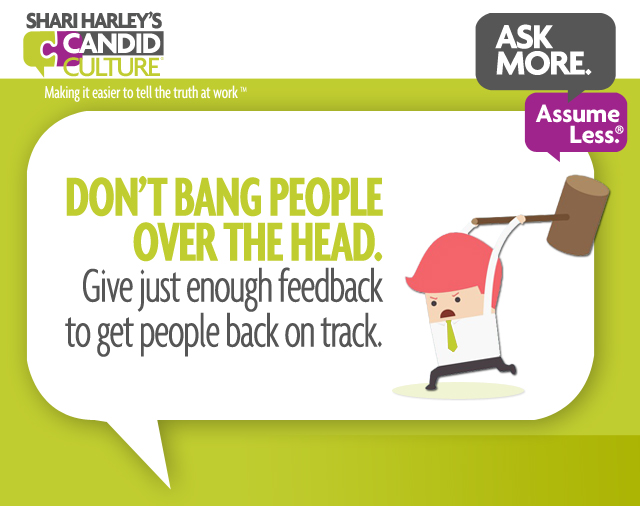 People often hoard feedback until a situation becomes so frustrating that they can’t help but speak up. And because they waited too long to say what they think, many more words come tumbling out than is either necessary or helpful.
When it comes to giving feedback, less is more. Be specific, give an example or two, and stop talking.
If you want people to be receptive to your feedback, make it easier to hear by saying less. By saying less, I don’t mean don’t tell the truth or provide enough information that the person knows precisely what to do differently. I do mean, don’t provide more information than is necessary.
You are likely familiar with the phrase “let someone save face.” Allowing someone to save face requires saying just enough that the person knows what to do differently, but not so much that the person feels attacked.
Here are two examples of giving feedback do’s and don’ts:
Too much feedback: Last week you turned in a report that had five typos and had important pieces of information missing. I’m surprised you’d be so careless. It made our entire department look bad. I’m perplexed that you’d submit work without checking it first. What is leading you not to check your work and submit incomplete reports?
Don’t repeat feedback. Say it once and move on. And remove unnecessary judgments (careless) and share just the facts.
Just the right amount of feedback: The report you gave me last week had a few typos and was missing some important information. The report went to the client with those errors which didn’t reflect well on our department. What happened?
Too much feedback: I noticed you didn’t speak up during last week’s department meeting. People won’t know the value you provide if you don’t share what you’re working on. You need to be more vocal. People’s only exposure to you is often during our team meetings. If you don’t speak up, you won’t establish yourself as a leader in your department. People really need to know what you’re working on and the impact you’re making.
Too much feedback sounds like nagging. Most people don’t want to work with their parents.
Just the right amount of feedback: I noticed you didn’t speak during last week’s department meeting. Often, team members’ only exposure to you is during our weekly meetings. How can I help you feel comfortable speaking up so you can establish yourself as a leader in the department?
It’s easy to get carried away when giving feedback. We’re likely frustrated. And when our emotions run the show, it’s easy to say too much.
Here are three practices for giving feedback:
- Practice the 24-hour guideline and the one-week-rule. If you’re upset, wait 24-hours to give feedback, but not longer than a week after an event.
- Plan what you’re going to say both in writing and out loud. Practicing a conversation in your head is not the same as speaking it.
- Let someone you trust hear what you’re planning to say and ask that person how you can improve the feedback. Ask what you can remove without losing any of the message.
Planning a conversation is like packing for a trip. When packing for a trip, many people put their clothes on the bed, then put the clothing in a suitcase. Realizing they have way more than they need, they start taking things out of the suitcase. Eventually they arrive at their destination with much less than they initially packed, but still more than they need.
Use the same principles when planning a feedback conversation. Put every thought you have on paper, and then remove what you don’t need, leaving only the necessary points that tell the person just what he needs to do differently.
When giving feedback, less is more. Tell the person what happened, why it’s a problem, and what she needs to do differently. Then stop talking and let her save face.
Stuff happens. People won’t give you what you need to complete projects. Things will break. And you will look bad. When breakdowns happen, I always ask myself, “What could I have done to prevent this situation?” or “What did I do to help create this situation?”
It may sound odd that I always look at myself when breakdowns occur, even when it’s someone else who didn’t do her job, but it’s just easier. I can’t control anyone else. But I can control me (admittedly, some days I do a better job at this than others). When I can identify something I could have done to make a situation go differently, I feel more in control – aka better.
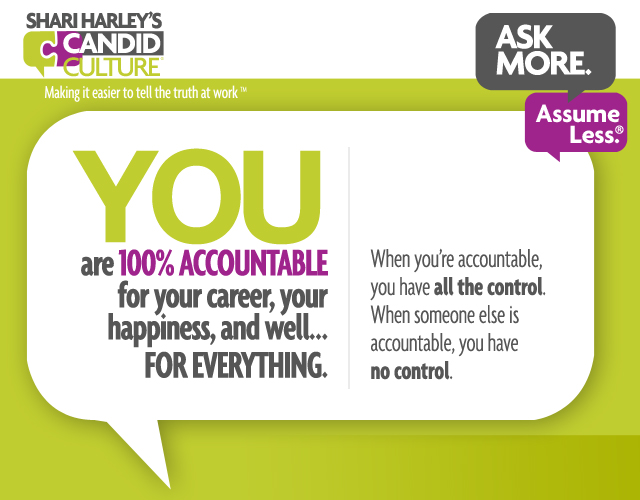
It’s like getting off a highway with bumper-to-bumper traffic. Your alternate route may take longer, but at least you’re moving. You feel like you’re doing something and thus have more control. Taking responsibility for everything that happens to you is similar. When you’re accountable, you can do something to improve your situation. When someone else is accountable, you’re at the mercy of other people and have very little control.
There are, of course, exceptions to the practice that “we’re always accountable.” Terrible acts of violence, crime, and illness happen to people, about which they have no control. But in general, in our day-to-day lives, there is typically something we did to contribute to a bad situation or something we can do to improve it.
Here are four practices for improving difficult situations, even when you didn’t create the mess (alone).
1) Increasing accountability in the workplace: Ask more questions. If you’re not clear about what someone is expecting from you, ask. You’re responsible for doing good work, regardless of the type of direction you receive.
2) Increasing accountability in the workplace: Tell people what you think they’re expecting and what you’re planning to do, to ensure everyone’s expectations are aligned. Clarifying expectations beats doing weeks’ worth of work, only to discover what you created isn’t what someone else had it mind.
3) Increasing accountability in the workplace: Ask for specific feedback as projects progress. Don’t wait until the end of a project to find out how you performed.
4) Increasing accountability in the workplace: Say “thank you” to whatever feedback you receive versus defending yourself. People will be pleasantly surprised and their upset will dissipate more quickly. That could sound like, “That’s good feedback. I’m sorry that was your experience. Thank you for telling me.”
5) Increasing accountability in the workplace: Admit when you make a mistake or when you wish you had done something differently. Don’t wait for someone to tell you. Saying, “I’m sorry. How can I make this right with you?” goes a long way.
I am always asking these questions:
“What could I have done differently?”
“What did I do to contribute to this situation?”
“What can I do now to make this situation better?”
And I encourage you to do the same, even when someone else drops the ball. You can’t control others, but you can control you. And your happiness and success is your responsibility.


A professional athlete would never get on the court, field, or ice without knowing the rules of the game. Athletes know every action that will result in points, penalties, and other positive and negative consequences. Yet many of us go to work without any idea of how we’re being held accountable and what a good job looks like.
In the next few weeks, way too many people will have a performance review during which they will receive feedback that’s a surprise.
Writing clear, specific, and measurable goals is the key to managing your own work performance and to not being caught off guard by performance appraisals. Writing goals may not be sexy or fun, but doing so is the key to taking control of your year.
Four tips for setting goals at work:
1. Setting goals at work: Don’t wait for your manager to suggest writing goals. Ask permission to draft 5 to 7 goals.
2. Setting goals at work: Discuss and finalize each goal with your manager, and ask that the goals be the criteria for your 2015 evaluation.
3. Setting goals at work: Write such specific goals, that at the end of the year, it’s very clear whether you did or didn’t produce the agreed-upon results. When goals are specific, performance appraisals write themselves.
4. Setting goals at work: As business priorities and objectives change, goals change as well. Review your goals with your manager quarterly and make changes as appropriate.
Here are questions to answer when writing goals:
- What results will you produce? What will be different in the organization at the end of the year? (X%) Assign each goal a percentage. Weight each goal by importance.
- What actions will you take? What will you do, and when will you do it?
- How will you know you’ve made progress or achieved your goal? What will be different as a result of your work? (This should be quantitative. Use numbers.)
Here is a completed sample goal:
Results to produce: Retain 90% of new customers. Weighting: 40%
Actions to take:
- Have a setting-expectation meeting with each new customer.
- Return all customer calls within 24-hours.
- Call 10% of customers quarterly, and ask for feedback.
Milestones and year-end results:
- Customer complaints will drop by 20%.
- Customer change orders will drop by 10%.
Early in my career, I worked for an organization that did goal setting well. Each employee wrote 5 to 7 goals that were weighted and extraordinarily specific. It was obvious, throughout the year, if employees were meeting performance standards. And at the end of the year, it was so clear whether or not employees had done what they needed to do, employees could write their own performance appraisal. That’s the power of goals. Well–written goals drive performance, empower employees, and remove the debate about results.
When what you need to do during the year is clearly articulated, you’ve set yourself up to win. You know exactly what you need to do to be successful.
Not every goal or objective at work is numerical and clear cut, but many are. Write down what you need to do and what the desired outcome looks like, whenever possible, and you’ll feel more empowered and in control at work than you previously thought possible.
Now is when people set New Year’s goals. Our goal at Candid Culture is to help you have a year filled with the people and things you enjoy most. Here are 12 of our best tips for creating the best year yet.
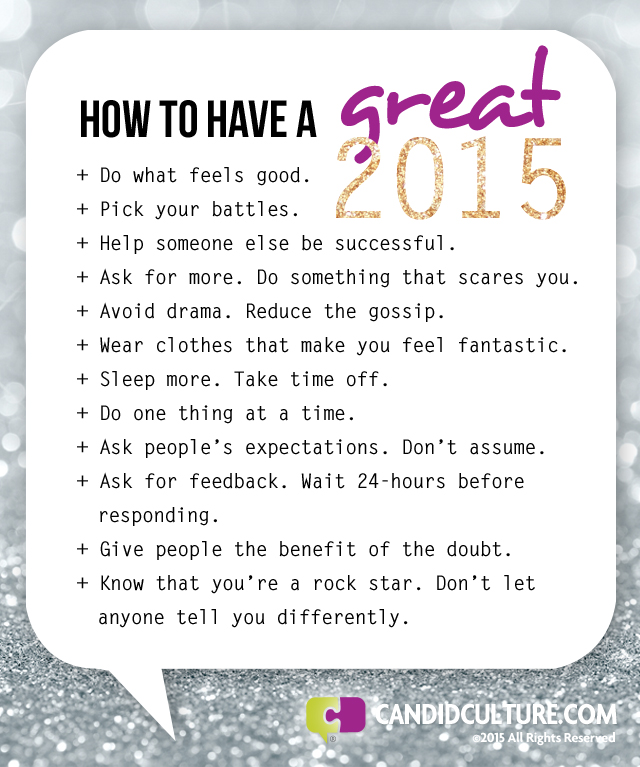
Goals for the New Year #1: Do what feels good.
How many ‘friends’ do you have that after you spend time with them, you actually feel worse? How often do you eat food you know you’ll regret later? Or procrastinate on a project that leads to late nights and lots of stress? If you know something doesn’t make you feel good, stop doing it. If you know someone makes you feel worse, stop spending time with that person.
Goals for the New Year #2: Pick your battles.
There are a lot of things you could legitimately get upset about. Wait to get annoyed. Time brings clarity. Chances are that what’s upsetting today, won’t be nearly as frustrating tomorrow.
Goals for the New Year #3: Help someone else be successful.
Make time to be available for your friends, coworkers, and family, and help them get what they want. The world is better when we focus on someone other than ourselves.
Goals for the New Year #4: Ask for more. Do something that scares you.
It’s so easy to play it safe. But safe is not where the juice is. I’m not suggesting you invest your life savings in risky investments or quit your job before having another one. I am suggesting you try something you’re not sure you can do and say yes, when you’re filled with fear.
Goals for the New Year #5: Avoid drama. Reduce the gossip.
Drama is just a way to say that you need attention. And we all need attention. Just tell the people in your life you need a little love, don’t be shy about it.
Gossip is inherently negative. Avoid people who are always complaining. Spending time with them is exhausting.
Goals for the New Year #6: Wear clothes that make you feel fantastic.
We always feel better when we look good. Take the time to look good. And then periodically lie around your house in clothing that should never see the light of day. And order a pizza, or two.
Goals for the New Year #7: Sleep more. Take time off.
Everything is bigger and feels worse when we’re tired. We get more done, are more patient, and feel better about everything when we’ve had enough sleep.
This ‘thing’ in our country that it looks bad to take time off and someone can’t possibly take all of their vacation time is, forgive me for being so direct, the most stupid thing I have ever heard. People aren’t judging you for taking a vacation. And if they are, then the company shouldn’t have given you the time off in the first place. Get a passport and use it!
Goals for the New Year #8: Do one thing at a time.
Multitasking is bunk. It doesn’t exist, unless you’re driving and talking on the phone, or washing dishes and talking on the phone. Working on a project, while intermittently checking and responding to emails is why you can’t take a vacation.
Goals for the New Year #9: Ask people’s expectations. Don’t assume.
Other people don’t necessarily need, want, or expect what you do. If you’re killing yourself to do something in the way you think someone else wants, perhaps ask what the other person is expecting, and give yourself a break.
Goals for the New Year #10: Ask for feedback. Wait 24-hours before responding.
Be courageous. Ask for feedback (when you’re in a good mood and have had a full night’s sleep), and wait to respond. We’ll say crazy stuff, that we’ll surely regret later, when we’re upset.
Goals for the New Year #11: Give people the benefit of the doubt.
It’s so easy to judge, make assumptions, and jump to conclusions. It’s so much harder and more time consuming to suspend doubt, inquire, and decide later. Many careers and relationships have been damaged by assuming first and asking later, if at all.
Goals for the New Year #12: Know that you’re a rock star. Don’t let anyone tell you differently.
If you don’t think you’re great – at something –none of the nice things anyone else tells you will matter. Fill your own bucket.
Add a comment to the blog about which of the 12 practices you aim to do regularly, and we’ll enter your company into a drawing for a $1000 off your next training with us, because what makes me feel good, is working with you.
Happy New Year! Wishing you a year like no other.