Archive for September, 2014
How many times have you been sitting at your desk wondering, “Why won’t he ___________ ?’ Perplexed, you talk with your buddy at work. The conversation goes something like, “I’ve got this person, and I can’t figure out why he won’t ______________.” Or perhaps you talked directly to the person, but after several conversations, he still hasn’t done what you asked him to do.
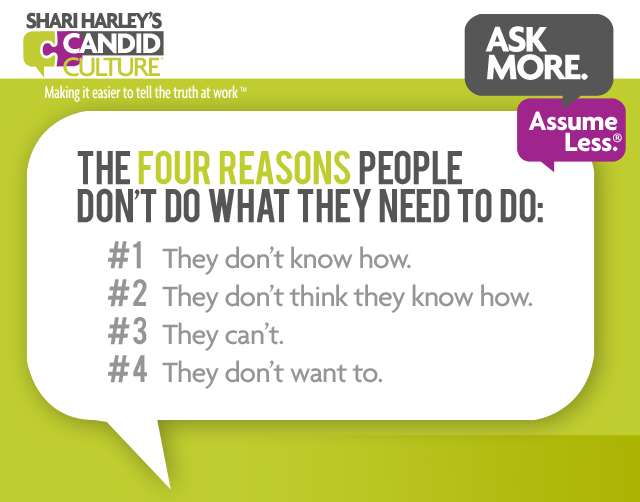
There are four reasons for a lack of employee performance and why people don’t do what you want them to do:
- They don’t know how.
- They don’t think they know how.
- They can’t.
- They don’t want to.
Reason number one for a lack of employee performance, they don’t know how, is the easiest to solve. People who don’t know how to do something need training, coaching, a mentor, a job aid or some other form of instruction. The hope is that with the right training and exposure, he will be able to do what you’re asking.
Reason number two for a lack of employee performance, they don’t think they know how, can be improved over time with patience and consistent coaching. You aren’t working with clean slates. Most people are recovering from or reacting to a past relationship or situation. If a person worked for a controlling manager who never let him make a decision or worked for someone who invoked punitive consequences for making mistakes, the person will be hesitant to make decisions. Hence why he does drive-bys on you, repeatedly checking in, but never pulling the trigger on anything.
If you work with someone who doesn’t think he knows what to do, but you know that he has the answer, encourage him to trust himself. When he comes to you for validation or approval, ask questions, don’t give answers. Tell the person you trust his judgment and encourage risk taking. Tell him that you’ll support his decision, even if it proves to be the wrong one. And encourage him to make the decision next time without consulting you. And then keep your word. If he makes the wrong call, you have to have his back and can’t invoke negative consequences.
Reason number three for a lack of employee performance, they can’t, is challenging but clear-cut. People who can’t do a task their brains aren’t wired for, will never do that responsibility well, regardless how much coaching, training, and assistance you provide. If you have repeatedly AND EFFECTIVELY, coached, trained, and provided support, remove that responsibility and give the person something he can do well. If that responsibility is a large part of the job, you have someone in the wrong job. It’s time to make a change.
Reason number four for a lack of employee performance, they don’t want to, is annoying but manageable. There are lots of reasons people don’t do things they don’t want to do. Those reasons include, but aren’t limited to, boredom, lack of buy-in as to why something is important, insufficient time, feeling like a task is beneath them, etc. If you’ve got someone who can but doesn’t want to do something, you can either take the responsibility away, incent him to do it, or give feedback EVERY TIME the task doesn’t get done.
Giving negative feedback isn’t fun for the giver or the receiver. No one wants to hear that he isn’t meeting expectations and most people don’t want to tell him. But the discomfort of receiving negative feedback EVERY TIME the person doesn’t do what he needs to do will create behavior change. He will either begin doing what you ask, quit, or ask for a transfer. Either way, your problem is solved.
The first step in getting people to do what you want them to do is to discover why they’re not doing what you ask. It’s impossible to appropriately manage employee performance if you don’t know why someone isn’t doing what he needs to do. And the person to ask why a responsibility isn’t getting done isn’t you or your buddy, it’s the person not doing the work. So get out of your head, leave your office, and go talk to the person not doing the work.
Here’s how to start an employee performance conversation:
“I’ve noticed you’re not doing ___________. Help me understand what’s happening.” Watch your tone, inquire from a place of genuine curiosity, and identify the reason he isn’t doing what he needs to do. Then you can intervene appropriately and hopefully get what you want.
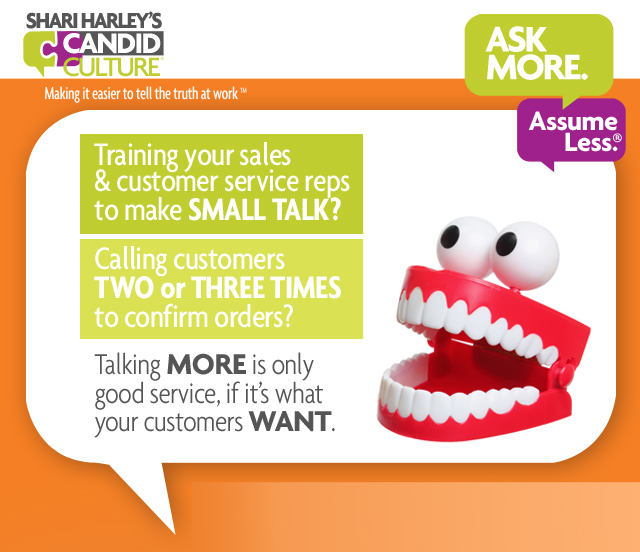 Many organizations think they’re improving customer service by training sales and customer representatives to make small talk, asking how customers’ day, week, or trip is going. Asking questions and chatting with customers about personal matters is only good customer service if clients WANT to make small talk.
When room service delivers breakfast and the guest is standing in a towel, he’s probably not interested in talking about whether his trip is for business or pleasure and whether or not he’ll have time for fun while he’s in town. Improving customer service will likely require the wait person to get in and out of his room quickly. When a taxi driver talks with you, when you want return phone calls, his desire to chat probably isn’t improving customer service.
Sales and customer service representatives can also over communicate about business related issues. Last weekend I ordered some equipment online. Shortly after placing the order, a customer service representative called me because I’d provided different billing and shipping addresses, and he wanted to be sure that someone wasn’t fraudulently using my card. Focused on improving customer service, he asked me to call back before they’d ship my item, which I needed Monday and paid $32 to have sent via overnight mail.
When I called back, I got voicemail and left a message. Then I spent the day wondering if the guy got my message and if my order would arrive on Monday. Then he left another voicemail saying that one of the items I ordered was out of stock but he thought they might have it in another color. He then called again to tell me that they did indeed have the item in a different color and asked me to call back. When I called back, I was told that my order had already shipped. Three phone calls on a Saturday is not improving customer service.
You may be thinking this situation is an anomaly, but it happened to me again a few days later. I returned a pair of pants I bought online. I wrote a letter explaining for what item I wanted to exchange the pants. A customer service representative called to ask if I was sure about what I wanted, and asked me to call back. When I returned the call, I was told that my order had already shipped.
I suspect companies think they’re improving customer service by asking how a customer’s day is going and by calling customers personally when questions arise. Perhaps I’m too busy, but having to call a vendor to tell them that I meant to order what I ordered and I really do have a separate billing and mailing address, is not improving customer service. It’s time consuming and annoying.
I’m aware my preferences are not consistent with all buyers, and many customers appreciate calls from vendors and making small talk with wait staff, taxi drivers, and other service providers. But you won’t know what your customers want if you don’t ask them. Consider asking customers about their preferences when they buy something.
Here are a couple of questions you could ask, with the goal of improving customer service:
If we need to contact you, what method is best? Phone, email, or text message?
Taxi drivers, massage therapists, dentists, etc. ask, “Would you like a silent ride/visit?”
What’s your definition of good customer service? Check all that apply.
- Get it done fast and right the first time.
- Get to know me. I’m happy to chat.
- Get it done right and ask all the questions you’d like.
- I’ll sacrifice pleasantries for speed.
Our customers don’t necessarily share our definition of good customer service. Small talk may suit some customers, while it alienates others. Read your customers’ body language and listen to their tone of voice. Do they look and sound like they want to chat with you? Do they happily provide you with detailed answers to small-talk related questions, or do they provide short answers and appear impatient? Listen, watch and adjust your behavior accordingly. Or preferably, ask what customers are expecting from you when they buy. Ask more. Assume less.


What to say about September 11th, this year, didn’t come to me until I was standing in front of a client’s leaders, talking with them about retaining employees and what they could do to become an even better place to work.
Their office isn’t too far from Shankesville, PA, where flight 93 crashed on September 11th, so they seemed like the right group with whom to share my story. Then I decided that perhaps I should share it with you too.
I bought my first house in Denver in 1999 and went on vacation shortly after closing on the house. Right before I left, my manager told me he had too many direct reports and was putting a layer between us. I’d have a new boss when I came back from my vacation.
Two weeks later, I returned to my new manager and found her to be defensive, paranoid, and irrational – in short, impossible to work with. I did everything I knew to work well with her, calling on our HR department and the EAP counseling available to me, for help. Despite that I led communication skills training for the company and taught conflict resolution, I couldn’t work with her, and let my old boss know I’d be leaving.
I suspect he already knew my new boss wasn’t going to work out (I wasn’t the only person struggling to work with her), and offered me a position in our New York office. He told me that if after 90-days I wanted to return to Denver, I could. Ninety-days in New York with all my expenses paid or unemployment with no plan? The choice was clear. I went to New York and moved into my office in Tower Two of the World Trade Center, where I worked on September 11th.
I’m not proud of uprooting my whole life for a manager I couldn’t work with, and it’s not something I recommend others do. But it does demonstrate the difference one person can make. I never actually lived in that first house I bought. I accepted a permanent job in New York, but wasn’t ready to let go of my life in Denver. So I struggled with the decision of whether to stay in New York or return to Denver, for three years.
It’s normal to question our purpose and wonder if we make a difference. If you ask these questions, consider all the people you work with on a daily basis and how you impact their daily lives. We spend a huge portion of our existence at work, and how we interact with coworkers, customers, direct reports, and vendors impacts their happiness, or lack thereof, in a big way.
Don’t underestimate the difference you make when you smile at someone in the hallway at work, or don’t. When you thank someone for making your job easier, or don’t. When you take the time to teach someone a quicker way to do something, saving him countless of hours, or don’t. Regardless of your title and position in your organization, you impact the people around you in a huge way, every day.
During last week’s training in Pennsylvania, I talked about the four things essential to retaining employees.
Retaining employees –the four things employees need to be satisfied and engaged at work:
- I trust the leaders who run this organization.
- My opinion means something. I am listened to.
- I feel respected (by my manager). We have a good working relationship.
- My work is challenging and interesting. My career is going somewhere here.
If you’re a manager working on retaining employees, spend time with your employees. Ask questions about their career goals. Take the time to coach and give feedback. If you’re a senior leader committed to retaining employees, be visible. Walk around your office(s), addressing employees by name, and asking about their daily work. And if you’re not in a position of leadership, be easy to work with by keeping your commitments, being a short cut and providing information when you can, and offering to help employees who are overwhelmed. Retaining employees is not just a manager’s job. Every person we work with impacts our daily lives more than we know.

Saying no is hard. We don’t want to disappoint or let people down. And yet, you can’t say yes to everything. You can say no and still sound like a responsible, easy-to-work-with, accommodating professional.
Here are four techniques for how to say no:
- Thank the person for asking. “Thank you for asking me.”
Saying “thank you” acknowledges the other person and buys you time to think about his request.
2. Tell the person you need some time to think about his request. Ask, “Can I have a few days to think about it? I’ll get back to you by Friday.”
You don’t need to reply in the moment. I often regret things I agree to without thinking through the request thoroughly.
3. Consider what you really want and are willing to do. It’s much worse to over commit and under deliver than to simply say no or renegotiate requests.
4. Get back to the person in a timely way (when you said you would) and tell him what you’re willing to do.
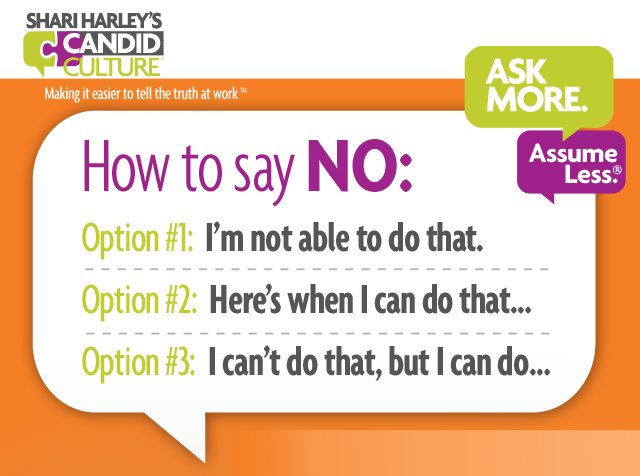
How to Say No Option One: Simply say no.
Example: “I really appreciate you asking me to write the proposal for the __________ RFP. I’m not able to do that. Can I recommend someone else who has the expertise and will do a great job?”
Don’t give a bunch of reasons for saying no. People aren’t interested in why we can or can’t do something. They just want to know if we will do it.
How to Say No Option Two: Agree and negotiate the time frame.
Example: “I’d be happy to do that. I can’t do it before the last week of the month. Would that work for you?” If the answer is no, negotiate further. Ask, “When do you really need it? I can certainly do pieces by then, but not the whole thing. Given that I can’t meet your timeline, who else can work on this in tandem or instead of me?”
How to Say No Option Three: Say no to the request but say what you can do.
Example: “I can’t do _______. But I can do ________. How would that work?”
A review of how to say no:
- Acknowledge the request by getting back to the requestor within 24 hours.
- Give yourself time to think about and respond to requests.
- Negotiate requests to your and the requestor’s satisfaction.
- Agree on what you can and are willing to do.
- Keep your commitments.
Saying no is always hard. But it’s always better to say no than to ignore requests, or to say yes and do nothing.
We added to our team at Candid Culture a few weeks ago, so we did what I teach other organizations to do –use Candor Questions to onboard our new team member, and help the entire team get to know each other better.
I sent my team the Candor Questions below and asked them to pick a few additional team building questions for everyone on the team to answer.
- What will keep you working here and what would make you leave?
- What’s the best way to get information to you – voicemail, text, or email?
- What time is too early?
- What time is too late?
- Do you leave your email and/or text alerts on at night/when you go to sleep?
- Would you prefer I send all emails and text messages during regular business hours?
- What frustrates you at work?
- What are your pet peeves?
- What’s something you want to learn, skill or business wise, that you haven’t had a chance to do?
- What’s something you wish I would start, stop, or continuing doing?
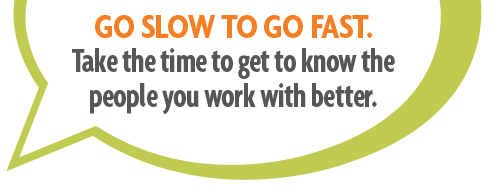
We run so fast at work and are so focused on completing goals, we often don’t take the time to really get to know the people we work with. I feel very strongly that asking the team building questions above will help people work better together. We’ll make fewer ‘mistakes’ with each other, and get more done with less stress and more ease. As William Ury said in his book, Getting to Yes, “Go slow to go fast.”
How many times have you sent someone five emails and become frustrated when none were returned? Or you thought an employee was happy, only to be surprised when she quit? Or you needed to talk with someone but couldn’t get her attention, so you walked by her office throughout the day, wondering if it was ok to knock? Working with other people doesn’t have to be so hard.
Taking the time to ask team building questions is much faster than recovering from missteps with other people. Ask the questions at the beginning of anything new – when you hire a new employee, get a new customer, or start a new project. And keep asking the questions as you work with people.
Asking questions about working style preferences and goals is an ongoing process, and it’s never too late. You can ask the team building questions during meetings or just slip them into your conversations. The process doesn’t have to be formal or time consuming. The point is simply, don’t guess what people need and are expecting from you, ask.