Archive for January, 2014
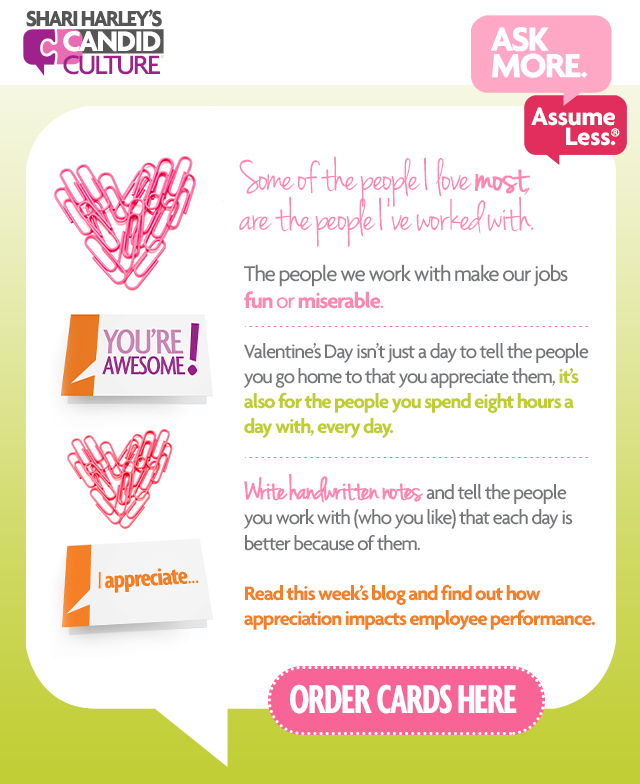 Whenever I leave a job, the thing I take with me are the relationships. The projects and deliverables quickly become distant memories, but the people and the experiences we shared together stay with me. Some of my closet friends and the people most important to me in the world are the people I’ve worked with. It makes sense that we make friends at work; it’s where we spend a lot of time. And the people we work with make work fun or miserable.
There is a considerable amount of research citing the connection between having good business relationships and employee engagement, retention, and high performance. When we feel we belong and have good relationships at work, we are happier and do better work. It makes perfect sense.
As I’m writing this, I’m thinking about my coworkers with whom I spent weeks on the road, who endured a presentation, practice session for an upcoming town hall meeting that lasted until 1:00 am, and the coworkers I worked with in the World Trade Center. As much as I appreciated and cared about the people I worked with, I not sure how often I told them that they made my work world better.
Valentine’s Day is a day we express appreciation for the people closest to us. Don’t limit your appreciation to your loved ones at home; include your coworkers who make your work fun and who help you get things done. Of course, I hope you’ll tell express appreciation more than once a year, but Valentine’s Day is an occasion not to miss.
Write the people you work with, who matter most to you, a handwritten note that they’ll keep for a long, long time. You can see our assortment of greeting cards for the workplace here. I’ll admit that I collect stationary and love giving and receiving handwritten notes. I suspect the people you work with will appreciate receiving a handwritten note too.
Click here to see all of our greeting cards:

No one likes to make mistakes. We want to do good work and have people think well of us.
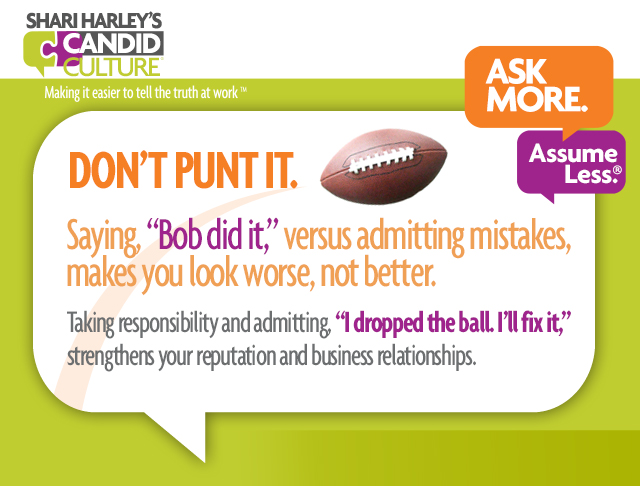
The key to maintaining your relationships and reputation, when you make a mistake, is to take responsibility and make things right as soon as possible. Saying something wasn’t your fault or becoming defensive will only damage your reputation and relationships. As counterintuitive as it sounds, you will gain respect and credibility by admitting fault and correcting problems.
I often get asked if people lose credibility by being humble – asking for feedback and admitting to making mistakes. It takes strength to ask for and be open to feedback and to admit when you drop the ball. So while it may seem counterintuitive, the more you ask for and respond to feedback, and admit when you make mistakes, the stronger you will appear.
I made a mistake at work. Now what?
When you make a mistake say something like:
“I dropped the ball on that. I apologize. I’ll fix it and let you know when it’s been handled.”
Or, “Thank you for the feedback. This clearly didn’t go as planned. I’ll make those changes and let you know when they’re done.”
Also, let people know the steps you’ll take to avoid similar challenges in the future.
You could say something like:
“Thanks for letting me know that our process is causing your department challenges. We certainly want the process to be smooth. My team will fix this month’s report, so your team doesn’t have to invest more time. We’ll update the process for next month and walk you through the changes before the report is due.”
Don’t provide a bunch of reasons for breakdowns. No one cares. Telling people why something occurred can sound like excuse management. People just want to know things will be made right.
Asking for feedback, taking responsibility, and telling people how you will correct errors may not be your natural or first reaction. The more you can train yourself to do these things, the easier you will be to work with and the better your reputation and business relationships will be.

Click here to download free questions to find out what your coworkers and internal and external customers are satisfied with about your performance and what they wish you would do differently.
For the most part, people are afraid to speak up at work. Despite the town hall meetings and roundtable discussions executives host, the feedback training offered, the existence of ask-the-CEO email addresses and blogs, and employee satisfaction and engagement surveys, many employees are still afraid to give feedback at work, citing fear of damaging relationships, being fired, and other forms of retaliation.
Those of you who have worked with me, read How to Say Anything to Anyone, and/or used our tools, know that I am on a quest to make it easier to tell the truth at work.
The Candid Culture Vision:
- Coworkers, leaders, and managers set clear expectations before problems occur. No one has to guess what is expected of them and what a good job looks like.
- Employees ask for and receive regular, balanced and candid feedback and always know where they stand performance wise.
- Managers and leaders are open to and ask for feedback. They always know what’s really happening in the organization and can lead accordingly.
- People talk to each other versus about each other. Gossip and drama is the exception, not the norm.
- Work is a fun place to be. People enjoy working together and produce their best work.
Many of you are taking actions to create the environment I’ve described above. I want to hear from you and want to use this blog to share practices for creating more candid communication at work.

Add a comment and tell us:
- What you are doing to increase the trust and communication in your organization.
- The avenues you are using to give feedback on your team, in your department, or in your entire organization.
We’ll enter you to win 50 of our new door tags. The door tags were designed to tell your coworkers that your office is a place they can speak freely, without concern.
 Many year-end performance reviews include whatever the manager and direct report can remember happening during the last six to twelve weeks of the year. For the most part, managers and direct reports sit in front of blank performance appraisals and self-appraisal forms and try to remember everything that happened during the year. The result: A vague, incomplete performance review that leaves employees feeling disappointed, if not discounted.
If you were disappointed by your performance review this year, don’t let it happen again next year. Take charge of your career by writing your own goals.
One of the first companies I worked for did the goal process so well, I learned early in my career how powerful well written goals could be. Each employee set five to seven goals. Experienced employees wrote their own goals and then discussed those goals with their manager. Less experienced employees wrote their goals with their manager. Managers wrote goals for inexperienced employees. The goals were so specific and clear that there could be no debate at the end of the year whether or not the goal had been achieved. It was obvious. Either employees had done what they said they would, or they hadn’t. This made writing performance appraisals very easy. Very little on the appraisal was subjective. And this gave employees a feeling of control over their year and performance.
It’s great if you work for an organization or manager who works with you to write goals. If you don’t, write your own goals and present them to your manager for discussion and approval. Managers will be impressed you took the initiative to write goals and will be thankful for the work it takes off of them.
Goals should be simple and clear. It must be obvious whether you achieved the goal or not. There should be little if any room for debate.
Sample goals are below.
Desired Outcome (goal):
• Improve client feedback – too vague
• Get better written reviews from clients – better
• 80% of clients respond to surveys and respond with an average rating of 4.5 or above – best
Actions you will take to achieve the goal:
• Ask clients for feedback throughout project — too vague
• Ask clients for feedback weekly – better
• Visit client site weekly. Talk with site manager. Ask for feedback — best
Goal template:
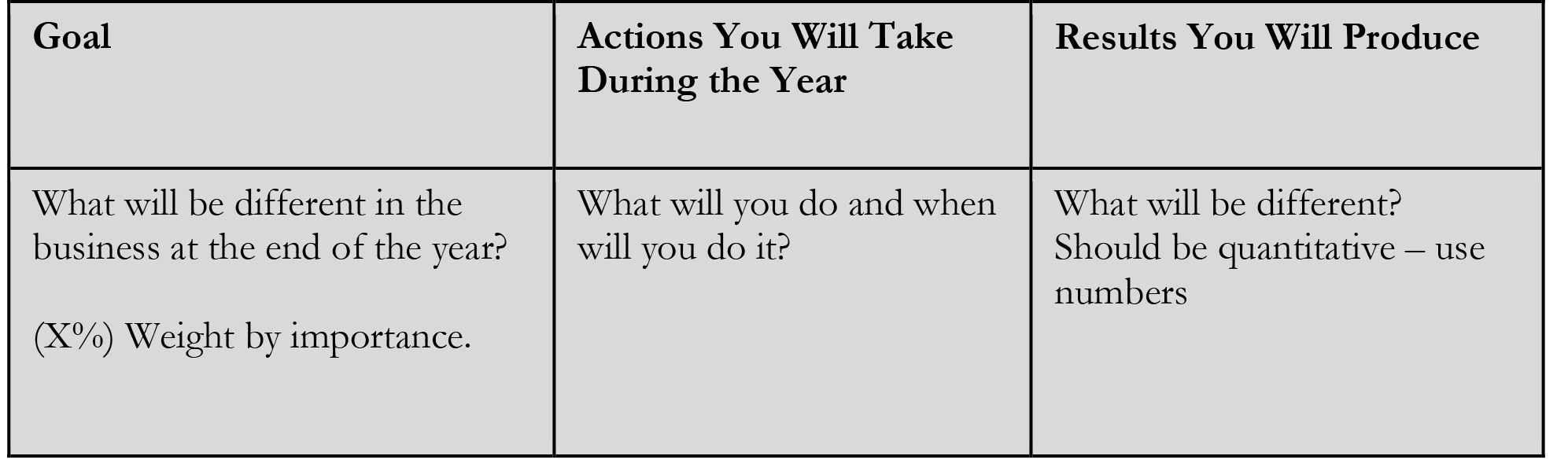
Completed sample goal:
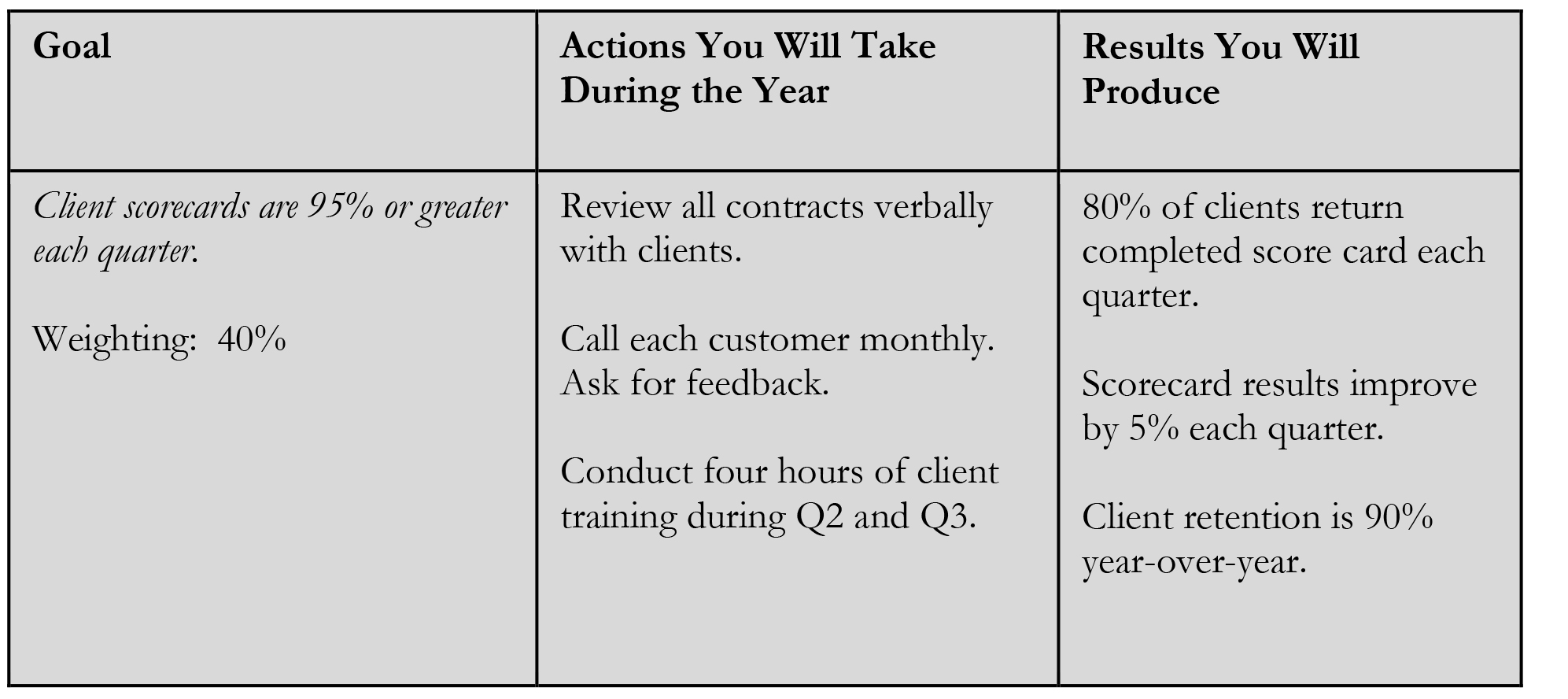
How to approach your manager with written goals:
Try using this language with your manager: “I want to be sure I’m working on the things that are most important to you and the organization. I’ve written some goals for 2014 to ensure I’m focused on the right things. Can we review the goals, and I’ll edit them based on your input? And what do you think of using the agreed-upon goals to measure my performance in 2014?
You have nothing to lose by writing goals and presenting them to your manager. You will gain respect from your manager, clarity of your 2014 priorities, and more control of your year-end performance review. Give it a try, and let me know how it goes.
If you want more feedback from your manager, ask these questions.