Archive for December, 2013
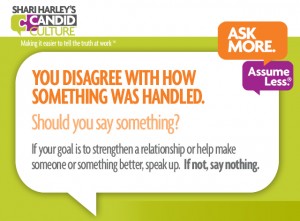 Most of us grapple with whether or not we should give feedback when someone else does or says something frustrating.
Here are a few criteria to help you decide whether or not you should give feedback or say nothing:
- Do you have a relationship with the person? Do you know each other well enough to share your opinion? Aka, have you earned the right?
- Has the other person requested your opinion? Unsolicited feedback often goes on deaf ears.
- If the other person has not requested your opinion, does he appear open to hearing feedback?
- Are you trying to make a difference for the other person or just make him look or feel badly?
- Do you want to strengthen the relationship?
Before you give feedback, do something I call, ‘check your motives at the door.’ If your motives are pure – you want to strengthen the person or the relationship, and you have a good enough relationship that you’ve earned the right to speak up — then do it.
People are more open to feedback when they trust our motives. If we have a good relationship with the person and he knows we’re speaking up to make a difference for him or for the relationship, you’ll be able to say way more than if your motives are questionable – aka you want to be right.

 Last week I was on plane and the woman in back of me kicked the back of my seat throughout the flight. It made me nutty. The guy next to her talked so loudly, I’m pretty sure the people six rows in front and behind him could hear the conversation. And no one said anything.
Many of us don’t return food in restaurants that isn’t good. We often say nothing when people drop the ball and make mistakes. We replace ineffective vendors and service providers rather than tell them where they’re falling short.
People usually claim they aren’t giving feedback because they don’t want to hurt the other person’s feelings, think the person is not likely to change, or because they’re not sure if their complaint is valid. I don’t buy most of these reasons.
I think the real reason we aren’t giving feedback is because we don’t want to deal with the other person’s reaction. We are concerned – often rightly so – that the person will kill us off. We will be given the cold shoulder, excluded from projects, or thrown under the bus.
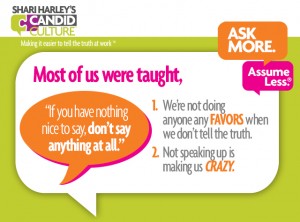
You may be wondering why I, who wrote a book called How to Say Anything to Anyone and who teaches other people to give feedback, didn’t speak up on the plane last week. I too have been trained to pick my battles and that if I have nothing nice to say, say nothing at all. Each day I also grapple with when to speak up and when to let things go.
The concern over giving feedback will get better if the people in our lives – personal and professional relationships – agree it’s ok to tell the truth and agree that there will not be negative consequences for doing so. Open and direct conversations will be had. Disagreements will be discussed and resolved as best they can. And when the conversation is over, it’s over. People can’t hold the conversation over your head or hold a grudge.
It would be difficult to agree to open and honest communication with the people who sit behind you on planes, but you certainly can make that agreement in your office and with your family and friends. Agreeing to tell the truth without consequence can be one of your organization’s values and a practice you establish in your personal relationships.
You can hire people who understand they are expected to speak candidly and then let disagreements go. And you can manage people who don’t speak up, who hold grudges, and who punish people for giving feedback. You can tell friends and family that you want candid relationships in which challenges are dealt with quickly and then the disagreement is over.
Making the request for open and honest communication and assuring people there will be no negative consequence for doing so is the differentiator between being able to speak up when you’re frustrated or say nothing.
Last week I was upset, really upset. I worked hard to practice what I preach when giving feedback – wait to talk until I’m calm, ask questions, and no matter what happens, don’t send a text message. It was hard, really hard.
I was mad and wanted to say, “What the *&^#$@?” But I know that when people receive negative feedback they feel judged. And when people feel judged, they become defensive, making it very difficult to hear what the other person is saying and have a conversation.
When my emotions don’t get the best of me, I plan hard conversations by asking myself these questions:
- What do I want to have happen as a result of the conversation?
- How do I need to approach the conversation to get that result?
Knowing that if I want to have a good conversation, I need to reduce the other person’s defensiveness, I often start feedback conversations by asking the neutral question, “Help me understand; what happened the other day?”
Last week one of my employees tipped me off that the people who work for me are on to me. They’ve read my book. When I ask, “Help me understand; what happened the other day,” they know that feedback will follow.
You don’t want to approach your relationships and conversations in a formulaic and inauthentic way. Inauthenticity stinks and it can damage relationships more than freaking out will do. But it’s not a terrible thing to put someone on notice. If the people who work with me know that negative feedback follows the question “what happened,” they know the conversation is important. Yes, they’ve been tipped off and perhaps as a result they’re on the defensive, but I still think asking “what happened yesterday” is a heck of a lot better than raising your voice, accusing, and asking questions later.
Asking questions to discuss thwarted expectations is hard to practice. It takes great self-management, which I don’t always have. I mostly practice what I teach, and when I don’t, I clean up the mess I’ve made, apologize and recommit to doing so in the future. And you can do the same.
A Few Practices to Consider:
Holiday Promo – $12 a book for 7 or more books.
- Wait to give feedback until you won’t freak out, but don’t let situations fester and become bigger than they need to be. Have the conversation as soon after an event as possible.
- If something is important to you, ask for it. Trying to persuade yourself that it isn’t a big deal and might be your issue, probably won’t help. We want what we want. Be true to yourself.
- Consider starting hard conversations with “help me understand.”
And when you find that you’ve put the other person on the defensive and s/he feels judged, work to do better next time. But in the end, speaking up is always better than stuffing how you feel, even if you handle the conversations differently than you had planned.