The Feedback Formula:
1. Introduce the conversation so feedback recipients know what to expect.
2. Empathize so both the feedback provider and the recipient feel as comfortable as possible.
3. Describe the observed behavior so the recipient can picture a specific, recent example of what you’re referring to. The more specific you are, the less defensive he will be, and the more likely he’ll be to hear you and take corrective action.
4. Sharing the impact or result describes the consequences of the behavior. It’s what happened as a result of the person’s actions.
5. Having some dialogue gives both people a chance to speak and ensures that the conversation is not one-sided. Many feedback conversations are not conversations at all; they’re monologues. One person talks and the other person pretends to listen, while thinking what an idiot you are. Good feedback conversations are dialogues during which the recipient can ask questions, share his point of view, and explore next steps.
6. Make a suggestion or request so the recipient has another way to approach the situation or task in the future. Most feedback conversations tell the person what he did wrong and the impact of the behavior; only rarely do they offer an alternative. Give people the benefit of the doubt. If people knew a better way to do something, they would do it another way.
7. Building an agreement on next steps ensures there is a plan for what the person will do going forward. Too many feedback conversations do not result in behavior change. Agreeing on next steps creates accountability.
8. Say “Thank you” to create closure and to express appreciation for the recipient’s willingness to have a difficult conversation.
If you’re giving more than one piece of feedback during a conversation, address each issue individually. For example, if you need to tell someone that she needs to arrive on time and also check her work for errors, first go through the eight steps in the formula to address lateness. When you’ve discussed an agreement of next steps about being on time, go back to step one and address the errors. But talk about one issue at a time so the person clearly understands what she’s supposed to do.
Here’s how a conversation could sound, using the eight-step Feedback Formula:
Step One: Introduce the conversation.
“John, I need to talk with you.”
Step Two: Empathize.
“This is a little awkward, and it may be uncomfortable. I want you to know that while I wish I didn’t have to tell you this, I’m doing it because I care about you and I want you to be successful.”
Just because you’re direct doesn’t mean you’re not empathetic. But remember, these are my words. You’ll need to find your own words that you feel comfortable using to deliver such a difficult message.
Step Three: Describe the observed behavior.
“John, I’ve noticed that you have an odor.”
Step Four: Share the impact or result of the behavior.
“I know this is a very awkward subject (more empathy). We work in a small space. I don’t want others to avoid working with you or say negative things about you. And as awkward as this is, I would rather you hear this from me than from someone else. Sometimes health conditions can cause certain odors, as can eating certain foods.”
Step Five: Have some dialogue. Ask the recipient for his perception of the situation.
“What are your thoughts?”
Give John time to say whatever he wishes to say.
Step Six: Make a suggestion or request for what to do next time.
“Again, I’m really sorry to have to tell you this. Please make sure you shower every day before coming to work and wash your clothes regularly. And please tell me if there’s something else you’d like me to know.”
Because of the awkwardness of this subject, skip step seven, and go to step eight.
“Thank you for being willing to have this conversation with me.”
You Can Say More Than You Think You Can
You might be gasping, thinking there is no way you could ever tell someone he smells. It’s definitely an awkward conversation, one I hope you never have to have. I used one of the most difficult things you will ever have to say to demonstrate that even the most awkward feedback can be delivered empathetically and quickly.
The short and concise body-odor conversation is a lot less uncomfortable for the recipient than the drawn-out, evasive first version. Just think, would you rather listen to someone tell you that you smell for two minutes or for twenty?
You may also think, “I shouldn’t have to tell someone to take a shower and wash their clothes.” That’s true, you shouldn’t. But if you’re working with someone who doesn’t do these things, clearly someone needs to tell him. Remember, other people are not you and don’t do things the way you do, even when those things appear to be no-brainer basics.
Lastly, you may think that telling someone to shower and wash his clothes is insulting and demeaning. It’s true: No matter how you spin it, there’s nothing nice about this message. But which is worse, having your coworkers ask for different desks and be unwilling to work with you, or having someone who has your best interests at heart tell you privately to clean it up—quite literally? When you tell people the truth, you do them a favor.
Here’s another example: A few years ago I had a coworker who was a lingerer. Lisa would hover outside my office until she saw an opportunity to interrupt. She then walked in uninvited and started talking. I was still mid-thought about whatever I’d been working on and wasn’t ready to listen. After a few sentences, I would interrupt Lisa, saying, “I’m sorry. I don’t know what you’re talking about. Will you please start over?”
Embarrassing as it sounds, this went on for more than a year. I wanted to be seen as accessible and open, yet this “lingering” method of interrupting was driving me crazy. And it was a waste of both of our time. After many months of frustration, I decided to use the eight-step Formula.
Step One: Introduce the conversation.
“Lisa, I want to talk about something I’ve noticed.”
Step Two: Empathize.
“I probably should have said something a long time ago. I’m sorry I didn’t.”
Step Three: Describe the observed behavior.
“I’ve noticed that when you want to talk to me you stand at my door, waiting for a good time to interrupt. When you come into my office, you’re often in the middle of a thought or problem that you’ve probably been thinking about for a while.”
Steps Four and Six: Share the impact or result of the behavior and make a suggestion or request for what to do next time.
“Because I’m in the middle of something completely different, it takes me a few seconds to catch up. By the time I have, I’ve missed key points about your question and I have to ask you to start over. This isn’t a good use of either of our time.
“Here is my request: When I’m in my office working and you need something, knock and ask if it’s a good time. If it is, I’ll say yes. Give me a few seconds to finish whatever I’m working on, so I’m focused on you when we start talking. I’ll tell you when I’m ready. Then start at the beginning, giving me a little background, so I have some context. And if it isn’t a good time for me, I’ll tell you that and come find you as soon as I can.”
Step Five: Have some dialogue. Allow the recipient to say whatever she needs to say.
“What do you think?”
Step Seven: Agree on next steps.
“Okay, so next time you want to talk with me, you’re going to tap on the door and ask if it’s a good time to talk. If it’s not, I’ll tell you that and come find you as soon as I can. If it is a good time, you’re going to give me a second to finish whatever I’m working on and give me some background about the issue at hand. Does that work for you?”
We have just managed “the lingerer”—a challenge you probably have, unless you work from home or in a closet.
You may have noticed that I changed the order of the Feedback Formula during this conversation. It’s not the order of the conversation that’s important. It’s that you provide specific feedback, offer alternative actions, and have some dialogue before the conversation ends.
Summary: Good Feedback Is Specific, Succinct, and Direct.
Provided you have a trusting relationship with someone and have secured permission to give feedback, there is very little you can’t say in two minutes or less. The shorter and more direct the message, the easier it is to hear and act upon. Follow the eight-step Feedback Formula. Be empathetic and direct. Cite specific examples. Give the other person a chance to talk. Come to agreement about next steps. Remember, you do people a favor by being honest with them. People may not like what you have to say, but they will invariably thank you for being candid.
This week’s blog is an excerpt from my book How to Say Anything to Anyone: A Guide for Building Business Relationships That Really Work. I hope it helps you have the conversations you need to have! Be candid. You can do it!
If I hear this one more time I might lose it.
Manager: “One of my employees has been making a lot of mistakes. He seems disengaged. I’m not sure what’s happening.”
Me: “Have you talked to him?”
Manager: “No. Performance appraisals are coming up, so I’ll just wait to give the feedback until then.”
Me: “When are performance appraisals?”
Manager: “In six weeks.”
Most people hoard feedback. We wait for the right time, aka when we’re comfortable. That time will never come. The right time to give feedback is when something happens or shortly thereafter. Practice the 24-hour rule and the one-week guideline. Give feedback when you’re not upset, but soon after the event occurs, so people remember what you’re talking about.
Most employees feel as if they’re treated unfairly during some portion of a performance appraisal. Employees receive feedback they’ve not previously heard, or receive feedback that is unbalanced – overly positive or negative, or the feedback is so vague employees aren’t sure what to do more, better or differently.
Good performance appraisals are a quick summary of all the performance conversations you’ve had during the year and planning for next year. To have an appraisal meeting like this one, managers need to meet with their employees regularly and give feedback every time you meet. And that is the management BEST suggestion I can make.
Meet regularly with your employees. If you never meet one-on-one with employees, start meeting monthly. If you meet monthly, meet twice a month. If you meet twice a month, consider meeting weekly for 30 minutes.
The one-on-one meeting agenda, which the employee owns:
- What is the employee working on that’s going well?
- What is the employee working on that is not going great, but she doesn’t want your help?
- What is the employee working on this isn’t going great and she wants your help?
- Give each other feedback: What went well since you last met? What could be improved?
** Give and receive feedback on the work and on your relationship. This will be hard the first few times you do it, but will become easier with each successive conversation.
Ask your employee to create a meeting agenda. Take notes on the agenda and keep your notes. The summary of these meetings becomes your annual performance appraisal.
Regardless of whether or not you’re meeting regularly, throughout the year and have performance notes, you can only give small pieces of feedback during the appraisal meeting. Discuss three SPECIFIC things the employee did well during the year and three things she should do next year. People can’t focus on more.
Think about the New Year’s resolutions you may have made last January. You might have promised yourself you’d save ten percent of your income, lose twenty pounds, take a two-week vacation without your phone, and apply to attend graduate school. How many of those things did you do? Setting too many aggressive goals sets us up to fail. And performance appraisals are not different.
Consider how each of your employees must impact your department and your organization’s annual goals. In that context, determine the most important things each employee did to contribute to those goals this past year and what she should have done more, better or differently? That’s your appraisal. Not more and not less.
During performance appraisals, force yourself to focus on and present ONLY the most important behaviors and outcomes, and your employees will bring the same focus to the ensuing year.

Most of the feedback people receive in the workplace isn’t feedback at all. It’s what I fondly refer to as Cap’n Crunch – vague and unhelpful words that make people defensive but don’t change behavior. If you want the people you work with to do some differently, give specific feedback.
Most of the fake feedback people get sounds like this:
“You did a great job on that.”
“You’re doing really good work.”
“You’re dressing inappropriately.”
“You’re difficult to work with.”
None of this is feedback. It’s all Cap’n Crunch. Vague, vague, and more vague.
The first words out of your mouth will invariably be Cap’n Crunch. Follow those words with, “for example” and you’ll be headed in the right direction.
“You did a great job on that. For example, I never had to ask about the status of the project. You gave me an update every Friday, and that made me feel comfortable that we were on track.”
You dressed inappropriately for that meeting. For example, the client was dressed in business casual and you were jeans and tennis shoes. Next time, please dress as the client dresses or a step above in khaki pants or slacks, a button down shirt, and a jacket.”
Most people are afraid to give feedback because they don’t want to deal with the defensive reaction they anticipate. The more vague you are, the more defensive people will be. Because they don’t know what you’re talking about.
If employees shop your feedback around, asking what others think of the feedback, it’s because you were vague, they disagree with you or they’re being defensive. Feedback will be received better and resisted less if you’re specific.
Specific feedback can be captured on video. Meaning, you can video someone walking into a meeting late, rolling his eyes, and texting on his phone. I dare you to video “you were disrespectful in the meeting, you dressed inappropriately, or you’re difficult to work with.” If you can’t capture the feedback on video, you don’t yet have specific feedback. You have Cap’n Crunch.
When I teach managers to give feedback I ask the managers to, “Describe the situation to me. What did the person do? Managers often reply with, “He was negative.” This is Cap’n Crunch. So I keep asking questions. “What did he do that was negative? What did it look like?” After two or three questions the manager tells me, “I overheard him complaining to other employees in his cube about the decisions the company is making. I’d rather he ask me questions about the direction we’re going versus gossip to his peers.” Now we have specific feedback.
Wait to give feedback until you have a specific example. If you don’t have a specific example, go get one. Without an example, employees will look at you in a confused way, question the validity of what you’re saying and become defensive. And they’ll be right in doing all of these things.
Most of us dread giving and receiving performance reviews. Last week, this week and next week’s blogs are designed to make the performance appraisal process easier. If you want more help, chapters nine through twelve of How to Say Anything to Anyone provide a clear and easy-to-follow formula for giving specific feedback.
I’ll be back next week with more tips on giving feedback that actually changes behavior. Until then, BE SPECIFIC. If you’re not using the words “for example” you’re not giving specific feedback.

Appraisals can raise performance and morale, but most damage both. The appraisal process is broken. Summarizing an entire year’s work into one conversation and giving all that work a numerical rating is demoralizing and ineffective. Yet it’s the system most of us have to work with.
It’s time to get ready to write, deliver, and receive useful, motivating, and effective performance appraisals.
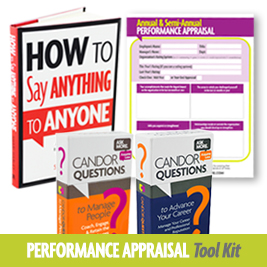 First evaluate your performance appraisal. If it’s more than two pages, it’s too long. If HR professionals are chasing appraisals, trying to get managers to complete them, the tools you’re using aren’t working. If you have to conduct a training to teach people how to complete the appraisal, it’s too complicated.
The next few blogs will be about how to write and deliver effective performance appraisals. I’ll also make Candid Culture’s effective performance appraisals tool kit available. Contact us for bulk pricing.
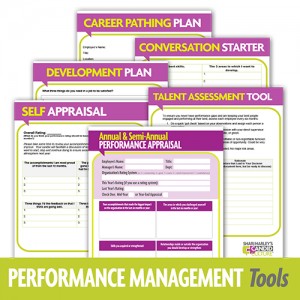 When I managed leadership training and succession planning, in a past job, I inherited a 12-page performance review that no one wanted to use. One of the leaders I supported told me, “If you can give me something that’s one page, I’ll get my people to use it.” From that day on I was on a quest to create tools for effective performance appraisals that were one or two pages. Today Candid Culture offers a suite of performance management tools – self appraisal, annual appraisal, talent assessment, development plans, etc. — that are one and two pages. Let me know if you want to talk with me about using them in your organization.
Employees, make it easy to review your performance. Write a one-page document summarizing your accomplishments. Assemble feedback you’ve received during the year from the people you support. Ask permission to provide both to your manager to make it easier to write your review.
Lastly, managers and employees, get ready to give and receive useful feedback. Most of the feedback employees receive isn’t feedback at all. It’s what I fondly refer to as CAP’N Crunch – vague and thus unhelpful. Effective performance appraisals should focus on three specific things the employee did well during the year and three specific things she can improve. People can’t focus on more than that.
 How to Say Anything to Anyone: A Guide for Building Business Relationships that Really Work is perfect preparation to get ready to deliver and receive performance feedback. I feel so strongly that the book will elevate the appraisal process, that we’re going to offer the book at a deep, bulk discount, to encourage organizations to make it available to managers and employees.
The appraisal process doesn’t have to damage relationships, lower morale and make employees question their commitment to your organization. Get ready now. Don’t wait. Start capturing what employees did well during the year and what could have been improved. Be specific. If you don’t have an example, you’re not ready to give feedback.
Next week I’ll provide specific examples of how to create useful performance feedback that will raise performance while maintaining morale. Until then, start planning! Good luck