Archive for June, 2013
 Wearing too much perfume or cologne will make people scatter, or wish they could. Unfortunately, rather than tell you that you’re wearing too much, people will just avoid sitting near you. Scent is such a personal thing, like clothing, that people are hesitant to comment on it.
I suggest not wearing anything scented at work, on airplanes, or when you’ll be in close proximity with other people you don’t know well. But if I can’t persuade you to skip the scent, here are a few guidelines when putting on cologne and perfume:
• Spray the air ten inches in front of you, and walk through the mist, rather than spraying your skin.
• If you can smell the scent on yourself or people who are more than a few inches from you can smell it, you’re wearing too much.
• You should never be able to smell a person’s cologne after they’ve left a room.
No, I’m not an expert on how to wear perfume. I googled it.
The next step is to ask a few people you trust to tell you when you wear too much perfume or cologne. Give people permission to give you this feedback, and promise you won’t bite their head off when they do. This could sound something like, “I want to be sure I’m not wearing too much perfume. Would you be willing to tell me when I do? I promise I won’t freak out or jump down your throat. I really want to know.”
Let’s say you work with someone who wears too much perfume. She hasn’t asked if she’s wearing too much, and you want to say something. You could say something like, “This is a bit awkward, but the perfume you wear is a bit overwhelming. Would you be willing to wear less or none at all when you’re in the office?” This is an awkward conversation that most people don’t want to have. Consider that you’re doing the person a favor. Would you rather know the amount of scent you wear keeps other people away, or would you rather alienate the people around you?
If the relationship is a personal one, you could say, “You wear the most lovely perfume. And I’ve noticed that the smell is quite strong. Would you be willing to wear less of it?” Again, this is an awkward conversation. But you won’t die from having it and the other person won’t either. When she gets over being embarrassed and defensive, your relationship will be fine. And if it’s not, you didn’t have much of a relationship to begin with.
Use our Candor Questions to Advance Careers to find out what people say about you when you’re not there.
 You have too much to do and not enough time. Something has to go. You have four choices:
- Get further behind at work
- Have less fun
- Spend less time with your kids, spouse and/or friends
- Sleep less
Most people forgo sleep in favor of work, fun, and time with family and friends. But this choice, like all choices, has consequences.
I’ll admit to being a bad sleeper. I stay up too late stalking people on Facebook who I don’t care about. Then I wake up in the middle of the night to use the facilities and have trouble falling back to sleep. Instead of quieting my mind, I make to-do lists on my phone, which, yes, I sleep with. I am quite functional with five hours of sleep for one or two days. The third day I’m a disaster – cranky and unproductive.
Most people need more sleep than they’re getting. With enough sleep everything works better. With a lack of sleep nothing seems to work. We would actually increase productivity if we slept more. Mornings would start better, days would be more efficient, and the people we work and live with would like us more.
But the problem remains, most people don’t feel they have enough time. And something has to go.
Here are a few things I’m trying to increase productivity:
- Set realistic goals. I’m probably not going to go to be at work at 8:00 am, go to the gym, and see friends five days a week. Three days is more realistic.
- Put the phone on the other side of the room when I go to bed, so it still serves as an alarm clock but isn’t within arm’s reach.
- Don’t read or reply to email in the middle of the night.
- Wind down earlier. Start getting ready for bed 30 minutes before I want to go to sleep.
- Accept that I need more sleep and that while four or five hours worked while I was in college, I’m no longer 20.
- Realize that when I get seven hours of sleep I’m nicer to be around. I feel better and am more productive.
When human beings sleep seven or eight hours a night we are more focused, happier and we increase productivity. Thus sleeping more actually creates more time.
Commit to feeling better and enjoying your work and personal life more by getting more sleep. But if you opt to stay tired and cranky, email me at 3:00 am and we’ll catch up.
 I’m pretty sure at least one person reading this blog has a magnet or card hung at her desk with the words, “What are you going to do with your one precious life?” As far as we know, we only get one go around. So while the question may be overused, what are you going to do to create your life with the time you’re given?
I have an existential friend who is trying to convince me that there is no such thing as time. I am not persuaded. All we have is time, and it’s the only thing we can’t get back. You can gain weight and lose weight, make money and lose it, make friends and lose them, but you can never get back your time. So what are you doing with your time?
I had the privilege of being interviewed by Greg Giesen, one of my graduate school professors, about my new book. During the interview Greg asked how I define success. I answered with, “If I am pursuing what’s most important to me, I am successful [living my desired life].” If I’m doing what I think I should be doing or what someone else wants me to do, then I’m living someone else’s life.
You create your life. A few questions to consider:
- What do you love doing most? How often are you doing that?
- What’s most important to you in life? Does what’s most important to you make up a majority of where your time and energy goes?
- How much time do you spending doing things you think you should be doing, but don’t really want to be doing?
- How much time do you spending doing things someone else wants you to do?
I’m not suggesting you live an indulgent life without compromise. If you’re in relationship with other people, you will, at times, do things you don’t want to do. But I’m hoping that doing things out of obligation is not what your life’s about.
Not everyone in your life will approve of your choices. That’s ok. This is your life. Don’t knowingly harm anyone or anything. Besides that, I don’t know of any rules, except for this, don’t get to the end of the road and wonder “what if.” Create your life.
No one wants to tell you you’re dressed inappropriately for work.
The office dress code conversation seems to be feedback managers avoid and struggle with the most. Perhaps because attire is so personal, I’m not sure. But I do know that I’m getting more and more requests to train managers how to give employees feedback that their butt crack is showing. Yes, really.
Many employees push the envelope on the office dress code during the summer, breaking out tank tops, jeans and capri’s. The problem with dressing this casually is that some of the people you work with will judge you for it, but they are not likely to tell you. They’ll just decide you have poor judgment and that you may not be the right person to stand in for your boss at a meeting or conference.
A couple of office dress code guidelines to follow, unless you work in a very casual office environment where even the folks at the top wear jeans and t-shirts to work:
- Make friends with your iron, or a dry cleaner.
- If you put something on and ask “Can I get away with this,” the answer is most likely no.
- Ladies, your cleavage should never show at work. Never ever. It will only limit your career.
- T-shirts and cargo pants are not business casual.
- Capris and sandals are ok, if your company allows them. Spandex and shorts are not.
- Thongs and butt cracks are a no-no. Ladies, don’t wear low rides to work. Men, if your belt sits below your stomach, buy a bigger pair of pants and raise the belt. This will solve the butt crack problem.
- Ladies check your skirt length. If it’s too tight or too short, it’s not for the office.
- Lots of women are wearing really high heels to work. They look great, at a club.
- General rule of thumb, if can comfortably leave work and go to a club or a baseball game, you’re not dressed conservatively enough for work.
Most of these suggestions are aimed at women because women have more flexibility with clothing and thus a greater margin for error. Men have the man’s business casual uniform: khakis and a button down or golf shirt. That’s hard to screw up, unless of course you sleep in the khakis.
Here’s how you can give a woman feedback that she isn’t dressed appropriately for your office dress code:
“I’ve noticed that some of your clothing shows cleavage. When people look at you, I want them thinking about how smart you are and all that you add to our organization. I don’t want them distracted with something else.” Replace cleavage with whatever misstep the person is making.
Here’s another example: “I’ve noticed that you wear short skirts and pretty high shoes to work. We work in a pretty conservative environment. You always look great, but not for our office environment. I’m going to ask you to wear longer skirts, that aren’t as form fitting, with lower shoes. I know this conversation is awkward, and I appreciate that you’re willing to have it with me. When people look at you I want them thinking about how smart you are and all that you add to our organization. I don’t want them distracted with something else.”
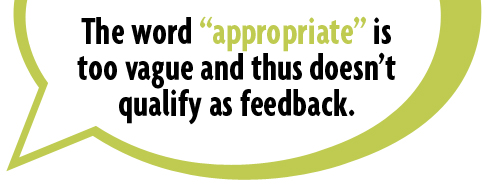
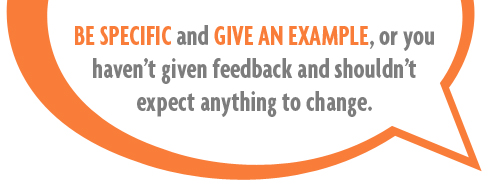
Notice, I didn’t say, “You’re not dressed appropriately for work.” The word “appropriate” is too vague and thus doesn’t qualify as feedback. Being vague doesn’t tell the person what to do differently. If your employees felt that what they are wearing to work was inappropriate, they’d wear something else. You need to spell it out. And this is true for all forms of feedback. Be specific and give an example, or you haven’t given feedback and shouldn’t expect anything to change.
Men, you can’t have this conversation with the women in your office. Ask a woman the employee has a relationship with to have the conversation on your behalf.
Read How to Say Anything to Anyone to get the words to have other difficult feedback conversations.
Some of you are currently gasping, thinking there is no way you can have this conversation. Yes you can. I have these office dress code conversations with clients regularly without damaging my relationships. So few people will tell someone when they’re wearing clothing that damages their reputation, when the feedback recipient gets over being shocked and embarrassed, s/he’ll thank you for caring enough to give such honest feedback.
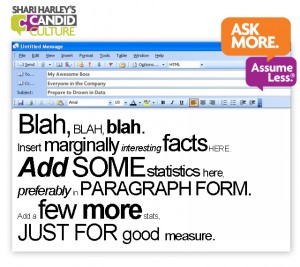 When I get an email that has multiple paragraphs I look at it, decide I don’t have time to read it, and close it out, promising to go back to it later when I have more time, which never happens. Sorry if you’re the recipient of this practice. I’m sure there are several people reading this who have given up on the idea of my responding.
Here are a few tips for writing effective emails that more likely to be read:
- Put a specific subject in the subject line that says what the email is about.
- This does not include your name. We already know your name.
- Ex.: “Trip” (that’s not specific). Instead try: “Trip to Arkansas to see Walmart”
- Highlight and bold important parts of the email
- Limit this practice so what’s bolded and highlighted stands out.
- If everything is bold, nothing stands out.
- Use bullets
- Use the fewest number of words possible
- Use jump links that send readers to relevant information
- Offer additional information if desired
If you read my blog regularly, you’ll notice bold important sentences and use bulleted and numbered lists to make the blog easier to read, like the list above.
The shorter your emails are, the more likely they are to get read. You can always offer additional information, but readers won’t get to the detail if they never read the email. When it comes to writing effective emails, shorter is better.