Archive for July, 2012
Even after working in the corporate arena for 18 years, I am amazed at how much people talk about other people. I’m a little embarrassed that gossip in the workplace still catches me off guard. I used to live in New York City. How can I be this naïve?
Last week I talked with a friend I used to work with. She still works for the company where we worked together. She told me that Michael, one of our old coworkers, was job hunting. “How do you know that?” I asked. She said Bob the IT manager had told her, and Lisa the marketing director had told Bob. Lisa is friends with Michael. Michael must have confided in Lisa, who told Bob, who told my friend, who told me. I have, by the way, changed everyone’s names, so as not to tell the rest of the world that Michael is job hunting. But in the event that you have an open job that would be a good fit for Michael, perhaps I should put his real name and email address here.
Michael trusts Lisa. But Lisa clearly isn’t trustworthy. I’m sure she thinks she is, but clearly, she can’t keep information to herself. Lisa trusts Bob to keep a secret, but clearly Bob can’t and neither can my friend.
So what does this say? Everyone is a liar and no one keeps confidences? No, I’m actually saying neither of these things.
I really believe that people think they keep a confidence when they share information like this. We rationalize telling ourselves, “I only told one person, and Bob won’t say anything. I trust him. And Michael wouldn’t mind if I told Bob. They’re friends. And even if he did mind, Bob needs to know because if Michael leaves it will impact IT.” And so it goes.
I’m not telling you this to make you paranoid. I’m saying it to make you careful.
I have started to assume that whatever I tell someone will be told to someone else. And it makes me more careful about what I say and write, especially what I write. Don’t put anything in an email you wouldn’t be comfortable being forwarded to someone else.
You may be wondering how this is possible. There is no one who keeps a confidence? How can you run a business like that? Anything I tell someone will be told to someone else? Not if you’re talking to an outside consultant, a business coach, your attorney or accountant, but inside your organization, yes. People have a tendency to share gossip in the workplace with their inner circle –the people in the organization they’re close to. So be careful. Watch what you say and to whom. And assume that whatever you tell someone may go elsewhere. Consider the upside –you can use your coworkers to share news that you don’t have time to broadcast yourself.
Unfortunately people taking phone calls via speaker phone, listening to music without headphones, and entertaining a posse’ of visitors in his/her cube is not limited to the movie Office Space, which should be required viewing for anyone who works with other people.
Cubeland can be loud. And most people are hesitant to ask our coworkers to quiet down. We’re afraid of the conflict. We don’t want our coworkers to dislike us, talk poorly about us when we’re not there, or kill us off. So we suffer in silence, hoping the person will get a clue that he’s making us crazy. He won’t. If he knew the phone calls bugged you, he would have already stopped making them.
You may find it incredulous that your coworkers don’t know how annoying noise in cubeland is. It’s an obvious, no brainer. How could they not know?
Much of Candid Culture’s work is dedicated to people feeling more comfortable telling the truth at work. But even with books, and training on how to establish candid relationships and tell the truth, speaking up is often challenging. So know that if you are doing annoying people at work, they are not likely to tell you.
Here’s what you can do: Avoid annoying people at work. For your convenience, I’ve made a short list.
- Conversations, music, and phone calls taken on speaker phone in cubicles. Take the meeting or conversation to an empty office or conference room.
- People who are late for meetings and text or email throughout meetings.
- People who start most sentences with, “No we can’t do that, and here’s why.”
- People who say they’ll do something and miss the deadline every time.
- People who borrow your stuff and don’t return it.
Look at how much stress I’ve saved you. Now you don’t need to give the people you work with feedback, you can just forward them this blog, which is a passive aggressive form of feedback. But it beats throwing their phone out the window or hiding out in an empty office so you can actually get some work done.
If you choose candor instead (which I, of course, prefer) simply say, “It’s hard to work when music is playing, or when you’re on your speaker phone, or you’ve got visitors in your cube. I know space is at a premium. But if you’d be willing to take the conversations elsewhere, I’d really appreciate it.” Done in twenty seconds or fewer. And no one died. You can do it. And if you can’t, call me, and I’ll do it. It’s always easier to have these conversations when they’re not your own. But it will cost you a bag of chocolate chip cookies or perhaps a Candor Bar.
The sprinkler guy just left my house, after teaching me the nuances of how sprinklers work for TWO hours. I don’t want the details about how the sprinklers function. I don’t care. I just want them to work. And I told the sprinkler guy this. But he insisted on teaching me –a.k.a. dragging me to each broken sprinkler head and having me observe as he repaired it. Exasperating! Then he billed me for his time. Without the lesson the visit would have been 30 minutes and $45. With the lesson, it was two hours and $130.
Read your audience. Are you putting in too much work?
Where are you over communicating? Who’s reading all of those PowerPoint presentations and reports? Just because you’ve created that report for the past five years doesn’t mean it’s still necessary or desired.
Ask your internal and external customers (everyone you work closely with) how they want to receive information, in what format, and how frequently.
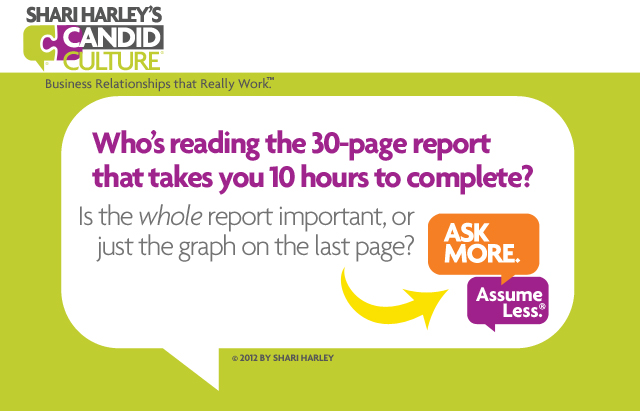
Ask internal and external customers:
- Do they prefer to receive information in bullets or narrative form? Detailed or big picture? Graphs and/or charts?
- What information is important and what is unnecessary?
- Who needs to receive the information? People have enough to read. Most people won’t be insulted to receive one fewer email.
- How often do they want to receive the information?
I am hesitant to change processes when I begin working with an organization, assuming there is a good reason they exist. But when I ask why we do certain things as we do, invariably no one can tell me. I am often told, “We’ve just always done it that way.”
Don’t change things just to change them. And before you make a change, consult those who are impacted. Ask what people want and what they don’t. Then make changes. You may just pick up 10 extra hours each week and reduce your and others’ frustration 20 fold.
Most professionals spend their work day constantly checking email. An email comes in, and we feel compelled to reply. We put aside the project we were working on and promise ourselves we’ll get right back to it. But then we receive five more emails, and so most days go. As a result, many people start doing their actual jobs at 5:00 p.m.
When was the last time you did an hour and a half of actual work without being drawn into your inbox? My hunch is, not in years.
Email has become a noose and an albatross.
I too have fallen into the constantly checking email, time-sucking trap. Every email must be returned immediately. Or worse, I open emails, read them and say I will reply later, but never do. I promise myself I’ll go back to the old, unanswered messages only to get distracted by the many more emails that have piled on top of the existing emails. Older messages get buried, never to be returned. And I, in turn, become a seemingly unresponsive flake.
The days that I discipline myself to read my email only after working on a project for a good chunk of time, are the days I get the most done and feel the most in control of my day. We have all started our work day with a well-intentioned list of things to do, only to find that at the end of the day we did none of them. This lack of control feels terrible and is unbelievably stressful.
Most time management books and training programs recommend checking email at certain intervals during the day –once in the morning, once in the afternoon, and once at the end of the day. Read an email once and resolve it. Reply, delete, or forward the message to a more appropriate person. But this is hard to do. What happens if we don’t reply immediately? Will we look bad? What will we miss?
One of the keys to having a balanced life and true down time is to be disciplined about how you spend your working hours.
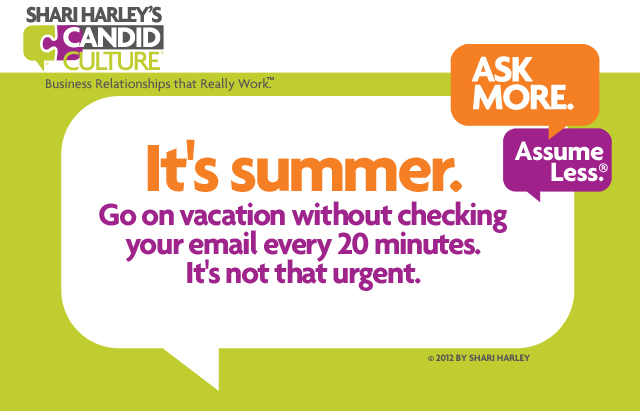
What if we made July, check-your-email-every-three-hours month? How much more would we get done? How much more relaxed and free would we feel?
I’m going to try it, and I’m expecting you to keep me true to my word. If you send me an email and I reply immediately, you’ll know I have failed and have been sucked into the Outlook vortex of lost time. But if you read my reply, I’ll know you’ve been sucked in too.
I admit it, it’s one of my pet peeves –calling someone and getting a voicemail message that says the person is traveling and will return to the office on May 24th, when it’s July 1st. I don’t know why this bugs me, it just does. It creates the impression that the person is a little out of it.
While we’re on voicemail pet peeves, why not list a few more:
- voicemail messages that sound like the message was recorded from a busy, street corner
- a voicemail message that promises to return your call as soon as possible, when this person never returns calls
- people who leave LONG messages with a phone number that is said so quickly that even after listening to the message four times, you can’t make out the number
- emails that say the person is out of the office, but don’t say when she is returning
Be careful and aware of the impression you’re creating.
Are your voicemails and emails consistent with how you want to be perceived by others? Do you even know? Call your phone and listen to how your voicemail message sounds. And if you don’t think others will like what they hear, change the message.