Archive for June, 2012
Unless I’m out of town or steeped in laziness, I go to a yoga class most Monday nights. There is another class in the same studio right after the class I attend. During the last few minutes of this week’s class, people attending the next class began to congregate outside the studio and were talking loudly enough that our class could hear them. The teacher walked outside and asked them to be quiet. Then she walked back into the room and told our class that she just did something she doesn’t typically do–speak up. When the class was over she went back outside and apologized to the people she’d asked to be quiet.
Why!? Why!? Why!?
What is the big deal with giving feedback and asking people to do something differently?
Unless you live in a cave, this happens to you too. People talk near your office or cubicle and it’s distracting, but you don’t feel you can say anything. Someone in your office cc’s your boss every time he wants something from you. It annoys you and makes you distrust the person, but you don’t feel you can say anything. The people sitting in front of you at a movie theater talk throughout a movie, it’s annoying, but you’re hesitant to say anything.
Again, why, why, why!?
I already know what you’re going to say. People will be angry at you for speaking up at work and will kill you off.
That may be true, but what the heck?! That’s crazy. We do stuff. It annoys other people. They tell us. BIG DEAL! No one died.

My entire business, Candid Culture, is focused on helping people feel they can be more candid at work. Speaking up at work is a struggle in every organization. People are afraid to give feedback. They fear retribution –real or imagined.
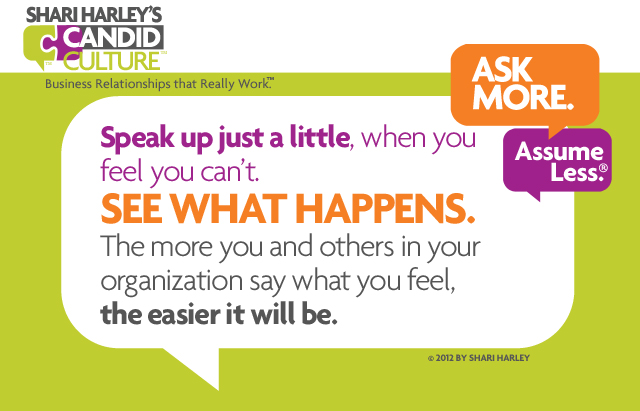
Make a pact with each other that it’s ok to tell the truth. And that people will take the feedback in the spirit it was intended –to make something better, not to be critical. Give each other permission to be candid without consequence.
The more often you find yourself speaking up at work and giving feedback, the easier it will be.
There are things in our lives that bug us, but we put up with them. They’re often little things like a burned out light bulb or a messy drawer in which we dump stuff that doesn’t have a real home. Maybe the bulb has been out or the drawer has been a mess for so long that we no longer even notice it.
Our workplace isn’t any different. There are things in your organization you’re tolerating. Perhaps a process or software is inefficient, but you don’t say anything to the people in your organization who can do something about it. Or maybe you said something a few times, but you didn’t feel anyone listened and you gave up.
Organizations are comprised of doers and leaders. And organizations need both. If everyone wants to lead, you’ll have trouble. If no one leads, you’ll have even more trouble. Doers keep things going from day-to-day. Leaders create opportunities, fix problems, and upgrade existing conditions.
I’m often asked to coach managers in organizations. The coachees’ boss tells me, “He’s a great employee. But if he wants to move up in this organization, he needs to be a leader.” And more often than not, the employee is confused by what the manager wants. Coachees say things like, “I give my opinion in meetings. I volunteer for stuff. What else does my boss want?”
I tell my coachees the most straightforward thing I know to transition from a doer to a leader –improve processes and look for opportunities to fix things that are broken.
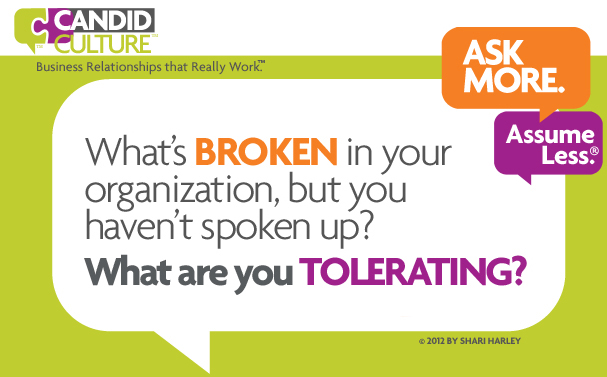
Want to know how to become a leader in an organization? Ask these questions regularly:
- What in the organization frustrates people? What could we do differently to ease people’s frustration?
- Where do we have mediocre results? What’s the breakdown?
- Where are we wasting money? Where are our costs too high? Where are we losing revenue?
- What processes take longer than they need to? Or where is there a lack of process?
- Where do we have inefficiencies and redundancies?
- What practices work in one department that could work in another?
Leaders in organizations are always looking for ways to make things better. They look for opportunities and (picking their battles) pursue solutions. Pursuing a potential change does not mean asking your boss or department leader once or twice. It means telling someone in a position of formal authority about a missed opportunity, asking permission to make a change, and then doing the work required to make it happen. Leaders do not tell their boss about a problem and walk away. Leaders suggest and implement a solution.
If you read your organization’s handbook carefully you will see, in the very fine print, the rule stating that there will be three people in your organization who no one can work with. Everyone knows who these people are. They are the people who employees are afraid of, who tend to make others’ lives hard, and who no one wants to work for.
Employees wonder, doesn’t anyone in management know about these people? Why isn’t anyone DOING anything? Someone is most likely doing something. Dealing with difficult coworkers just take time to work themselves out. And managers can’t talk about others’ performance with you, as you wouldn’t want them talking about your performance with others.
What to do in the face of a crazymaker who doesn’t appear to be going anywhere?
Crazymakers are often bullies and bullies push the people around who let them do so. Despite your fear, give it right back to a bully. Chances are she will back off and find someone else to pick on. Do this professionally. Don’t compromise your own reputation by interacting with a bully in the way she interacts with you.
Work around the person. I’m not giving you a pass to avoid the people you don’t like working with. If you have done everything you can to work well with someone and he won’t work with you, do your minimal best. Be polite and respectful. Keep the person in the loop when necessary. But don’t go out of your way to nurture the relationship. You can’t work with someone who won’t work with you.
Doing everything to work well with someone includes talking to the person about your working relationship, admitting it’s strained, and asking for feedback about what would improve the relationship. Doing everything might involve getting a third party or outside mediator to broker a conversation. It might include weekly meetings to ensure regular communication. If you’ve tried ALL of these things with no outcome, then you can work around the person. But everything is NOT, “I sent three emails and didn’t hear back.”

You can leave your organization to avoid the person who makes you crazy, but s/he will be waiting for you at the next company in a different body.
If you like the work you’re doing and, for the most part, like where you work, don’t let dealing with difficult coworkers drive you from the organization. Ask for help. Let someone who can do something about the situation, assist you or at least give you the go ahead to work around that person, when possible. And if the situation becomes untenable, before you resign, tell someone in a position of formal authority that you’re at the end of your rope and you’re planning to leave. If something is going to change in the short term, he or she will often know and tell you.
Your self esteem is impacting this relationship.
This is a line I’ve always wanted to use. But I won’t. Because although I think it’s true, saying it would be unhelpful. And unhelpful critique is just mean.
People who think highly of themselves are easier to work with than people who don’t. They are more confident and self assured. They don’t need a lot of reinforcement. People who have a high self esteem at work know they’re good. They may appreciate it if you tell them, but they don’t need you to tell them.
People who don’t think highly of themselves need an endless amount of reassurance. No matter how much reinforcement you provide, you will never fill the need. You can’t fill it. No one can make someone else feel good about him or herself. No amount of reassurance or accolades replaces a lack of belief in oneself. That belief must come from within.
People who don’t have high self esteem at work come off as arrogant. They’re the people who tell you how great they are, rather than letting their results speak for themselves. They’re slow to partner and quick to point fingers. They’re often the bully of the organization. They make others’ lives’ hard and take the credit for others’ work. They are the people employees get warned about when they join a new company.

You might be wondering when I became an arm chair psychologist. I didn’t. But I work with a lot of organizations and a lot of people. And the more organizations and people I work with, the more I see how similar people and organizations are.
Every organization has power struggles, egos, and similar communication challenges. I’ll tell you what I tell the organizations who tell me that their companies are worse at feedback and open communication than other companies. You’re special, but you’re not different.
The best thing you can do for your organization is to hire smart, driven, emotionally healthy people. As most of us know, that’s easier said than done. How do you identify emotionally healthy?
I ask these questions of EVERY person I interview both for my company and when I interview candidates for my clients. And a candidate’s answer is often a deal breaker that ends the interview process.
- What’s some negative feedback you’ve gotten in the past?
- What did you learn?
- What did you do with the information?
I will only hire people who are self aware. People who are self aware know where they’re strong and they know where they need to develop. There is no one who has gotten to adulthood without receiving some negative feedback. And if a candidate can’t muster up an example of this, then they’re not open to feedback. And people who are not open to feedback aren’t coachable. People who aren’t coachable are very difficult to work with.
You need coachable, introspective people in your organization. And not having those traits should be a deal breaker in your hiring process.
I would put $1000 on the table and say comfortably that the people in your organization who are difficult to work with are not self aware nor open to feedback.
Add assessing self awareness to your hiring process. Don’t hire people who don’t know themselves and aren’t open to feedback, and your organization culture and performance will improve. I guarantee it.
You can access the rest of our interview questions for hiring managers here and candidates here.