Posts Tagged ‘work life balance’
Posted under
Uncategorized on May 10, 2015 by Shari Harley. Comments
I’m going to admit that I’m terrible at what I’m recommending today – taking time for yourself. Often my weekly blog is something I too am working on, and this week is no exception.
Many of you know that I’m often in three to five states a week doing what I love most–working with all of you. When I get home, I often spend my evenings and weekends catching up.
While I feel I need to maintain this schedule to keep up, I’m aware that I can’t and don’t want to work all the time. So today’s blog is for all of us who don’t know how to turn it off and walk away from the laptop.
The value of downtime and taking time for yourself is well documented. There is a lot written on the need to take breaks to recharge, rejuvenate, and avoid burn out. The question is how to do so without feeling like something else is getting short shrift.
Here are seven tips for taking time for yourself:
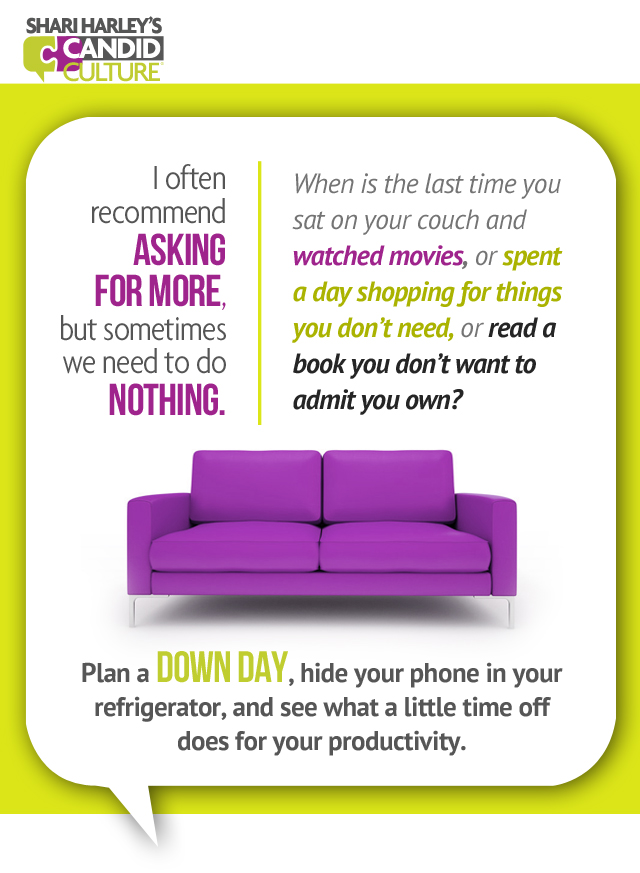
Taking time for yourself tip one: Give yourself permission after a really busy few days or week(s) to take a day and do nothing. If you’ve been on the road for four days or worked really long hours, plan to sleep in on the fifth day. Don’t schedule early morning meetings and a full day. Know that you won’t be productive on day five anyway, so you might as well plan to do very little, which is what you’re likely to do anyway.
Taking time for yourself tip two: Plan a day doing non-work-related things you really want to do. When is the last time you did something you really love to do, just because? You’re more likely to dedicate time off to doing something you love than just lying around. But, if a day of planned recreational activities feels like another ‘to do,’ you’re better off doing nothing and not feeling badly about it.
Taking time for yourself tip three: Plan time to see one or two friends a week. I’ll admit that I have to schedule phone calls to catch up with friends and schedule time to see people I care about. Yes, I admit, this seems wrong. But do whatever it takes. If you have to put lunch or a phone call with a friend in Outlook for it to happen, do it.
Taking time for yourself tip four: Don’t feel badly about taking time off. I always feel guilty when I sleep until 11 am or do nothing until 3 pm on a Saturday. I still do it, but my enjoyment is diminished by my self-imposed judgment. Just do what you need to feel rested and refreshed. Stop judging yourself.
Taking time for yourself tip five: If you take a day off or sleep late, don’t work until two in the morning the next day to compensate. Doing so defeats the purpose and will put you in a hole the next day.
Taking time for yourself tip six: Watch where your time goes when you’re ‘working.’ I know that I squander lots of time while I’m ‘working.’ I allow myself to get distracted reading emails as they come in, texting, and chatting in our office. You could work fewer hours if you reduced these distractions.
Taking time for yourself tip seven: Decide what you really want your life to be about and what’s really important to you. Do you want work to be your focus or do you want an equal balance of friendships, family, and community activities? You likely have what it is that you really want.
If what you really want is a career-centric life, then just admit that and don’t judge yourself for it. But do take enough time off that you are rested, productive, and don’t resent your work.
 You have too much to do and not enough time. Something has to go. You have four choices:
- Get further behind at work
- Have less fun
- Spend less time with your kids, spouse and/or friends
- Sleep less
Most people forgo sleep in favor of work, fun, and time with family and friends. But this choice, like all choices, has consequences.
I’ll admit to being a bad sleeper. I stay up too late stalking people on Facebook who I don’t care about. Then I wake up in the middle of the night to use the facilities and have trouble falling back to sleep. Instead of quieting my mind, I make to-do lists on my phone, which, yes, I sleep with. I am quite functional with five hours of sleep for one or two days. The third day I’m a disaster – cranky and unproductive.
Most people need more sleep than they’re getting. With enough sleep everything works better. With a lack of sleep nothing seems to work. We would actually increase productivity if we slept more. Mornings would start better, days would be more efficient, and the people we work and live with would like us more.
But the problem remains, most people don’t feel they have enough time. And something has to go.
Here are a few things I’m trying to increase productivity:
- Set realistic goals. I’m probably not going to go to be at work at 8:00 am, go to the gym, and see friends five days a week. Three days is more realistic.
- Put the phone on the other side of the room when I go to bed, so it still serves as an alarm clock but isn’t within arm’s reach.
- Don’t read or reply to email in the middle of the night.
- Wind down earlier. Start getting ready for bed 30 minutes before I want to go to sleep.
- Accept that I need more sleep and that while four or five hours worked while I was in college, I’m no longer 20.
- Realize that when I get seven hours of sleep I’m nicer to be around. I feel better and am more productive.
When human beings sleep seven or eight hours a night we are more focused, happier and we increase productivity. Thus sleeping more actually creates more time.
Commit to feeling better and enjoying your work and personal life more by getting more sleep. But if you opt to stay tired and cranky, email me at 3:00 am and we’ll catch up.
Your job will not tell you that you need a vacation. Your company won’t tell you that you look tired and it’s time to go home. Your job is like a toddler. It wants and will take more, more, more. You need to decide what you’re willing to give.
Admittedly, I’m terrible at work life balance. I’ve always lived twenty minutes or fewer from my office so that I could easily go in on evenings and weekends. I gained twenty pounds the first year I worked at OppenheimerFunds because I never left the office before eleven p.m., and the only thing around to eat late at night was candy. No one told or expected me to work the hours I did. I put this pressure on myself.
Some of us enjoy working long hours. We love what we do. Work is where we derive a great deal of fulfillment. There is nothing wrong with working long hours and getting a great deal of enjoyment from your work. Just don’t blame your organization when you’re tired, stressed out, or out of balance.
You are accountable for your happiness at work.
Every time you email an internal or external customer on a weekend, take a work-related call at 8:00 pm, or check your email while you’re on vacation, you’re training the people you work with that you are always available.
Some of my clients’ employees tell me they feel taken advantage of by their organization and feel leaders’ expectations are unrealistic. As a result employees work more hours than they want to and miss vacations and evenings with their kids. The managers tell me they’re not expecting employees to work the hours employees say they feel pressured to work, so where’s the disconnect?
I suggest talking with your manager about her expectations.
The conversation could sound something like this:
“I want to make sure I’m meeting your expectations. When are you expecting X project to be done?
How are you evaluating my success? What does a good job look like?”
Or, “I’m stressed and am finding myself working evenings and weekends. I’d like to get a better understanding of your expectations about X project. I might be putting this stress on myself.”
I’m not suggesting being lazy or cutting corners. Work hard. Do good work. And know your limits.
In Sheryl Sandberg’s new book Lean In, Sandberg shares a story from her career when the manager of one of the McKinsey & Company offices, where Sandberg worked, realized that every person who left the organization blamed burnout and exhaustion for the reason for their departure. Upon some research the manager discovered that each of these exiting employees had unused vacation time.
Here are my work life balance tips:
- Set realistic goals.
- Under promise and over deliver.
- Work reasonable hours, then go home.
- Recharge your batteries in whatever way fills you up.
- Get enough sleep. Everything feels and works better when we’ve had enough sleep.
See yourself as accountable for creating work life balance. Stop waiting for your boss to tell you you need a break. Send yourself home.