
Call Shari 303-863-0948 or Email Us

Posts Tagged ‘vague communication’

Be Specific in Your Business Communication – Vague is Unhelpful

When a customer service agent answers my questions with words like, “That sounds right, I think so, or that should work,” I hang up and call back, hoping to get someone who can give me an affirmative answer. People do this to you too; they just don’t tell you about it.

Vague communication is unhelpful. Being vague instills doubt in the people around you and reduces your credibility.
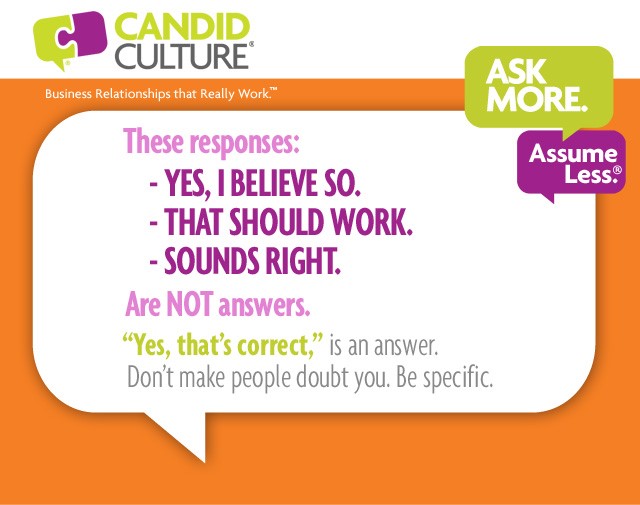
Pay attention to your language. If the answer is yes, say “Yes.” If the answer is no, say “No.” “I think so,” says neither yes nor no. Saying, “I think so” tells people you don’t really know.

A few phrases to avoid and what to say instead:

Avoid: “That should be done by Friday.”

Instead, be specific and give a final date. “That will be complete by Friday. If I can’t get it done by Friday, I’ll call you to let you know by 5:00 pm on Thursday.”

Avoid: “Sounds right.”

Instead, be specific and say, “That’s correct.”

Avoid: “We should be able to do that.”

Instead, be specific and say, “We can do that.”

Avoid: “I guess.”

Instead, be specific and say, “Yes” or “No.”

When I teach feedback training, the biggest thing training participants struggle with is specificity. “You’re difficult to work with.” “Your clothing is inappropriate.” “I just find you to be negative.” “You did a good job on that.” “It’s a pleasure to have you on the team.” All of this is vague and thus unhelpful to the feedback recipient. And the same is true when answering questions and making promises.

Tell people exactly what to expect. Be specific. Even if they don’t like your answer, they’ll be happy to have a clear answer.


Don’t Give Fake Feedback

Most ‘feedback’ sounds like this:

  • You’re awesome.
  • Good job.
  • Nicely done.
  • You’re cutting corners.
  • You have a bad attitude.
  • You’re not committed.
  • You’re careless.
  • You’re disengaged.

I’m not sure why, I wish I could give you a good reason, but the vague phrases above are what come out of people’s mouth’s first when giving feedback. To prevent giving fake feedback, you have to prepare.

There is a reason you think the person is awesome or has a bad attitude. What did they do that created that impression? Until you can describe what the person did to create an impression, you’re not ready to give feedback. You’re better off saying nothing.

All of the phrases above are opinions with no facts. Opinions are judgments. Feeling judged makes people defensive. When people are defensive, it’s hard to listen.

The purpose of feedback is to help another person. Give the person enough information that they know what to replicate and what to change. Before you give feedback, write down three things the person did that created your impression. If you can’t give an example, wait to have the conversation until you can. It’s better to say nothing than to say something vague and unhelpful.

Vague positive feedback sounds inauthentic. Vague negative feedback is judgmental. Neither strengthens your relationship or are helpful.

If you really want to be heard and you want to be helpful, provide an example. No example, no feedback.


Sign Up

Career tips
you won't get
elsewhere. Sign up
to get a free
tip card.
MENU

Shari Harley